
Duterte Arrested for Alleged Crimes Against Humanity: How Did We Get Here

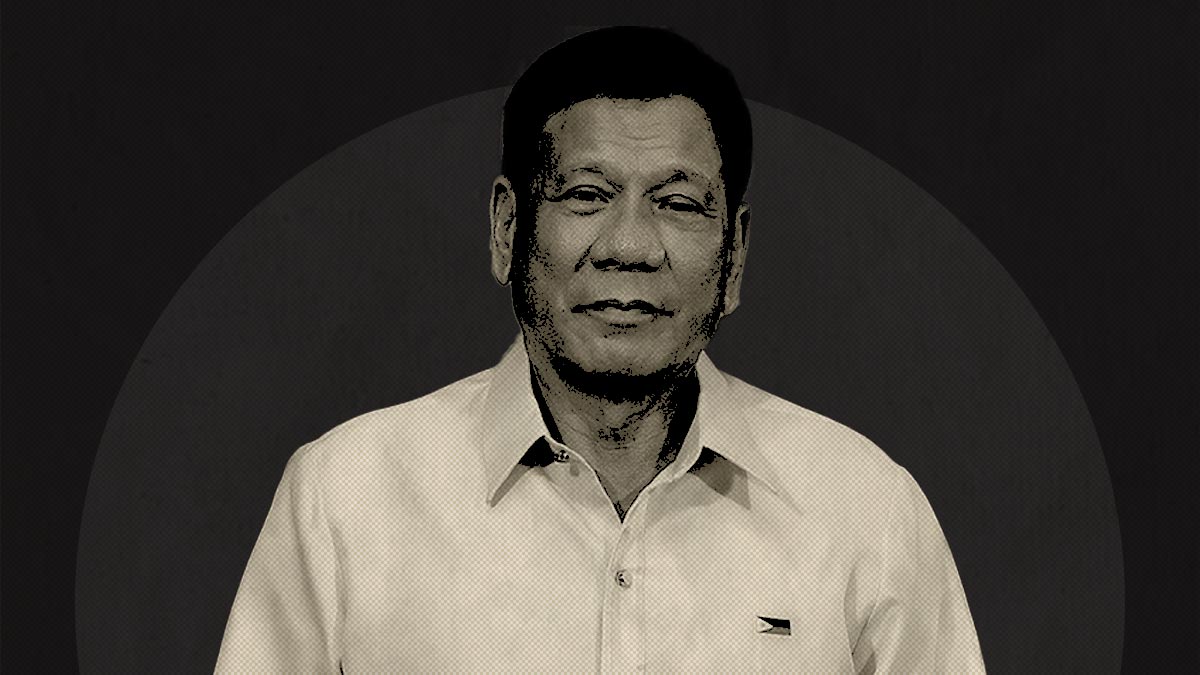
Former Philippine president Rodrigo Duterte was arrested by the Philippine National Police at the Ninoy Aquino International Airport on Tuesday morning, March 11, 2025, following an International Criminal Court (ICC) warrant for crimes against humanity allegedly linked to his so-called "war on drugs."
Duterte had just arrived from Hong Kong, where he, his daughter, Vice President Sara Duterte, and reelectionists Senator Bong Go and Senator Bato dela Rosa attended an event called "Pasasalamat kay PRRD with OFWs" last Sunday, March 9. It was organized by the Kingdom of Jesus Christ, which was founded by pastor and senatorial candidate Apollo Quiboloy—who was wanted by the FBI for his alleged participation in a labor trafficking scheme and was arrested on September 8, 2024.
As of this writing, Duterte is aboard a chartered plane en route to Hague, The Netherlands, which is the headquarters of the International Criminal Court.
ALSO READ:
Why the Interpol Is Involved in Duterte's Arrest
Collateral Damage: How Duterte's Alleged Crimes Followed a Manila Cop to Canada
What is the International Criminal Court (ICC)?
The International Criminal Court (ICC) is an intergovernmental organization and international tribunal established in 2002 in The Hague, Netherlands. It "investigates and, where warranted, tries individuals charged with the gravest crimes of concern to the international community: genocide, war crimes, crimes against humanity, and the crime of aggression," according to the ICC website. ICC was formed following the Rome Statute, which was drafted and signed at a diplomatic conference in Rome, Italy, in 1998.
The ICC is not a substitute for national courts, as it is the duty of every State to exercise its criminal jurisdiction over those responsible for international crimes. However, when a State is either unable or unwilling to carry out its own investigation and prosecution, then the ICC can intervene.
What are crimes against humanity?
Crimes against humanity, which is the allegation against Duterte, are serious violations "committed as part of a widespread or systematic attack directed against any civilian population, with knowledge of the attack."
It includes: murder; extermination; enslavement; deportation or forcible transfer of population; imprisonment or other severe deprivation of physical liberty in violation of fundamental rules of international law; torture; rape, sexual slavery, enforced prostitution, forced pregnancy, enforced sterilization, or any other form of sexual violence of comparable gravity; persecution against any identifiable group or collectivity on political, racial, national, ethnic, cultural, religious, gender as defined [two sexes, male and female], or other grounds that are universally recognized as impermissible under international law, in connection with any act referred to in this paragraph or any crime within the jurisdiction of the Court; enforced disappearance of persons; the crime of apartheid; and other inhumane acts of a similar character intentionally causing great suffering, or serious injury to body or to mental or physical health.
Why does the ICC have jurisdiction in the Philippines?
The Rome Statute, even after it was adopted in 1998, remained open for signature at the United Nations Headquarters until December 31, 2000. While the Philippines played an active role in the drafting of the Statute, it was only on December 28, 2000, that the government signed it. It was ratified on August 30, 2011, under the administration of the late President Benigno Aquino III and was concurred in by the Senate with 17 affirmative votes, one negative vote (then Senate President Juan Ponce Enrile), and no abstension. This approval by the Senate of the Philippines is in compliance with Sec. 21, Art. VII of the Constitution, which states that "no treaty or international agreement shall be valid and effective unless concurred in by at least two-thirds of all the Members of the Senate." With the ratification, the country became qualified to nominate a Filipino as one of the 18 judges of the ICC. The Philippines officially became a State party to the Rome Statute upon its entry into force on November 1, 2011.
On March 17, 2018, the Philippines deposited a written notification of withdrawal from the Statute, and this took effect on March 17, 2019. While this is so, ICC retains jurisdiction with respect to alleged crimes that occurred on the territory of the Philippines while it was a State Party from November 1, 2011, up to and including March 16, 2019. This is whether or not the relevant crimes appear to have started before and/or continued after the dates indicated.
The Supreme Court of the Philippines on July 21, 2021, also ruled that "even if [the Philippines] has deposited the instrument of withdrawal, it shall not be discharged from any criminal proceedings." This is part of the unanimous 106-page decision, which was penned by Associate Justice Marvic M.V.F. Leonen with 14 justices concurring, dated March 16, 2021, and published on July 21, 2021.
How did the ongoing ICC investigation start?
Duterte was sworn into office on June 30, 2016. In his inaugural address at the Malacañang Palace, he said: "I know that there are those who do not approve of my methods of fighting criminality, the sale and use of illegal drugs and corruption. They say that my methods are unorthodox and verge on the illegal." At the forefront of his campaign was "Oplan Tokhang," which is a portmanteau of "toktok" (knock) and "hangyo" (plea). It involved policemen knocking on the doors of suspected drug users and inviting them to surrender. At the same time that "tokhang" became a common word on the streets, "nanlaban" (fighting back) became a common alibi among police officers who allegedly executed suspects in the guise of self-defense.
October 2016: ICC Prosecutor Fatou Bensouda is "deeply concerned about alleged killings"
On October 13, 2016, then ICC Prosecutor and Gambian lawyer Fatou Bensouda released a statement saying that her "office is aware of worrying reported extra-judicial killings of alleged drug dealers and users in the Philippines, which may have led to over 3,000 deaths in the past three months. I am deeply concerned about these alleged killings and the fact that public statements of high officials of the Republic of the Philippines seem to condone such killings and further seem to encourage State forces and civilians alike to continue targeting these individuals with lethal force."
She pointed out that extra-judicial killings may fall under the jurisdiction of the ICC "if they are committed as part of a widespread or systematic attack against a civilian population pursuant to a State policy to commit such an attack." This is the very definition of one of the four crimes, crimes against humanity, that is investigated by the ICC.
"My Office, in accordance with its mandate under the Rome Statute, will be closely following developments in the Philippines in the weeks to come and record any instance of incitement or resort to violence with a view to assessing whether a preliminary examination into the situation of the Philippines needs to be opened," the statement ended.
November 2016: Duterte threatens to withdraw from the ICC
Russian President Vladimir Putin, on November 16, 2016, signed an executive order officially withdrawing Moscow's signature from the Rome Statute. Putin is the subject of an ICC arrest warrant for alleged war crimes in Russia's invasion of Ukraine.
Duterte, before his departure for Lima to attend an Asia-Pacific summit, said he might consider the same action. "They are useless, those in the international criminal (court). They (Russia) withdrew. I might follow. Why? Only the small ones like us are battered," he told reporters.
April 2017: Filipino lawyer Jude Sabio files complaint to ICC
Filipino lawyer Jude Sabio, on April 27, 2017, submitted a 77-page document to the ICC titled "The Situation of Mass Murder in the Philippines." The full report was previously published in The New York Times.
"The situation in the Philippines reveals a terrifying, gruesome, and disastrous continuing commission of extrajudicial executions or mass murder from the time President Duterte was the mayor of Davao City," the complaint said.
Sabio also indicated that the president was the "mastermind" of a campaign that killed more than 9,400 people since Duterte was first elected mayor of Davao City in 1988. It cited investigations from Human Rights Watch and Amnesty International and a statement from the Catholic Bishops’ Conference of the Philippines.
"The basic material hallmarks or elements in the extrajudicial executions in the Davao Death Squad in Davao City and in the continued extrajudicial executions after President Duterte became the president are too numerous and too obvious to escape scant attention," it added.
Sabio represented two men, Edgar Matobato and Arturo Lascañas, who claimed to be members of the Davao Death Squad that Duterte allegedly created.
Sabio retracted his allegations in January 2020 and told the ICC that the 77-page document should be "set aside and ‘thrashed’ for being just a part of the political propaganda," supposedly by the Liberal Party. However, the Office of the Prosecutor (OTP), in reply to an e-mail inquiry from the Inquirer, said that "the Office cannot effectively destroy or return information once it is in its possession or control." It cited Regulation 23, saying that the complaint filed "cannot be withdrawn" since the Office had "an obligation to register whatever it receives." OTP added that Sabio's complaint was not the only evidence that ICC had.
To allegations that the Liberal Party was behind Sabio's initial filing, Senator Leila De Lima responded: "Whatever is the true reason for such an awful move, Atty. Sabio has become very vulnerable to the machinations from the dark forces [...] The worst thing we can do is accept the false narrative that resort to the ICC and other global mechanisms for accountability is about politics or propaganda. No, this is about human lives and a quest for justice and accountability, which is never a lost cause."
February 2018: The situation in the Philippines is under preliminary examination
Bensouda has officially opened a preliminary examination into the situation in the Philippines, "a careful, independent and impartial review of a number of communications and reports documenting alleged crimes potentially falling within the jurisdiction of the International Criminal Court."
The statement indicated that the preliminary examination will "analyze crimes allegedly committed in this State Party since at least 1 July 2016, in the context of the 'war on drugs' campaign launched by the Government of the Philippines."
It was emphasized that the "preliminary examination is not an investigation but a process of examining the information available in order to reach a fully informed determination on whether there is a reasonable basis to proceed with an investigation pursuant to the criteria established by the Rome Statute."
March 2018: Philippines withdraws from the ICC
The United Nations officially notified the ICC on March 19, 2018, that the Philippines had deposited a written notification of withdrawal from the Rome Statute on March 17, 2018.
March 2019: Philippines' withdrawal takes effect
According to Article 127 (1) of the Rome Statute, "A State Party may, by written notification addressed to the Secretary-General of the United Nations, withdraw from this Statute. The withdrawal shall take effect one year after the date of receipt of the notification, unless the notification specifies a later date."
With this, the Philippines' withdrawal from the International Criminal Court took effect on March 17, 2019.
June 2021: ICC Prosecutor Bensouda requests to open an investigation of the Situation in the Philippines
With the conclusion of the preliminary examination into the situation in the Republic of the Philippines and the impending end of the term of Bensouda as ICC Prosecutor, she has "determined that there is a reasonable basis to believe that the crime against humanity of murder has been committed on the territory of the Philippines between 1 July 2016 and 16 March 2019 in the context of the Government of Philippines 'war on drugs' campaign."
Her statement cited that available information indicates "that members of the Philippine National Police, and others acting in concert with them, have unlawfully killed between several thousand and tens of thousands of civilians during that time." They were also able to review information that related events were committed as early as 1 November 2011, the beginning of ICC's jurisdiction in the Philippines, and those would also require investigation.
September 2021: ICC Pre-Trial Chamber I authorizes the opening of an investigation
The Pre-Trial Chamber I of the ICC, on September 15, 2021, granted Bensouda's request to commence the investigation. Three Pre-Trial judges were assigned: Judge Péter Kovács (Presiding Judge), Judge Reine Adélaïde Sophie Alapini-Gansou, and Judge María del Socorro Flores Liera.
According to the Chamber, "the so-called 'war on drugs' campaign cannot be seen as a legitimate law enforcement operation, and the killings neither as legitimate nor as mere excesses in an otherwise legitimate operation."
October 2021: New ICC Prosecutor Karim A. A. Khan QC takes over
British lawyer Karim A. A. Khan QC took over the office after Bensouda's term ended. In a statement made on October 7, 2021, he said: "My investigation will seek to uncover the truth and aim to ensure accountability. We will focus our efforts on ensuring a successful, independent, and impartial investigation. In doing so, we aim to bring justice to the victims and affected communities, and count on the support and cooperation of States Parties, civil society and other partners."
November 2021: Philippines requests to defer ICC investigation
J. Eduardo Malaya, Ambassador of the Republic of the Philippines to The Netherlands, wrote to the Office of the Prosecutor to inform the ICC that the Philippine Government "is investigating or has investigated its nationals or others within its jurisdiction with respect to the alleged crimes against humanity."
Since the Rome Statute indicates that "a State may inform the Court that it is investigating or has investigated its nationals or others within its jurisdiction with respect to criminal acts," ICC's investigation has been deferred.
June 30, 2022: Rodrigo Duterte's end of presidential term
Presidential elections in the Philippines were held on May 9, 2022. Bongbong Marcos won the seat, and Duterte officially ended his term when Marcos was sworn in on June 30, 2022.
2023: ICC resumes investigation
On January 26, 2023, Pre-Trial Chamber I of the ICC said that it "is not satisfied that the Philippines is undertaking relevant investigations that would warrant a deferral of the Court’s investigations on the basis of the complementarity principle."
It added that the materials from the Philippine government and victims' observations "do not amount to tangible, concrete and progressive investigative steps in a way that would sufficiently mirror the Court’s investigation."
They granted the Prosecutor's request to resume the investigation.
On February 3, 2023, the Philippine government filed with the Registry its Notice of Appeal. This is an appeal against a decision concerning jurisdiction and admissibility. The government also requested an extension in the time limit for filing the Appeal Brief, allowing them to file until March 11, 2023. On 27 March 2023, the Appeals Chamber rejected the request of the Republic of the Philippines for the suspensive effect of Pre-Trial Chamber I’s decision.
Ultimately, the Appeals Chamber of the ICC confirmed ICC Pre-Trial Chamber I’s decision granting authorization to the ICC Prosecutor to resume the investigations in relation to the situation in the Republic of the Philippines on July 18, 2023.
March 2024: Judge Iulia Motoc takes over as presiding judge of ICC Pre-Trial Chamber I
On March 12, 2024, Judge Péter Kovács was reassigned to Trial Chamber V – The Prosecutor v. Alfred Yekatom and Patrice-Edouard Ngaïssona. Following this, on March 18, 2024, Judge Iulia Antoanella Motoc (who was assigned to the Pre-Trial Division) was elected to act as Presiding Judge of the Chamber with immediate effect.
Motoc, a Romanian judge, took over Kovacs for the ICC Pre-Trial Chamber I case on the situation in the Philippines. She is joined by Judge Reine Alapini-Gansou and Judge Socorro Flores Liera.
What happened on the day of Duterte's arrest?
The Presidential Communications Office, on Tuesday morning, March 11, 2025, confirmed that INTERPOL Manila received the official copy of the warrant of arrest against Duterte from the ICC.
"Ika-9:20 ng umaga ngayong araw, 11 Marso 2025, ang dating Pangulong Rodrigo Duterte at ang kanyang grupo ay dumating sa Maynila mula Hong Kong sakay ng Cathay Pacific CX 907," they said in a public post.
Security was tight at NAIA Terminal 3, and among those present were Philippine National Police Chief Police General Rommel Marbil and Criminal Investigation and Detection Group Chief Major General Nicolas Torre III. Duterte was arrested by the PNP upon arrival from Hong Kong and was brought to the Villamor Airbase.
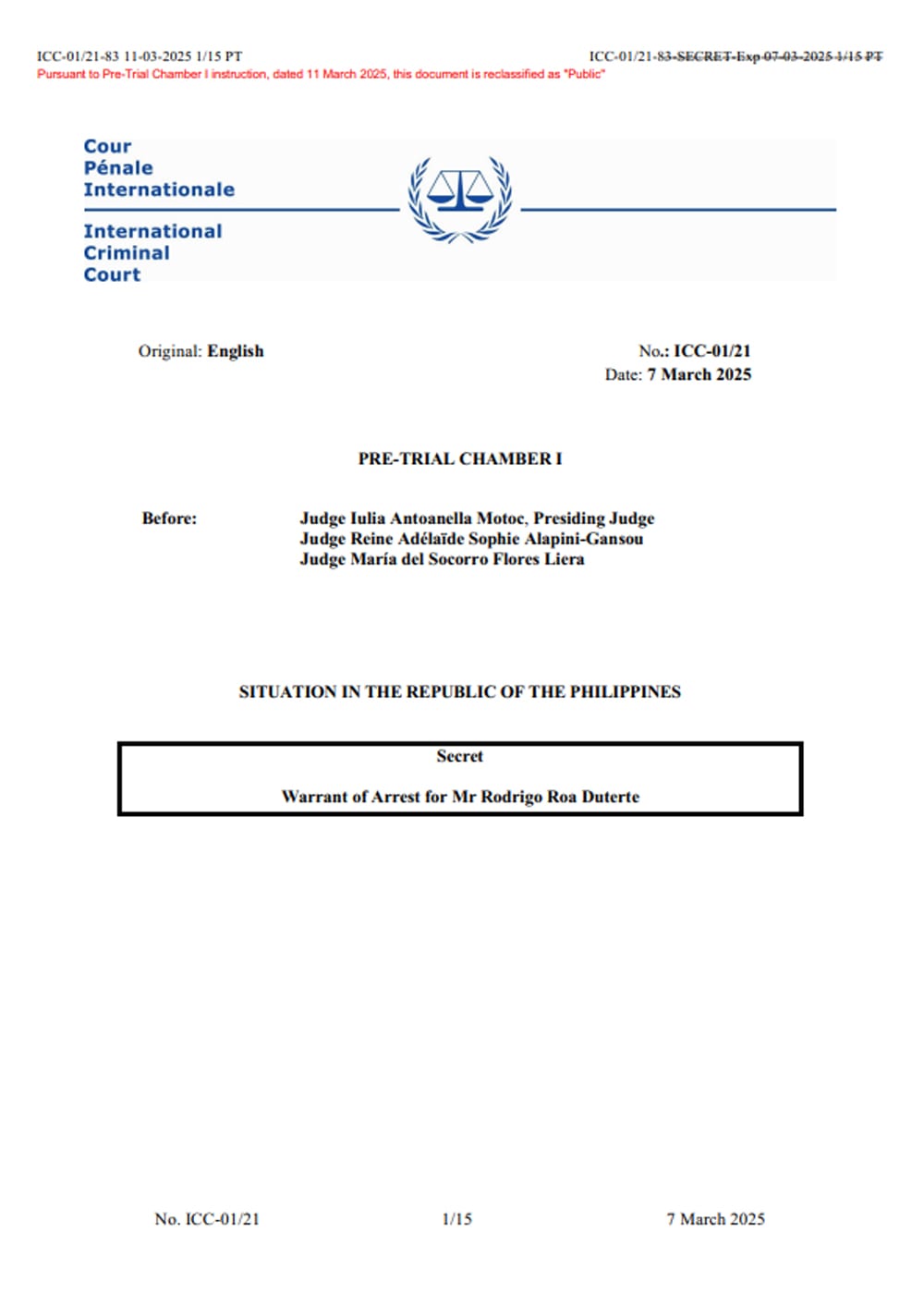
A copy of the warrant, which is publicly available on the ICC website, from the Pre-Trial Chamber I indicates the date: 7 March 2025, procedural history, jurisdiction and admissibility, and other legalese in a 15-page document. It was initially a "Secret" document but was reclassified as "Public" on March 11. It was signed by the three judges of the Pre-Trial Chamber I: Judge Iulia Antoanella Motoc (Presiding Judge), Judge Reine Adélaïde Sophie Alapini-Gansou, and Judge María del Socorro Flores Liera.
Page seven of 15 of the warrant of arrest for Duterte details alleged crimes:
"Based on the material submitted by the Prosecution, which relates to a non-exhaustive list of incidents, the Chamber finds reasonable grounds to believe that, during the Relevant Period, murders of persons allegedly involved in various forms of criminal activities, including drug-related ones, were committed as follows:
a| at least 19 persons, allegedly drug pushers or thieves, were killed by members of the DDS in various locations in or around Davao City
b| at least 24 persons, allegedly criminals – such as drug pushers and thieves – or drug users, were killed by or under the supervision of members of the Philippines’ law enforcement, sometimes with the assistance of persons who were not part of the police, at various locations in the Philippines
The document, on page 11, added that Duterte made essential contributions to committing the alleged crimes in the following manner:
a| Designing and disseminating a project aiming at targeting alleged criminals, including during his presidency campaign, for the achievement of which the anti-illegal drugs project ‘Double Barrel’ was launched,60 and subsequently endorsing this project;
b| Establishing and overseeing the DDS and providing it with firearms, ammunition, vehicles, safehouses, and communications equipment to perpetrate the killings;
c| Instructing and authorizing violent acts to be committed against suspected criminals, including drug dealers and users;
d| Appointing key personnel to positions that were crucial in executing the crimes;
e| Offering financial incentives and promotions to police officers and ‘hitmen’ to kill the suspects, promising immunity, and shielding them from investigation and prosecution;
f| Making public statements authorizing, condoning, and promoting killings and dehumanizing alleged criminals as the Mayor of Davao City and the President of the Philippines, including publicly naming suspects, some of whom were subsequently killed in police operations;
g| Authorizing state actors to take part in the anti-drugs campaign and revoking such authorizations.
Page 13 of 15 of the warrant of arrest indicated that Duterte is 'individually responsible for the crime against humanity of murder':
"Taking into account the totality of the information before it, the Chamber finds reasonable grounds to believe that Duterte is individually responsible for the crime against humanity of murder (Article 7(1)(a) of the Statute) as an indirect co-perpetrator within the meaning of Article 25(3)(a) of the Statute, committed during the Relevant Period."
To define "indirect co-perpetrator," Article 25, Section 3 (A) states that "a person shall be criminally responsible and liable for punishment for a crime within the jurisdiction of the Court if that person commits such a crime, whether as an individual, jointly with another or through another person, regardless of whether that other person is criminally responsible."
On Tuesday night, Duterte's lawyer, Martin Delgra, confirmed that the ex-president is aboard a charter plane that will take him to The Netherlands. Marcos also later confirmed that the former president departed the Philippines at 11:03 p.m., March 11, 2025.
What happens now?
The case continues in its Pre-Trial Stage, where Pre-Trial judges confirm the suspect's identity and ensure the suspect understands the charges. After hearing the Prosecution, the Defense, and the Legal representative of the victims, the judges decide (usually within 60 days) if there is enough evidence for the case to go to trial.
During the Trial Stage, the Prosecution must prove beyond reasonable doubt the guilt of the accused.
Judges consider all evidence, then issue a verdict, and when there is a verdict of guilt, they issue a sentence. The judges can sentence a person to up to 30 years of imprisonment and, under exceptional circumstances, a life sentence.
Verdicts are subject to appeal by the Defense and by the Prosecutor.
Judges can also order reparations for the victims.
During the Appeals Stage, an appeal is decided by five judges of the Appeals Chamber, who are never the same judges as those who gave the original verdict.
The Appeals Chamber decides whether to uphold the appealed decision, amend it, or reverse it. This is thus the final judgment unless the Appeals Chamber orders a re-trial before the Trial Chamber.
Sentences can either be imprisonment for a specified number of years, which may not exceed a maximum of 30 years, or a term of life imprisonment when justified by the extreme gravity of the crime and the individual circumstances of the convicted person. Sentences are served in countries that have agreed to enforce ICC sentences.
References
International Criminal Court [website]
ICC. Rome Statute of the International Criminal Court [document]
ICC. Understanding the International Criminal Court [document]
ICC. Situation in the Republic of the Philippines [webpage]
Senate of the Philippines. "Senate approves ratification of Rome Statute on final reading." 23 August 2011. [webpage]
University of the Philippines Law Center - Institute of International Legal Studies. "On Claims Relating to the Investigation of the Prosecutor of the International Criminal Court into the Philippine Situation." [webpage]
UPDATED (March 12, 2025; 10 a.m.): This article has been edited to include the details of the warrant of arrest, which is now publicly available on the ICC website.
