
Collateral Damage: How Duterte's Alleged Crimes Followed a Manila Cop to Canada

Former President Rodrigo Duterte is scheduled for his initial appearance before the Pre-Trial Chamber I of the International Criminal Court (ICC) on Friday, March 14, 2025, 2 p.m. (The Hague local Time)—which is 9 p.m. in Philippine time.
"Mr. Duterte is suspected of murder qualified as a crime against humanity, allegedly committed in the Philippines between 1 November 2011 and 16 March 2019. During this time, Mr. Duterte was, at varying times, the President of the Philippines, the Mayor of Davao City, and, allegedly, the head of the Davao Death Squad," according to the media advisory issued by the ICC on March 13.
It was in January 2023 when Pre-Trial Chamber I granted the Prosecutor’s request to resume an investigation into the Situation of the Republic of the Philippines on the grounds that the alleged crimes took place as a part of a widespread and systemic attack on a civilian population, the very definition of crimes against humanity.
Duterte supporters have since been in protest about the arrest, with people gathering outside the gates of Villamor Air Base, where the president was first detained upon arrival from Hong Kong. Others held a candlelight rally in Davao, while more protested and criticized the government for its involvement with the Interpol and ICC in other provinces. Duterte's daughter, Kitty, also alleged that his father was unlawfully arrested and illegally detained.
In an earlier statement by Duterte following his arrest, he said in a video taken while aboard the plane to The Netherlands: "I think this has something to do with the law and order noon. At sinasabi ko naman sa mga pulis, military na, trabaho kayo at ako ang managot. So, ito na nga. For all of the whatever happened in the past, ako na 'yong nag-front sa ating law enforcement pati military. Sinabi ko na, I will protect you and I will... ako ang managot sa lahat. This will be a long, legal proceedings but I say to you, I will continue to serve my country and so be it kung gano'n ang destiny ko."
But it seems that Duterte is not the only one being held accountable.
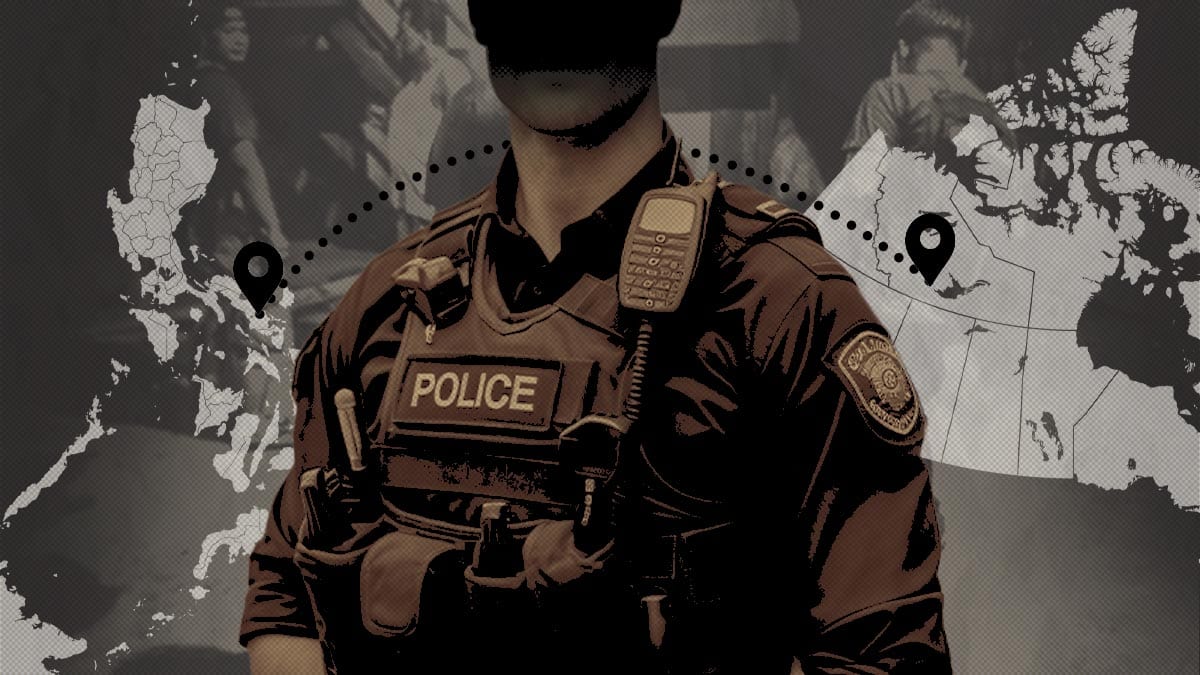
Two months before the former president was taken into custody at the ICC in The Hague, Netherlands, a certain Josue Limmong Ahuday was denied his application for permanent residence in Canada.
ALSO READ:
Duterte Arrested for Alleged Crimes Against Humanity: How Did We Get Here
Today I Learned: Why the Interpol Is Involved in Duterte's Arrest
Josue Limmong Ahuday's Involvement in Duterte's 'War on Drugs'
In Ahuday v. Canada (Citizenship and Immigration), dated January 7, 2025 in the Federal Court Decisions database, it was concluded that "Mr. Ahuday made a voluntary, knowing, and significant contribution to the crimes against humanity committed by the drug units of the PNP as part of President Duterte’s war on drugs, and is therefore is inadmissible to Canada pursuant to s.35(1)(a) of the Immigration and Refugee Protection Act." Thus, his application for judicial review was dismissed. It was recognized that "as a career rank and file police officer, he was thrust into difficult circumstances with the onset of the war on drugs."
Ahuday's background is also detailed in the Federal Court Decisions document, which is publicly available.
"He was a police officer in the Philippine National Police (PNP) at Jose Abad Santos Police Station in Manila from January 2012 to June 2021. He joined the PNP after graduating from college, as it was known to be a respectable career choice. From January 2012 until December 2016, he was assigned to the Mobile Patrol Unit, where his duties included patrolling roads and vehicles within his assigned area, as well as assisting in car accidents and conducting checkpoints to search for contraband and suspected persons," the document said.
Ahuday's service in the police force coincided with Duterte's term, which was also when the president implemented the so-called "war on drugs." This was executed by the PNP as "Operation Double Barrel," which included Oplan Tokhang as the lower barrel and Oplan High-Value Target as the upper barrel. "Oplan Tokhang," a portmanteau of "toktok" (knock) and "hangyo" (plea), involved policemen knocking on the doors of suspected drug users and inviting them to surrender. They knock and search the house until someone allegedly fights back ("nanlaban"), and the suspect gets allegedly killed in the guise of self-defense.
The Federal Court Decisions document further narrates that Ahuday was assigned to a Drug Enforcement Unit (DEU) at the Jose Abad Santos Police Station from December 2016 to February 2017, then later received a medal for "Implementation of Anti-Illegal Drug Campaign." He continued working at the police station, but not anymore with the DEU, and was awarded a promotion in May 2019. He resigned from the force in June 2021 "and only did so for the purpose of immigrating to Canada." Ahuday moved to Canada on a spousal open work permit and was included on his wife’s application for permanent residence as a dependent spouse.
In May 2023, he received correspondence from the Canadian Border Services Agency advising him that he had been reported as inadmissible to Canada on the grounds of violating human or international rights. It should be noted that the Minister of Citizenship and Immigration did not allege Ahuday of directly committing crimes against humanity.
"The claim, rather, was that he was complicit in acts committed as part of a widespread and systematic attack against a civilian population, as a police officer during the anti-drug campaign in the Philippines, constituting offenses under sections 4 to 7 of the Crimes Against Humanity and War Crimes Act (CAHWCA)," the document indicated. That was when Ahuday was referred to the Immigration Division for an admissibility hearing.
Immigration reviewed documentary evidence and considered Ahuday's activities within the PNP and the DEU, and assessed based on the test for complicity established by the Supreme Court of Canada in Ezokola v Canada (Citizenship and Immigration), which is also publicly available on the SCC website under 2013 SCC 40, dated January 17, 2013. The decision adopted a "contribution-based test for complicity — one that requires a voluntary, knowing, and significant contribution to the crime or criminal purpose of a group."
Factual findings on Ahuday were also enumerated based on the three factors — voluntary, knowing, and significant contributions.
Voluntary
For one, Ahuday "voluntarily joined the police force" and was not placed into the DEU "against his will or under any type of duress." And he remained a police officer even "after Duterte’s public statements regarding eliminating those suspected to be involved with drugs." Immigration also found inconsistencies in his testimony. Ahuday first stated that he left DEU due to a "reshuffle," then later said that he requested to leave DEU for safety concerns as he was getting married. Either way, his request was granted, again indicating voluntariness.
Knowledge
In terms of knowledge of the PNP/DEU’s involvement in crimes against humanity, the Immigration used Ahuday's own testimony that the police "was engaged in dangerous activity including that the police needed to 'neutralize those drug addicts' if they had guns, and that he had heard about things happening in other stations but never his own.
A colleague also testified that Ahuday "personally witnessed raids where they kicked in the door, which was consistent with the objective evidence concerning buy-bust activities."
Significant Contribution to the Crime
Ahuday himself testified that he "participated in Tokhang operations, which he described as a peaceful community outreach program intended to encourage suspected drug users to surrender to authorities for education and treatment." He also said that "he never saw violence used." But this was found to be, again, inconsistent with Ahuday's claims that he wanted to leave DEU "due to how dangerous the assignment was."
The Court in Ezokola also set out six non-exhaustive factors for consideration:
- size and nature of the organization - the Philippine National Police
- part of the organization with which the applicant was most directly concerned - the Drug Enforcement Unit
- applicant's duties and activities within the organization - participated in Tokhang operations, as testified; objective evidence showed involvement in violent encounters, "including extrajudicial killings in faked 'buy-bust' encounters with police"
- applicant's position or rank in the organization - Ahuday received a commendation medal for the "Implementation of Anti-Illegal Drug Campaign"
- length of time - was in the PNP from 2012 to 2021, with the years 2016 to 2021 under the administration of Duterte
- method by which the applicant was recruited and the applicant's opportunity to leave the organization - voluntarily joined the police force and resigned when he decided to go to Canada. The document added that Ahuday "informed his superior that he would return to the police if he was given an opportunity."
Collateral Damage in the Time of Duterte
Ahuday was likely just a cog in the machine of Duterte's so-called "war on drugs," which is now under investigation by the ICC. It was determined back in 2021, based on the ICC Prosecutor's preliminary examination into the situation in the Republic of the Philippines, that "there is a reasonable basis to believe that the crime against humanity of murder has been committed on the territory of the Philippines" in the context of the government's "war on drugs" campaign.
Estimates of the death toll during Duterte's time vary. The government's official tally between 2016 and 2022 was 6,252. But the ICC, based on evidence and reports, estimates the total number killed to be between 12,000 to 30,000 - and that's just between July 2016 and March 2019. Among those killed in drug operations were teenagers, women, and children. Others were killed by unknown gunmen, later found to be police officers.
One of them was Kian Delos Santos, a 17-year-old student killed by three policemen in Caloocan City on the night of August 16, 2017. He was gunned down in an alley, where his last words were: "Tama na po, may exam pa ako bukas," as heard by his neighbors.
There was also the three-year-old girl, Myca Ulpina, caught in the crossfire during a buy-bust operation in Rodriguez, Rizal, that targeted her father but ultimately resulted in her getting shot in the head.
Following this incident, Bato dela Rosa, current Senator and former PNP chief (2016-2018), told reporters: "Sabi ko nga, imperfect world… Shit happens." He later talked about collateral damage.
"Aminin ko sa inyo, mayroong nangyayari na talagang in the course of operations. Honest to goodness na talagang may nagiging collateral damage."
During the "war on drugs," the three-year-old Myca Ulpina was collateral damage, defined as an incidental and undesired death, injury, or other damage inflicted, especially on civilians, as the result of an activity.
After Duterte's administration, Josue Limmong Ahuday's hope for a future in Canada was denied. He is also collateral damage to the so-called war, except that he wasn't killed in the process.
