
Today I Learned: Why the Interpol Is Involved in Duterte's Arrest

The Interpol was mentioned multiple times on March 11, 2025, the day of Rodrigo Duterte's arrest, after the International Criminal Court (ICC) issued a warrant for the former president.
In a statement released by the Presidential Communications Office on Tuesday morning, they said: "Kaninang madaling araw, natanggap ng INTERPOL Manila ang official copy ng warrant of arrest mula sa International Criminal Court (ICC)."
Likewise, President Ferdinand Marcos Jr. on Tuesday night explained in an official statement: "Hours before his arrival [at 9:20 a.m. from Hong Kong], Interpol Manila received an official copy of the ICC warrant. This prompted the Prosecutor General of the Department of Justice to serve the warrant.
Interpol asked for help, and we obliged because we have commitments to Interpol which we have to fulfill. If we don't do that, they will no longer help us with other cases involving Filipino fugitives abroad."
ALSO READ:
Duterte Arrested for Alleged Crimes Against Humanity: How Did We Get Here
Collateral Damage: How Duterte's Alleged Crimes Followed a Manila Cop to Canada
Why exactly was the Interpol involved in the arrest of former President Rodrigo Duterte? We start with the definition of terms.
What is the Interpol?
We often hear about the Interpol in heist films, like Now You See Me (2013), which follows FBI agent Dylan Rhodes and French Interpol Alma Dray's (Mélanie Laurent) arrest of four highly talented magicians. There's also the heist comedy flick Lift (2024), where there are Interpol agents tracking Cyrus Whitaker (Kevin Hart).
The Interpol is short for International Criminal Police Organization, which is also sometimes abbreviated as INTERPOL with all caps. It was established in 1923 (yes, more than a century ago), originally with the name International Criminal Police Commission (ICPC), the direct forerunner of Interpol. The countries participating in that International Police Congress in Vienna were Austria, Czechoslovakia, Denmark, Egypt, France, Fiume, Germany, Greece, Hungary, Italy, Japan, Latvia, Netherlands, Poland, Romania, Sweden, Switzerland, Turkey, United States and Yugoslavia. At the time, membership to the ICPC was based on the election of individual Chiefs of police and not on countries.
Following World War II, ICPC was revived as the International Criminal Police Organization (ICPO) in 1946. It then adopted a new Constitution on June 13, 1956, with its shorthand as INTERPOL.
The Philippines has been a member since June 12, 1952, and so it was listed as one of the founding members in their 1956 Constitution.
Interestingly, China has officially been a member of modern-day Interpol since September 4, 1961. INTERPOL Beijing has two sub-bureaus, each with a regional authority delegated to the special administrative regions of Hong Kong (China) and Macao (China).
As an intergovernmental organization, the Interpol helps the police in their 196 member countries "to make the world a safer place." It assists local police authorities with a "range of technical and operational support" while sharing access to data on crimes and criminals (from names and fingerprints to stolen passports) found on 19 police databases it manages. The Interpol offers investigative support such as forensics, analysis, and assistance in locating fugitives around the world.
The Interpol is headquartered in Lyon, France, with a global innovation complex in Singapore and several satellite offices in different regions (Argentina, Cameroon, Cote d'Ivoire, El Salvador, Kenya, and Zimbabwe).
INTERPOL Innovation Centre in Singapore
What is INTERPOL Manila?
Each member country hosts an INTERPOL National Central Bureau (NCB). For the Philippines, the NCB is located in Manila. Thus, INTERPOL Manila.
NCBs serve as the point of contact between other NCBs and the INTERPOL's General Secretariat, which runs the day-to-day activities in international policing. "NCBs are at the heart of INTERPOL and how we work," said Interpol on their website.
NCBs work with law enforcement agencies in their own country, other NCBs and Sub-Bureaus around the world, and the General Secretariat’s offices worldwide. NCBs also cooperate on cross-border investigations, operations, and arrests.
The composition of an NCB varies from country to country, but it is usually part of the national police force.
In the past, members of the Philippine National Police have worked with other NCBs of Interpol's member states. For example, in 2015, the PNP went to INTERPOL Indonesia for the arrest and deportation of Dalia Guerrero Pastor, alleged co-conspirator in the killing of her husband, race car champion Ferdinand Pastor. In 1992, the PNP received a report from Interpol about a large shipment of narcotics arriving in Manila by air mail. In 2011, an American by the name of William Strong was arrested and detained by the operatives of the Bureau of Immigration pursuant to an Interpol Red Notice.
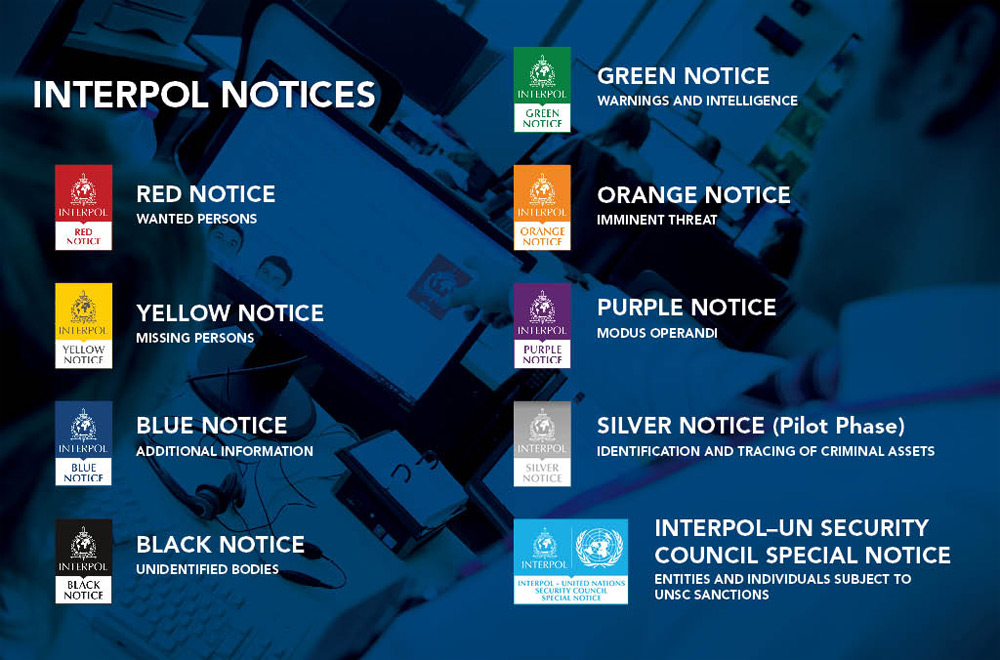
What is an Interpol Notice?
Interpol Notices are international requests for cooperation or alerts allowing police in member countries to share critical crime-related information. Notices can also be issued at the request of International Criminal Tribunals and the International Criminal Court to seek persons wanted for committing crimes within their jurisdiction, notably genocide, war crimes, and crimes against humanity.
A Red Notice is basically issued for wanted persons. It is a request to law enforcement worldwide to locate and provisionally arrest a person pending extradition, surrender, or similar legal action. Interpol's website emphasized in large font: "A Red Notice is an international alert for a wanted person, but it is not an arrest warrant." The implication of this is that an individual is never wanted by Interpol, but rather, they are wanted by a country or an international tribunal. Most Notices are for police use only and are not available to the public unless the requesting country wishes to alert the public and unless it's a United Nations Special Notice.
What were the roles of INTERPOL Manila, the International Criminal Court, and the Philippine National Police during Duterte's arrest?
To summarize, the ICC issued a warrant of arrest for Rodrigo Duterte (classified as 'Secret' on March 7, 2025, and reclassified as 'Public' on March 11, 2025). The Chamber issued the warrant of arrest for Duterte's "alleged criminal responsibility" for "the crime against humanity of murder" committed in the Republic of the Philippines during the Relevant Period. The Relevant Period, in this case, is between November 1, 2011, and March 16, 2019, since the Philippines was a member state of the ICC between those dates.
"An arrest warrant is issued against a suspect to ensure that the person appears at trial, does not endanger or obstruct the investigation or the court proceedings or, where applicable, to prevent the person from continuing with the commission of that crime or a related crime," according to the ICC.
States Parties to the Rome Statute have an obligation to cooperate fully with the ICC. However, non-State Parties are only invited to provide assistance, with no obligation, but are encouraged to do so. While the Philippines is no longer a State Party since 2019, the warrant of arrest is for crimes committed when it was still a State Party.
The ICC added: "Although some arrest warrants attract more publicity than others, they are all equally important and are all issued on the basis of the same evidentiary threshold. The Court strives to ensure that they are all executed. Considering the obligations of States Parties under the Rome Statute, the warrants cannot be left unexecuted."
In a press conference at Camp Crame the day before Duterte's arrest, PNP spokesperson Brig. Gen. Jean Fajardo said the PNP, as a member of the Interpol, is duty-bound to cooperate.
"Dadaan tayo sa proseso. Kung meron pong hihingin po na tulong ‘yong ating Interpol, the PNP has a legal obligation to reciprocate ‘yong courtesy na ibinibigay po sa atin ng Interpol," she said on Monday. At the time (March 10, 12 p.m.), the PNP has not received any warrant of arrest.
The Philippine government and the Philippine National Police are not legally obligated to carry out INTERPOL's Red Notice. Interpol's rules clearly indicate that "member countries apply their own laws in deciding whether to arrest a person." In this case, it cannot be concluded that Marcos' administration was obligated, but rather, it agreed for the purposes of diplomacy.
INTERPOL Manila received ICC's warrant of arrest hours before Duterte's arrival from Hong Kong on Tuesday, March 11. During Duterte's arrest at the Ninoy Aquino International Airport, a representative from INTERPOL Manila was present, as confirmed by Criminal Investigation and Detection Group (CIDG) Director Maj. Gen. Nicolas Torre in a chance interview with DWIZ. Also present were representatives from the Philippine Center for Transnational Crime and the Philippine National Police, including PNP Chief Police General Rommel Marbil.
Duterte was brought to custody at the Villamor Air Base, where he spent most of the day. He was transferred to a charter plane, which took off at 11:03 p.m. (March 11) en route to The Netherlands, where the ICC is headquartered. On Wednesday morning, March 12, it landed at Al Maktoum International Airport (DWC) in Dubai for a technical stop.
