
Gold Leaf and Pink Fur: The Layers of a Woman’s Gaze

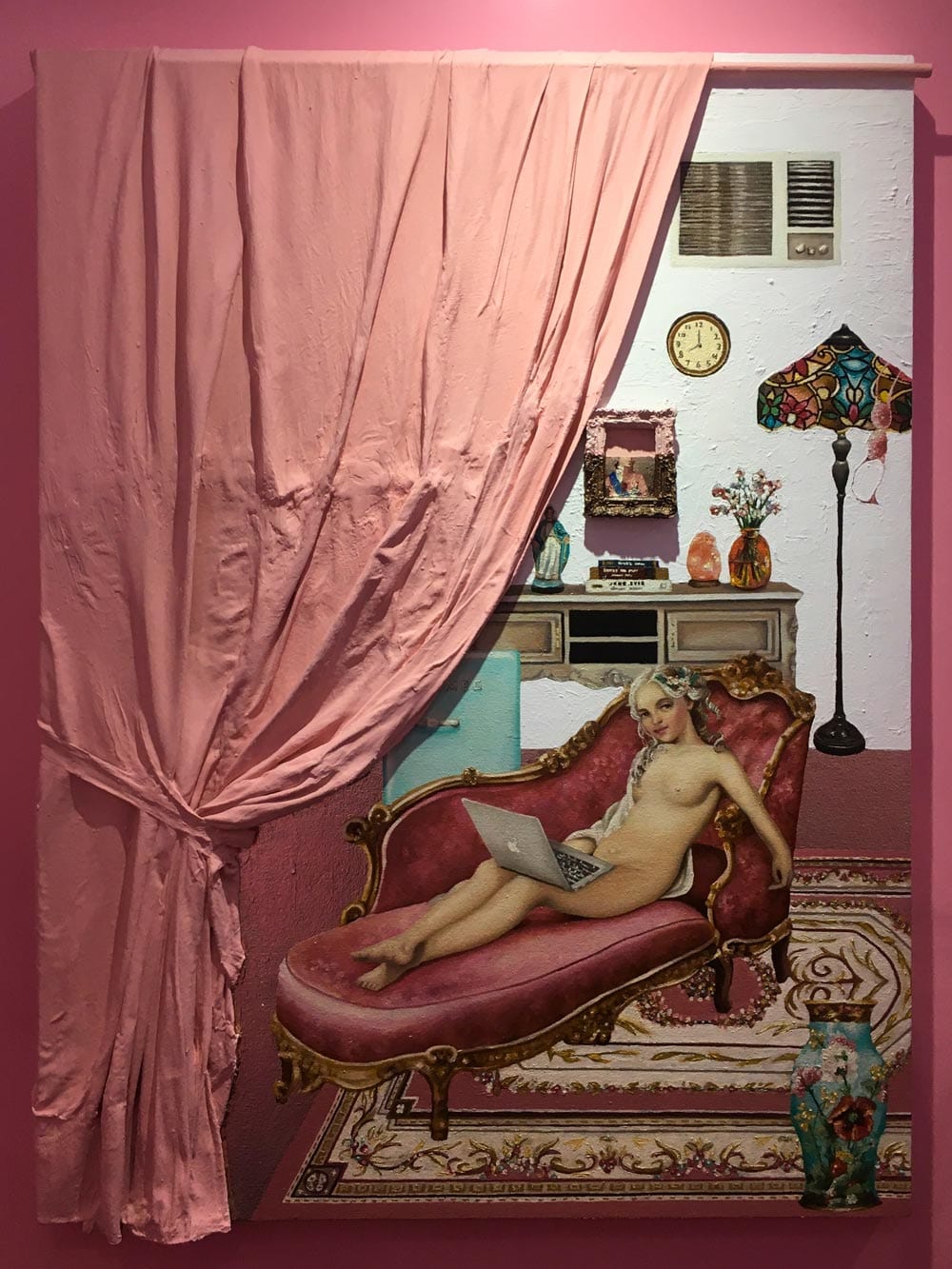
There she is, reclining on the pink fainting sofa. Naked. A MacBook is on her lap. Her gaze meets ours. Hanging from the Tiffany Baroque floor lamp is a pink bra. The clock says it’s 8 o’clock. On the console table in French Provincial style—romantic like the Victorian, but not as dramatic as to render itself unapproachable—sit Mama Mary, a pile of books including Jane Eyre, a Himalayan salt lamp, and a vase with delicate flowers. Just behind the pink curtain is a Smeg refrigerator in the same pastel blue as the floor vase with floral paintings in the foreground. We can imagine the air-conditioning is on as she lies there as if she has just come home from work. The title of the mixed-media painting is "Make Time for Bedrotting." The woman in the painting is Arianna Bongato herself, portrayed in the style of Rococo painter François Boucher—soft, mythological, ornamental, and erotic. There is an awareness in the woman’s eyes. She knows we are looking at her. John Berger would call it complicity in self-objectification. I call it self-assertion.
ALSO READ:
Contemporary Positionalities of Women in the Arts: Anita Magsaysay-Ho, Nena Saguil, and Pacita Abad
Movers of Filipino Contemporary Art: 25 Artists We Love
On the wall adjacent to the console table is a painting of a woman, the upper part obscured by a block of pink, while the rest remains a portrait. It is self-referential. It is Arianna’s visual poetics. Artemisia Gentileschi used to paint herself in her works to promote her art, control her narratives, and assert her identity. Arianna’s work is a self-portrait of her as an artist after work hours.
'Make Time for Bedrotting' (2024), Curing Salt, White Walls Gallery
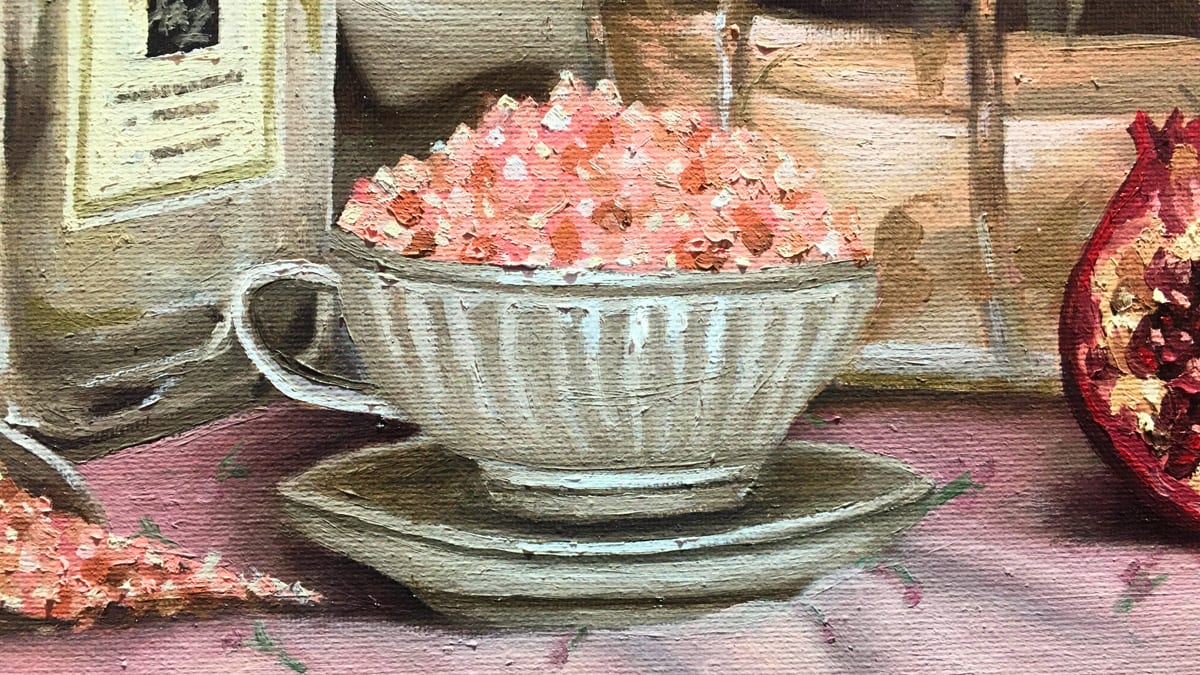
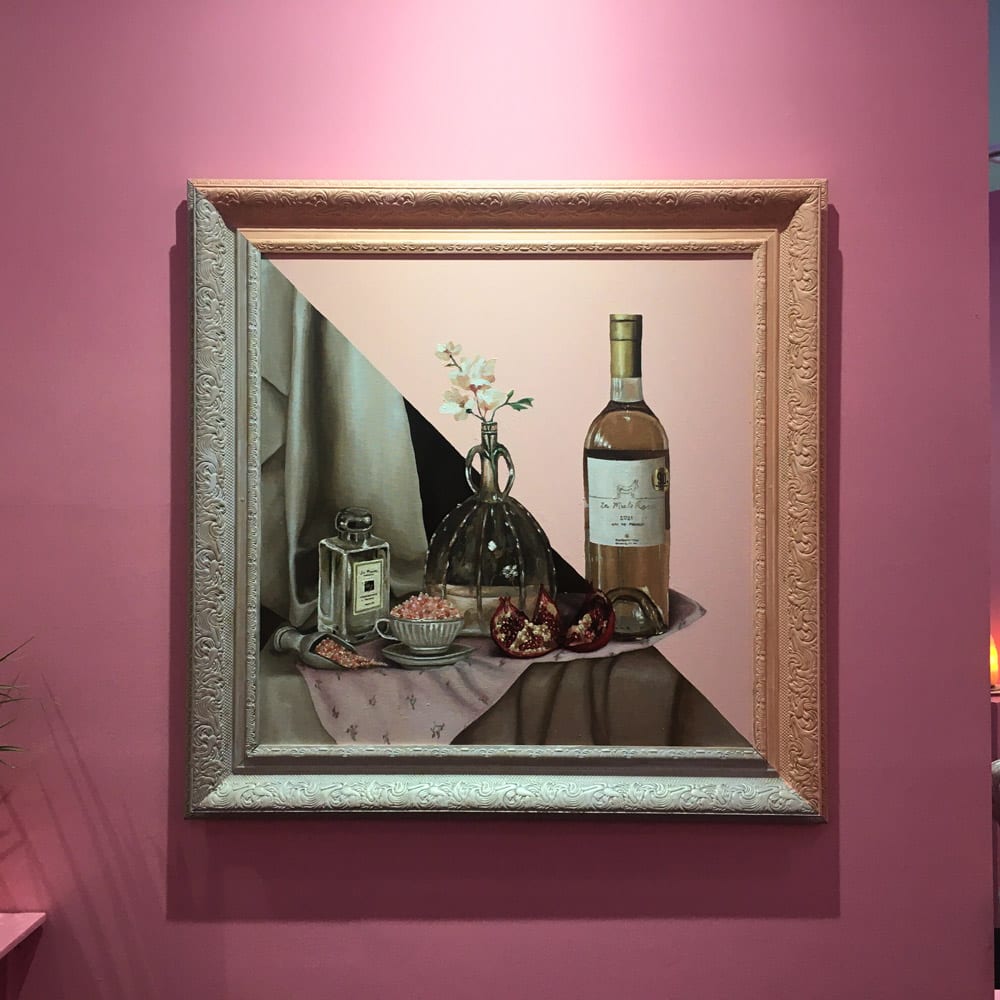
While "Make Time for Bedrotting" is placed at the back of the panel that welcomes visitors to her third solo exhibition, Curing Salt, at Art Fair Philippines 2025, it is a compelling place to begin. Beside it is a still life in Arianna’s distinct style of empty spaces—ma in Japanese aesthetics. There is a bottle of Jo Malone, a serving of pink Himalayan table salt, a vase with what seem like cherry blossoms, a pomegranate sliced open, and a bottle of François Lurton La Mule Grenache Rosé 2021. The title of the painting is "Bottomless Brunch," a not-so-distant echo of her afternoon tea theme from her second solo exhibition, Sip Slowly, in 2023.
'Bottomless Brunch' (2024), Curing Salt, White Walls Gallery
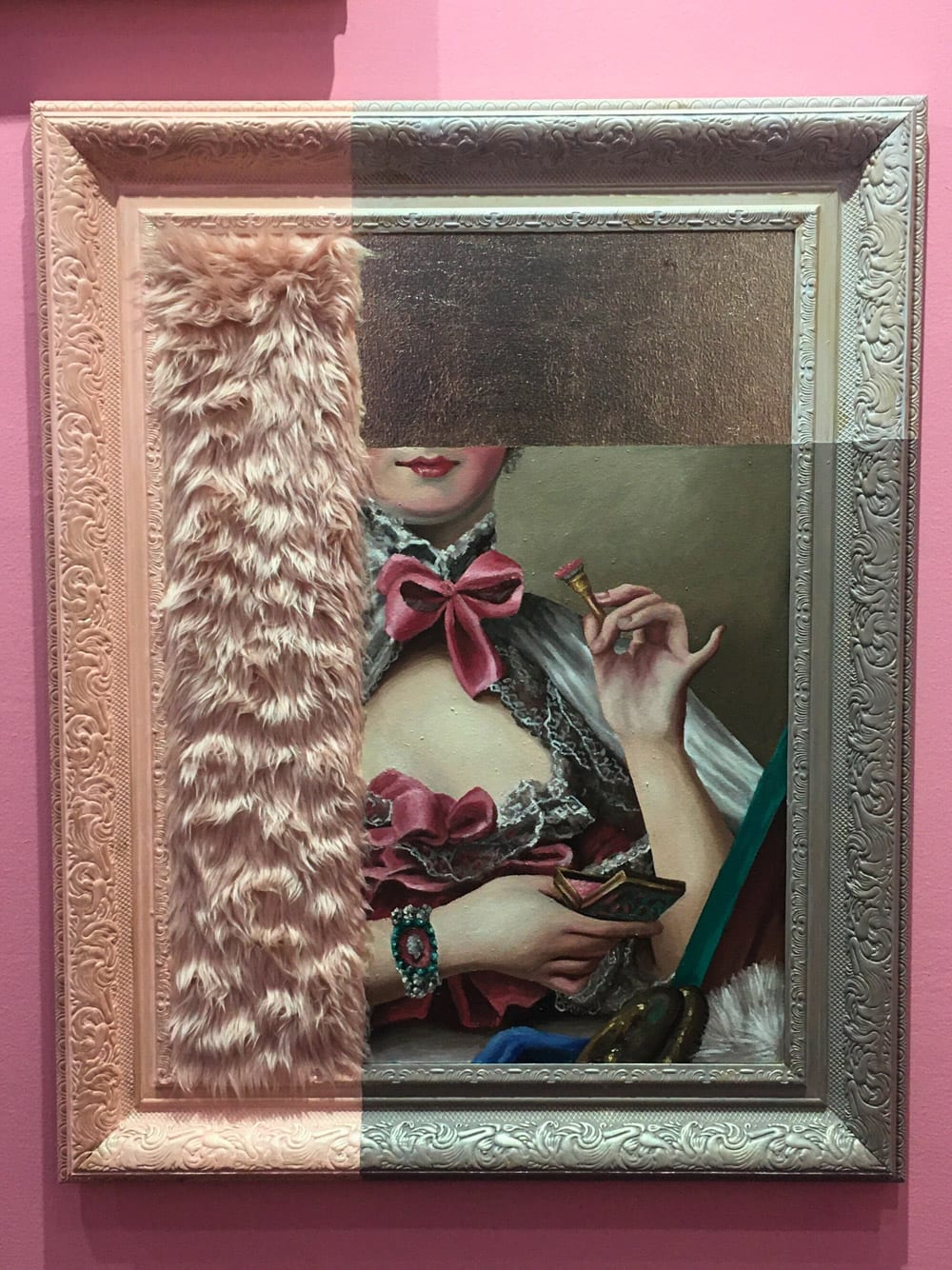
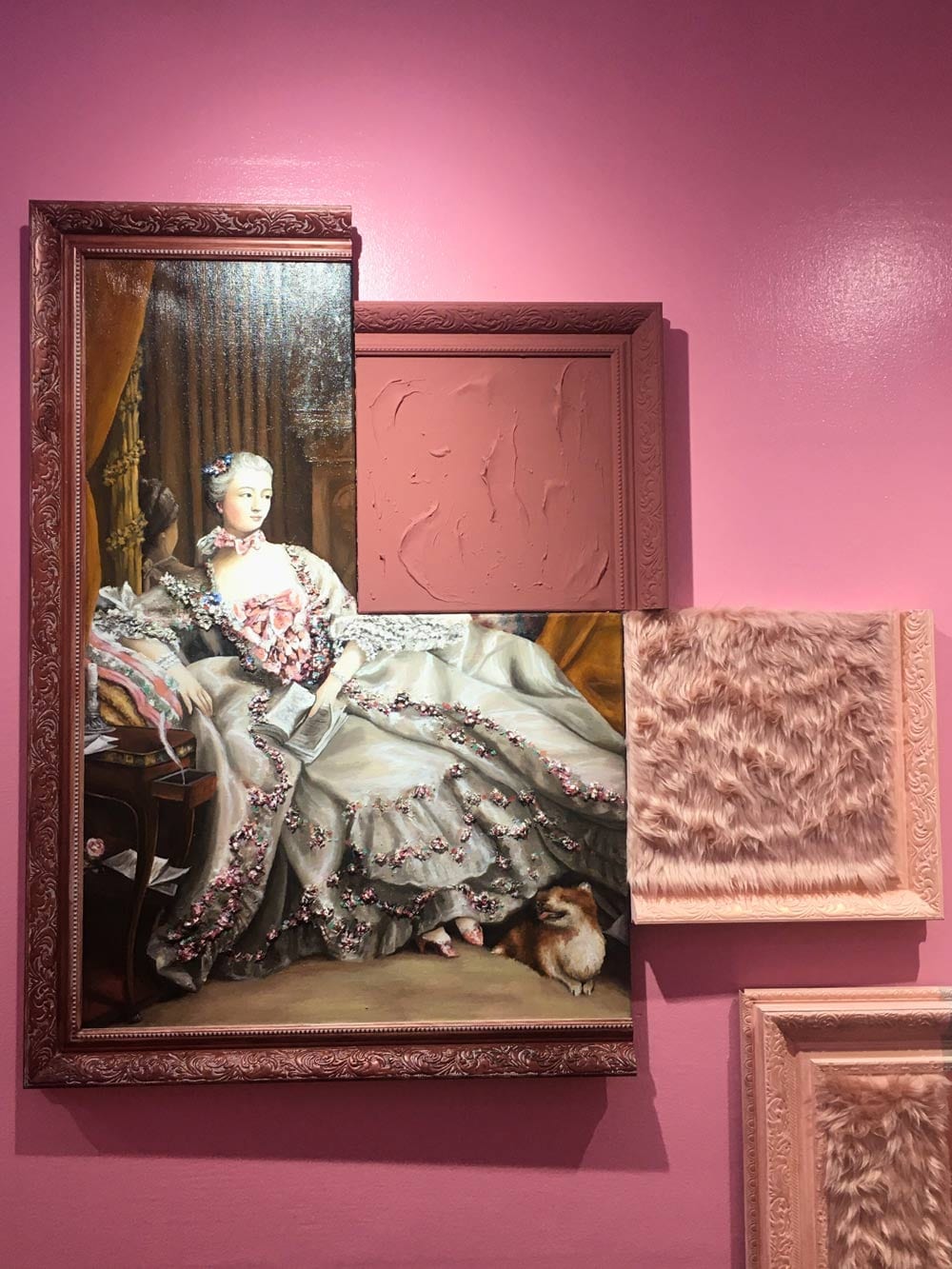
Arianna’s works in her third solo show are more unapologetic in their ambition of mixing mediums. We still see the ma from her first solo exhibition in 2022, Salt, where she experimented with blocks of white paint or gold leaf to efface certain parts of old masters' paintings. It became her signature style, affirmed in her second solo as she introduced solid, colorful paints like in "Puce and Saudade," along with textured finishes using the impasto technique, as seen in "Study of a Background Conversation." In "Curing Salt," we still see her bold use of paint and gold leaf in "Envy Among Common Feathers" and "Thought Daughter," and impasto in "A Little Pink to Make the Naysayers Think." Yes, familiar, but different. She now generously uses light pink fur in her works—romantic and feminine, playful and glamorous. This is most evident in "Grwm," where she crops Boucher’s "Pompadour at Her Toilette," a portrait of Madame de Pompadour applying makeup. In the portrait, Madame holds a tin of rouge—a blush compact in today's terms—in her right hand and a face brush in her left, pinky raised. Arianna obscures the upper part of her face with a block of gold leaf, making her unidentifiable. The left side of the portrait is adorned with a block of light pink fur, affirming Madame as the epitome of Rococo elegance.
'Grwm' (2024), Curing Salt, White Walls Gallery
'Stepping Into the Weekend' (2024), Curing Salt, White Walls Gallery
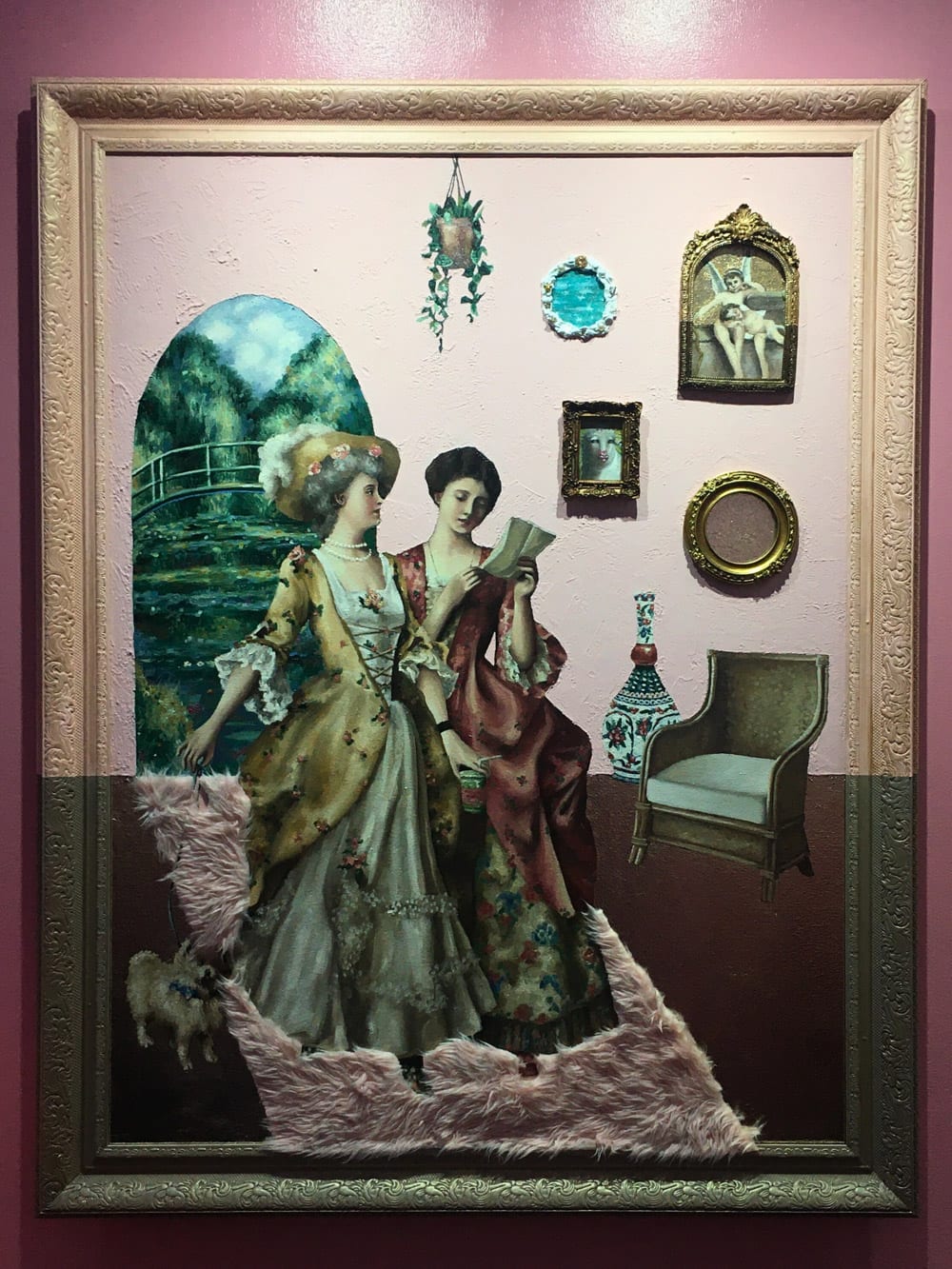
At first glance, Arianna’s works may seem like an impish ode to the old masters, an element present since her first solo. Linda Nochlin retraced the absence of great women painters in art history, asking, "Why have there been no great women artists " It is a question she deemed flawed, as it implies a woman’s inherent inability to create "great" art, as though it were part of her deficiency. Yet women's exclusion from institutions that trained the old masters, as in white men, systematically deprived women of resources. After all, women were expected to become wives and mothers, allowed to pursue art only as amateurs, never as professionals. Arianna’s reinterpretation of old masters’ works, then, may not be an ode at all. It is an appropriation, a reclamation of women’s place in art history. It is proof that women artists can be as "great" as men artists—a phrase that feels oddly clunky, while "women artists" rolls smoothly off the tongue—just as Juan Luna once proved that Indios could paint as Europeans did. But this is not to affirm a singular definition of what "great" art is. The adjective, like salt, should be taken with a grain.
The female figures in Arianna’s works are not stuck in the Victorian era. She layers small contemporary details like the iced matcha latte in "Stepping into the Weekend" onto her appropriations of old masters. In this piece, she appropriates Claude Monet’s Japanese bridge from his "Water Lilies," affirming Arianna’s attempt to seamlessly incorporate Eastern elements into her predominantly Western visual language.
'A Little Pink to Make the Naysayers Think' (2024), Curing Salt, White Walls Gallery
To further emphasize that Arianna’s female figures are not the oppressed women of Queen Victoria’s reign, let’s return to "Make Time for Bedrotting." Fainting sofas were once used by women to recover from the restricted breathing caused by their corsets. Yet the figure in Arianna’s painting, herself, lies there relaxed, her bra hanging from the lamp. Does it echo the Free the Nipple movement? Or the myth of bra-burning feminists? (Yes, it is a myth. The collective protest of bra-burning never truly happened. Art Buchwald sensationalized an event where some women tossed their brassieres into the Freedom Trash Can in his New York Post article, "The Bra Burners," calling it "the final and most tragic part of the protest.") Arianna’s image of a bra hanging from a lamp evokes Elizabeth Stuart Phelps Ward’s call during the Gilded Age in America—an era overlapping with the Victorian—to "Burn up the corsets!"
Arianna’s art refuses to be confined by the past—not by the romanticism of the Rococo, not the restrictive ideals of the Victorian era, nor the historic erasure of women artists. Just as her works layer contemporary references over the old masters, she asserts that women’s art does not have to sever itself from history to be radical. It can appropriate, reclaim, and reimagine. Her third solo exhibition, Curing Salt, does not seek to preserve the past but to cure it, drawing out its contradictions, its exclusions, and its overlooked beauty. In her world, pink is not just soft. It is bold. Leisure is not laziness. It is resistance. And the woman artist is not an anomaly. She is a force.
