The Gathered and the Gathered Against
On the finalists for the 43rd National Book Award for Best Collection of Short Fiction in English.
Published on Mar 8, 2026
THESE FIVE BOOKS disagree with each other. They disagree about what the short story collection is for, about whether horror and folklore belong in the same conversation as literary realism, about whether a career should be gathered whole or a city built from fragments, or a moral darkness tracked across nine variations of the same unanswerable question. This disagreement is, I want to argue, one of the most revealing things about this year’s finalists for the National Book Award for Best Collection of Short Fiction in English, because it maps the terrain of the short story in English in the Philippines in 2024, shows where the fault lines are, where the energies converge and where they pull apart, what this peculiar, precarious form is being asked to do by writers who have very different ideas about what it can hold.
I say peculiar because the short story collection occupies an unusual position in the ecology of Philippine publishing. It is not the novel, which carries the prestige of sustained ambition and the promise of a single world fully realized. It is not the individual story, which finds its home in magazines, workshops, and awards ceremonies, and which achieves its effects in pages rather than tomes. The collection is something else: it is the claim that these discrete stories, placed in sequence between covers, produce something that none of them could produce alone—a cumulative argument, a pattern visible only from a sufficient distance, a book. And the National Book Award, by awarding the collection rather than the individual story, insists that this claim matters, that we should assess not only whether these five finalists contain good stories—all of them contain at least a few—but whether they achieve the more difficult ambition of being good books, whether the arrangement itself creates knowledge that no single piece within it could generate on its own.
I have assessed, in earlier essays, the finalists for Best Novel in Filipino and Best Novel in English, and the finalists for Best Collection of Short Fiction in Filipino, and each of those assessments required its own framework, its own way of asking what the form can hold and what it cannot. The short story collection in English faces pressures specific to its position: it must negotiate the tensions of language and audience that the English-language novel also faces—the question of who reads Philippine fiction in English, the awareness that the language carries colonial history in its syntax, the relationship between local material and the global literary marketplace—but it must do so in compressed form, in stories that must make every sentence bear more weight because there are fewer sentences to distribute the burden across. And the collection must do something more: it must demonstrate that these compressed effects, placed in sequence, produce a cumulative vision that justifies the book’s existence as a book rather than as a loosely affiliated set of magazine or journal publications gathered between covers for the desire to have a book, whether or not the possibility of submitting it for a book award was part of that desire from the beginning.
The five finalists under consideration are In the Blood and Other Stories by Joseph Anthony Montecillo, Other Stories and Etymologies by Hans Pieter Arao, Sojourner, Settler, Seer: The Complete Stories of Charlson Ong by Charlson Ong, The Fireline: Stories from Cagayan de Oro by NH Legaspi, and Vile Creatures by Exie Abola. They range from a debut writer’s thesis project to the complete collected works of one of the most accomplished fiction writers in the country. They were published by university presses and independent publishers whose resources and reach vary enormously — from the University of the Philippines Press and Ateneo University Press to Milflores Publishing and Balangay Books. And they represent five profoundly different understandings of what the short story collection can be: a showcase for genre fiction, a record of a writing life, a portrait of a city, an investigation of moral darkness, an accumulation of searching disconnections.
What I want to ask of these five collections is not only which contains the best individual stories—though that question matters and I will address it—but which achieves the most as a book, which proposes the most compelling argument about what the short story collection in English can do in the Philippines in 2024.
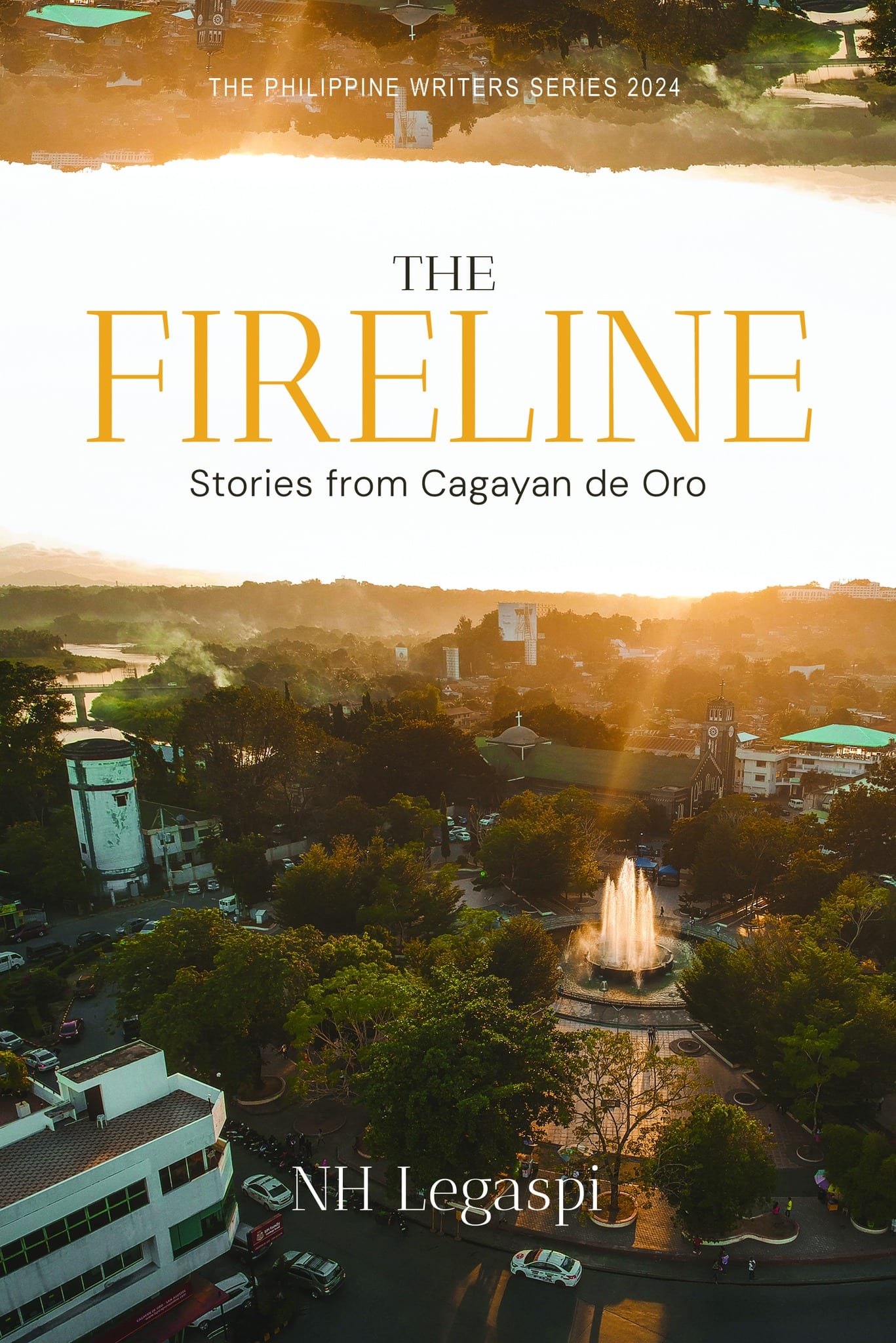
The Fireline and the City That Burns and Floods
NH Legaspi’s The Fireline: Stories from Cagayan de Oro is the collection that most deliberately exploits the possibilities of the form, the one that most clearly understands that a collection can do: hold a city in fragments, approach it from multiple angles, multiple time periods, multiple subject positions, and allow the reader to assemble from these fragments a portrait more complex than any single narrative could provide. The title itself announces this ambition: the fireline is the strip of land in Cagayan de Oro’s Divisoria that was donated by an early municipal mayor to serve as a divider against future blazes, and the word carries the collection’s central preoccupation with boundaries—between safety and danger, between the city and the river, between the colonial past and the postcolonial present, between the people who belong and the people who are displaced.
The opening story, “Daybreak,” establishes the collection’s method: a trans girl, displaced by Typhoon Sendong, stands on Ysalina Bridge and looks at the place where her neighborhood used to be, and from this present moment the story spirals backward and forward through the city’s history—the Higaonon people who were relocated downriver by El Padre Capitan, the fireline donated by Tirso Neri, the flood of 2011 that swept away the girl’s home and the pig tied to the bamboo post—and in this spiraling we understand that the city is not a backdrop but a character, not a setting but a palimpsest of violences and displacements that have accumulated across centuries. The girl is born in a body she does not want, is displaced by a flood that was itself a consequence of decades of settler complacency and government neglect, is rejected by a father who, drunk after a memorial mass, tells her he wished their pig had survived the flood instead, and she stands on the bridge looking at a delta that no longer exists, and in this convergence of gender, disaster, colonialism, and urban geography, Legaspi achieves something remarkable: she makes visible the structures that produce displacement, shows that the girl’s personal crisis of identity is inseparable from the city’s crisis of development, that both are products of the same colonial logic that reorganized bodies and land according to foreign priorities.
The subsequent stories deepen this portrait without repeating it. “Good People” is set in 1974, during the Marcos era, and follows a boy named Credo riding a bus alone from Linamon to Cagayan de Oro to fetch his father, and on this bus he encounters a Muslim mother and son, Rizwan, and the story unfolds against the backdrop of the Tacub Massacre and the Moro-Christian tensions that have shaped Mindanao’s history, and what happens to Credo on that bus—an encounter with predatory adults that the story handles with devastating restraint—becomes legible only in the context of the broader violence that the collection has established, the systematic vulnerability of children in a landscape organized by conflict and impunity. “I’m Growing Up” follows an adolescent girl recently arrived in CDO from Tuguegarao, navigating the social topography of a new school, and here the city appears through the eyes of a newcomer, the motorela and jeepneys and street corners becoming occasions for the discovery of belonging and its limits.
What makes The Fireline succeed as a collection is the discipline of its constraint: every story is set in Cagayan de Oro, every story engages the city’s geography and history, and yet no two stories approach the city from the same angle. The collection spans from the colonial era to the present, from the perspective of a child to an elderly domestic worker, from the trauma of natural disaster to the slow violence of poverty and trafficking. By the time we reach “After Dusk,” the final story, in which a girl named Cara—who may or may not be the same trans girl from “Daybreak,” now older, now living on the streets of Divisoria—is nearly abducted by traffickers, the city has become legible as a system, a set of interlocking forces that produce certain kinds of vulnerability and certain kinds of survival, and the collection has earned its title: it is itself a fireline, a carefully constructed barrier that makes visible the fires—colonial, environmental, sexual, economic—that threaten to consume the people who inhabit this place.
The writing is uneven in ways that are consistent with a debut collection born from a graduate thesis. Some stories carry more exposition than they need, as though the writer does not entirely trust the reader to follow the implications of what has been shown. The historical research sometimes sits uneasily alongside the fictional material, as in “Daybreak,” where the account of the Higaonon relocation reads more like a passage from a history textbook than like the consciousness of a girl standing on a bridge. But these are the unevennesses of ambition rather than carelessness, and the ambition itself—to write a city into existence through stories that honor its complexity, its multiple populations, its layered history of displacement—is exactly the kind of ambition that Philippine fiction in English needs more of. That Legaspi wrote this collection using voice-typing software because of a chronic pain condition affecting her upper extremities only deepens the sense that these stories were wrested from difficulty, that the material demanded to be told even when the body resisted.
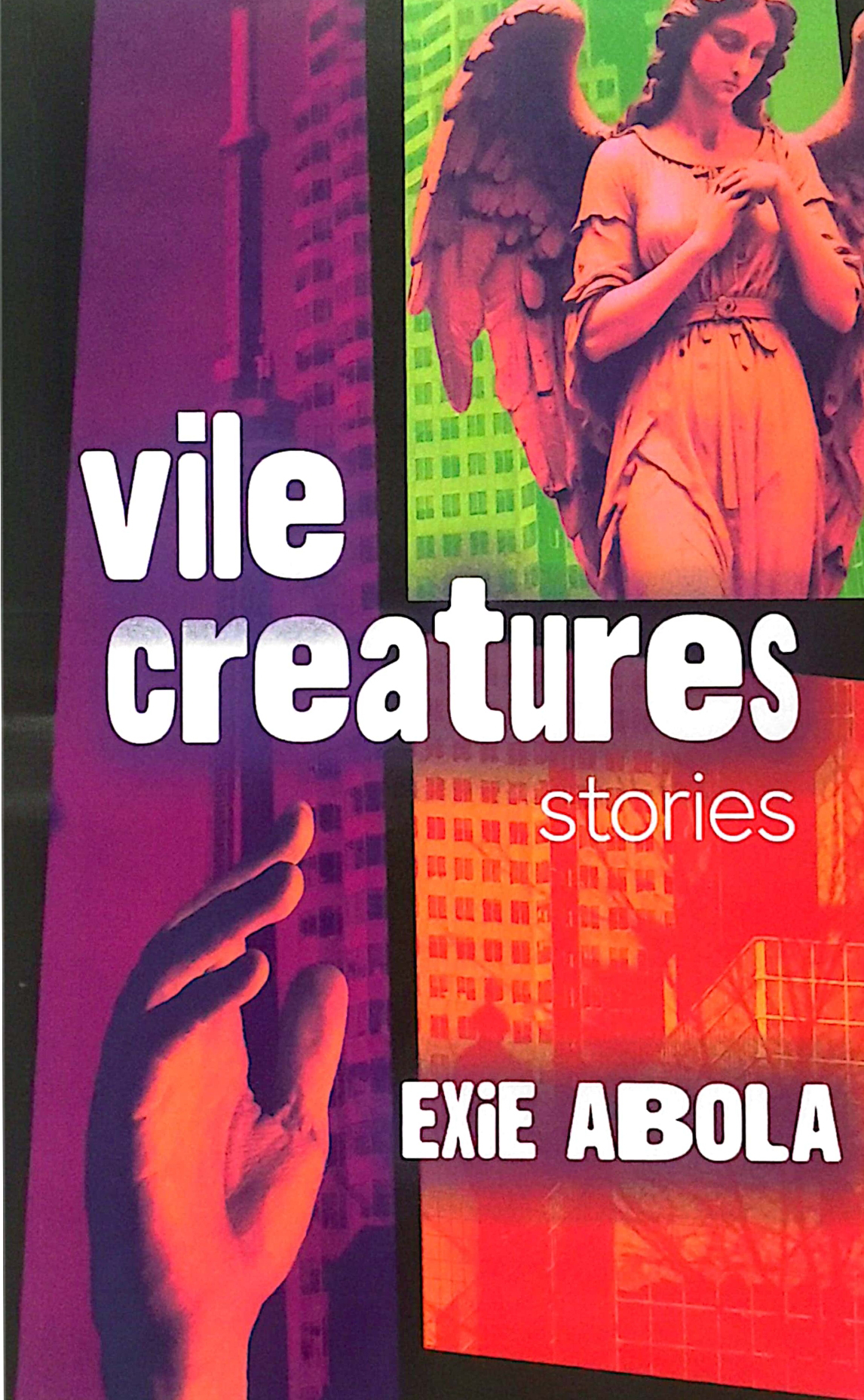
Vile Creatures and the Architecture of Moral Attention
Exie Abola’s Vile Creatures is the collection that most consistently rewards the kind of close reading that distinguishes literary fiction from genre entertainment, the one whose sentences repay the most sustained attention, whose structures reveal themselves most fully on rereading. It is also, perhaps, the most disturbing of the five finalists, not because it traffics in horror—Montecillo’s book does that more explicitly—but because its horrors are entirely human, entirely recognizable, entirely located within the ordinary structures of Philippine middle-class and upper-middle-class life, and the prose that renders them is so controlled, so measured, so apparently calm, that the reader may not immediately register the depth of the darkness being presented.
Consider “Into Ashes All My Lust,” which is told in the first person by a successful businessman who recounts, in the tone of a man reviewing his investment portfolio, a series of sexual relationships with progressively younger women—women in their thirties, then their twenties, then a college student, then a high school student. The narrator’s voice is the story’s achievement and its horror: it is articulate, self-aware, even capable of self-deprecation, and it never once acknowledges that what it describes is predation. The story does not moralize; it does not need to, because the gap between the narrator’s smooth self-presentation and the reader’s growing revulsion produces a moral reckoning more powerful than any authorial judgment could achieve. This is the kind of difficulty that Philippine fiction in English needs—not the difficulty of obscure form or impenetrable language, but the difficulty of being made to inhabit a consciousness you find repulsive and being forced to recognize its logic, its self-justifications, its terrifying plausibility.
“Phallic Symbols” approaches a similar territory—adolescent sexuality, the relationship between innocence and knowledge, the structures of power that shape young women’s lives—from the opposite direction: the narrator is a high school girl in an all-girls Catholic school, and her voice is funny, frank, irreverent, alive with the pleasure of discovering language and the body simultaneously, and the story manages the remarkable trick of being genuinely entertaining while also tracking, through the girl’s growing awareness, the violence that underwrites the world she inhabits—the teacher who has a miscarriage and returns to work as though nothing happened, the classmate who gets pregnant and disappears from school, the question of who got Jenny pregnant that the institution would prefer to leave unanswered. What Abola achieves in this story is a tonal balance so precise it seems almost accidental: the humor is real, the pleasure is real, and the violence is also real, and neither cancels the other, and this refusal to resolve the tension between comedy and brutality is itself the story’s moral argument—that these things coexist in the lives of young Filipino women, that the laughter and the danger are not separate but braided together, and that to flatten either dimension would be to lie about the experience.
The title story, “Vile Creatures,” is the collection’s most ambitious piece, a novella-length narrative that begins as the story of a Filipino mother visiting her sisters in Canada while her young son Biboy stays behind in Manila with the yaya, and becomes something far stranger—a meditation on maternal guilt, diaspora loneliness, and the persistence of folk belief in the form of the aswang, which may or may not manifest at the story’s end. The story’s power comes from its patience, its willingness to build the world of Dina and her sisters Beth and Juliet in a house outside Toronto with such domestic specificity—the Swiss Miss hot chocolate, the GO Train to Union Station, the not-so-subtle invitations to emigrate—that when the supernatural element enters through Biboy’s increasingly alarming phone calls from Manila, it carries the weight of everything that has preceded it: the distance between mother and child, the guilt of being away, the yaya Yolly whose body is quietly failing from concussions no one takes seriously enough, the sense that something essential has been extracted from these women by the very mobility they sought.
As a collection, Vile Creatures earns its unity through the consistent depth of its moral attention rather than through thematic or geographical constraint. The nine stories span different settings, different characters, different time periods, but they share a commitment to looking at what most fiction politely avoids—the predator’s interiority, the victim’s complicity, the bystander’s self-serving neutrality—and they do so with prose that is precise without being showy, controlled without being cold. The inclusion of an “About the Stories” section at the end, in which Abola explains the genesis of each piece, adds another dimension: these are not just stories but the products of a specific writing life, a specific set of encounters with other texts (Dalisay’s “Penmanship,” Joyce’s “Araby,” Lawrence’s “The Rocking-Horse Winner,” Kafka, Adam Johnson), and this transparency about influence and method enriches rather than diminishes the work, positions the collection within a tradition of craft that it honors by extending.
If there is a limitation, it is perhaps the narrowness of the social world the stories inhabit. The characters are overwhelmingly educated, middle-class, Atenean—teachers, businessmen, high school girls in private Catholic schools, condo-dwellers—and while this is not a flaw in itself (a writer must write from what they know—or must they?), it means that the collection’s vision of Philippine life, for all its moral complexity, remains bounded by the perspectives of a particular class, a particular set of institutions. The domestic workers who appear at the edges of several stories—the kasambahay’s daughter who is the protagonist of “Ardor,” the household help glimpsed in the backgrounds of other pieces—are present but rarely centered, and one might wish for a collection this skilled at inhabiting difficult consciousness to turn that skill toward the consciousnesses of those who are most systematically rendered invisible. But this is perhaps unfair—the demand that every collection be everything. What Vile Creatures does, it does with such sustained craft that the complaint feels almost ungrateful.
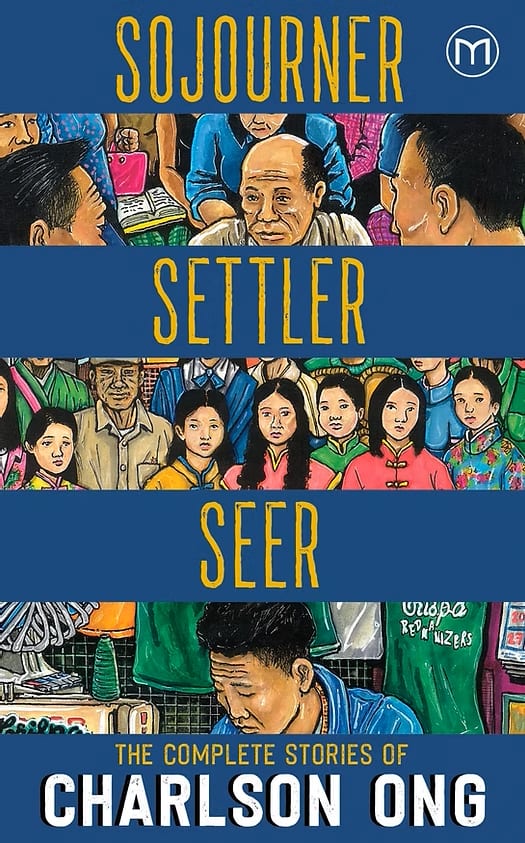
Sojourner, Settler, Seer and the Weight of a Career
Charlson Ong’s Sojourner, Settler, Seer: The Complete Stories of Charlson Ong presents a different challenge to the critic, because it is not a collection in the ordinary sense—not a curated selection of stories written around a common theme or during a particular period—but the complete gathered works of one of the most significant fiction writers in Philippine literature in English, spanning from 1982 to the present, collecting four previously published books (Men of the East, Woman of Am-Kaw and Other Stories, Conversion and Other Fictions, Of That Other Country We Now Speak and Other Stories) along with three uncollected pieces. To assess this book is to assess not a moment but a career, not a single argument about the world but an evolving relationship between a writer and his materials that has deepened and complicated itself across four decades.
The book’s title names the three subject positions that Ong’s fiction has explored with particular authority: the sojourner, the temporary resident whose relationship to the Philippines is defined by the expectation of return or departure; the settler, the one who has committed to staying but whose belonging is never fully secured; and the seer, the one who perceives what others miss, who understands the hidden connections between past and present, between the Chinese diaspora and the Filipino nation, between the individual life and the historical forces that shape it. Ronald Baytan’s introduction situates Ong’s work within the broader context of Chinese Philippine literature, and this contextualization is essential because Ong’s achievement cannot be understood apart from the particular position he occupies—as a Chinese Filipino writer who has insisted, across four decades, that the Chinese experience in the Philippines is not marginal to the national story but central to it, that to understand who Filipinos are requires understanding the sangley, the huaquiao, the lannang, the Intsik, the Chinoy, and the centuries of encounter, exploitation, intermarriage, and mutual transformation that these names carry.
The earliest stories show a young writer already in command of narrative voice and capable of surprising structural choices—“Last Two Minutes” investigates a basketball fanatic’s violent end with a formal playfulness that prefigures the more accomplished work to come—but it is from Woman of Am-Kaw and Other Stories onward that Ong reaches his full powers. Stories like “How My Cousin Manuel Brought Home a Wife,” with its unforgettable portrait of a man so committed to the esoteric that he will trust a healer’s raw egg over a doctor’s examination, and “Woman of Am-Kaw,” with its deliberate refusal to resolve its central mystery into fact, demonstrate what Baytan identifies as the hallmark of Ong’s mature fiction: endings that are suggestive and symbolic rather than direct and literal, stories that refuse to present things as facts and instead offer them as provisional truths signaled by the marker “some say,” a covenant with the unknowable that makes certain of Ong’s stories contemporary masterpieces.
But the decision to publish the complete stories as a single volume creates its own problem, which is that the book includes everything—the apprentice work alongside the masterwork, the stories that have earned their place in the canon alongside the stories that exist primarily as evidence of development. A curated selected stories might have been a more powerful book, a volume that contained only the twenty or twenty-five stories that represent Ong at his best, that demonstrated the range and depth of his achievement without the dilution that inevitably accompanies completeness. The two most recent uncollected pieces, “Mystic Marriage” and “Sheltering,” confirm that Ong remains a writer of considerable skill—“Sheltering,” set during the COVID-19 pandemic, demonstrates his lifelong fascination with the fragility of human connection—but they also feel like additions to a body of work rather than essential components of a collection’s argument.
This is the paradox of the Complete Stories as a form: it is simultaneously more and less than a collection. More, because it offers the reader access to the full trajectory of a major career, because it preserves stories that might otherwise be lost, because it allows scholars and readers to trace the development of themes and techniques across decades. Less, because it cannot achieve the kind of curated unity that distinguishes a great collection from a great accumulation, because the inclusiveness that is its virtue is also its limitation, because a book that contains everything inevitably dilutes the intensity that the best collections achieve through selection and arrangement.
None of this diminishes Ong’s stature as a writer. His best stories—and there are many of them in this volume—demonstrate a mastery of craft, a depth of cultural knowledge, and a generosity of imaginative vision that few Philippine writers in English can match. The Chinese Filipino experience has never been rendered with more complexity, more humor, more tenderness, or more unflinching honesty than in Ong’s fiction, and the decision to gather these stories in a single volume ensures their availability to future readers and scholars. But as a finalist for an award that recognizes the best collection of short fiction published in a given year, Sojourner, Settler, Seer faces a structural disadvantage: it is being measured as a 2024 collection against books that were conceived and executed as 2024 collections, and the form of the Complete Stories, however valuable it is as a publishing event, is not optimized for the kind of curated impact that the award category implicitly values. (By now, the public knows that the book ultimately won the award, for me a testament to how difficult it is for any body of critics to resist honoring the career when the career is this distinguished, despite my personal reservations about the book's completeness working against itself.)
In the Blood and Other Stories and the Possibilities of Genre
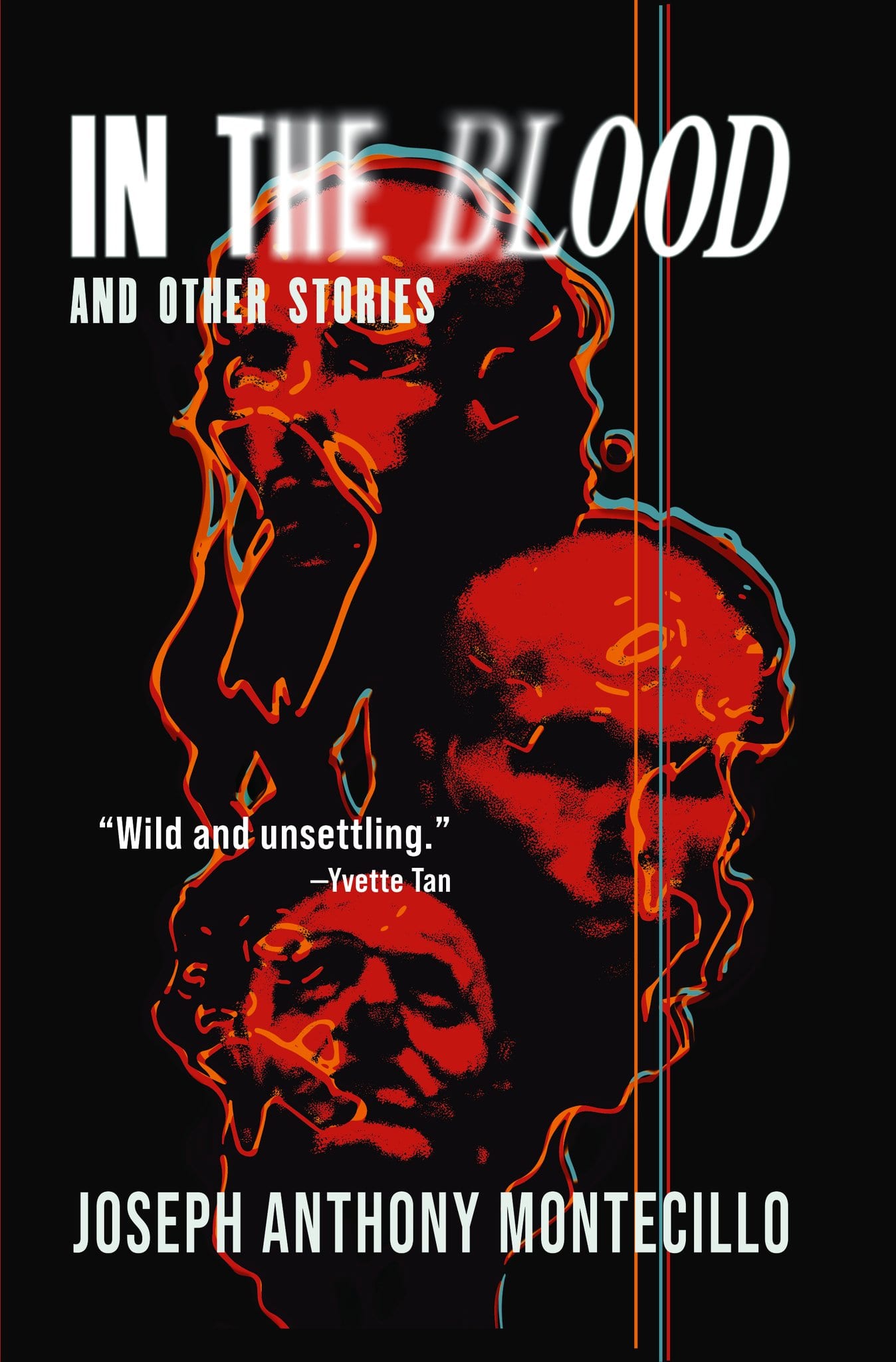
Joseph Anthony Montecillo’s In the Blood and Other Stories represents a different proposition entirely: this is a genre collection, a book of horror stories that announces its allegiance to the supernatural, the violent, the grotesque, and asks to be assessed on those terms. The foreword by Alma Anonas-Carpio sets the tone—enthusiastic, even breathless, a fellow genre writer welcoming a kindred spirit—and the fourteen stories that follow deliver on the promise of blood and monsters and things that go bump in the night with considerable energy and occasional inventiveness.
The collection’s strongest stories are those that use the supernatural not merely as a source of fright but as a lens for examining social structures that produce real-world horror. “An Aswang Fight in New York” is perhaps the collection’s most fully realized piece: two aswang, Lino and Paul, are a married couple running a restaurant in the city, trying to control their predatory urges while building a life together, and the story’s domestic comedy—Paul mopping the floor naked after a feeding frenzy, Lino counting to twenty-two to prevent his own transformation—works because the aswang becomes a figure for the immigrant experience, for the labor of assimilation, for the constant negotiation between what you are and what the world demands you pretend to be. That Lino and Paul are a queer couple is handled with matter-of-fact ease, their marriage as ordinary and fraught as any marriage, their monstrousness a shared secret that binds them more tightly than desire alone could, and the story’s final exchange—planning a vacation to Negros to kill some kids in the forest—is darkly funny precisely because it works as both horror and romance, both genre satisfaction and emotional truth. “Night Predators of Niladan” builds an entire secondary world, a city of guardia civil and dragons and brujas, and through this world investigates the intersection of colonial violence and supernatural violence, the way that the Bruja Killer’s “justice” reproduces the same hierarchies that the brujas themselves resist, and the manananggal detective Mel becomes a figure of considerable complexity—a predator who hunts predators, a monster whose monstrosity is more legible than the monstrousness of the state.
But the collection is uneven in ways that reveal the limitations of genre convention when it is not pushed far enough. Several stories rely on twist endings that, once revealed, leave little residue in the reader’s consciousness—the surprise is the story’s entire point, and once the surprise has been delivered, the story has nothing more to offer. “Baby Blue” and “New Toy” fall into this category: they are competently executed but disposable, efficient mechanisms for the delivery of a shock that dissipates as soon as it has been felt. “Pressure and Release,” told in second person, attempts something more ambitious—the interiority of a bus driver who deliberately crashes his vehicle, the narrative structured as a crescendo of violence—but the story’s reliance on the second-person device, while initially effective, becomes a constraint that prevents the character from developing beyond the mechanism of his destruction.
As a collection, In the Blood announces its organizing principle through its title—blood as heritage, blood as violence, blood as the supernatural current that connects predator and prey—and this principle provides coherence but also limitation. The book operates almost entirely within the register of horror, and while the best stories transcend their genre to address larger questions about immigration, sexuality, state violence, and colonial history, the weaker stories remain confined within the genre’s conventions, delivering their frights without leaving the reader anything to carry beyond the final page. The question for any collection at the National Book Awards—genre or otherwise—is whether its formal choices produce something beyond the satisfactions of convention, whether it uses those conventions not merely to deliver their expected pleasures but to illuminate, and In the Blood does this intermittently rather than consistently.
What deserves recognition, however, is the collection’s willingness to center Philippine mythology and folklore—the aswang, the manananggal—not as curiosities or as vehicles for cultural tourism but as living presences with their own logics, their own social structures, their own forms of community and conflict. At its best, In the Blood participates in the larger project that several of this year’s finalists across categories share: the insistence that the supernatural is not escapism but methodology, not decoration but a way of making visible what realism cannot render. Montecillo’s contribution to this project is to locate the supernatural within genre conventions that have their own histories and possibilities, to argue implicitly that horror fiction is not inherently less serious than literary realism, that it is simply a different set of tools for investigating the same questions about power, vulnerability, and what it means to be human—or not quite human—in a world organized around violence.
Other Stories and Etymologies and the Struggle for Form
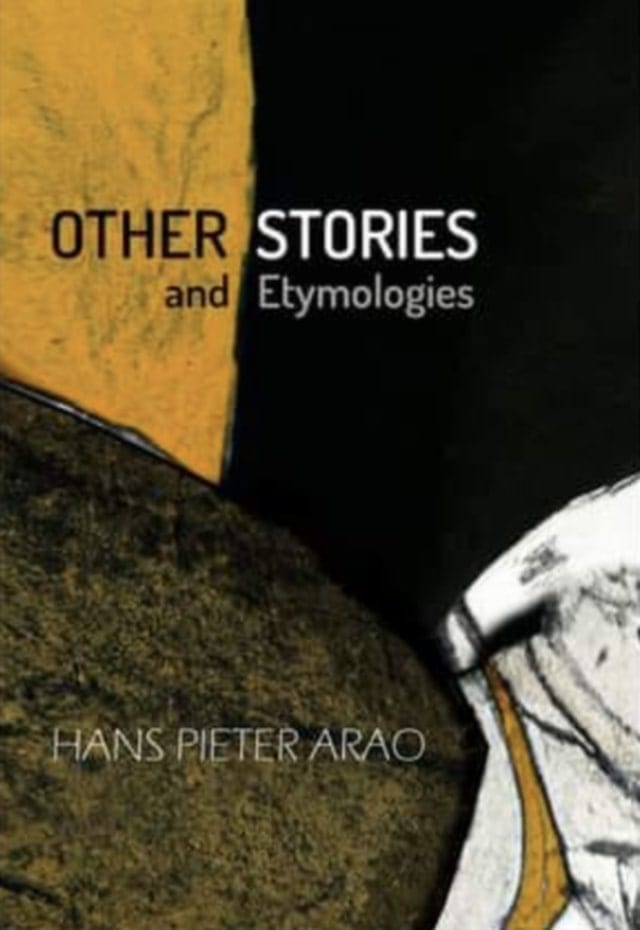
Hans Pieter Arao’s Other Stories and Etymologies is the collection that most clearly shows the marks of a writer in the process of becoming, a book whose ambitions frequently exceed its current technical resources, whose best moments suggest a talent still finding its way toward fuller expression. Published by Balangay Books, an independent press, the collection gathers nine stories that address themes of disconnection, longing, diaspora, and the persistence of folk belief in modern life—themes that are rich and urgent and that deserve the kind of sustained attention that the strongest stories in this collection begin to provide.
“Instagram Stories” is perhaps the collection’s most formally interesting piece, a story that uses the architecture of social media—highlights, archived stories, the gap between curated presentation and lived reality—as both subject and structure. A man obsessing over his ex-girlfriend’s Instagram page during quarantine discovers that the digital archive of their relationship has been edited, his presence removed, the grid reshuffled to paper over the cracks, and this discovery becomes an occasion for meditating on the nature of memory in the age of digital permanence, on the difference between remembering and having access to records, on the particular cruelty of being deleted from someone’s curated life. The story’s strength is its recognition that Instagram is not merely a platform but an epistemology, a way of knowing and being known that has restructured how we understand our own pasts, and Arao renders this recognition with intelligence and feeling.
“Etymologies,” the collection’s final story, works in a completely different register—rural, grounded, concerned with the encounter between modern education and folk knowledge—and achieves a quiet power through its portrait of Jun, a Manila-educated man returning to the province and confronting the gap between what he has been taught and what the land and its people know. The child Niña who scolds him for failing to offer atang before defecating by the Acacia tree represents a knowledge system that Jun’s education has trained him to dismiss, and the story’s tension—between the rationalist who sees “stories and stories” and the farmers who see spirits and obligations—is rendered without condescension toward either position. The ending, in which Jun drives away from the province carrying a lamp he came to fetch but finding only darkness on the road ahead, achieves the kind of resonant ambiguity that the collection’s best moments aspire to.
But several stories in the collection suffer from overwriting, from a tendency toward ornate language that obscures rather than illuminates, from sentences that reach for lyricism and arrive instead at opacity. “Mollusks and Flowers” begins promisingly—the opening section’s account of Pete’s sexual health education through pop culture and campus gossip is vivid and culturally specific—but the story’s later sections lose focus, the relationship between Pete and his unnamed partner becoming harder to track as the prose grows more self-consciously “literary.” “The Cistern” and “The Rule of 3’s” show similar patterns: strong premises undermined by execution that has not yet learned when to be simple, when to trust the story’s materials to carry their own weight without rhetorical amplification.
As a collection, Other Stories and Etymologies does not achieve the cumulative force that the strongest entries in this category manage. The nine stories feel gathered rather than arranged, their sequence more incidental than structural, and the reader does not experience the kind of deepening or complication that occurs when stories are placed in deliberate conversation with each other. The title gestures toward a unifying concept—“other stories” suggesting alternatives, counter-narratives, the stories that exist alongside and beneath the official versions; “etymologies” suggesting origins, roots, the buried histories of words and places—but the stories themselves do not consistently pursue this concept with enough rigor to make the collection feel like a book rather than a selection.
This is not to dismiss Arao’s talent, which is real and which manifests in moments throughout the collection—the social media architecture of “Instagram Stories,” the cultural specificity of “Spirit of the Dead,” the quiet dignity of the domestic worker in “Homecoming,” the earned ambiguity of “Etymologies.” It is to say that the talent has not yet been matched by the formal discipline that would allow these moments to accumulate into a sustained vision, and that the collection reads as the work of a writer who is still discovering what his stories are about, still learning how to shape individual pieces into a whole that exceeds their sum. Given that several of these stories appeared in the Philippines Graphic and other periodicals years before their collection in book form, the gathering feels more archival than architectural—a record of what has been written rather than a design of what these writings, placed in conversation, might collectively reveal.
Alive, Precarious, Uneven
What, then, do these five collections tell us about the state of the short story in English in the Philippines in 2024? They tell us, first, that the form continues to attract writers working in radically different modes—literary realism and genre horror, the workshop-honed craft story and the place-based documentary impulse, the career retrospective and the thesis-driven debut. They tell us that the institutional infrastructure for the short story remains precarious: these books are published by university presses and independent imprints, none of which can offer the kind of commercial reach that might expand the audience for Philippine short fiction beyond the small circle of writers, academics, and dedicated readers who already attend to it. They tell us that the workshop tradition—UP Diliman, Ateneo, the Palanca Awards, the literary magazines—continues to shape how stories are written and published in this country, for better and for worse: for better because it produces writers who are technically competent and who engage seriously with the traditions of the form; for worse because it can produce a certain uniformity of approach, a certain reluctance to venture beyond the aesthetic norms that the workshop and the literary prize reward.
The collections that succeed most fully here—The Fireline and Vile Creatures—are the ones that understand the collection not as a container for stories but as a form with its own possibilities and demands. Legaspi builds Cagayan de Oro through accumulation, approaching the same city from different angles, different decades, different subject positions, until the city becomes legible not as a setting but as a system of interlocking forces that produce vulnerability and survival in equal measure. Abola sequences increasingly complex moral cases until what seemed like separate stories reveal themselves as different faces of the same darkness, each piece recalibrating what the reader thought the previous one had settled. Both writers have grasped that the collection’s unit of meaning is not the individual story but the space between stories, the way one piece alters the reader’s encounter with the next—and this understanding is what separates their books from the other three finalists, each of which succeeds at something real (Montecillo’s insistence that genre horror can carry serious cultural work, Ong’s preservation of four decades of essential fiction, Arao’s moments of genuine formal discovery) without achieving the same coherence as a book. The Fireline’s limitations are those of a debut—occasional overwriting, the seams of a thesis still visible—but they are the limitations of a writer reaching beyond her current grasp, which is always preferable to a writer who stays safely within it. Vile Creatures’ limitations are those of a writer who knows exactly what he is doing within a defined social range—the educated middle-class world of Ateneo and Ortigas and Quezon City—that one might wish were broader, more inclusive of the voices that the collection’s own moral logic would seem to demand.
And yet I return to the question that began this essay: why are these stories together? The answer matters because it is the answer to a larger question about what literature can hold, what forms are adequate to the multiplicity of Philippine experience, what it means to compress a life or a city or a career or a moral universe into the concentrated space of the short story and then to arrange those compressions into a book that is itself a larger argument. The short story collection in English in the Philippines in 2024 is alive—uncertain, precarious, uneven, but alive—and these five finalists, for all their differences and all their limitations, are evidence of that life, are proposals about what this strange, demanding, compressed form might still achieve in a country that has too many stories to tell and too few readers to receive them.
These five collections, whatever their individual achievements and limitations, are contributions to the ongoing argument about what the short story in English can do in the Philippines, and I offer this assessment as one reader’s necessarily partial, necessarily situated, necessarily temporary account of what these books have given me and what they have left me wanting—knowing that other readers will read differently, will value differently, will carry different things away from these same pages. What I hope, finally, is that people will read these books—will continue to read them, will seek them out, will let them do the slow, strange work that only stories gathered between covers can do.

Edgar Calabia Samar is Associate Professor and Chair of the Department of Filipino at Ateneo de Manila University. He is the author of the award-winning Janus Silang series and of several other novels, including Teorya ng Unang Panahon, a Palanca and National Book Award winner currently being translated into English as Theory of a Long Time Ago by PEN Presents x International Booker Prize winner Christian Benitez, under a National Book Development Board translation grant. His first novel, Walong Diwata ng Pagkahulog, received the NCCA Writer’s Prize in 2005, and its English translation, Eight Muses of the Fall, was longlisted for the 2009 Man Asian Literary Prize. He previously served as Visiting Professor at Osaka University from 2017 to 2022 and as Writer in Residence at the University of Iowa in 2010. He is the Head of the National Committee on Literary Arts of the National Commission for Culture and the Arts and a member of the Filipino Critics Circle, formerly the Manila Critics Circle, the Filipinas Institute of Translation, and LIRA, where he served as President from 2001 to 2003. In 2024, he received the S.E.A. Write Award from the Royal Family of Thailand for his contributions to Southeast Asian literatures. He develops literature and novel-writing guides and maintains a growing Filipino komiks archive through Santinakpan Otherwise on patreon.com/ecsamar.
ALSO READ:
What the Stories Hold When the Collection Gathers: On the finalists for the 43rd National Book Award for Best Collection of Short Fiction in Filipino
What the Novel Carries When It Leaves: On the finalists for the 43rd National Book Award for Best Novel in English
Edgar Calabia Samar is an award-winning poet, critic, and novelist, and an Associate Professor at Ateneo de Manila University. IG: @ecsamar.
View More Articles About: