What the Novel Carries When It Leaves
On the five finalists for the 43rd National Book Award for Best Novel in English
Published on Feb 7, 2026
Disclosure: Gerardo T. Los Baños was my co-fellow at the 38th UP National Writers Workshop in 2001, when we were still addressed by surname—I was Samar, he was Los Baños, and we had another co-fellow whose surname was Pangasinan, which made for an inadvertent geography lesson in every session. Kaisa Aquino is a colleague at the Ateneo de Manila University, where she teaches at the Department of Fine Arts. Isagani R. Cruz is the founding chair of the Manila Critics Circle, now the Filipino Critics Circle, though our time there did not overlap; I joined long after his departure. I note these connections in the interest of transparency, though I have endeavored to assess all five finalists with equal rigor and honesty. The criticism and opinions expressed here are my own and do not represent the views of the Filipino Critics Circle as a whole.

A TEENAGE football star collapses on the field after scoring a header, his leg giving out beneath him in a way that the coaches attribute to exhaustion but that will soon reveal itself as the first symptom of a glioma growing at the base of his brain. A twenty-eight-year-old revolutionary crawls through the flatlands of Delfin Albano with a bullet in her thigh, biting into the leather strap of an empty holster as she plunges trembling fingers into the wound to remove what the state has put inside her. A mute ten-year-old boy pushes a wooden cart of paper lanterns through Manila traffic, unable to speak since he watched his father die in the hills of his home province. A zillionaire publishing magnate arrives in heaven to find Jose Rizal, Emily Dickinson, and William Shakespeare, all of them waiting to discuss literature and the nature of eternity. A daughter counts since her mother packed her bags while her father lay drunk behind the couch and walked out the door without saying goodbye.
These are the figures that populate the five novels shortlisted for the 2024 National Book Award for Best Novel in English: a dying athlete, a wounded revolutionary, a silent child, a dead publisher in paradise, a young woman who writes dictionary definitions of Tuesday because she cannot write what Tuesday means. And if I begin with these bodies—diagnosed, wounded, mute, deceased, counting—it is because the question that animates all five finalists, however different their registers and ambitions, is finally the question of what it means to leave and what it means to remain, what structures compel certain bodies toward departure and what structures might make staying possible, what the novel carries when it leaves the country and what the country carries when it leaves the novel.
The Philippine novel in English has always been marked by departure—the departure from Filipino and the regional languages that preceded English, the departure from the colonial tongue itself even as one writes in it, the departure of writers who leave and return and leave again, the departure of stories that cross oceans and thresholds and political imaginaries. The finalists in English share with their counterparts in Filipino—which I assessed in an earlier essay—a mnemonic function, a capacity to remember what the nation forgets, but they face a different set of pressures: the novel in English must justify its language choice in ways the novel in Filipino does not, must negotiate its relationship to a global literary marketplace that remains hungry for certain kinds of Philippine stories while ignoring others, must find forms adequate to experiences that have been shaped by English even as they exceed it.
The five finalists under consideration are Extra Time by Gerardo T. Los Baños, Isabela by Kaisa Aquino, So Heaven by Isagani R. Cruz, The Solemn Lantern Maker by Merlinda Bobis, and The Weather of Leaving by Victoria Dialogo Cuevas. These five novels represent profoundly different aesthetic choices, different formal ambitions, different understandings of what the novel can and should do in the Philippine context, and this diversity itself tells us something important about the state of the novel in English in the country today: there is no consensus about form, no dominant aesthetic that commands allegiance, no single way of imagining how the novel might address the crises that define contemporary Filipino experience. While one might read this lack of consensus as fragmentation or incoherence, I prefer to read it as possibility, as the persistence of multiple paths through the forest of the contemporary, as evidence that writers are still experimenting with what the novel can hold, still dreaming worlds that operate according to principles other than those of extraction and abandonment that govern so much of Philippine life.
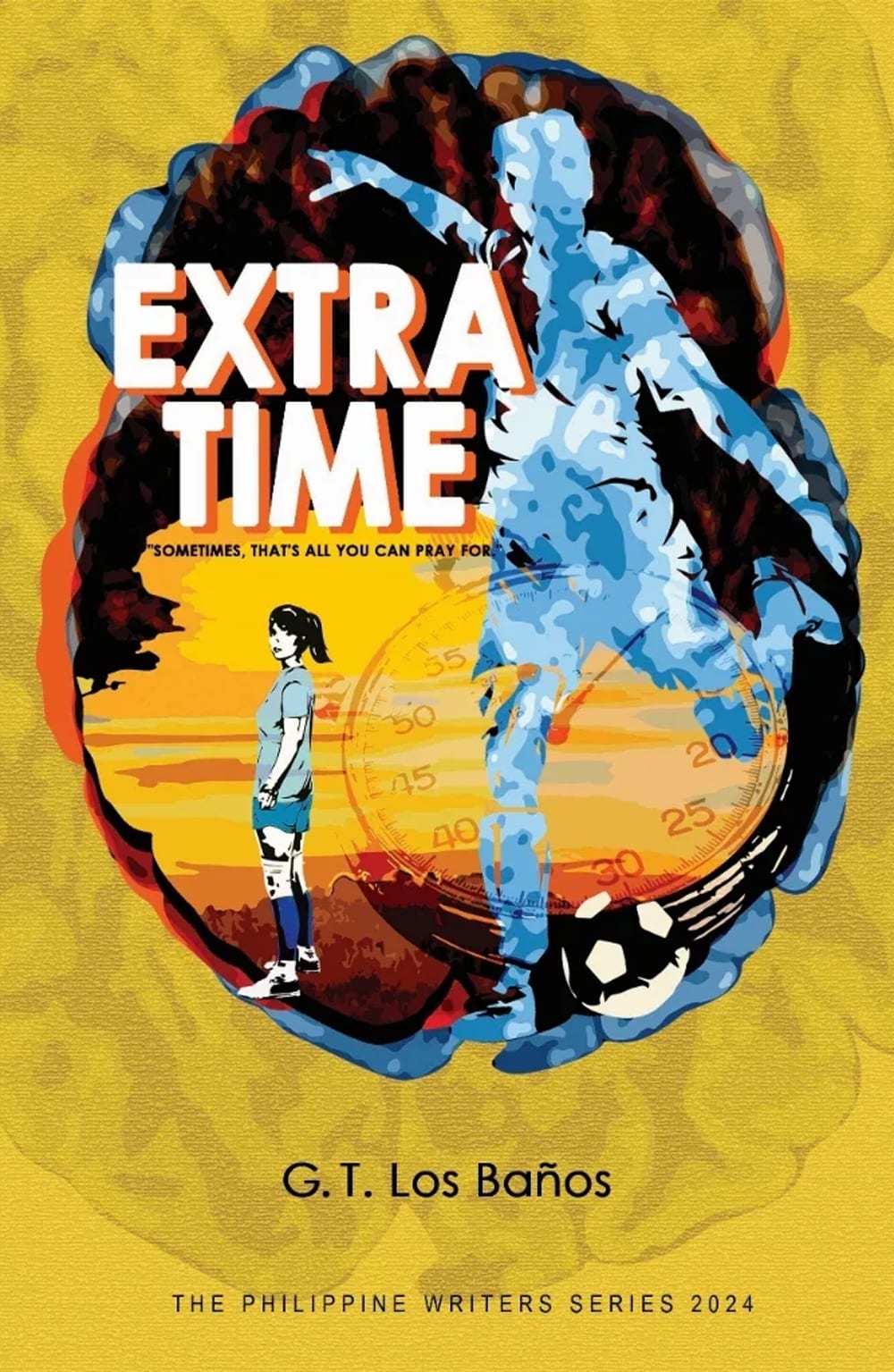
Extra Time on Landing and Taking Off
Extra Time by Gerardo T. Los Baños arrives most squarely in the tradition of the young adult novel, the Bildungsroman that follows its teenage protagonist Benj through the crisis of a brain tumor diagnosis that disrupts his trajectory as a star football player at Altius High. The novel knows what it is and executes its intentions with clarity: Benj plays football, Benj experiences symptoms (his leg gives out during a game, he collapses after scoring a header), Benj learns he has a diffuse intrinsic pontine glioma, Benj undergoes radiation treatment, Benj falls in love with Denise, Benj watches his team compete without him, Benj contemplates mortality while discovering what remains when the future you planned for is taken away.
The foreword by Carla M. Pacis notes that “the YA novel is still a rare commodity in Philippine literature, more so the sports novel,” and Los Baños’s contribution to this underserved genre deserves recognition. The football scenes carry enough technical specificity to ground us in Benj’s physical world—the through passes, the defensive formations, the feeling of mud under cleats, the way a header connects with the skull in the moments before the body begins to betray itself. The hospital scenes manage the balance between medical detail and emotional accessibility, the radiation treatments and their side effects rendered with the precision of someone who has done his research without letting that research overwhelm the narrative. The relationships with family members—the estranged father whose corporation sets up a foundation for children with cancer, the devoted mother who takes leave from her pottery studio to care for him, her boyfriend Tito Rod, who organizes a charity golf tournament that brings these disparate figures together—provide the network of care that surrounds Benj as he confronts his diagnosis.
What the novel does well, it does very well. The title’s ambiguity—extra time as both the additional playing minutes in a tied match and the extended life that treatment might provide—gestures toward the kind of layered meaning that literary fiction aspires to. The football matches that continue without Benj become occasions for him to understand what it means to support something larger than yourself, even when you can no longer participate directly, a lesson that the novel treats with appropriate tenderness. The budding romance with Denise unfolds with the awkwardness and sweetness appropriate to teenage love, made more poignant by the awareness that this love exists under the shadow of mortality.
But the novel rarely risks anything that might disturb its genre framework. Benj is likeable from the first page and remains likeable to the last, his emotional journey a clear line from denial through anger to acceptance that will be familiar to anyone who has read the illness narratives that precede this one, from Eric Segal to John Green. The football operates primarily as backdrop rather than as thematic engine that might teach us something about illness or embodiment that we couldn’t learn through any other activity—the sport could be replaced with basketball or swimming or chess without fundamentally altering what the novel has to say about mortality and connection. The Filipino setting is present but largely unmarked, the socioeconomic specificity of private school sports culture and access to quality healthcare gestured toward but never interrogated. The father’s corporation setting up a cancer foundation is treated as straightforward generosity rather than as an occasion to examine how wealth shapes access to care, how the same diagnosis would unfold differently for a family without these resources.
Los Baños has written a well-crafted novel that knows its audience and serves them with genuine care. The prose is accessible, the emotions legible, the arc recognizable—and for young readers confronting mortality or watching loved ones confront it, this clarity is itself a gift. Not every novel needs to reinvent the form; some novels do their work precisely by providing the emotional architecture that readers need, the catharsis that genre conventions have developed over decades to deliver. Extra Time does this work honestly and well. If I note that the novel does not push the formal or ethical possibilities of the Philippine novel in English into new territory, this is not a dismissal but a recognition that it operates in a different register, pursues a different kind of success. That success is real, and for its intended readers, it may be exactly what is needed.
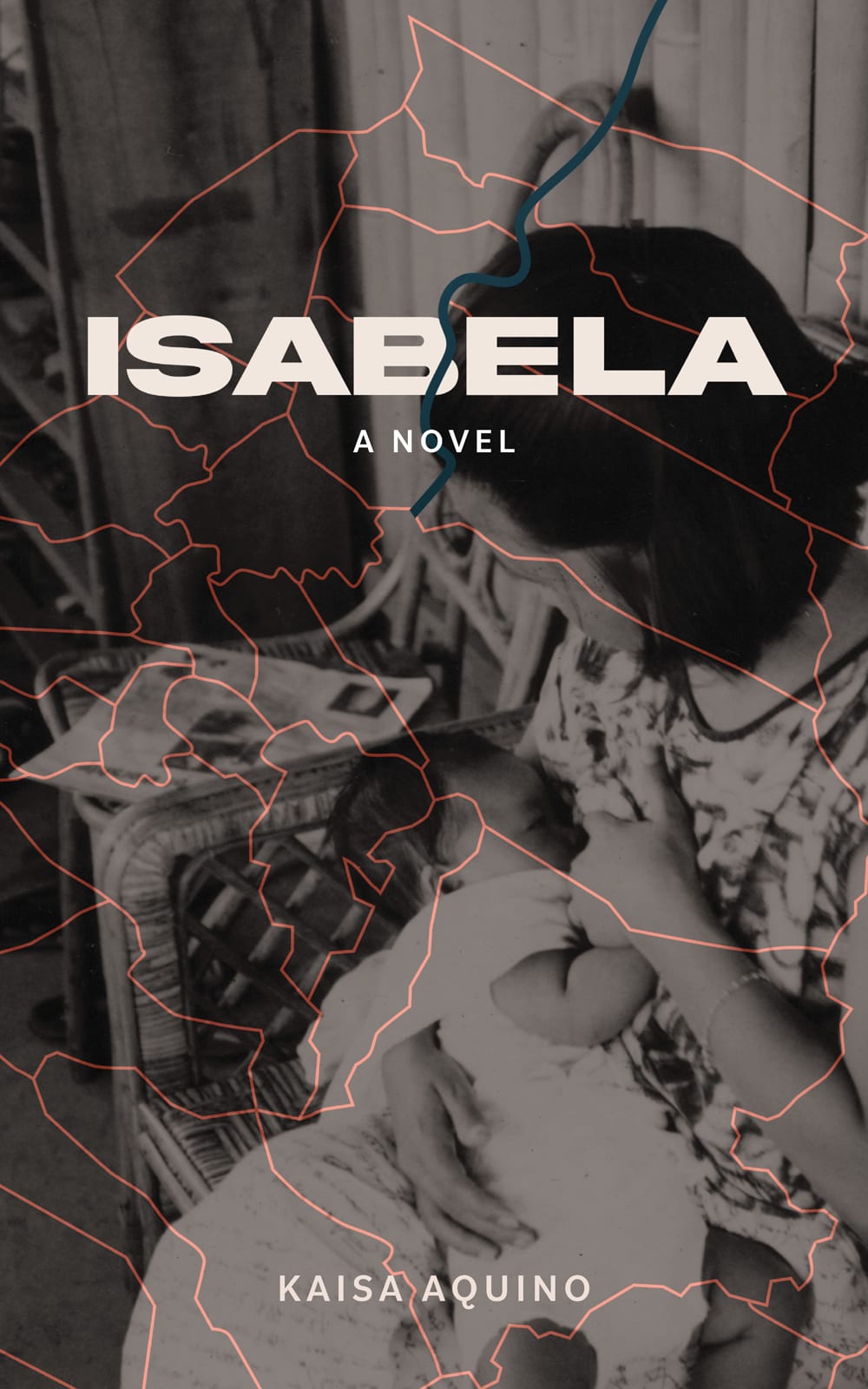
Isabela, the Hills and the Women Who Climb Them
Isabela by Kaisa Aquino enters territory that the Philippine novel in English has rarely dared to enter: the ongoing armed struggle in the countryside, the revolutionary movement that has persisted for more than half a century in the mountains of Luzon and beyond, the lives of women whose commitment to collective liberation has required them to leave behind family, comfort, safety, and sometimes their own children. Where Extra Time works within the established conventions of its genre, Isabela attempts something more difficult: to find structures that can hold the complexity of revolutionary commitment without either romanticizing or condemning it.
The novel arrives as a chorus of women’s voices—Ka Julia, Ka Abel, Prof. Isabelle “Isang” Gracia Lagasca, Sabel, Sierra, Belay, Issey, Louisa Isabelle Narciso, Karina, Patis, Celine—names that circle around and through the word “Isabela,” the province in the Cagayan Valley that serves as the novel’s geographical and spiritual center. Some names contain fragments of “Isabela” (Sabel, Abel, Isabelle, Belay); others evoke the landscape (Sierra, for the Sierra Madre range); all suggest that these women are bound to this place, that the province has shaped them as surely as they have shaped it. The naming signals that Aquino is reaching beyond straightforward realism: these women are variations on a theme, and what happens to Ka Julia has happened before and will happen again, the struggle producing certain kinds of experience that recur across generations.
The novel opens with Ka Julia wounded and bleeding, crawling through the flatlands of Delfin Albano after an encounter with the military, shot in the thigh by forces that have been circling the community with their trucks and agrochemicals and doctored papers of the land. She is twenty-eight years old. She removes the bullet herself, biting into the leather strap of her empty holster as she plunges trembling fingers into the wound, and this scene of self-surgery—visceral, embodied, refusing the luxury of medical care that the state does not provide to those who resist it—establishes the novel’s commitment to showing what revolutionary life actually costs, what it means to have accepted that going up in the hills means you could die. Ka Julia’s wounded consciousness becomes the frame through which we access the other women’s stories, their voices flickering in her mind as she hovers at the threshold between life and death: “You are these women. You are these women, at one point, in the past, somewhere in the future. In another life.”
The structure allows Aquino to move across decades—the activism of the Marcos years, the post-EDSA disillusionment, the continuing war in the present—showing how different women at different historical moments have encountered the same questions: what it means to commit one’s body to a cause larger than oneself, what particular burdens women carry within a movement that, for all its revolutionary aspirations, has not fully escaped the gendered hierarchies of the society it seeks to transform. The novel’s most powerful passages attend to decisions that male revolutionaries rarely face with the same intensity: whether to bear children when your body belongs partly to the struggle, how to raise a daughter when the hills keep calling you back, what it means when your comrade and lover can no longer look at the movement the same way after everything that has happened.
The novel does not flinch from the movement’s failures, the distinct wounds it has wrought in women’s lives, and this willingness to critique from within rather than to romanticize from without gives Isabela a complexity that propaganda lacks. When Apa, Ka Julia’s comrade and the father of her child, confesses that “This movement that you trust so much… I don’t know if I can look at it the same after everything,” and Ka Julia responds, “I’m going back,” the novel refuses to resolve this divergence into victory for either position. Apa has been disappointed by that which he surrendered his life for; Ka Julia, despite everything, feels life rush through her so violently she “shuddered like a bird about to take flight” at the prospect of returning to the hills. Neither is wrong. Both are wounded. The novel has the wisdom to let them diverge.
The landscape itself becomes character in Aquino’s telling—the Sierra Madre mountainside blooming with varying shades of blue and purple hydrangeas, the flatlands of Delfin Albano where Ka Julia crawls, the barrios surrounded by military trucks and agrochemicals and doctored papers of the land. This attention to geography grounds the novel’s politics in material conditions: the farmers and agricultural workers are fighting not for abstract ideology but for the soil itself, for the right to remain on land that their families have worked for generations. If the prose sometimes flattens into the rhythms of testimonial literature, if the multiplication of voices occasionally creates confusion rather than resonance, these are the risks of a novel that refuses the safety of a single perspective. The final line—“Tell her I’m going home”—carries the full weight of what “home” means for a revolutionary: not the apartment where she has been raising her daughter, but the hills, the struggle. The daughter will receive this message and must interpret it. The novel does not cushion the blow.
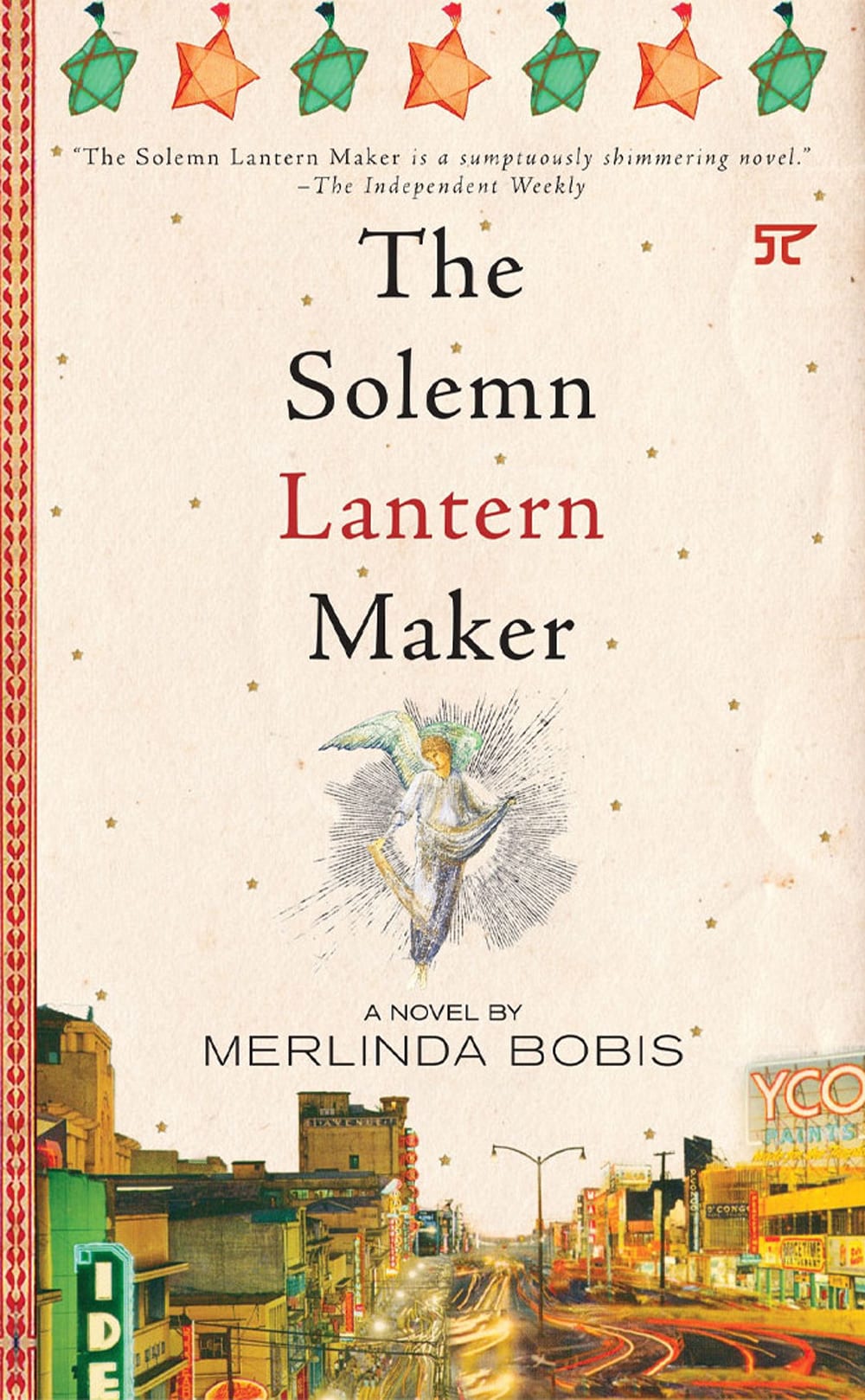
The Solemn Lantern Maker, or Stars That Fall and Hands That Reach
Why does a novel return? The Solemn Lantern Maker by Merlinda Bobis was first published in 2008 by an Australian press; its 2023 Philippine republication by Anvil raises the question of what it means for a novel to come home, to be re-presented to Philippine readers fifteen years after its initial appearance. The answer, I think, lies in what the novel does with its materials: it tells a story of Manila’s street children with a poet’s attention to language and a novelist’s attention to structure, and both the materials and the attention remain urgently necessary. The trafficking of children has not ceased. The poverty that drives ten-year-olds to sell paper lanterns at intersections has not been addressed. The novel returns because the conditions it depicts have not departed.
The title names our protagonist: Noland, ten years old, mute, maker of paper star lanterns that he sells at traffic intersections in the days before Christmas. The muteness is not congenital but traumatic—it began with his father’s death, witnessed in the hills of his home province, the body “covered in red and dirt,” the eyes “looking up, trying not to forget the sky.” This image haunts the novel as it haunts the boy, returns in various forms throughout the 112 numbered sections that structure the narrative, suggests that what cannot be spoken must nonetheless be carried, that silence is not absence but a different mode of presence.
The novel teaches, with a patience that rewards sustained attention, how to read silence, how to attend to what cannot be spoken, how to understand communication that exceeds language. Noland’s inner life remains vivid despite his inability to voice it; his theory that stars have five lights because angels live in them represents not ignorance but a way of making sense of a world that offers little sense, a cosmology constructed by a child who has seen his father murdered and who must find some framework within which such a thing can be understood. His relationship with Elvis, his twelve-year-old “parol assistant” who can sell anything to anyone with his rapid patter and his baseball cap turned at jaunty angles, provides the novel with its most tender passages—two children navigating a city that sees them as nuisances or opportunities, never as children.
The structure—112 numbered sections spanning the days before Christmas—creates rhythm through accumulation rather than linear development. We move between perspectives: the man eating a pork bun who becomes momentarily a poet (“Palm as small as a star, star as small as a country”), the American tourist whose presence will draw the novel toward questions of global attention and its limits, the journalist navigating grief and professional ambition, the senator whose political machinations intersect with the lives of street children in ways both direct and indirect, Bobby Cool with his Walkman and gold crucifix whose kindness toward Noland conceals darker purposes. The effect is kaleidoscopic, each turn revealing new configurations of the same materials—poverty, Christmas, violence, hope, the mute boy at the center whose silence gathers meaning as the novel progresses.
The Christmas setting allows Bobis to deploy the full symbolic apparatus of the holiday—angels, stars, hope, gift-giving, the arrival of salvation—while simultaneously revealing how those symbols operate in a landscape of deprivation and trafficking. The irony is never heavy-handed; the novel trusts readers to perceive how the festive business of the season (“Only six days to Christmas, ma’am, sir, so you’re getting these cheap”) coexists with the desperate business of survival, how the same intersection contains both the six-thousand-peso capiz shell lanterns and Noland’s fifteen-peso paper stars, both the official economy of Christmas consumption and the informal economy of children selling whatever they can. The trafficking plot that develops as the novel progresses—the American tourist, the shadowy networks, the bodies of children circulated as commodities—emerges from this economic ground, is presented not as aberration but as extension of ordinary violence.
The multiple-perspective structure disperses attention broadly, and some storylines—particularly the American tourist subplot—feel somewhat obligatory, as though the novel needed to include a First World witness to Third World suffering in order to reach an international readership. The climactic events move quickly enough that the emotional resolution feels somewhat determined in advance, the various threads gathered together with an efficiency that the earlier sections’ patient accumulation had not prepared us to expect. But these are minor limitations in a novel that otherwise demonstrates what mature artistry can achieve when brought to bear on materials that demand both ethical seriousness and aesthetic care. Bobis writes from the diaspora—she lives and writes on Ngunnawal Country in Canberra—but this distance does not diminish the novel’s Filipinoness; if anything, it demonstrates how the Philippine novel in English has always been a literature of departure and return, of creating through distance the imaginative space necessary to see what cannot be seen when one is too close.
So Heaven and Its Discontents
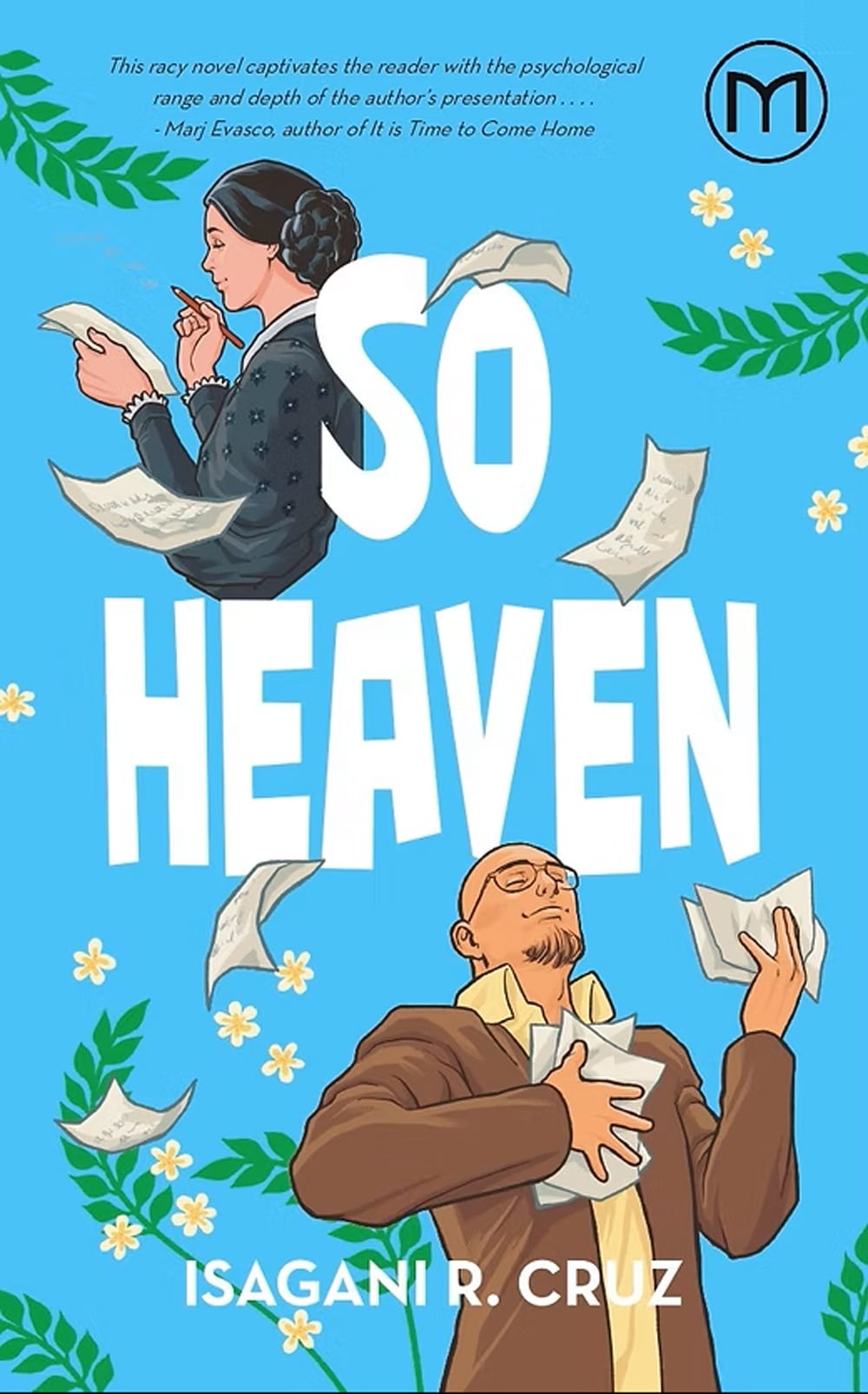
So Heaven by Isagani R. Cruz represents an entirely different mode of novel-making, one that abandons the ethical seriousness of Isabela and The Solemn Lantern Maker in favor of satire and metafiction, playfulness and provocation, the deliberate flouting of realist conventions in favor of a comedy of ideas populated by figures both contemporary and historical. Cruz is a significant figure in Philippine literary criticism—Professor Emeritus, founding chair of the Manila Critics Circle (now the Filipino Critics Circle), a scholar whose critical essays have earned praise from figures including Fredric Jameson—and So Heaven reads in part as a senior writer’s deliberate provocation, a novel that refuses the pieties of both realist fiction and political earnestness in favor of a tonal register that includes the bawdy, the irreverent, the deliberately outrageous.
The novel follows Danny Livingstone, a wealthy publishing magnate who has done everything, slept with everyone (men and women both), achieved mastery in every domain from chess to polo to amateur boxing, invented ear-based computer systems that made him a zillionaire, and who finds himself, after death, in a heaven populated by figures including Rizal (as “Joe”), Dickinson (as “Emily”), Shakespeare (as “Bill”), and a shape-shifting omniscient deity referred to as “Lord” whose pronouncements on everything from the nature of eternity to the cure for cancer structure the novel’s philosophical enterprise. The premise—that heaven exists and that it includes everyone, that Rizal and Dickinson and Shakespeare converse as old friends, that the Lord appears variously as man or woman to deliver wisdom that often sounds like cosmic punchlines—operates through accumulation and excess, through the multiplication of perspectives (each character gets chapters as narrator) and the deliberate collision of registers.
Cruz is not the first Filipino novelist to use the afterlife as setting—Alfred Yuson’s Great Philippine Jungle Energy Café (1988), which Francisco Arcellana called “the great comic Filipino novel,” imagines a “wild cafe in the mountains” where heroes gather after death, populated by figures as various as Muhammad Ali, Rasputin, Juan Luna, and Dame Edith Sitwell. In a delicious irony, Cruz himself appears as a character in Yuson’s afterlife, where “arch-critic Isagani Cruz stared strongly and quizzically” at the protagonist. Now Cruz has written his own version, turning heaven into a space for extended meditation on literature, creativity, national heroism, sexuality, and the nature of belief itself. The literary elements are substantial—the Shakespeare authorship debate receives serious treatment, Dickinson’s poems appear and are discussed with the attention of a scholar who has spent decades teaching literature, the question of how texts reach readers and what happens to them along the way animates several subplots. Joe/Rizal dispenses observations on Philippine nationalism, on his own canonization, on the gap between who he was and who the nation has made him. The multiple narrators—Danny, Annie, Christine, George, Faith, Joe, Emily, Bill—create a polyphonic structure that prevents any single perspective from dominating.
The novel’s engagement with sexuality deserves attention: Danny’s encounters with both men and women are rendered with frankness, and the novel’s concluding revelation—that female ejaculate contains the cure for cancer, presented as divine wisdom discovered through the character Annie’s research—gestures toward something transgressive, a refusal of the shame that typically surrounds discussions of women’s bodies and sexuality. Whether this revelation lands as liberatory or merely provocative will depend on the reader; Cruz seems less interested in resolving this ambiguity than in producing it, in forcing readers to confront their own discomfort with sexuality rendered comically rather than solemnly.
But satire requires velocity, and So Heaven too often lingers in scenes that have made their point, extends conversations that have exhausted their comic potential, allows subplots to meander when tighter construction would have served the material better. The heaven sections, with their endless discussions among literary figures, can feel more like graduate seminar than novel, the ideas interesting but the dramatic tension slack. The earth sections, involving Danny’s various relatives and associates navigating their lives after his death, provide narrative momentum but sometimes feel disconnected from the metaphysical comedy that is the novel’s primary mode. The literary elements remain largely decorative, never generating the intellectual pressure that might make them feel necessary rather than merely entertaining. Rizal as “Joe” dispenses advice that rarely rises above the platitudinous; Dickinson as “Emily” remains more concept than character, her famous reclusiveness translated into heaven without being transformed by it.
The novel demonstrates that Cruz is capable of writing a comic novel in English, can handle multiple perspectives and extended philosophical dialogue, has earned through a lifetime of scholarship the right to be playful with the figures and texts he has studied. What the novel does not finally demonstrate is why this particular comic novel needed to exist in this particular form at this particular length—what it contributes to Philippine literature beyond the claim that such a novel is possible, that a senior Filipino writer can write heaven as farce and populate it with figures from multiple literary traditions. This is not nothing; the claiming of registers and possibilities has value. But the novel leaves the reader wishing it had pushed harder, had found the structure that would make its provocations cohere into something more than a series of entertaining scenes, had discovered what it wanted to say about literature and heaven and sexuality and death beyond the observation that all of these things are more complicated and more funny than we usually admit.
The Weather of Leaving and the Climate of Staying
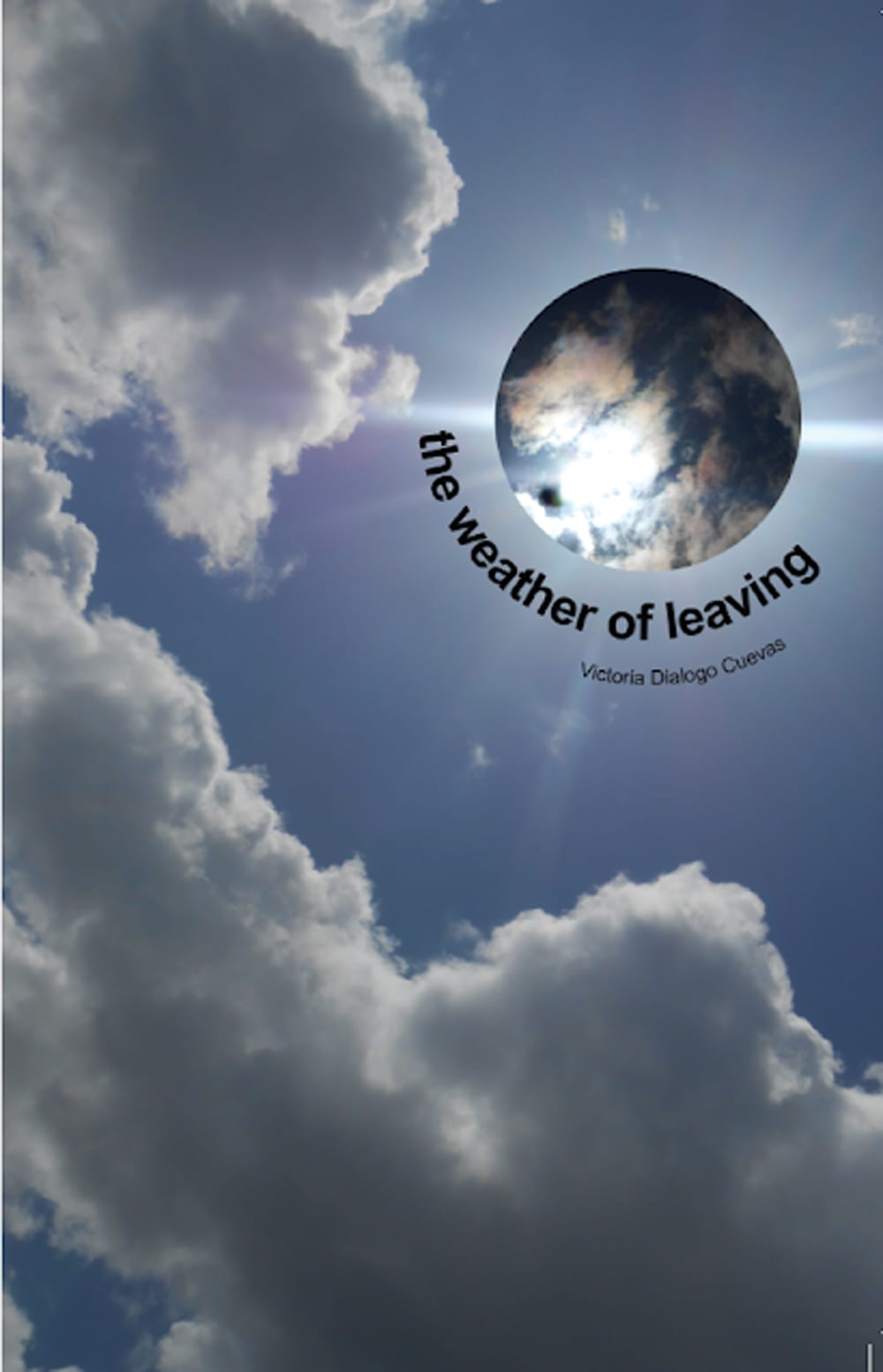
The Weather of Leaving by Victoria Dialogo Cuevas is the most formally varied of the five finalists, and perhaps the most difficult to assess by conventional criteria, because it deliberately refuses conventional criteria, refuses to be a novel in any sense that the term typically implies, refuses narrative continuity, character development, realist representation, in favor of a structure that might better be called an assemblage, a constellation, a collection of forms held together by recurrent preoccupations rather than by plot or protagonist. The author is a nineteen-year-old scholar at the Philippine High School for the Arts, and this is her thesis project, and these facts matter not as excuses for whatever limitations the work displays but as context for understanding what she is attempting: a young writer testing how far she can push form, discovering through the act of composition what structures might serve the material that haunts her.
The book is organized around a central situation—a young woman whose mother left thirteen years and almost six months ago (the precision matters, the counting matters, the fact that she is still counting matters), who is now meeting her mother for the first time on the morning of her older sister’s wedding, in a seafood restaurant—but this situation is approached through an extraordinary variety of textual forms: writing prompts on how to write about the weather, fragments, poems, dictionary definitions, film descriptions, short stories in versions with and without dialogue, song lyrics with extensive annotations, fairy tales, wedding speeches, todo lists, stage plays, screenplays, interview transcripts, a “climate change assessment,” and finally photographs of the sky with text overlaid. The weather functions as both subject and method: talking about the weather is what people do when they cannot talk about what actually matters, when the real questions are too painful to ask directly.
The same scene—daughter meeting mother at the seafood restaurant—appears as short story, as stage play, as screenplay, as interview transcript, and each formal frame reveals something different about the encounter. The screenplay’s directions to actors (“her hands nervously clutching her handkerchief before putting it back to her bag as soon as she sits down”) visualize an interiority that the stage play’s dialogue must imply through rhythm and silence. The interview transcript’s artificiality exposes the performativity of conversation that the short story naturalizes. The dictionary definition of “Tuesday”—the day the mother left, the day the sister is getting married, the day of their meeting—allows the word to accumulate meanings that no narrative summary could provide: “I was almost named Tuesday, but I was born a day earlier.”
The annotations to the song lyrics represent an effective strategy. A song about “things left in your old apartment” becomes occasion for meditations on the shelf life of canned corn (“It takes three to five years for a can of corn to expire. This establishes that the apartment has been empty for about more or less the same amount of years”), on the “suspension bridge effect” in which fear is transformed into desire, on the etymology of Tuesday as named for the Norse god of law and justice, on the fact that it never snows in the Philippines and never will. These annotations have the quality of obsessive attention, of a mind that fills silence with research because it cannot fill it with conversation, and this quality precisely matches the narrator’s situation: she has been holding on to her mother’s departure for thirteen years and almost six months, and the counting, the researching, the formal variety are all ways of approaching what cannot be approached directly.
The writing prompts that open the book—“To write about the weather, we must see the sky, and to see the sky, we must not look at the sun”—establish a method that the rest of the work will follow: indirection as a way of approaching what cannot be faced head-on. “If you cannot describe the sky accurately, write about the sun instead. If you cannot write about the sun, write about the people. If the people are gone, write about how they left.” This is not merely clever; it enacts what the book understands about loss—that certain kinds of grief can only be written about by writing about something else, that the mother’s departure can only be approached through questions about the weather, through dictionary definitions, through annotations to a song about an empty apartment.
The fairy tale embedded in the text—“The Lonely King and His Garden”—tells of a boy who becomes a man who never wants to love like his father because he doesn’t want to leave like his father. His father took care of the garden, and when the father dies, “vines aimlessly hang on the fences and corpses of flowers piled up on the cracked soil.” To tend the garden would require checking the weather, and checking the weather would make him like his father, so he goes everywhere except the garden—until he meets his wife, fixes the garden to give her flowers, has two daughters, and then she leaves, and the garden dies again, and he stops going outside at all. This allegory illuminates the narrator’s father without explaining him, suggests the depth of damage that the mother’s departure caused to everyone who remained, without reducing that damage to psychological case study. The form—fairy tale—allows distance, allows approach.
The work is perhaps too short to fully develop the emotional complexity it identifies—the relationship with the boy who once lived in the apartment next door is gestured toward but never explored, the father’s isolation is registered but not investigated. The formal variety sometimes reads as abundance for its own sake rather than as necessity. The photographs of the sky that conclude the book, while visually striking, do not quite provide the culmination that the accumulating structure seems to promise. But these are the limitations of a first work, a thesis project, a writer still discovering her voice—and the voice that emerges, even incompletely, is genuine and distinctive, capable of finding forms that enact meaning rather than merely stating it. The acknowledgments thank Makoto Shinkai for making Weathering with You and “being an inspiration to take on the concept of weather as words,” and this influence is visible throughout: the book understands that weather is not backdrop but structure, not setting but condition, not metaphor but material reality that determines what kinds of life are possible in any given place at any given time.
The Cost of Carrying and On What Remains
What, then, do these five finalists tell us about the Philippine novel in English in 2024? They tell us that the form remains contested, that there is no consensus about what the novel should be or do, that writers are pursuing radically different projects with radically different aesthetic commitments. The young adult novel coexists with the revolutionary testimonial, satire with lyrical realism, experimental assemblage with more conventional narrative structures. The novel in English continues to attract writers across generations—from Cruz’s senior provocation to Cuevas’s thesis project—and the form remains capacious enough to accommodate their different ambitions, their different accounts of what persists and what is lost.
Of the five, two novels emerge as most successful at what the Philippine novel in English might achieve in this moment—Isabela and The Weather of Leaving—and their success, taken together, suggests something about the possibilities and responsibilities of the form at this historical juncture. Consider: one novel addresses the collective, the political, the armed struggle that has persisted for half a century in the mountains; the other addresses the private, the familial, the abandonment of a single mother that has shaped a single daughter’s life for thirteen years. One novel spans three decades of revolutionary history and multiplies its protagonists into a chorus; the other contracts time into the hours before a wedding and focuses its attention on a single consciousness. One is written by a novelist named after Cagayan and Isabela, whose acknowledgments speak of parents and their “comrades,” who writes from within a history she calls “yours to tell”; the other is written by a nineteen-year-old student at the Philippine High School for the Arts, producing her thesis project. These are not the same kind of novel. They are not even the same kind of ambition.
And yet both novels arrive at a similar recognition: that certain experiences resist direct narration, that the inherited conventions of realist fiction—linear chronology, consistent point of view, the steady accumulation of scenes toward resolution—may not be adequate to their particular materials. These are not new recognitions; modernist writers arrived at them a century ago. What matters is that Aquino and Cuevas have taken up the challenge rather than defaulting to safer choices. Ka Julia’s wounded consciousness becomes the frame through which other women’s voices flicker; the daughter’s obsessive counting becomes the occasion for dictionary definitions and annotated lyrics and fairy tales. Both novels understand that to write about what cannot be faced head-on, one must write about something else—the other women who are also you, the weather that stands in for the departure you cannot name.
What does it mean that the most successful novels come from writers whose relationship to the form is shaped by particular inheritances and urgencies? Aquino writes from deep connection to Isabela and from proximity to the revolutionary tradition that her acknowledgments gesture toward without fully disclosing. Cuevas writes from adolescence, from a generation that has grown up in the shadow of departures—OFW parents, broken families, climate anxiety, the sense that the forms inherited from previous generations may not be adequate to the crises of this one. Both are producing novels that are difficult in productive ways, that demand readers willing to be disoriented, that refuse the consolations of conventional narrative in favor of structures that more honestly represent the experiences they are trying to hold.
The other three novels have their merits. Extra Time serves its young adult audience with competence and care, provides a rare example of the sports novel in Philippine literature, handles illness and mortality with the gentleness that its readers deserve. The Solemn Lantern Maker demonstrates what a mature artist can achieve when lyrical attention meets ethical seriousness, returns to Philippine readers a novel that the conditions of its publication had kept from them. So Heaven claims for the Philippine novel a register of playfulness that counters excessive earnestness, reminds us that literature can be funny even when it is serious. But the question that drives assessment is not only which novels are good but which novels take risks commensurate with their materials, which novels attempt difficulty rather than settling for competence.
In my earlier essay on the finalists for Best Novel in Filipino, I argued that the novel remembers what the nation forgets—that the present is not natural or inevitable, that it was made by decisions that could have been made differently. The novels in English face a different burden: they must remember not only what the nation forgets but also what the language they are writing in has been used to make us forget. English in the Philippines carries the weight of colonial education, of class distinction, of departure toward the metropole. To write the Philippine novel in English is already to be caught in contradictions that the novel in Filipino does not face in quite the same way. The most successful novels in English, I want to suggest, are those that make these contradictions productive rather than paralyzing, that find in the tensions of language choice the energy for formal ambition, that use the novel’s capaciousness to hold what the nation and the language would prefer to leave behind. What unites Isabela and The Weather of Leaving is their willingness to take on difficult material and to reach for structures that might hold it. This is what the Philippine novel in English needs: the patient work of engaging experiences the nation would prefer to forget. The war that continues in the mountains. The departures that continue to shape every family. The cost that someone is always counting, and what remains when the counting is done.
Edgar Calabia Samar is Associate Professor and Chair of the Department of Filipino at Ateneo de Manila University. He is the author of the award-winning Janus Silang series and of several other novels, including Teorya ng Unang Panahon, a Palanca and National Book Award winner currently being translated into English as Theory of a Long Time Ago by PEN Presents x International Booker Prize winner Christian Benitez, under a National Book Development Board translation grant. His first novel, Walong Diwata ng Pagkahulog, received the NCCA Writer’s Prize in 2005, and its English translation, Eight Muses of the Fall, was longlisted for the 2009 Man Asian Literary Prize. He previously served as Visiting Professor at Osaka University from 2017 to 2022 and as Writer in Residence at the University of Iowa in 2010. He is the incoming Head of the National Committee on Literary Arts of the National Commission for Culture and the Arts and a member of the Filipino Critics Circle, formerly the Manila Critics Circle, the Filipinas Institute of Translation, and LIRA, where he served as President from 2001 to 2003. In 2024, he received the S.E.A. Write Award from the Royal Family of Thailand for his contributions to Southeast Asian literatures. He develops literature and novel-writing guides and maintains a growing Filipino komiks archive through Santinakpan Otherwise on patreon.com/ecsamar.
READ MORE:
What the Novel Remembers When the Nation Forgets
The Doorway That Speaks Both Ways: 'Potiki' and the Threshold as Resistance
The Road That Only Descends: 'Pedro Páramo' and the Threshold You Cannot Uncross
Edgar Calabia Samar is an award-winning poet, critic, and novelist, and an Associate Professor at Ateneo de Manila University. IG: @ecsamar.
View More Articles About: