Chasing (Michelin) Stars: Filipino Fine Dining Today
Filipino chefs are reinventing tradition, blending street flavors, nostalgia, and bold innovation to put the country’s cuisine on the global stage.
Published on Feb 7, 2026
It’s Michelin star-chasing time for Filipino restaurants. Late last year, I walked into Chef Patrick Gabon’s and Celine Wuu’s Restaurant Naides in San Francisco’s Nob Hill. We were the first diners to ever walk through their doors, and I’m a proud supporter. With his background in New Nordic cuisine, Gabon was unashamed to cook an aggressively sour and fermented version of our food.
A Filipino fine dining restaurant in California was long overdue, said Gabon, and the inclusion of Filipino restaurants in the Michelin Guide in Manila and Cebu only reinforced that conviction.
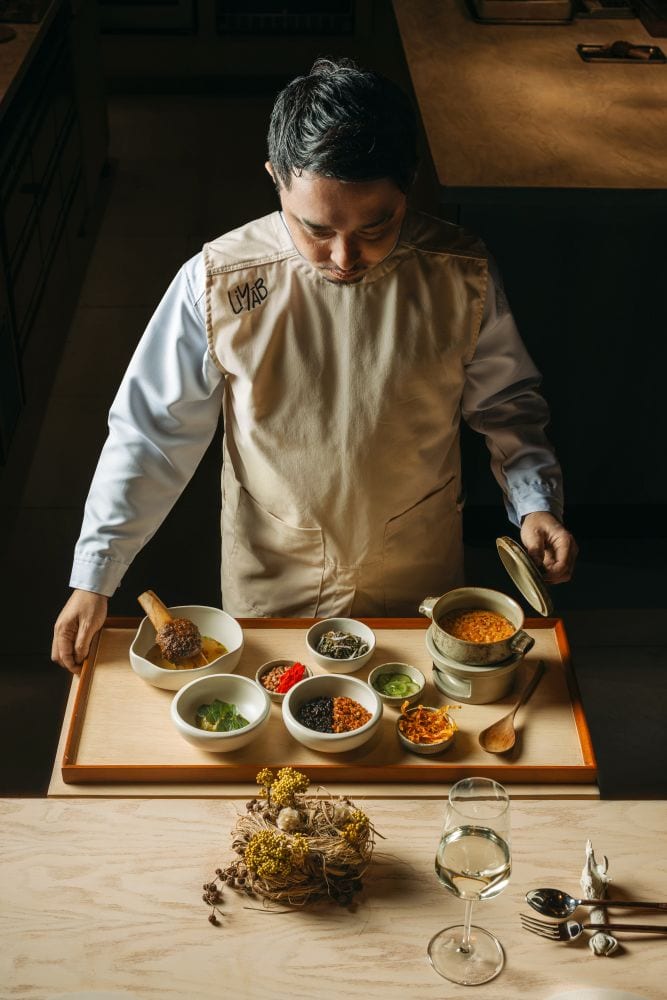
In Manila itself, new tasting menu restaurants opened in time for the holiday season. Since they are not yet on the Michelin Guide, tables were a bit easier to snag. Charles Montañez’s Liyab is his take on traditional open-fire cooking. Meanwhile, Kevin Uy’s Flow investigates the “culinary biomes” shared by the Philippines and Peru.
There is no single canon defining Filipino fine dining. Unlike Japan, with its long Kaiseki tradition, no history constrains or informs what Filipino chefs can put in dishes. And while the Michelin Guide is notorious for its European biases, it does seem open to a diversity of approaches to Filipino food, from the high modernism of the El Bulli-trained Chele Gonzalez to the almost Nordic localism of Don Baldosano’s Linamnam.
With very few crutches and clichés, there’s much room for creativity and innovation. Yet the Michelin-style tasting menu (degustación, say the titas) is a luxury product. And luxury may sit uneasily with the history of Filipino food and present class differences.
At no other time has Filipino fine dining been so vibrant. Something similar could have happened during the late Marcos period. In the 1970s and early 1980s, Via Mare’s Glenda Barretto created a possible blueprint for Filipino fine dining. But the economic collapse of the 1980s—our worst crisis since the Japanese occupation—destroyed demand.
It’s no surprise that the new wave of fine dining restaurants comes after the high growth/high inequality years of the late Arroyo to early Duterte presidencies. When pioneering restaurants like Toyo Eatery, Gallery by Chele, and Metiz began to appear, they were working off a mostly blank slate.
Soon, these restaurants established ways of structuring menus that are increasingly familiar. Most of Jordy Navarra’s early menus at Toyo had a gulay, kilaw, and ihaw courses. And fine dining reverence for the humble barbecue on a stick must be credited to him. At Naides, the “tusok-tusok” course consists of pineapple-sweetened grilled duck leg and thigh, a dish that reminded me both of Filipino street barbecue and Mexican street al pastor. At Liyab, Montañez most explicitly pays tribute to street food-style protein-on-a-stick with a course of squid balls, tawilis, and his own take on the pork barbecue.
Where Naides leaned slightly traditional (which it isn’t), it was in the kinilaw course, where the acid was conveyed by fermented coconut juice, while pine oil provided a Californian nod. At Flow, kinilaw was simply Lima ceviche made in Manila with ingredients common to both capitals: guyabano and kamote. There was no blending of cultures in the dish; the two places were just on the plate.
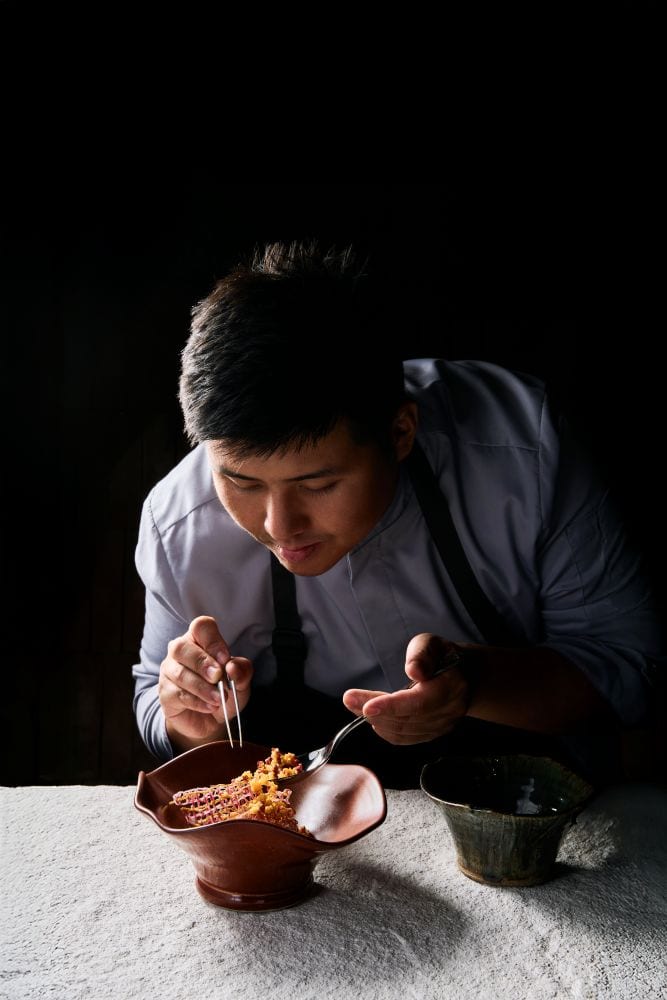
Flow’s Uy rightly rejects the word “fusion” to describe his food. To fuse two things assumes that they were separate. But the Philippines and Peru—especially their capital cities—were once part of a common space that early modern historians have started to call the Spanish Pacific. At the height of the Spanish empire, the two capitals were tied through the migration of people and goods, most crucially a common silver currency that forged a shared economic and cultural space.
Look closely enough, and this Spanish Pacific may still be found in our wet markets, where Uy sources his yacon, a root crop also known as the Peruvian ground apple. At Flow, he creates a final dish made almost exclusively from this tuber. The flesh crunched like apple pie filling, yacon cream calmed pickled yacon, and a yacon syrup oozed like sweet marmite.
If the yacon dish is forward-looking, it is also nostalgic—a look back at Uy’s travels and recent education. I’ve read many food influencers refer to recent menus as “highly personal.” Perhaps what they are detecting is a penchant for the nostalgic recreation of food memories. Montañez likes to call his opening soup a “bougie bulalo,” meant to remind guests of trips to Tagaytay.
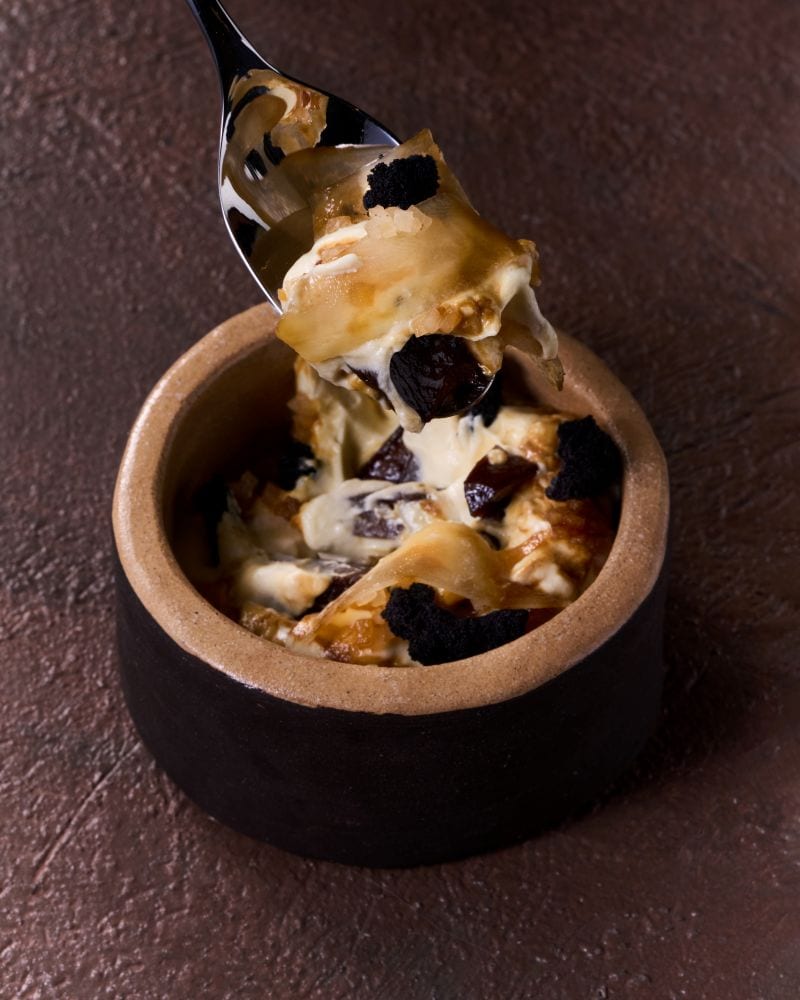
At Naides, the bread course, which included chicken liver, chicken sisig, and pan de sal brioche, was a recreation of his father’s breakfasts. Indeed, many migrant Filipinos bought canned liver spread (probably Purefoods) from Asian groceries to spread on their soft rolls. At Liyab, pastry chef Hannah Quiatchon’s pop rocks were made to taste like strawberry-flavored crushed ice, and brownies like Brown Cow or Hershey’s syrup. The result was an iskrambol (or ice scramble), the dessert grade school kids ate after dismissal in the 1990s.
The diversity of nostalgic food memories reflects various Pinoy experiences, particularly of the middle class, which has expanded in the post-EDSA years. This class—because it provides the creative energy and the clientele—is why we have a vibrant fine dining scene. And its diversity—urban, rural, new wealth, old wealth (fueled by various forms of migration) —is why this scene feels so exciting.
Unlike other fine dining scenes, the Pinoy version is not tied to a courtly or royal culture like the French or our Thai neighbors. It is, thus, a thoroughly bourgeois affair. The profusion of fine dining restaurants is culinary proof of how assertive our bourgeois is. But this same profusion amid poverty is, in turn, culinary proof of our country’s inequality. We are so far away from Denmark, where a construction worker could conceivably save up for a meal at Noma.
Our fine dining scene is therefore distinctly 21st-century Filipino—one where the best culture is perched on society’s contradictions. The Filipino chef speaks to a Filipino public, yet does so within the constraints of aristocratic patronage, where cultural work is sustained by those who can afford to consume. This is neither a moral nor an aesthetic failing. Rather, it is the dilemma of all artists. And the Filipino Michelin-hunting chef is, unmistakably, an artist.
READ MORE
Meet the Philippines’ First Michelin-Starred Restaurants
How to Make a Killer Tartare Like a Michelin-Starred Chef
DOT Pushes to Institutionalize Michelin Guide Presence in the Philippines
Lisandro E. Claudio is an Associate Professor of Southeast Asian Studies, the University of California, Berkeley.
View More Articles About: