Beyond Strawberries: The Women Leading Benguet’s Cacao Revolution
In the high elevations of Tublay, cacao trees have been bearing fruit for generations.

Published on Mar 10, 2026
“All the cacao trees in the region came to Asia via the Philippines. Now, there are award-winning single-origin chocolates from not only the Philippines but also Taiwan, Vietnam, Indonesia, and Thailand,” said Aliya Sartbayeva-Peleo, Assistant Professor at the University of the Philippines Diliman. Her areas of interest include biopolitics, international norms and development, and agriculture.
Cacao (scientific name: Theobroma cacao, where “theobroma” means “food of the gods”) can be traced back to the Mayans and Aztecs of Mesoamerica. It was a gift of the Manila-Acapulco galleon trade, and its first arrival on Philippine shores can be traced to about the year 1670. Through that long route, not only people and their property, but a variety of food was transported between Asia and the Americas, then to Europe, and back.
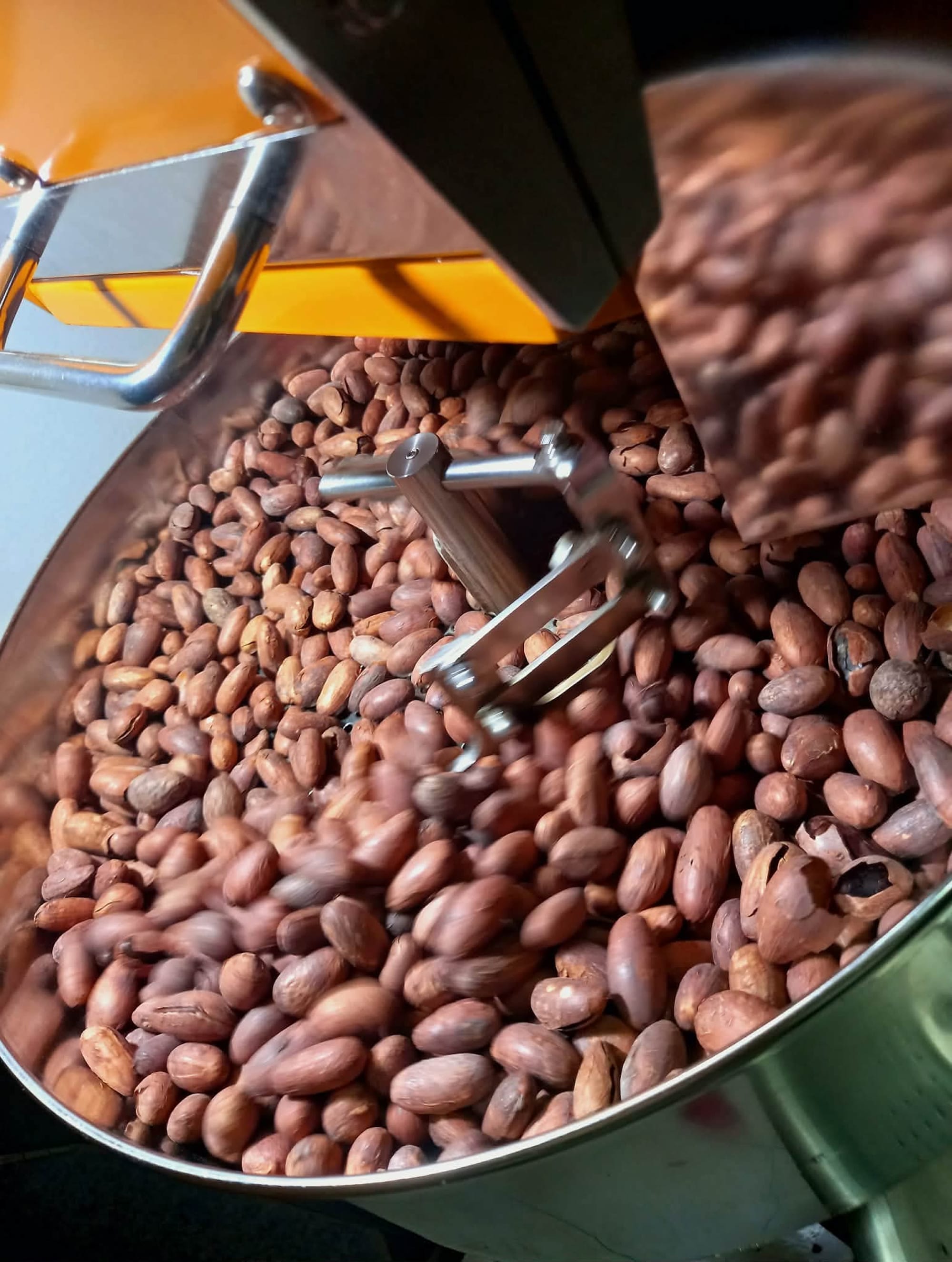
“In Asia, only the Philippines has a culture of drinking hot chocolate,” said Sartbayeva-Peleo. For that, we use Philippine tablea, formed by roasting fermented and dried cacao beans, then grinding and forming them into discs, sometimes adding sugar. To make traditional hot chocolate, tablea is boiled in water, then whisked in a chocolatera (metal pitcher) with a molinilo (wooden whisk), resulting in a frothy drink.
Cacao in the Countryside
Today, 80 percent of the cacao produced in the Philippines comes from Davao, while in the Cordillera region, Apayao and Kalinga are the top producers. Ninety percent of the cacao cultivated in the Philippines is a cross between the trinitario variety and the prized criollo variety.
In the high elevations of Tublay, Benguet (located about 250 kms from Manila), there are centuries-old cacao trees, most of them criollo, which have been bearing fruit for families over generations.
As children, Maria Teresa Larines, secretary of CGaPTA, and her friends would take ripe cacao fruit from neighborhood trees and snack on them. “We just ate the fruit and discarded the beans,” she said. “Once, my grandfather sun-dried some cacao beans, roasted them, then ground them, mixed them with hot water and sugar for us to drink. He didn’t ferment the beans at all,” she said.
Better Beans from the Mountains
During the First Cordilleran Chocolate Festival held in February 2024, Armi Garcia of the Philippine Cacao Industry Association and the Philippine Cacao Industry Council said that the region has the potential to grow high-quality cacao because higher elevation (between 800 and 1,000 meters above sea level) is a contributory factor to better taste and aroma. In some areas of Tublay, they are grown at up to 1,400 masl.
Based on official records, there are 50 hectares planted with cacao by more than 400 cacao growers in the region, in backyard farms.
Members of the Cacao Growers and Processors Tublay Association (CGaPTA) were organized in December 2021 with 45 members. But only 10 are currently active, with nine of them all women. Dr. John Tinoyan is the association's president.
They have since received some material assistance and undergone training from government agencies (Department of Agriculture, Department of Trade and Industry) and educational institutions (Benguet State University and Saint Louis University) for cacao growing and processing.
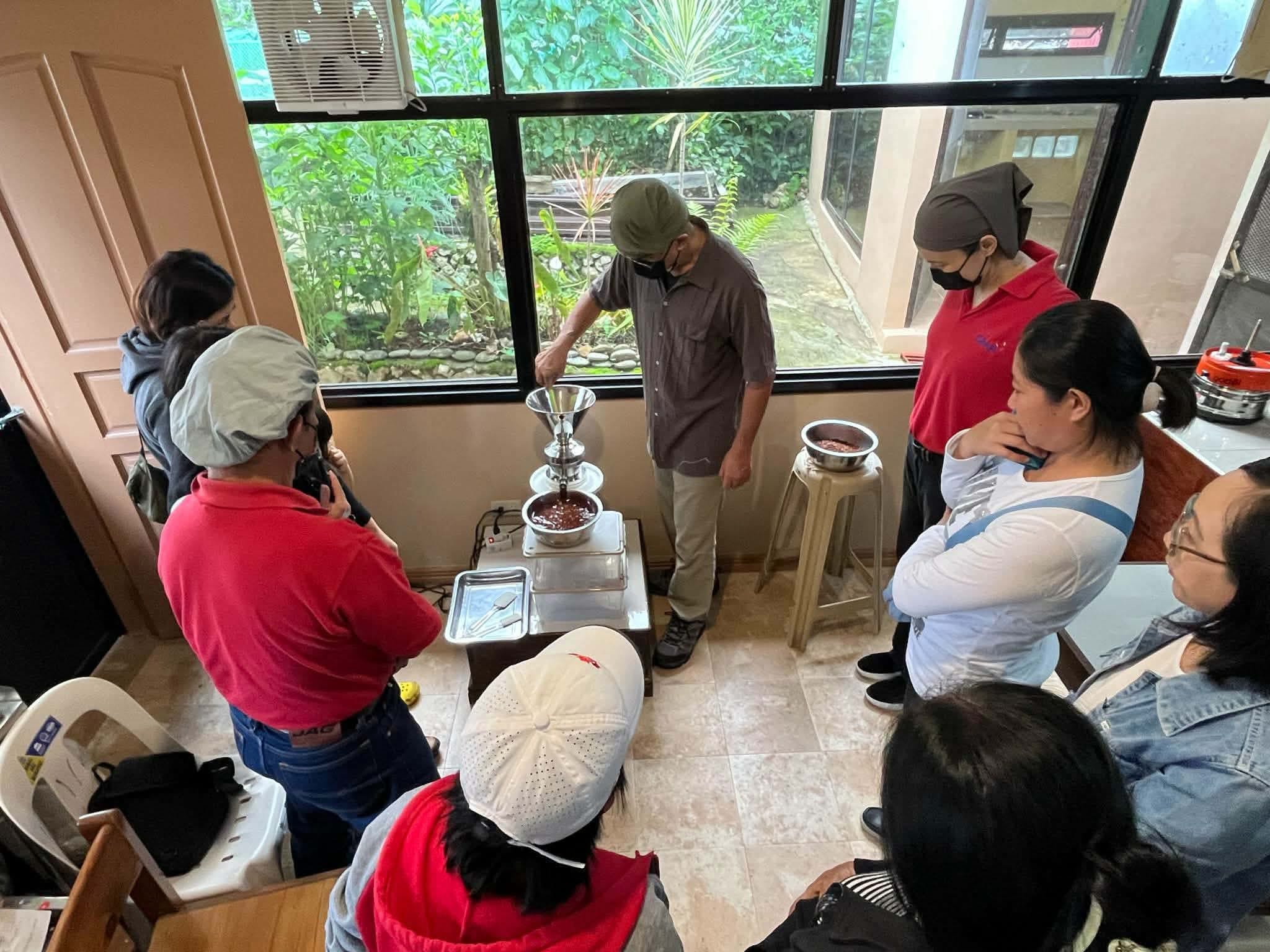
It was through one of these training sessions that the group met Sartbayeva-Peleo and her husband, Amador IV, who has undergone several training programs on all things coffee and cacao. They, in turn, shared their knowledge with members of CGaPTA, who have subsequently sold them their fermented and dried beans in small batches–between five and 10 kgs at a time. According to Larines, they appreciate that Wyldwood pays them a fair market price for their beans.
The yield, though, is far from ideal. Tublay is trailing behind its neighbors, Tuba, Kapangan, and Itogon, in terms of cacao production.
Livable Income From Smallholder Farms
According to Sartbayeva-Peleo, the problem is structural and systemic. “The Department of Agriculture requires the farmers to grow more and more. The Department of Trade and Industry wants processors to produce more and more and sell them. This type of assembly line production process might work for mass production, but not for small-scale farmers. Commercial farming is not sustainable. But smallholder farmers can actually take on the roles of grower, processor, and brand owner, as we have seen in Taiwan.”
While completing her PhD at the Institute of China and Asia-Pacific Studies of the National Sun Yat-Sen University in Taiwan, Sartbayeva-Peleo met coffee and cacao farmers in Taiwan as well as in Benguet. In Taiwan, it is common to see two-person teams working a half-hectare parcel of land planted with cacao trees. “If farmers occupy the whole value chain, you don’t need much land; you can have a livable income out of half a hectare.”
That being said, what about the market? The Peleos comprise the entrepreneurial team behind Wyldwood Coffee and Cacao, a microroastery they run out of their home in Hillside, Baguio City. They supply single-origin coffee beans and cacao for hot chocolate to Hot Cat Cafe (also located in Baguio) and to direct buyers.
“We don’t have a physical store, so we can manage our overhead expenses. Plus, our margins are very low because we're not here to make a lot of money,” she said. The couple considers it a social enterprise. “I have a lot of difficulty with the rhetoric of ‘helping farmers’. They don't need help; they just need to be paid a fair price and treated as human beings who need to maintain a certain quality of life. That way, they will be motivated to continue farming.” Cacao, after all, is a commodity that is traded on the New York Mercantile Exchange (NYMEX) and the Intercontinental Exchange (ICE) in London.
In 2016, then Benguet Governor Crescencio Pacalso advocated for cacao-growing in the province, distributing cacao seedlings from Davao and holding a series of training sessions for farmers. But the farmers found no market for cacao at that time.
“It’s hard to encourage people to cultivate cacao because they can’t see the value…yet,” Larines said. Since they have to earn a living for their daily expenses, many farmers have prioritized growing high-value crops like vegetables. But they can grow cacao alongside coconuts, bananas, and coffee, too.
Women Helping Women
Their baptism by fire was during a pop-up at local Baguio hangout Ebai’s Cafe & Pastry, located right at Upper Session Road in Baguio City. Cafe owner Lucia Catanes was looking for cacao seedlings to plant in Winaca Farm, also located in Tublay, to cultivate and eventually create single-origin chocolates to sell in Canada.
She and Janet Eque, a CGaPTA member, met at the end of 2024. As they got to talking, Janet shared that CGaPTA members had just finished their hands-on training on processing their cacao beans into tablea and chocolates, and needed a space to sell them.
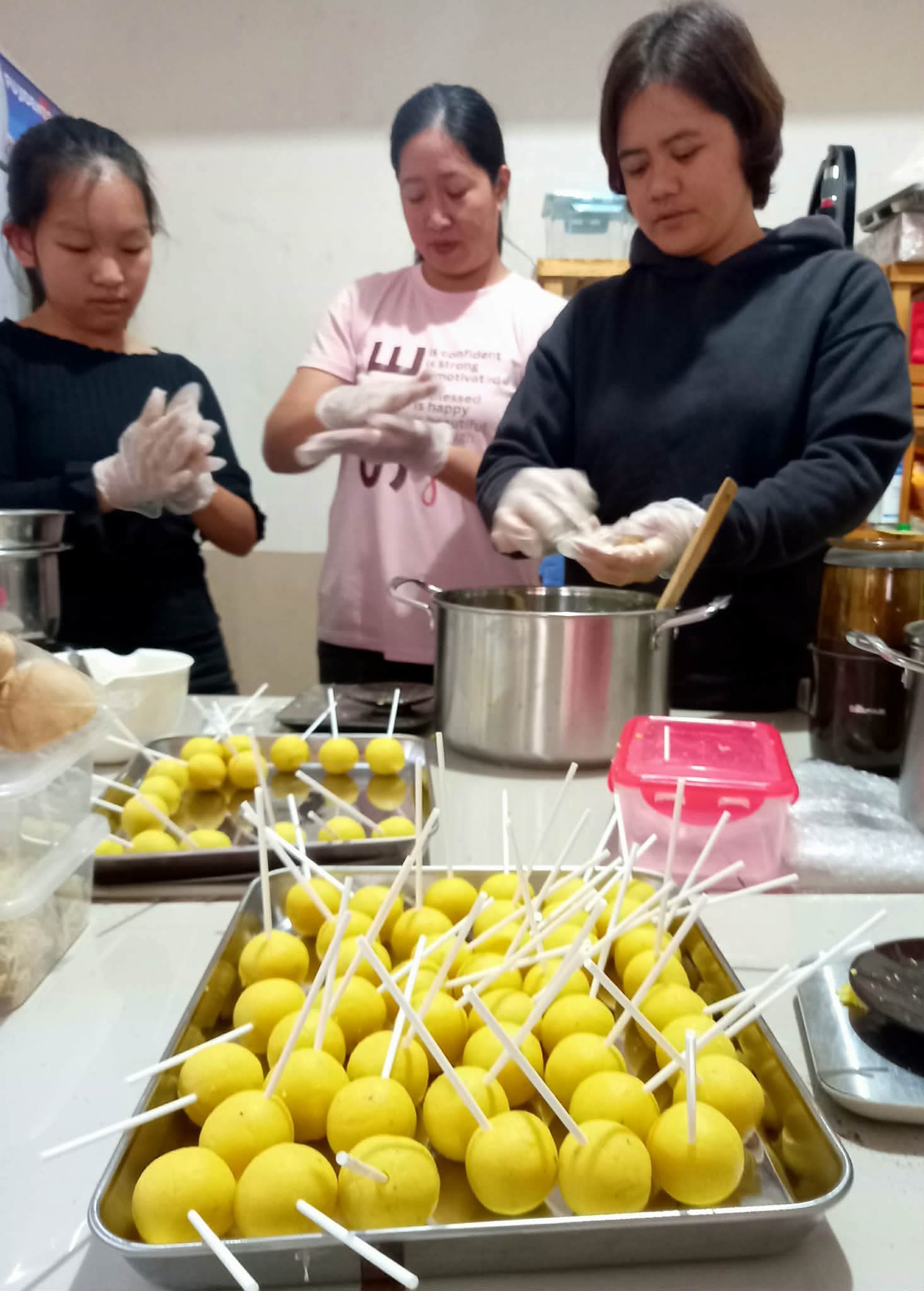
Catanes agreed to host their pop-up on December 20 and 21, 2025. There, they sold handmade tablea and kamote truffles. The idea for the kamote truffles came from a local merienda, mashed cassava, that one of the members, Tresia Sabino, brought to one of their meetings. Amador researched whether it was possible to coat them in local chocolate. He found out that they made something similar in South America. After a process of experimentation, through trial and error and by applying what they learned, the women came up with the kamote truffle.
Sabino had harvested 5 kgs of kamote (sweet potatoes) from her backyard at that time. Together, the women made about 70 pieces of truffles from it. Kamote was selling at only P80 per kilo at that time. They sold each kamote truffle at P30 per piece. They even had to close early on the second day because they had already sold all their stocks–proving that processing agricultural produce adds (monetary) value to it. They are planning to duplicate the event this month, still at Ebai’s.
The goal now is to encourage more CGaPTA members to plant more cacao trees in the members’ backyards–they have taken turns to help do so in each other’s farms. “We cannot compete with the likes of the farms in Mindanao in terms of volume,” Larines said. “So we will concentrate on producing high-quality cacao beans grown at our favorably high elevation.”
Long Way to Go
In many countries in South America, cacao is considered part of their heritage and there are programs to preserve and protect cacao trees.
“We sell our cacao for a low price to buyers from abroad. Then, they add sugar and artificial flavors, and sell it back to us for a higher price!” Sartbayeva-Peleo lamented. By focusing on single origin–that is, citing precisely who made it, how it was processed, and where it is from–farmers get the credit (and earn the income) that their hard work deserves.
By nurturing cacao farmers and supporting them, hopefully, cacao from the Cordilleras will reach its full potential soon.
ALSO READ:
The 12-Year Secret: What Does It Really Take to Create a Grain of Rice?
These Women Farmers Are Changing the Future of Eating
Mari-An authored Star of Samar, which documents a private sector effort to deploy more than 200 boats to fisher-communities in Samar post-typhoon Haiyan/Yolanda.
View More Articles About: