JL Burgos’ 'Ganggang' and the Fragile World of Young Filipino Schoolboys
The coming-of-age drama premiered at the 22nd Cinemalaya Philippine Independent Film Festival held in August 2026.
Published on Sep 7, 2026
This is the world that remains in our time: the widespread violence that instills fear, the continuously collapsing society and education sector, the endless conflict in the countryside, and the ongoing intimidation of farmers and civilians in rural areas by the military. And in the midst of all this, the destruction of the innocence and minds of the youth as they experience their daily lives. More so, as they go through their formative years, when their consciousness is being shaped.
In JL Burgos’ new film Ganggang, the narrative centers on three young friends: Ilay (Kenneth Vincent Mendoza), a child of the desaparecidos; Ten-ten (Don Rishmond Cerbito), a farmer's child; and Mel (Raine Dela Cruz), the son of a military officer. Together, they face and navigate their childhood amidst a newly developing bond and a shared desire to finally defeat the school bully, Anton (Prince Nathaniel España), in a spider-fighting game. From this perspective, the film dissects the awakening to not only the contradiction and distribution of power, but also the escalating military violence directed at the farmers and teachers in Barangay Sidhaya.
The film presents three facets of the dynamic of power. The first is its emergence inside the school through the game of ganggang, where spiders from two opposing sides fight. In this way, power exists among children like Ilay, Ten-ten, Mel, and their schoolmates. Here, they realize the concept of the strong and the weak: whoever wins gains the upper hand, while whoever loses becomes the weak one and faces ridicule.
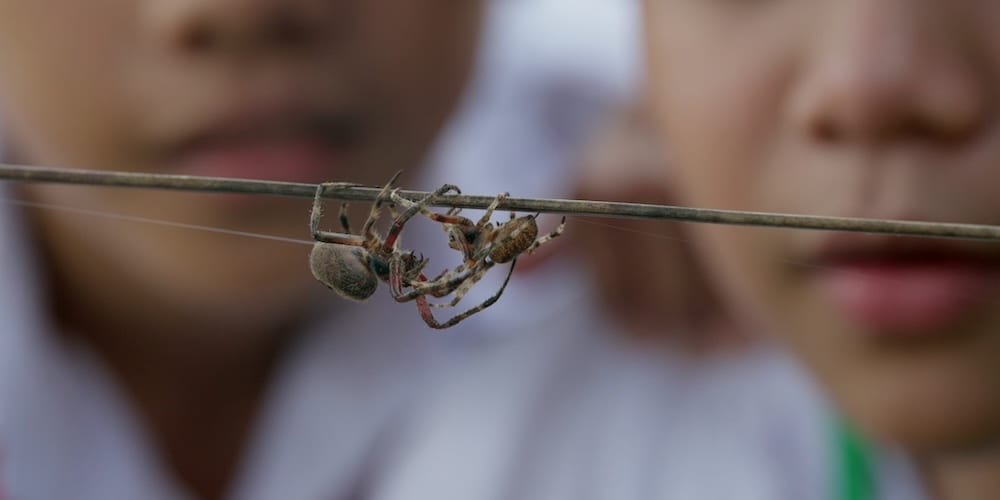
This seems simple enough, especially since this perspective comes from the point of view of young characters; however, looking more closely at it reveals that the contradiction in this distribution of power is already ingrained in the youth at a very young age. In school, which serves as their second home, these power dynamics frequently emerge: the institution (the school)—by extension, the teachers—holds the higher authority and directs the flow of power, while the students act as subordinates who are taught what is "right" and "wrong" to shape their character.
The inside of the house also gives face to the dynamics of power. In one anxiety-inducing scene (especially under the premise of them getting caught by the military, which later resulted in a mourning), Ilay, Ten-ten, and Mel sneak out in the middle of the night, disobeying their parents to look for a spider to pit against Anton's. Even though the parents repeatedly remind Ilay and Ten-ten of the danger, they still choose not to obey. The scene highlights their sense of agency, even while society dictates that the elders hold greater authority.
Within this dynamic, the tenderness of parental care and worry takes place, even as the young characters' desires and independent choices prevail against their parents' orders. Furthermore, this dynamic is also evident in the scene between Mel and her military father; despite knowing he holds a privileged position of power, Mel still cannot escape the brutal cruelty of his father.
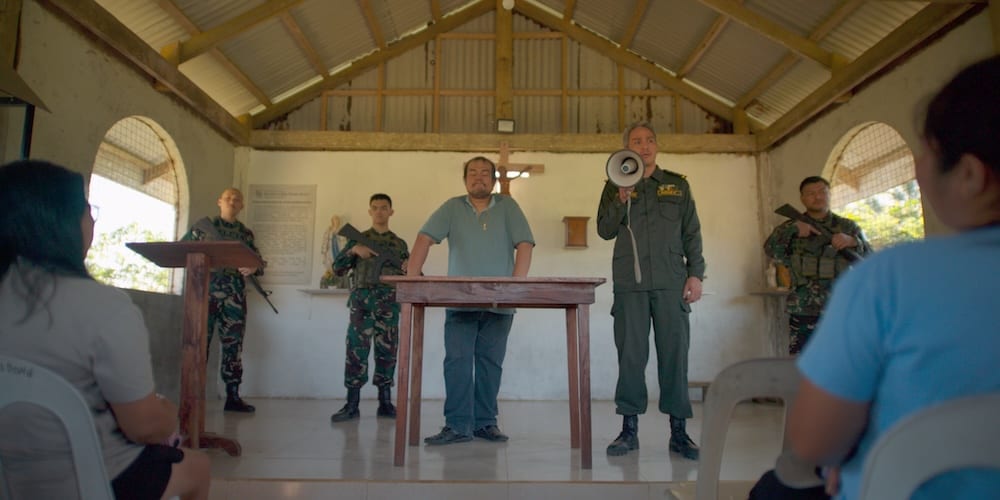
Finally, this manifests within the very society in which the characters revolve. At this point, Ilay, Ten-ten, and Mel are no longer the only victims of power and agency disparities. It encompasses the entire village, where armed military forces—capable of taking lives and twisting narratives to escape punishment—hold sway over their very existence. This interplay of power gains further complexity because the military aligns with the administration and enjoys backing from those even higher up than them, while the residents of Barangay Sidhaya rely solely on their own assertion to resist military oppression. The dynamic of power seems one-way at this junction, but over time, contestation emerges as acts of resistance, disobedience, and speaking truth to power heighten the ultimate power of collectivity.
Therefore, one infers that the coaction of power examined by the film is not merely passive; rather, it is actively shaped and contested to test its limits, particularly in how it unfolds from the perspective of the Ilay, Ten-ten, and Mel. In this manner, the different species of spiders become a metaphor for power, where the strongest are those found and captured in the deep recesses of the forest (a detail that hints at a scene in the post-credits of the film).
Interesting too, at this moment to observe how the film dissects the interplay of this power in a didactic manner. The film immediately presents its conflict all at once through its dialogues. What the workers should get, and why they are fighting. What the military is like and why they are the problem. And why it is just to resist all forms of violence and censorship. Further, while the film explains itself, it guides the viewers straight to the root of its conflict.
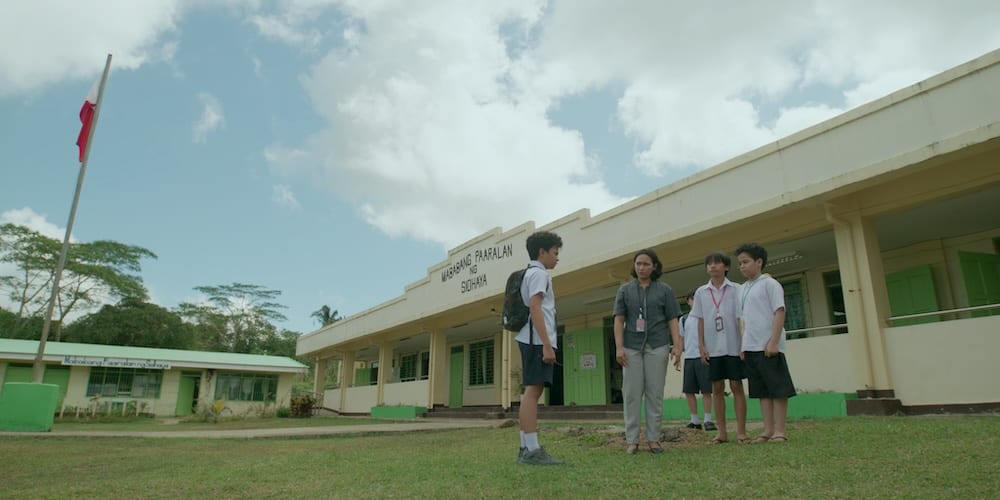
Elora Españo’s performance as Ma'am Rebelyn (who explicitly rebels against the deception and false sense of security provided by the military to the residents of Barangay Sidhaya) brings to life an emotional appeal, showing the audience just how vile and shameless the military's manipulation of the people in Barangay Sidhaya is.
It is also notable how the camera supplements the film's narrative progression. The stillness and restraint of the camera stand in sharp contrast to the chaotic and terrifying world navigated by Ilay, Ten-ten, Mel, and the entire Barangay Sidhaya under military control. The camera no longer functions as surveillance, as the space itself is already filled with those watching their every move.
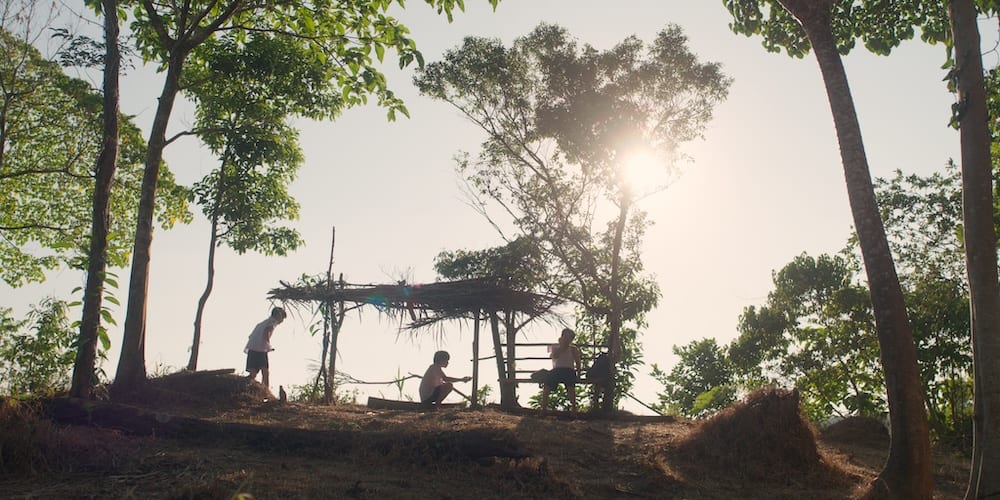
The camera, too, serves as a bridge that allows each scene to linger. Not only on the characters' emotions, but also on the vastness of the land that sustains, and is sustained by, the people of Barangay Sidhaya. It also acts as a vehicle to show the audience why the land is so desperately sought after, and what stands to be lost for the farmers.
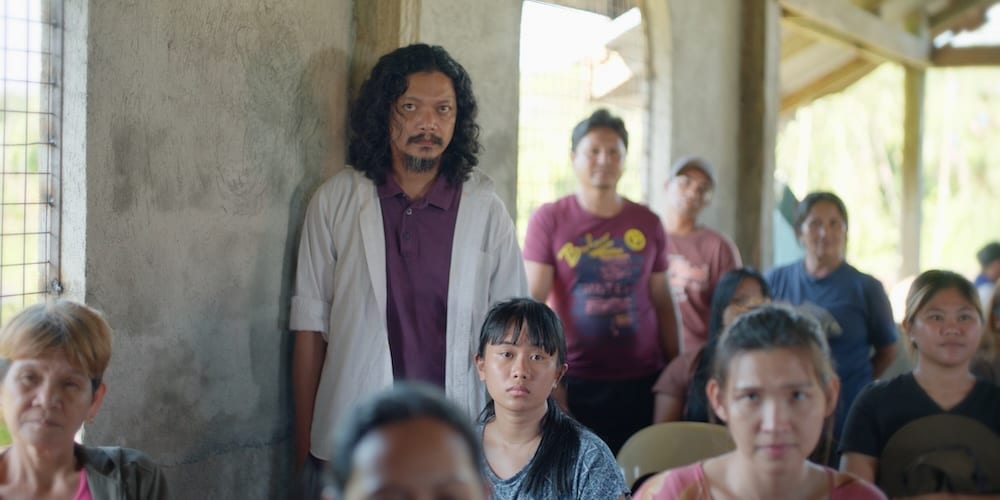
As I think about it, the film's didactic nature is not entirely a problem, because taking a clear stand on who deserves support is precisely what our time demands. The film answers this unequivocally: support belongs to the farmers themselves, to the activists who continuously resist amid state violence against them. Given that reality itself is uncompromising, the film is entirely justified in taking the same direct approach.
Beyond all of these, what truly emphasizes the world built by the film is what actually occurs outside of it. In recent months, school shootings have been frequently happening within the very schools that ought to serve as second homes for the youth. There is also the horrifying fate that befell the Negros 19 at the hands of the military, which includes among the casualties civilians such as Alyssa Alano, Maureen Santuyo, Errol Wendel—whose body has still not been returned to this day—and community journalist RJ Ledesma.
Additionally, the fate of Ma'am Rebelyn is not merely confined to the film. Rather, it has already occurred in the country's history of violence. In 2022, volunteer teachers Chad Booc and Gelejurian Ngujo II, along with community health worker Elgyn Balonga and two drivers, died at the hands of the military in New Bataan, Davao de Oro. Additionally, in 2023, activist and indigenous people advocates, Dexter Capuyan and Gene Roz Jamil “Bazoo” de Jesus, were abducted in Taytay, Rizal, by armed men who presented themselves as part of the Philippine National Police and are still missing.
These familiarities are what linger with the audience, the realization that the characters' experiences pierce through the world built by the film. It is this very familiarity that JL Burgos utilizes to amplify his call to surface the desaparecidos, a narrative he navigates and emphasizes too in his documentary Alipato at Muog (which won the Special Jury Prize at the 2024 Cinemalaya Philippine Independent Film Festival), that centers on his brother Jonas Burgos, who is forcibly disappeared by the military in 2007, and their ongoing search for justice.
One can also hear the echo of what Bienvenido Lumbera emphasizes in his seminal book Revaluation 1997: Essays on Philippine Literature, Cinema, and Popular Culture, where film is not merely an amalgamation of sound and light but a social and cultural product that serves as a mode to shape the consciousness of the audience, deeply rooted in the social reality from which the film is born. It is in this pivotal note that the film situates its critique of Philippine politics. Thus, Ganggang also stands as a counter-narrative to the very disinformations surrounding struggle and resistance.
Ultimately, the film navigates its subject with care and understanding to emphasize what the necessary response must be as the military's oppressive forces persist in the countryside. When the institutions themselves fail to protect the land, taking up the call of the times becomes just. Because this is the world the film seeks to forge: a society that is just and free from all violence.
ALSO READ:
Giancarlo Abrahan's Mag-Iina Is a Gothic Answer to Kisapmata
Temporal Dreams in the Cinemalaya Short, Elenita Elena Elaine
Lorence Lozano is a film critic and cultural worker from the Philippines. Their interests lie at the intersection of gender, politics, and space within Southeast Asian cinema.
View More Articles About: