Apparently, Drumbeats Deepen Diplomatic Ties for Japan and South Korea
A fever dream-like, diplomacy-fueled K-Pop drum duet between Japanese Prime Minister Sanae Takaichi and South Korean President Lee Jae-myung was not on our 2026 bingo cards.

by JV Ordoñez
Published on Jan 15, 2026
Like a scene straight from a quirky anime show or even a satirical film, Japan and South Korea's heads of state engaged in a lighthearted drumming jam session in an offbeat type of diplomatic deepening measure. Their alliance is a key factor in the region that is threatened by China's stubborn assertiveness that has resulted in tightened exports of rare earths and dual-use goods to Japan.
An important tidbit of background to note is that Japanese Prime Minister Sanae Takaichi in her university years played in a heavy metal band and has been an avid fan of serious rock outfits such as Black Sabbath and Deep Purple, among others. Japan's "Iron Lady" sure knows how to lean into her Iron Maiden-esque drum chops, especially when crucial bilateral ties and regional dynamics are involved.
South Korean President Lee Jae Myung is a self-admitted novice when it comes to the sticks and had visited her Japanese counterpart's hometown of Nara for a summit before the now viral drum performance.
South Korean President Lee Jae Myung and Japanese Prime Minister Sanae Takaichi triumphantly raise their sticks to depeening bilateral ties
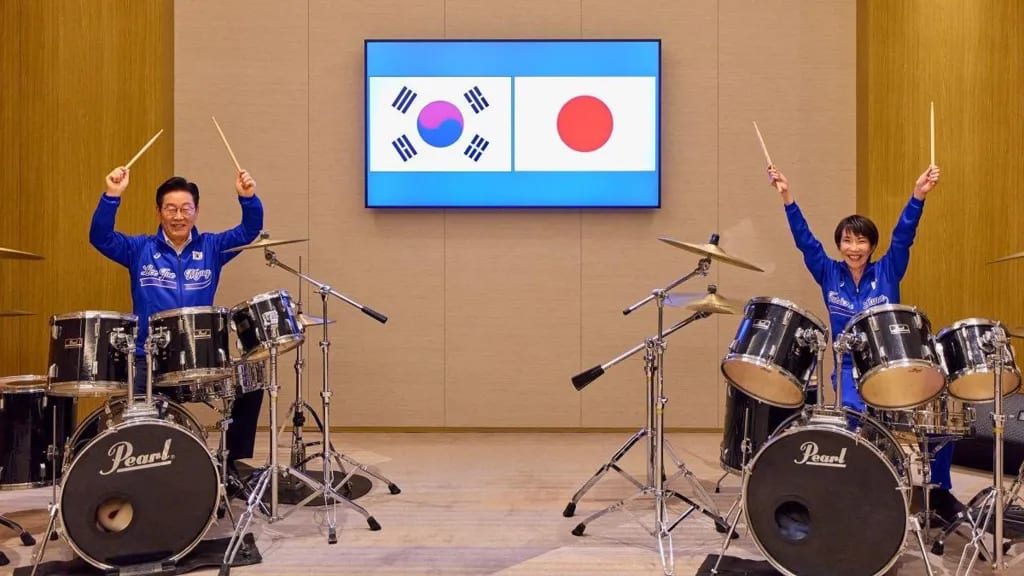
The South Korean President assessed his performance as "a little clumsy" in the video that has been making the rounds on social media.
Both world leaders wore matching blue jackets in drum performances of major K-pop hits such as "Dynamite" by BTS and the Grammy-nominated and chart-topping "Golden" from the hit Netflix series K-pop Demon Hunters.
"When we met at the Asia-Pacific Economic Cooperation last year, [Lee] said it was his dream to play the drums, so we prepared a surprise," the Japanese Prime Minister posted on X.
Tumultuous Times for the Region with Belligerent Beijing
These are tumultuous times for the region as China and Japan try to woo South Korea, with the rift catching fire when Takaichi said that a Chinese attack on self-ruled Taiwan could be considered a "survival-threatening situation," which would allow Japan to take military action. South Korea and Japan have quite the rough history dating back to the colonial period and the atrocities of World War II.
The meeting also came on the heels of Lee's meeting with Chinese President Xi Jinping in Beijing, the first time a South Korean leader visited China since 2019, clearly an attempt for Seoul to stabilize relations with the hegemon. "Although we have painful past experiences, it has been 60 years since the normalization of diplomatic relations between Korea and Japan, and we are starting a new 60 years," the South Korean President said during his opening speech at a summit in Takaichi's hometown of Nara.
China is doubling down on flexing its military might over areas of the South China Sea and Taiwan, which the superpower still sees as a renegade province and is keen on taking control over the island in due time, and if necessary, by force. Beijing has said it is keen on annexing the democratic island home to about 23 million people. It had also issued a bunch of travel advisories to its citizens about travelling to Japan and an unofficial ban on Japanese entertainment and a ban on Japanese seafood imports. Beijing had announced a ban on more than 800 dual-use goods to Japan.
Tokyo and Seoul are both key allies of Washington, another superpower that has its own trade war with Beijing over critical minerals and semiconductors. They have also backed the Philippines in calling out China's aggression in the South China Sea, calling on the international community to preserve a rules-based order in the region and to settle disputes peacefully. Although, things have been more volatile lately with the Trump administration's changing tariff schemes that could also affect trade dynamics between key players.
Lee and Takaichi's meeting resulted in a pledge to bolster economic cooperation amid the US worrying that Seoul would lean towards its largest trading partner, the belligerent Beijing. South Korea's leader has been treading the metaphorical tightrope meticulously among the global superpowers, with his recent rise to power being a relative question mark other than his firebrand reputation and his socialist economic leanings.
"Even if our timing was slightly different, our intention to find the same rhythm was shared," according to Lee's X post describing the drum duet. "In that same spirit, we will continue to build a future-oriented Korea–Japan relationship together, with one heart."
Where does Manila fit in?
The Philippines is also caught in between these global powerhouses, with Manila and its powerful neighbor engaging in skirmishes and air tussles over disputed features in the strategic South China Sea that sees about $3 trillion in trade passing through it every year.
Global actors such as the United Nations and its Permanent Court of Arbitration have voided China's so-called historical claim based on a 1940s map covering a seemingly arbitrary "nine-dash line." The Philippines has failed to enforce the ruling due to an imposing Chinese fishing and coast guard fleet.
Aside from the Philippines and China, Brunei, Malaysia, Taiwan, and Vietnam also have claims to parts of the South China Sea. Seoul is also a major trading and security partner of Manila, having already inked a key free trade agreement that is set to boost bilateral investments in lucrative sectors such as agriculture and automotives.
The East Asian nation has consistently participated in joint military exercises and visits with the Philippines as the Southeast Asian neighbor tries to build an international movement to deter China's vast military might in disputed maritime features.
Takaichi, who is a staunch conservative, is also expected to build on Tokyo and Manila's recently signed Reciprocal Access Agreement that will ease the entry of defense, military equipment, troops, and disaster response tools on each other's soil. This all unfolded as China continues to double down on its growing assertiveness backed by sweeping claims over the heavily disputed South China Sea and accompanying features.
So which beat will each key regional player follow? The security and economic stage is set for the Year of the Horse.
View More Articles About: