How Will Japan-PH Ties Fare Under First Female Prime Minister?

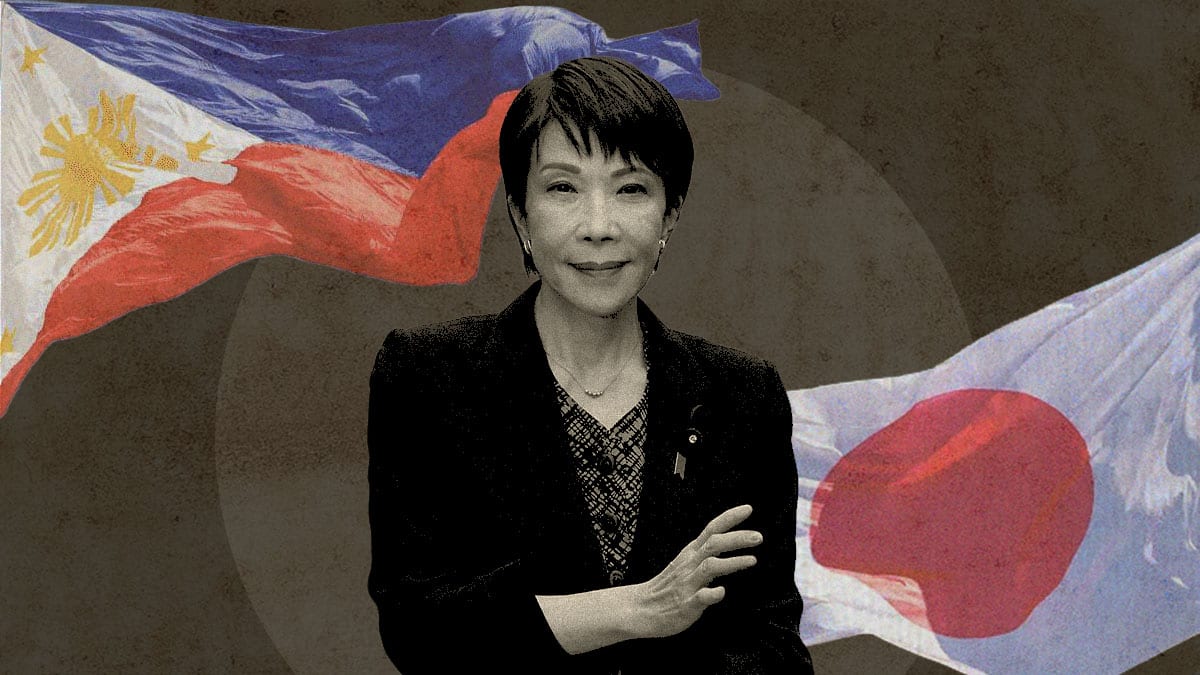
Japan has elected its first female Prime Minister who has decades of political experience under her belt. The 64-year old Sanae Takaichi is seen as a proverbial protégée of the country’s longest-serving prime minister, the late Shinzo Abe. Her landmark win sees her dealing with Japan’s high costs of living, plummeting government approval ratings, and scandals that her predecessors had to deal with.
With the dynamic and volatile geopolitical landscape in the Indo-Pacific region, the staunch conservative’s win begs the question of how this shapes Tokyo’s multi-dimensional relations with the Philippines against a backdrop of souring tensions with Beijing.
ALSO READ:
Japan Will Give All of its Citizens Nearly P50,000 Each For COVID-19 Relief
What The Japan-Philippines RAA Means For Our Ties With China
The stage is set for the fourth-largest economy in the world as Takaichi is expected to balance Tokyo’s precarious ties with South Korea, considering her right wing leanings, navigate delicate trade ties and defense ties with the Trump-led US, and carrying out her hawkish stance against an assertive hegemonic China.
She is also dubbed the “Iron Lady” on account of her firm conservative views and her admiration for the late United Kingdom Prime Minister Margaret Thatcher, who held the same moniker.
Defense relations between Japan, the Philippines, and their western ally the United States has flourished in the past year, forming a trilateral pact meant to keep the peace in the region, especially in the South China Sea.
Manila and Tokyo and their respective legislative bodies have ratified a Reciprocal Access Agreement (RAA), a military pact that eases the entry of defense, military equipment, troops, and disaster response tools on each other’s soil.
This all unfolded as China continues to double down on its growing assertiveness backed by sweeping claims over the heavily disputed South China Sea and accompanying features.
“The Takaichi administration, in line with its defense posture strategy, may explore the possibility of signing a mutual defense agreement with the Philippines or something along those lines,” Raphael Cortez, who teaches diplomacy and international relations at the De La Salle College of Saint Benilde School of Diplomacy and Governance, told Esquire Philippines in a Facebook Messenger chat. “This is because it is also in their interest to ensure that its allies—all facing the same threat—would be willing enough to adopt a deterring posture should the need arise.”
Cortez says that Manila should expect more talks on joint military and defense exercises with Tokyo to deter their neighbor’s aggression in the waterway.
To recall, the military pact between the allies is the first of its kind in Asia as the Philippines continues to beef up its defense capabilities to counter the persistent Chinese Coast Guard and fishing fleet forces from the global hegemon. The Southeast Asian nation has already set aside about P35 billion to upgrade its military in the next decade.
Nearly a decade ago, the Hague-based and United Nations-backed Permanent Court of Arbitration struck down China’s almost 80 percent claim over the South China Sea for lacking legal basis. Other Southeast Asian nations such as Malaysia, Indonesia, and Vietnam also have competing claims over the West Philippine Sea.
China’s claims are based on what it claims are 1940s maps that it sees as a historical basis. The waterway is seen as a crucial trade route as more than $3 trillion worth of global trade flows through it.
Manila has failed to enforce the ruling because of China’s vast fishing fleet and imposing coast guard vessels.
"Under Sanae Takaichi’s leadership, we will expect a proactive but conservative cooperation between Tokyo and Manila as we speed up the scale of the newly operationalized RAA," Chester Cabalza, founding president of the security think tank International Development and Security Cooperation, told Esquire Philippines in an interview. "Japan will assure its partners including the Philippines of a strategic framework in achieving a free and open Indo-Pacific through unwavering defense and diplomacy efforts in the region."
Beijing has built manmade islands on a few submerged features in the strategic sea, constructing runways, hangars, radar systems, and ports to maintain the country’s strong naval presence in the waterway.
“Given that we champion the same set of norms, including freedom of navigation, the way she will be managing the leadership position, which in turn will shape how Japan would act vis-a-vis the rest of the world, can help us out in promoting these norms and international fundamentals more,” Cortez said.
What Happens to Economic Ties Between Japan and Manila?
Takaichi is no stranger to managing Japan’s fiscal and trade policies, having previously served as minister of economic security. She favors an “Abenomics” approach to the economy, which is anchored on Japan’s central bank carrying out aggressive monetary easing, increased spending to stimulate the economy, and dynamic structural reforms.
Experts and pundits are expecting the country's first female Prime Minister to revive this school of thought on monterey policies. Abenomics is essentially a fusion of big fiscal spending and monetary easing.
For context on Japan partisan-politics, Takaichi won primarily by forming a new ruling bloc called Ishin, between her Liberal Democratic Party and the Japan Innovation Party. The partnership is backed by proposed policies that includes tax cuts, wealth distribution, and cutting bureaucratic red tape and the needless spending of public funds.
The new premier is expected to deploy a spending package that would cost more than her predecessor Shigeru Ishiba’s 13.9 trillion-yen plan crafted last year, global news wire service Reuters earlier reported.
So what should the Philippines keep an eye on as it tries to spur economic growth with its longtime-ally and largest development partner?
Sonny Africa, executive director of the think tank IBON Foundation, says the Philippines should take after Japan’s visible shift to a more assertive nationalist economic strategy and to cut dependence on official development assistance from its neighbor.
“Japan seeks to revitalize its domestic industrial base including through more government spending and easy monetary policy, greater public-private sector collaboration and screening of foreign investment, and wage growth astride tax cuts,” Africa said in a Viber message. “The concern is probably not so much that the volume of financial flows will fall but rather the Japanese nationalist restrictions on these flows which will limit the benefits for Philippine national economic development.”
The economist notes that the biggest danger is domestic in nature, warning that the Philippine government should avoid favoring a one-sided view on financial flows from Japan rather than developing local industries.
“The best adaptation of the Philippines to shifts in Japanese economic priorities is national industrialization policy, orienting the economy away from its dependence and asymmetrical integration in foreign- and Japanese-led production and finance networks,” Africa said.
Based on government data, Japan is still the Philippines’ largest development partner, with $13.23 billion in active commitments involving 82 projects.
Japanese credit watchdog Rating and Investment Information, Inc. has affirmed the Philippines’ investment-grade “A-” rating signifying a “stable” outlook due to steady economic growth.