Opinion: Lessons from Venezuela and Vietnam for the West Philippine Sea
International law does not fail because it is wrong; it fails because it is unenforceable without power.
by Atty. Camille Recalde, and Jan Emil Langomez
Published on Jan 22, 2026
Recent developments in global politics reveal a widening gap between public international law and the actual conduct of powerful states. On 4 November 2025, President Ferdinand “Bongbong” Marcos, Jr. directed the Armed Forces of the Philippines (AFP) to prepare for a hypothetical 30-day invasion and to strengthen the country’s capacity to defend itself independently, without immediate assistance from the United States (US), once the Mutual Defense Treaty is invoked.
A few months later, on 3 January 2026, the US, under President Donald Trump, launched Operation Absolute Resolve, which led to the successful extraction of Venezuelan President Nicolás Maduro. Trump justified this action by invoking the Monroe Doctrine, asserting US hegemony in the Americas.
Though far apart, these events reveal the same reality: Great Powers increasingly act based on strength and interest, not rules. The post-World War II “rules-based order” matters less when power is at stake.
The Philippines and its Transparency Initiative
Against this backdrop, the Philippines stands out for its heavy reliance on the “rules-based order” in dealing with China in the West Philippine Sea. Under President Marcos Jr., the Philippine government has adopted what scholars refer to as the Transparency Initiative, which documents and publicizes China’s actions to rally international support from like-minded states and reinforce China’s isolation by highlighting violations of the United Nations Convention on the Law of the Sea (UNCLOS) and the 2016 Arbitral Ruling in The Republic of the Philippines v. The People's Republic of China.
This strategy assumes that exposing China will impose reputational costs and pressure Beijing to follow international rules. In short, the Philippines believes that law, publicity, and moral high ground can restrain a Great Power. But the key question remains: does this still work in today’s world of Great Power politics?
Public International Law and the ‘Rules-Based Order’
Beyond UNCLOS and the 2016 Arbitral Award, which clarified the extent of the Philippines’ maritime entitlements and rejected China’s Nine-Dash Line, the Philippines’ territorial claims also trace their legal foundation to historic treaties, specifically the Treaty of Paris (1898) and the Treaty of Washington (1900). The Treaty of Paris affirmed the Philippine Archipelago as a cohesive political unit, following the end of Spanish colonial rule. The Treaty of Washington subsequently supplemented and clarified this framework by confirming that the Philippine national territory included islands not expressly listed in the Treaty of Paris, such as our claims in the Spratly Islands, thereby expanding and consolidating the country’s territorial and maritime scope.
These treaty-based foundations are expressly incorporated under the 1987 Philippine Constitution, which defines the national territory by referencing the terminology found in both treaties. Although the Philippines had not yet ratified UNCLOS at the time the 1987 Constitution was adopted, the constitutional text notably mirrors UNCLOS terminology and concepts. This alignment is unsurprising, as UNCLOS was already being drafted when the 1986 Constitutional Commission was framing the Constitution.
In law, the Philippines has a stronger claim. But geopolitics does not operate on law alone.
Lessons from Venezuela: When Law and Sovereignty Are Not Enough
Venezuela’s experience illustrates the limits of sovereignty and public international law when a state lacks credible deterrence and strategic leverage. Despite being a recognized sovereign state protected by the principles of non-intervention and sovereign equality under the United Nations Charter, Venezuela was unable to prevent decisive action by a Great Power once its interests were deemed threatened by US national security interests. International norms and customs proved insufficient when confronted with overwhelming military, economic, and political power.
More importantly, Venezuela demonstrates how dependence and isolation compound vulnerability. Years of economic decline, institutional weakening, and political pressure left Caracas with limited strategic partners willing or able to impose costs on external intervention. In fact, it is ironic that the day before President Maduro’s extraction by US Delta Force operatives, the Venezuelan president met with a Chinese delegation that pledged additional military and political support. Venezuela’s reliance on diplomatic customs without corresponding credible capabilities reduced international law to mere rhetoric rather than restraint.
For the Philippines, the Venezuelan case is a cautionary tale. A strong legal position, even one grounded strongly on public international law, does not guarantee protection if it is not reinforced by credible military capabilities, economic resilience, and diversified strategic relationships. Venezuela reminds us that public international law does not fail because it is wrong; it fails because it is unenforceable without power.
Right Makes Might in Geopolitics
In an ideal world, China would adhere to a “rules-based order.” For a time, Beijing was seen to be integrating itself with this liberal order, especially during the leadership of Chinese Paramount Leaders under Deng Xiaoping, Jiang Zemin, and Hu Jintao. This changed under President Xi Jinping. Under his Wolf Warrior Diplomacy, China began flexing its military and economic might through its assertive foreign policy and diplomatic posture. Beijing clearly understands that it is a Great Power, and therefore holds the upper hand in the disputed claims in the South China Sea not only against the Philippines, but also with other claimant and neighboring states.
In the West Philippine Sea, for instance, this includes the following military incidents, among others: (1) harassment by Chinese naval, coast guard, and maritime militia forces; (2) the 2012 Scarborough Shoal standoff; (3) the 2021 massing of vessels at Julian Felipe Reef; and (4) repeated water cannon attacks on Philippine resupply missions at Ayungin Shoal. Politically and diplomatically, China has also rejected the 2016 Arbitral Ruling as “null and void” and, economically, has used trade and investment as leverage to influence the Philippines. These actions show that China’s mix of hard and soft power has rendered “naming and shaming” alone ineffective, and may have even provoked a more assertive response on the part of Beijing.
The Philippines: ASEAN’s Strategic Outlier
Over the past decade, it is clear that among the member states of the Association of Southeast Asian Nations (ASEAN), the Philippines is the outlier in terms of its relative political alignment between China and the US. According to The Economist’s article assessing relative political alignment from 1995 to 2024, the Philippines is the only ASEAN country that overwhelmingly sides with Washington.
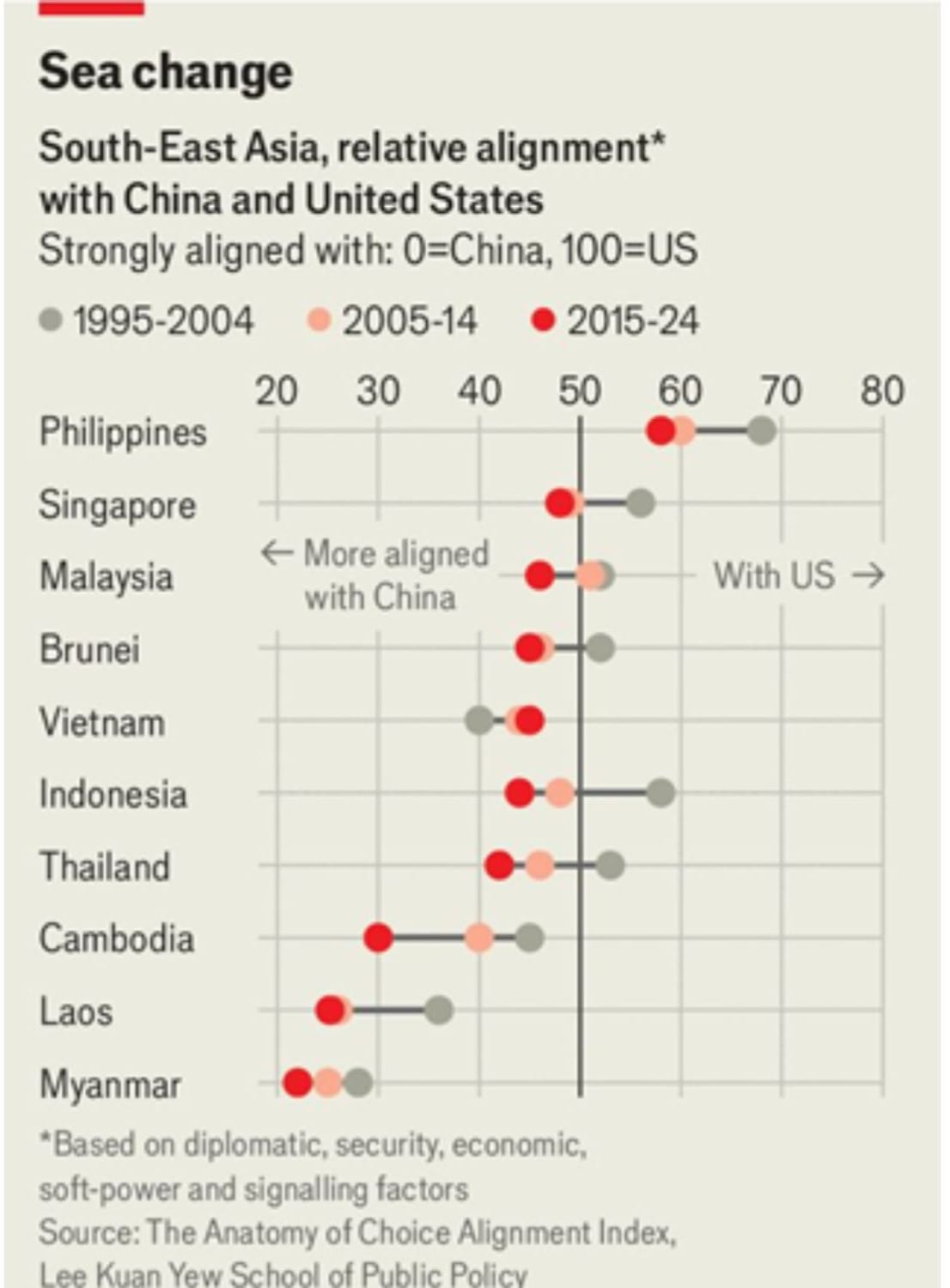
This is not surprising given that the Philippines is not only a treaty ally of Washington, but was also a former colony of the US. However, despite other Southeast Asian nations also being in dispute with China, our neighbors continue to build closer ties with Beijing. Even Vietnam, a nation-state that has had a short conflict against China in 1979, has sought a closer alignment with Beijing. Nonetheless, Vietnam has not relinquished its claims fully in the South China Sea. Rather, Hanoi continues to occupy even some of the features in disputed areas.
Lessons from Vietnam: Why Hanoi Succeeds Where Manila Struggles
Looking at Vietnam’s approach, there are two key factors why Hanoi has become more successful in balancing its relations with China. First, unlike the Philippines, Vietnam holds greater leverage in terms of military and economic strength. Vietnam’s military has had experience in engaging in conflict against China. According to the Lowy Institute Asia Power Index, which measures a country’s relative military strength, Vietnam ranks 12th in the Asia Pacific, with a score of 19.9. Meanwhile, the Philippines ranks 15th with a score of 15.2. In terms of economic strength, Vietnam is becoming an alternative global manufacturing hub compared to China. The Philippines continues to lag in manufacturing, with its economic output in 2025 falling as low as during the pandemic years. While the Philippines has the Mutual Defense Treaty with the US as its key leverage, this is mostly dependent on US commitment and resolve. Vietnam’s military and economic leverage are wholly its own, which it can utilize without much dependency on strategic partnerships. Second, former Prime Minister Lee Hsien Loong of Singapore emphasized that most Southeast Asian nation-states do not see China as an “existential threat.” If any, these nation-states view China more as a strategic partner.
To be fair, it is worth mentioning that the Philippines’ official foreign policy on China is similar on paper. Our foreign policy with China is hinged under the principle that the dispute in the West Philippine Sea is not the sum total of our engagement with Beijing. However, Vietnam succeeds because it has its own leverage. It has stronger military capabilities, a growing manufacturing-based economy, and less dependence on external security guarantees. The Philippines, by contrast, relies heavily on US commitments—commitments that ultimately depend on American political will.
Where Philippine Strategy Falls Incredibly Short
Despite diplomatic engagements, transparency efforts, and joint patrols with allies, the Philippines has made no real gains on the ground in the West Philippine Sea. This is despite both “de-escalation efforts” such as the Provisional Agreement on Ayungin or through utilizing our US alliance through regular joint patrols in the South China Sea. Alliances require concrete measures, and such are yet to fully materialize in light of the dispute in the West Philippine Sea. For instance, while the Philippines has agreed to expand the Enhanced Defense Cooperation Agreement (EDCA) with the US, the actual EDCA sites themselves have yet to be fully developed.
The Luzon Economic Corridor, an agreement among the Philippines, US, and Japan, meanwhile, has not seen much significant progress since its public announcement in 2024, possibly due to the previous US administration under President Biden. Although Washington, under President Trump, is said to have reaffirmed its prior commitments with the Philippines, it remains to be seen how such promises will be fully realized. Moreover, despite the push for the AFP Modernization Program, the pacing of this program has been too slow to be considered as a “catch-up” given the continued gap in capabilities on the part of the AFP. Latest acquisitions, such as the Malvar-class missile frigates and the next batch of FA-50s, are highly welcome, but these acquisitions were the result of years of delays in negotiations and procurement. The notoriety of Philippine procurement and the persistent lack of congressional funding support are the main causes of the significant delays concerning the AFP Modernization Program. A fact acknowledged by even the Secretary of National Defense himself, Gilbert Teodoro, which was highlighted during last year’s 2026 budget deliberations in the House of Representatives.
Meetings, statements, and agreements are not leverage. They only matter if backed by real capabilities.
Law Needs Power to Matter
To be clear, international law is on the Philippines’ side. It gives legitimacy to our claims and justifies our actions. But law without credible power cannot be enforced.
Venezuela’s experience shows that the “rules-based order” offers little protection when Great Powers decide otherwise. Vietnam’s experience shows that law works best when backed by genuine military and economic strength.
Transparency alone is not a strategy. Lawfare alone will not secure our seas.
Those in government, the academe, and in civil society who have put everything in the Transparency Initiative for the past three years should not be blinded by their own intellectual pride or, dare we say, hubris. If asserting our rights truly matters, then it is time to rethink our approach before law becomes nothing more than a footnote in a contest decided by Great Powers.
The real challenge for the Philippine government is this: Are we prepared to invest in real power—military, economic, and strategic—or will we continue to rely on moral victories while losing ground at sea?

View More Articles About: