The Picture Won’t Sit Still: On the Finalists for Best Graphic Novel and Comics in Filipino at the 43rd National Book Awards
The accomplishments of these books deserve to be distinguished, and their weaknesses considered without the compensatory politeness that sometimes accompanies the recognition of an emerging field.
Published on Oct 25, 2026
A fly occupies the opening pages of Vaughn Tan’s 11:30 to Baguio. It appears against a darkness that initially seems to contain almost nothing else, accompanied by the irritating noise of an insect whose movements we cannot actually hear, no matter how convincingly the letters suggest that we do. By the time we have moved several pages into the book, the fly has disappeared into a nighttime bus journey, and ordinary details have begun to accumulate: the rain hitting the road, passengers making themselves comfortable, a window through which the surrounding landscape is barely visible, a man who is trying to stay awake. Much later, after the book has subjected both this passenger and the reader to an ordeal of extraordinary duration, the insect returns. The same creature, or one resembling it closely enough that the difference cannot immediately be established, now belongs to a world that no longer seems capable of being understood through its earlier proportions. The fly has done almost nothing. Something has happened to the person looking at it.
I suspect this is one place to begin thinking about the five books selected as finalists for Best Graphic Novel and Comics in Filipino at the National Book Awards: 11:30 to Baguio by Vaughn Tan, Duty Ka Ba? Komiks 3 by Tepai Pascual, Elipsis by Ran Manansala and Jose T. Gamboa, Grade 3 by Doktor Karayom, and Lunatics by Russell L. Molina and Ace C. Enriquez. They were published in 2024, and they ask for radically different forms of attention. An insect in Tan’s book, an emergency-room worker’s expression in Pascual’s, the dots separating three lives in Elipsis, a child’s red-scratched body in Grade 3, a painting defaced or transformed in Lunatics: in each case, something visible acquires its meaning through its location among other images, often after the reader has already passed it.
But their placement within a literary award exposes an unfinished argument concerning what we recognize as literature. The difficulty cannot be settled through the familiar reassurance that comics are literature too. Such reassurance leaves intact an arrangement in which prose fiction confers prestige upon illustrated storytelling, as though a country that sustained a populous, inventive culture of serialized komiks for generations had to wait for the term graphic novel before its drawn narratives became artistically consequential. Francisco V. Coching and the many writers and artists whose work circulated in magazines and inexpensive publications were not merely preparing the ground for more respectable books. Their material conditions, audiences, rhythms of publication, and methods of pictorial storytelling formed a different, and substantial, literary economy.
Neither should the word literary become an exemption from the demands of comics. A sensitive script can be inadequately drawn; an astonishing drawing can interrupt rather than develop a story. In a page divided into frames, the artist has already determined what can be seen, yet the reader chooses how long to look and must infer what occurs in the spaces between. A fraction of a second may occupy several pages, while years can disappear in a single transition. The spatial organization of images redistributes time and therefore also redistributes knowledge: one character notices what another cannot, and the reader may know something that neither knows.
I want to attend as well to what changes when these sequences become books. A self-contained illustrated narrative must determine how its ending alters its beginning; a collection must give its episodes a relation more substantial than mere proximity; a third volume in a continuing series brings with it a community of readers and established expectations. The cost and circulation of such books also influence which formal ambitions can be sustained.
The following readings are neither a ranking nor an attempt to make the finalists satisfy a common theory. Their accomplishments deserve to be distinguished, and their weaknesses considered without the compensatory politeness that sometimes accompanies the recognition of an emerging field. Criticism might be most useful here when it discovers how a book’s strongest decisions expose the insufficiency of some of its others, and when that discrepancy allows us to imagine possibilities the work has opened without quite inhabiting.
11:30 to Baguio: The Passenger Who Returns to His Seat
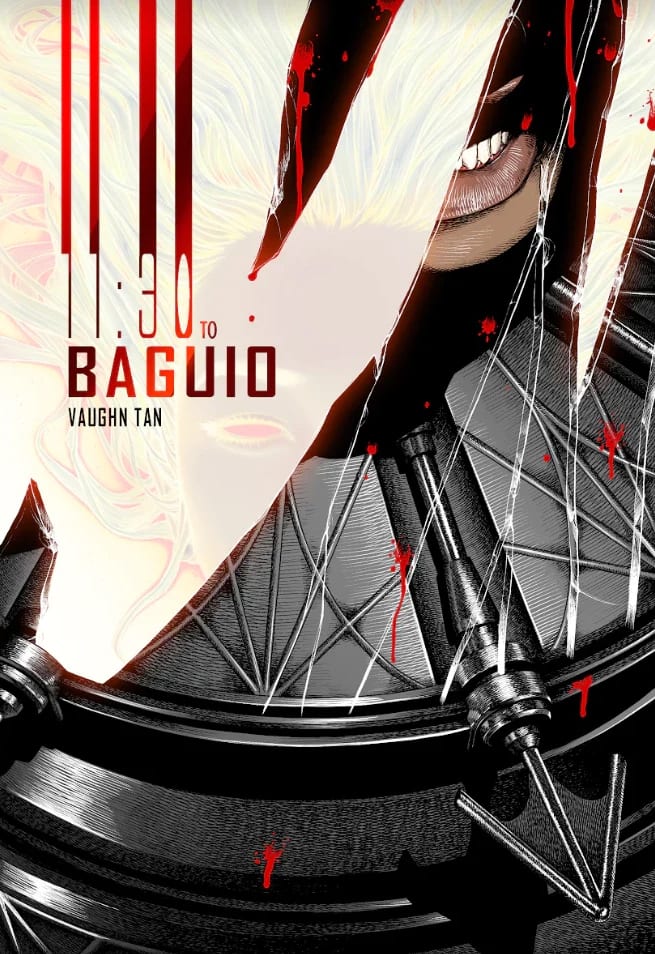
The most startling decision in Tan’s book is not the decision to bring its traveler into an impossible environment. It is the amount of time he is prepared to spend there, and the way the pages initially make that duration almost physically unreasonable. The bus, moving through mountain rain, is introduced with meticulous attention to mechanical and meteorological surfaces. Headlights illuminate a section of wet road; a road sign commands a turn; tires throw water; the interior gathers sleeping passengers into narrow rows. Mark, one of the passengers, is noticed through his eyes, his watch, his ear, and his proximity to a woman whose pregnant body will acquire an altogether different resonance later. They are ordinary means of identifying where a person is and how much of the surrounding world can enter his consciousness.
Then the book withdraws much of that world. Its pages break into black fields, isolated panels, repeated slivers of a face, and eruptions of red, green, and electric blue. The transition is exhilarating partly because it refuses to explain itself in advance. What appears to be an immense interior organism, populated by membranes, cavities, tendrils, and monstrous bodies, gradually replaces the bus’s comprehensible architecture. Mark moves through a space that seems to possess an anatomy rather than a geography. A luminous female figure appears; creatures confront him; elongated sequences of pursuit, combat, and bodily distortion occupy what would be an extravagantly disproportionate amount of ordinary narrative time.
Circular apertures recur; anatomical openings resemble tunnels; a protruding appendage changes scale from one frame to the next; the human face, previously an ordinary unit of recognition inside a passenger vehicle, becomes a precarious structure of eyes, teeth, and vulnerable flesh. Tan’s considerable technical skill lies in making the unfamiliar look textured enough to be encountered as matter. His most disorienting passages are not those in which a monster’s form is fully disclosed, but those in which a piece of it resembles the built environment sufficiently to make the difference uncertain.
The restriction of visual information is another source of power. Entire pages offer a fragment against blackness, requiring a reader accustomed to quickly identifying a scene to spend time reconstructing where the fragment might belong. Elsewhere, expanses of white make combatants appear terrifyingly small. Where a conventional thriller might reserve its longest sequences for exposition or the gradual accumulation of clues, Tan spends his pages on the bodily labor of perceiving and moving. Reading becomes slow because visibility itself has become difficult.
Yet there is a point at which this wager becomes vulnerable to its own accomplishment. Repeated grotesque confrontations can diminish the shock that made the first encounters effective. Once the reader has accepted that almost any part of this environment may develop teeth, limbs, or a predatory appetite, the uncertainty of what might appear next becomes less interesting than the question of what all this activity is changing. Several passages risk extending virtuoso physical action beyond the development of the emotional stakes. I do not think they can simply be excised, since the apparently excessive duration is central to the book’s unsettling experience of time. The issue is whether each prolongation alters our understanding of Mark or the space, or chiefly confirms that both remain in danger.
What makes the eventual return to the bus so important is that it gives this question a retrospective force. Passengers are waking, asking why the vehicle has stopped, looking for the driver, attempting to determine whether anything has occurred. Mark’s own recollection is radically out of proportion to the collective situation. The ordinary seats are again visible, but the body has become unreliable evidence: a mark around a neck, another passenger’s scar, and the disturbing recognition of what may have been carried across the interval complicate the apparent division between ordeal and awakening. The woman who was initially one more recognizable presence in the bus becomes implicated in this disturbance. What had seemed the realist opening of a fantastic excursion is now itself open to suspicion.
This second movement distinguishes the book from a technically accomplished demonstration of cosmic horror. A large part of what we have experienced may be inaccessible to everyone else inside the story. The reader possesses a memory that the surrounding characters cannot verify, and that asymmetry makes us less privileged than we might suppose. We can remember the earlier pages but cannot use them to establish what happened with certainty. At the end, when the fly reappears, its modest size makes the preceding extravagance more rather than less disturbing.
There is a specifically Philippine vulnerability in the premise, though not necessarily a disguised allegory waiting to be decoded. Passengers place themselves inside vehicles whose routes, maintenance, and pace are controlled by people and institutions beyond them; the promise of arrival depends upon other people’s work and upon roads increasingly exposed to severe weather. Tan begins with that familiar surrender of agency. The more difficult possibility he opens is that even a return to the recognizable does not restore the passenger’s confidence that their body belongs entirely to the world everyone else inhabits.
The book demonstrates how far Philippine graphic horror can be carried by the duration of looking. It also presents a problem that will matter beyond horror: when an artist can make virtually anything visible, the artistic decision of greatest consequence may be the determination of what the reader should never quite be allowed to see.
Duty Ka Ba? Komiks 3: An Emergency Room Full of Other People’s Stories

Tepai Pascual begins her third Duty Ka Ba? volume with a comic mechanism small enough to seem almost disposable. In “Putukan,” a conversation between a patient and a clinician turns on what the patient has meant by a word. Four panels hold essentially the same encounter, with the punch line arriving through clarification rather than action. A few pages later, “TT Things,” assembled around objects associated with unusual urological emergencies, makes another comic use of the distance between what bodies do and what people are prepared to say about them.
But anyone approaching Duty Ka Ba? Komiks 3, chiefly as an illustrated collection of emergency-room anecdotes, will discover a book increasingly occupied by something else. Its workers have elaborate lives outside consultation and treatment. They flirt, misunderstand, quarrel, conceal histories, seek affection, and develop relationships that the hospital’s professional labels cannot adequately describe. Character-introduction pages announce figures such as EMT Adonis, Nurse G, Doc Jason, Doc Max, Doc Nicole, and Doc Gareth with an almost exuberant willingness to let readers become attached to them. There are rapidly delivered jokes and longer sequences of withheld confession, interrupted intimacy, and painful memory. The book’s social world is organized less like an emergency room viewed from a patient’s chair than like a continuing ensemble drama whose particular institution happens to be a hospital.
That is an artistic decision worth assessing without treating popular romance as the embarrassing matter critics must first forgive before discussing the “serious” elements. The book understands something fundamental about serial readership: people return because a character’s appearance has become an event. A familiar face, an unresolved relationship, or a minor gesture taking on a significance earned through previous installments can produce pleasures unavailable to an entirely self-contained story.
Pascual has a direct and legible visual language, using pink grounds, bright color, expressive faces, and repeating panel arrangements that establish an expectation of emotional accessibility. That accessibility is put to surprisingly varied purposes. In “Sorry,” the sequence of faces, gestures, and bodily closeness makes reconciliation less straightforward than the title would lead us to expect; in other episodes, the exchange of a look or the interruption of an almost-confession has to carry more than the dialogue can acknowledge. Some of the book’s intimate arrangements resist the assumption that heterosexual courtship supplies the natural pattern for romantic storytelling. Its combinations of friendship, attraction, and gendered expectation frequently locate emotional uncertainty among people whose relationships are not easily contained by the familiar heterosexual pairing. There is value in the casual inhabitation of these attachments: the characters are allowed embarrassment, desire, tenderness, and absurdity without every encounter being converted into an argument for their acceptability. The result can be a more convincing imaginative accommodation of queer life than representation conceived principally to announce its own virtue.
And yet the volume’s considerable investment in attractiveness and romantic expectation produces its own conventions. Faces and bodies are often rendered within a restricted ideal of appeal, while circumstances that might have made healthcare a less glamorous field of labor are displaced by the urgency of interpersonal attachments. The comedy depends on immediately recognizable expressions, but that same readability can become a limitation when a character’s emotion is announced verbally after the drawing has already disclosed it. The desire to reassure an established audience about what someone feels occasionally weakens the productive uncertainty of the scene.
More troubling is the relation between care and entertainment. Patients appear in brief encounters that can deliver efficient jokes; the workers, by contrast, possess extensive histories and sympathetic interiority. This unequal distribution of attention is understandable in a continuing series centered on its medical cast. Nevertheless, a joke generated by a patient’s embarrassment depends on a relation of vulnerability that deserves greater consideration than its immediate comic effect. The professional knows more about the body; the patient has come seeking help. When the book asks us to laugh, it must also determine whose right to dignity the laughter presupposes.
The longer passages deepen the stakes. Nurse G’s experiences, including traumatic memories rendered in a markedly darker register, disturb the volume’s otherwise hospitable emotional palette. Here the book is attempting something more demanding than sweetening an existing relationship through disclosure. The question becomes whether another person’s affection can respond adequately to injuries produced long before the present relationship began. There are moments when the contrast between rosy romantic surfaces and recollected damage is powerful. There are others when disclosure functions too conveniently as the device that supplies a character with explainable vulnerability and moves the surrounding romance forward.
A hospital offers more than an attractive location for this problem. Care takes place through exhausted bodies, professional hierarchies, unequal pay, insufficient time, and decisions whose consequences are not always emotionally reparable. Pascual’s imagined workplace regularly humanizes medical personnel by showing that they love and suffer beyond their duties. What remains less fully examined is how duty organizes the very possibilities of those private lives. Some of the most complicated injuries in a healthcare system cannot be remedied through apology, romantic patience, or an exceptionally good colleague. A person may be caring and remain trapped in an institution that cannot adequately provide care.
As a book, this third volume shows both the achievement and the constraint of its serial origins. Its varying lengths and tones offer pleasures of reunion and discovery, but a collection of well-functioning scenes does not necessarily generate a further formal development when read continuously. Emotional reconciliations and quick comic resolutions sometimes accumulate without changing the assumptions that make them possible. It might be more adventurous to permit an established relationship, or even the idea of the hospitable hospital community, to become less reassuring as the series progresses.
Still, the volume makes an important contribution precisely by declining to turn comics into a contest of formal austerity. The next development in Philippine graphic storytelling will not be accomplished only through darkness, difficult layouts, or increasingly elaborate metaphors. Pascual reminds us that affective attachment is an artistic resource. The question her book leaves us is what a beloved fictional community becomes capable of showing once the writer trusts that readers can remain loyal to its people even when the world sustaining them becomes more difficult to forgive.
Elipsis: Three Dots, Three Lives, Too Much That Fits Together
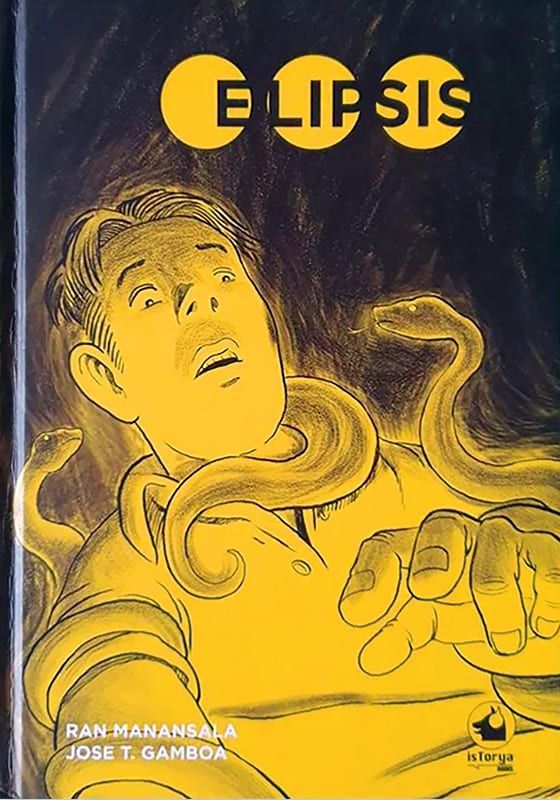
The title of Elipsis appears to promise interruption, but the book by Ran Manansala and Jose T. Gamboa is unusually committed to making connections. Its preliminary explanation of the punctuation mark includes omission, the suspension of a sentence, and the three dots in a chat window that indicate an answer is being composed. Those meanings do not coincide. An omitted passage may be inaccessible forever; a pause may be deliberate; a typing indicator suggests that someone is still present and may yet reply. The book organizes this uncertainty into three named movements: “Paghihintay,” Allan’s story; “Pagpapatawad,” Beatrice’s; and “Paghahanap,” Caloy’s. Their lives differ in age and circumstance, but the narrative eventually reveals relations among them that neither the characters nor the reader could establish at the beginning.
Allan’s predicament is initially ordinary enough to resist any expectation of an elaborate symbolic scheme. An aspiring writer receives a rejection from a copywriting job, confronts the discouraging demand for experience before one has been allowed to acquire it, and attempts to explain his ambition within a household concerned about income. A particularly revealing contradiction is that the employment he seeks would permit him to sell language in the service of advertising. His private wish to write has become entangled with an industry that calls the production of commercial persuasion creativity. The difficulty is not that nobody values imagination. It is that imagination receives a price and a prescribed use before he has determined what he wants his own writing to accomplish.
The narrative returns to an abandoned infant received by a religious institution, giving the adult pursuit of a future another temporal layer: the desire to establish a life cannot be separated from a past over which the child possessed no control.
Beatrice’s narrative moves through domestic responsibilities and the uneven circulation of help. Its attention to a child, schooling, roads, households, and relationships offers an alternative to the career-centered crisis of the first movement. The scenes are not organized around a single heroic intervention; opportunities for care emerge through contingent meetings and the willingness of people to become involved in lives that they might otherwise have passed without noticing. Caloy’s section shifts scale again, from a child’s fascination with a globe to the obligations and retrospective explanations of an adult who has achieved professional standing. His involvement with the institutions of family, enterprise, and adoption eventually brings the earlier lives into a shared frame. The recurring connection to Tita Cora and the orphanage is not an incidental coincidence added for surprise; it is part of the structure through which separated biographies are brought into mutual visibility.
This is a genuine book-level decision: their eventual relation becomes part of the reading experience. The past of one person becomes information that another person has lacked, and what looked like a minor presence acquires consequence elsewhere. The three dots acquire a different resonance once the book has taught us to expect another narrative after the apparent closure of the preceding one.
The illustration, predominantly in black and white ink, is exceptionally serviceable in its establishment of recognizable environments: offices, residences, streets, vehicles, eating places, and spaces where people discuss the next practical thing they need to do. The unassuming quality of these settings permits the narrative to move among different phases of life without each transition demanding an entirely new visual vocabulary. Particularly interesting are the moments when an object, a screen bearing a rejection, a globe, a childhood photograph, or an unfinished manuscript, gathers significance through the people who encounter it at different times.
But the book’s ambition is stronger in its narrative architecture than in its handling of individual pages. Dialogue and explanatory captions frequently perform work that the drawings might have been asked to undertake. Characters articulate their situations, the connections among episodes are clarified, and the reader’s opportunity to infer is sometimes curtailed by the desire to make every relevant relation intelligible. The title’s suggestive concept of omitted information therefore sits uneasily beside a narrative that often seems unwilling to let an omission remain unresolved.
A more consequential problem emerges from the work’s eventual confidence in meaningful coincidence. Its converging lives propose a generous account of human interdependence, especially for people whose biological families have not supplied security. The trouble is that the network of benevolent encounters can make the unequal distribution of opportunity appear reparable through exceptional individuals. Caloy’s rise in the business world allows assistance and recognition to circulate; an institution’s inadequacies can become less visible when a successful person has the means and inclination to intervene. The story’s consolation is understandable. Yet what happens to those who never encounter the right benefactor, whose applications continue to be refused, whose needs exceed what a private network can supply?
This is not a demand for a bleak ending, nor would making Caloy less generous improve the work. The question concerns narrative probability as an ethical arrangement. A book can recognize the significance of care without making eventual recognition the reward promised by every period of waiting. Some connections fail. Some people continue helping one another without ever acquiring the resources necessary to alter the conditions that made help indispensable.
Elipsis belongs to a valuable line of contemporary Filipino graphic narrative interested in employment, adoption, and the forms of kinship built when origin provides no adequate guarantee of belonging. Its strongest idea may be the one its unusually accommodating resolutions do not quite exhaust: that an ellipsis can be the evidence of someone still trying to answer, even when no answer is assured. A comic book has the ability to leave that uncertainty visible on the page without obliging the next panel to resolve it.
Grade 3: The Things a Child Is Not Supposed to See
In “Betamax,” the child who narrates one of Doktor Karayom’s recollections searches the family house for coins. He checks beneath furniture, near the refrigerator, even among the objects on the altar, and eventually gathers enough money to watch films at a neighborhood establishment where admission costs one peso. He sits with other children and people coming from work, entranced by monsters on a screen. The scene has the delicacy of a memory that has not been made more innocent by being remembered. There is pleasure, certainly, but it costs money the child must discover in places where adults have neglected to look. His excitement is already entangled with the economy of the household.
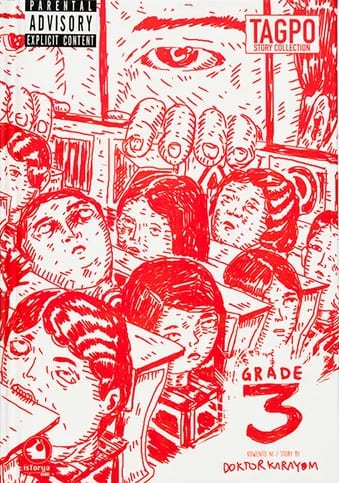
The drawings are red, fiercely scratched against white, and Karayom uses that apparent roughness to unsettle the familiar visual contract of childhood comics. His children are not consistently rounded, reassuring figures designed for adult affection. Their faces deform under embarrassment or terror. Ordinary objects acquire the appearance of bodily organs. Red can signify an eager sketch, an injured body, or a stain whose cause has not yet been disclosed. This is accomplished with considerable control; to mistake the marks for technically naïve drawing would be to mistake their refusal of polish for an inability to achieve it.
The title Grade 3 is a useful classification to distrust. A school places children together because they are understood to occupy the same stage of development, although that classification tells us remarkably little about the differences in their households or their opportunities to remain children. Karayom’s short pieces repeatedly bring the institution’s ordinary rituals into contact with experiences that exceed its capacity to explain them. In the story “Santelmo,” a child excited about a classroom Christmas party contributes a ball and towel bought with his mother, then receives a box of matches in the exchange. The initial disappointment grows into an extravagant fantasy of setting the room on fire. But as he walks home, he considers the possibility that the giver could not afford anything better and remembers that his own mother had borrowed money to purchase his contribution. The anger does not vanish through a lesson delivered by an adult. It alters as the child comes to imagine another family’s circumstances. A transaction meant to distribute gifts equally has exposed how unequally the children arrived at the exchange.
More devastating is “Nanay Ko si Darna.” Asked to speak about his mother, a child describes her with the language of superheroic devotion. She cares for him and makes money by distributing small wrapped packages. The story gradually supplies information that his admiration cannot yet interpret; televised warnings about sellers lead toward an armed pursuit, and his mother is shot. Karayom does not need to borrow a speech about the drug war to produce a recognizable account of how state violence enters a child’s understanding of the world. The boy’s invocation of Darna, and of his mother as Narda, becomes devastating because the superhero story has promised a form of protection that the actual conditions of their lives cannot deliver. The child’s power was always a relation of love, not a capacity to stop a bullet.
This is more complicated than an image of innocence destroyed by cruel knowledge. The child has been making sense of his mother through an imaginative form available to him, and the drawing does not simply correct his mistake. The mother remains heroic in his account, even after the story has shown how inadequate the language of heroism is to describe economic desperation, policing, and an irreversible death. The failure belongs less to the child’s imagination than to a society in which the labor of staying alive can render someone disposable.
“Sticker ni Happy” presents a different problem of pictures. Happy collects cheerful stickers, only to discover that her mother has pasted them across a wall. She is initially offered an ordinary domestic explanation: the stickers make the room prettier and can be replaced. Later, when her father becomes violent, the child understands that the smiling faces cover holes he has punched into that same wall. Here an image is not a window into what adults know. It is a deliberate interruption of sight, an attempt by one vulnerable person to protect another through concealment. The mother’s gesture is tender and inadequate at once. The stickers cannot stop the violence, but neither can their use be dismissed as foolish. They register how few other instruments of protection are available to her.
This is perhaps the collection’s sharpest account of what images do. They can nourish fantasy, as the Betamax films do; they can teach the child to perceive a parent through heroic conventions; they can be deployed to keep the evidence of danger out of view. Karayom’s own drawings refuse to provide that protection. The book makes the damage visible, and its peculiar cruelty is sometimes the cruelty of making an adult reader look again at conditions children were expected not to notice.
An imaginative transformation can occasionally serve as an anticipated shock, and the consistent urgency of red marks risks giving events of differing consequence the same visual temperature. The bilingual Filipino-and-English presentation further changes the page’s rhythms, occasionally asking dense captions to carry meanings that the drawings might have been permitted to hold longer. “May Bata sa Canton” imagines an exhausted beginning teacher discovering a baby in a pot of cheap food, and the bizarre premise gives a startling material form to the collision of hunger, care, and the desire to be needed. In “Tomeng,” children’s talk while burying a strange body wanders toward school, future work, parents overseas, and the cost of survival. Death has entered the scene, but it cannot prevent ordinary conversation from continuing.
That continuity makes Grade 3 less a collection about childhood terror than about the inadequacy of the divisions adults place between horror and daily life. One might wish for greater variation in the means by which the stories disturb us. But the collection’s most disturbing proposition is already precise: sometimes the child’s supposed misunderstanding is the only account that has not yet learned how to disguise what is happening. The question is what becomes of the image when such a child grows old enough to make one, and what happens when someone else owns the wall on which it must appear.
Lunatics: The Painting Is Too Large to Steal
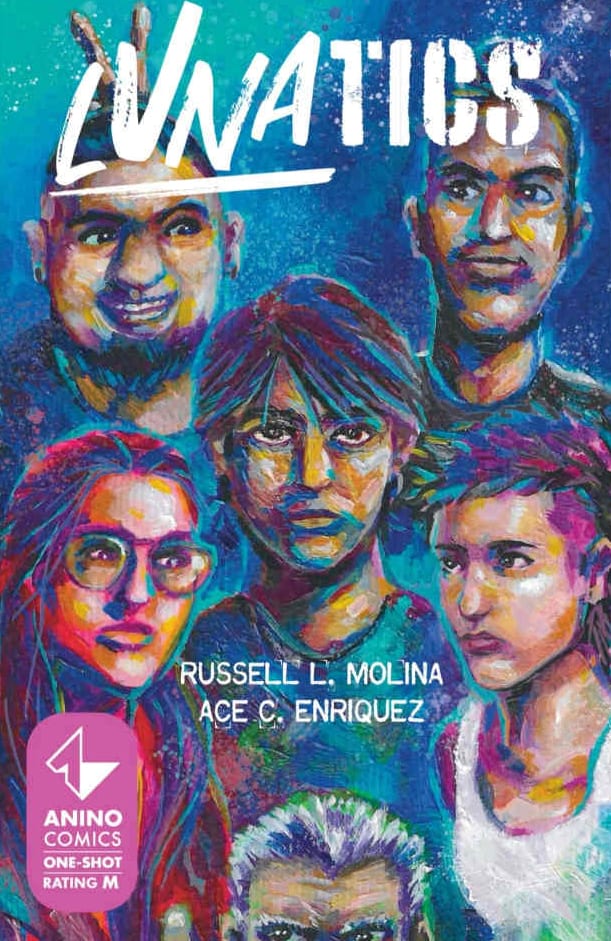
Vincent Faustino’s employer has a problem familiar to anyone who has commissioned an artist: the picture delivered is not the picture ordered. Instead of flattering portraits, Vincent has produced likenesses that turn clients into animals. One is a baboon, another a turtle. The joke is quick, but Russell L. Molina and Ace C. Enriquez allow it to open onto an argument that remains active throughout Lunatics. Is a portrait an attempt to represent a person, or a service purchased by someone who wants to control the way they appear? Vincent’s employer cannot pay his bills with disobedient brilliance. Vincent cannot bear to make the pictures expected of him. Before we decide that the young painter must be right, the book makes him lose his job.
The opening gives the problem a family history. Vincent belongs to a line of painters, and his grandmother says that oil paint flows in their veins instead of blood. Yet the inheritance has furnished neither the security nor the happiness that such a grand phrase seems to promise. His absent father remains an unsettled presence in the family, while relatives and acquaintances regard Vincent’s talent as something he ought to make useful. Artistic ability is treated as a precious family possession, provided its owner can be persuaded to spend it in acceptable ways.
Vincent and his friends concoct a scheme to steal Juan Luna’s Spoliarium from the National Museum of Fine Arts. A computer search makes the dimensions of the enormous painting clear, to the astonishment of companions whose knowledge of the work is limited. The proposed theft is ridiculous before it is criminal. Spoliarium is not a portable trophy that can be slipped beneath a jacket; it is a national artwork whose physical scale resists the fantasy of effortlessly transforming cultural value into personal cash. Even the friends’ uncertainty about the painting’s name becomes comic evidence of the distance between an institution’s declaration that an artwork belongs to the nation and the actual knowledge of the people supposed to inherit it.
The subsequent museum visit is among the book’s richest sequences. The group moves through galleries, confronts the imposing painting, and discovers that the museum has its own personnel and social relationships. Vincent encounters Joy, who works as a researcher and whose history with him is hardly neutral. The state collection is neither an inaccessible temple nor merely the setting for an adventure. It is a workplace, a place of knowledge, a site of emotional entanglements, and an institution whose protection of objects can conflict with the desires of those who claim a personal relation to them.
This tension is particularly charged because the object is Spoliarium. Luna’s painting has acquired an immense role in Philippine accounts of national artistic achievement, and a scheme to remove it from official custody can easily be read as an attack on cultural patrimony. Yet Molina and Enriquez do not simply convert the thieves into liberators rescuing art from the state. Their proposed plan is driven by money, damaged relationships, bravado, and Vincent’s unresolved obligations. The painting’s importance does not make its would-be appropriators admirable; their lack of cultural authority does not make the state the only legitimate guardian of its meanings.
Enriquez’s graphic treatment allows these opposed claims to remain materially present. Most of the narrative is rendered through emphatic black-and-white hatching, grimy walls, sharply framed faces, and city surfaces that appear already covered with traces of other people’s actions. At selected moments, color or a change of pictorial texture interrupts that system. Images of paintings can appear inside the book without becoming identical to the comic surrounding them. The contrasts are strongest when the museum’s monumental scale meets the improvised arrangements of Vincent’s group. Plans depend on friendship and favors; money is imagined on an absurd scale; the actual operation produces complications that no one has adequately prepared to manage. When what they acquire proves far less than the whole painting, the gap between ambition and possession becomes comically literal. Their proposed way of extracting payment, even from the government, exposes how readily the nation’s supposedly immeasurable artistic treasure can be translated into the price its custodians might pay to recover it.
But this is also where the book becomes vulnerable to the machinery of its plot. As the operation moves toward pursuit, concealment, and the practical difficulties of disposing of what has been stolen, the earlier questions about artistic value sometimes give way to the demands of comic adventure. The revelations concerning Vincent’s father, his supposed abandonment of the family, and the dangers that prompted his departure carry emotional stakes, although the successive disclosures place a heavy burden on explanations that arrive relatively late. The encounters with Joy likewise risk making a woman with her own professional and personal position function chiefly as the person who absorbs the consequences of Vincent’s decisions. Her accusation that he has used her deserves more than the protection customarily extended to a charismatic troubled protagonist.
What rescues the book from a simple romance of the artist’s rebellion is its willingness to reveal that Vincent’s choices can hurt the people who help him. His friends are not merely assistants in an eccentric masterpiece. They face the danger and possible criminal consequences of a scheme whose motives have not been honestly shared. The book does not always allow these injuries the duration they deserve, especially as its final movement turns toward revelations and restitution. Nevertheless, it has introduced a problem that no quantity of painterly talent can cancel: the artist’s right to make unexpected images does not include an unlimited right to conscript other people into the making.
Near the end, Vincent returns to painting, while the people around him return to the ordinary activity of being together. The conclusion risks settling difficulties too quickly, although it also alters the opening’s understanding of artistic inheritance. A painter may be born into an artistic family without becoming its obedient continuation. The significance of his work lies not in being able to purchase a famous painting, nor in securing permission to deface other people’s portraits, but in discovering what he can create without requiring every relationship to become material for his ambition.
Lunatics is the most explicit of these five books about the economic and institutional custody of images, and the fact that its argument is carried through a caper gives it a productive vulgarity. One cannot contemplate artistic freedom for long before someone asks about a commission, a debt, a sale, or the cost of a damaged canvas. The larger question it leaves is whether the nation that claims a painting as its treasure can extend comparable regard to the people now making pictures, including those whose work will never be hung in a museum.
The Reader Who Has Not Been Drawn
A literary prize can change a book’s public life without changing a single mark in it. The volume may become easier to notice, acquire a place on a library shelf, enter a syllabus, or be given to a young artist as evidence that the kind of work they want to make is possible. These consequences matter, but none is automatic. Recognition cannot ensure that a school will purchase the book, that a publisher can afford another printing, or that the people who produced its images will be paid well enough to undertake their next project.
This is where the National Book Awards’ classification becomes more than a question about the word literary. The category gathers different kinds of comics under the name of the book, an object that can be archived, purchased by institutions, assigned for study, and discussed by critics accustomed to the authority of print. Yet an important part of Philippine komiks history was sustained by circulation through magazines, borrowed copies, newsstands, and reading practices that did not always leave behind collectible volumes. When the bound book becomes the preferred evidence of a form’s accomplishment, we should ask what forms of work and access that preference makes less visible.
These volumes themselves reveal why the book is worth defending. Their length permits experiments in duration; their sequencing enables disparate episodes to accumulate meaning; their material presence allows images to be revisited after later pages have unsettled our first impressions. But the seriousness with which we read them ought to extend outward to the means by which readers encounter them. A literature that changes its forms without changing the conditions of access may become increasingly admirable to an increasingly specialized public.
There is also work for literary criticism here. A critic who can interpret a character’s monologue but cannot explain why the same face appears in three differently sized panels has not yet learned to read everything the book is saying. Nor is fluency in comics guaranteed by familiarity with international graphic novels or with the vocabulary of panels and gutters. One must notice what these particular artists do with Filipino speech, with the textures of Philippine streets and households, with inherited popular conventions and imported techniques whose meanings change when they enter another publishing economy.
Perhaps the most useful consequence of placing these books in the literary division would be a change in what literary institutions understand themselves to be responsible for seeing. Not a ceremonial enlargement of the canon, followed by a return to reading pictures as illustrations of sentences, but an enlargement of critical competence and of the communities that competence can serve.
A panel determines who appears within its borders. A book, however inventive, cannot draw the entire public to which it might belong. That public is made elsewhere, through libraries willing to acquire work outside familiar curricular categories, teachers who can help students attend to its visual decisions, publishers able to sustain artists, and readers whose first encounter may occur without the benefit of any award. What is at stake, finally, is not simply whether we will continue producing remarkable Philippine comics. We plainly can. It is whether the people who might recognize their own worlds transformed in these books will be given the chance to turn the page.

Edgar Calabia Samar is Associate Professor at the Ateneo de Manila University, where he recently completed a term as Chair of the Department of Filipino. He is Head of the National Committee on Literary Arts of the National Commission for Culture and the Arts and a member of the Filipino Critics Circle. He is the author of the Janus Silang series and several novels, including Teorya ng Unang Panahon. His Filipino translation of José Rizal’s Noli Me Tangere has just been published by Anvil and is now available nationwide. In 2024, he received the S.E.A. Write Award from the Royal Family of Thailand for his contributions to Southeast Asian literatures. He writes about reading, writing, and liberatory education and labor at Silid Santinakpan (patreon.com/ecsamar) and on TikTok and Instagram at @ecsamar.
ALSO READ FROM EDGAR CALABIA SAMAR:
No Medium Keeps Its Own Memory: On the Finalists for Best Book on Media Studies at the 43rd National Book Awards
The Book Has Already Lived Once: On the Finalists for Best Translated Book at the 43rd National Book Awards
A Person Is Here: On the Finalists for the 43rd National Book Award for Best Book on Drama and Film
Edgar Calabia Samar is an award-winning poet, critic, and novelist, and an Associate Professor at Ateneo de Manila University. IG: @ecsamar.
View More Articles About: