No Medium Keeps Its Own Memory: On the Finalists for Best Book on Media Studies at the 43rd National Book Awards
These are not simply books that explain films, television, journalism. They also ask what happens to culture after its moments of transmission.
Published on Sep 27, 2026
A VHS tape spent twenty years inside a cabinet in General Santos City, gathering dust around images that had not disappeared but had become, for most practical purposes, unreachable. The tape contained House Under the Crescent Moon, Gutierrez Mangansakan II’s first short documentary, which won first place in the documentary category of the Gawad CCP para sa Alternatibong Pelikula at Video in 2001. It might have remained there, an intact object slowly approaching the condition of absence, had the Mindanawon critic, archivist, and programmer Jay Rosas not asked whether Mangansakan still had a copy. He did. Rosas had the master digitized in Manila. Mangansakan’s phrase for what followed is exact: the film received “a second lease on life.” Twenty-three years after the events that gave the documentary its red ancestral house in Maguindanao, Mangansakan returned with a Blackmagic camera, no longer the borrowed Sony Hi-8 that had conked out every five minutes. He also returned to the voice he had once refused to use. The new work he imagined would allow him to revisit that earlier narration and reclaim himself, in his own words, as queer, Muslim, Bangsamoro, Maguindanaon, and Mindanaoan. Preservation had not returned the past unchanged. It had kept the past available long enough for its maker to become somebody capable of answering it differently.
I keep returning to this episode because it gives the four books gathered here a problem more precise than the capacious phrase media studies. Letters from the Future: 35 Years of the Gawad CCP para sa Alternatibong Pelikula at Video, edited by Adjani Guerrero Arumpac; Alternative Media: A Lineage of Resistance, edited by Ma. Diosa Labiste and Rolando B. Tolentino; Clodualdo del Mundo Jr.’s Disconnected Media and Other Essays; and Philippine Cinematic Art, in its second edition by Andrea L. Peterson, Gaspar A. Vibal, Christopher A. Datol, and Nicanor C. Lajom, are not simply books that explain films, television, journalism, or the institutions surrounding them. Read together, they ask what happens to culture after its moment of transmission. What remains after a screening? What becomes of a newspaper once the political emergency that required its circulation has changed form? What happens when a critic has spent decades writing about works that later scholars may no longer be able to see? What can a printed page do with an art whose first principle is movement?
The question is unusually Philippine because loss here is not theoretical. A negative deteriorates in heat and humidity; a community broadcast can cease when permits or money fail; a clandestine newspaper may survive because somebody hid a copy from the state. Even the cloud is a way of forgetting the cables, servers, electricity, and labor that let an image pretend it has escaped matter. Media do not preserve themselves. Somebody keeps carrying them from one vulnerable condition into another.
Across these books, something akin to translation occurs without any need to call them books on translation. They move cinema into prose and still image, institutional memory into chronology, fugitive journalism into academic history, scattered criticism into a career-shaped volume. Every transfer alters what it carries. A film reproduced as a photograph can no longer move, while an anniversary volume saves testimony by choosing who will stand for the institution remembered. Their value lies not in settling what a Philippine book on media studies should be but in exposing the costs of making media available to thought.
Their presence inside a literary division of the National Book Awards is therefore more than an administrative curiosity. Literature has never traveled without media, though literary institutions sometimes behave as if words reached readers by a more elevated route. A novel enters a printing economy before it enters anyone’s interior life; Philippine stories have long moved among komiks, radio, cinema, and now online platforms. The question is not whether media studies has wandered into literature’s territory, but whether literature can describe itself without the infrastructures that make anything readable or lost.
Letters from the Future: When an Institution Remembers Itself
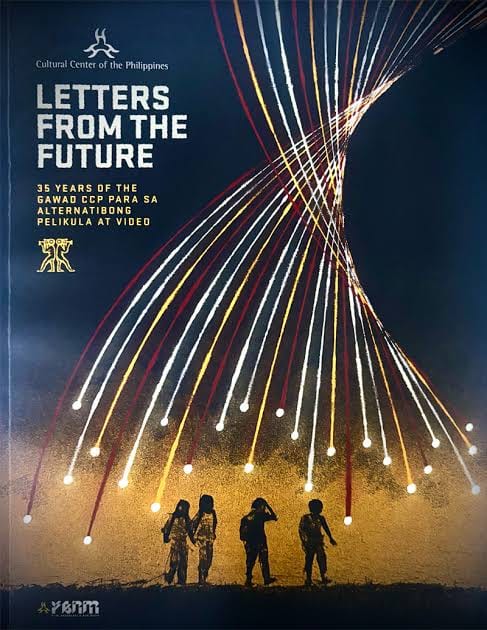
The most important word in Letters from the Future may not be “future” but “alternative,” because the book is intelligent enough to distrust the word it inherits. Mae Caralde’s opening note recalls the recurring question in Gawad deliberations: alternative to what, and for whom? The answer she offers does not treat the term as a stable aesthetic. It names instead an attempt to break from established structures of production and to create other expressive possibilities, while acknowledging almost immediately that the competition itself is a regular program of a national cultural institution with its own limitations and contradictions. Arumpac’s historical introduction deepens the difficulty. Philippine alternative cinema did not develop in a pure exterior to the state or industry. Its history passed through schools, activist formations, state programs, independent communities, and technologies whose costs determined who could make images in the first place.
That refusal of purity is one of the book’s achievements. Histories of independent culture often invite an easy romance in which whatever stands outside commerce is already emancipated and whatever accepts institutional support has surrendered. The history assembled here is less convenient. State patronage can sustain work that questions state power; filmmakers can need the venue they also outgrow. The Gawad becomes a recurring negotiation rather than a fixed authority: juries change, past winners later help choose new winners, and the values attached to “alternative” work accumulate through practice.
The book’s form understands this instability better than a conventional institutional history might. Tom Estrera III’s design repeatedly turns old catalog pages, jury lists, posters, photographs, and film stills into evidence that must be looked at rather than merely footnoted. The chronological ordering of filmmakers’ memories according to the years in which they received recognition lets technologies age in public. Anne Marie de Guzman can return to First Cup, her 1990 second-prize feature, through coffee and the memory of her mother, and find that what embarrasses her technically has not exhausted what the film knows emotionally. Eduardo Piano remembers making Abo in 1992 near Pinatubo with a 35mm camera, Fuji celluloid, a budget approaching P300,000, heavy rain, and the continuing threat of lahar. The apparatus does not sit outside the story of the work. It determines risk, scale, exhaustion, even what counts as possible.
Mangansakan’s “Learning to speak” pushes the anniversary form somewhere more demanding. The digitized tape does not function as proof that the institution had correctly recognized a masterpiece and preserved its maker for posterity. Instead, recovery makes self-revision possible. The filmmaker listens to the voice he once disliked, confronts why he refused to narrate the documentary himself, then imagines returning to the same house and making another film from a self no longer willing to hide behind an acceptable recorded voice. The archive here is not a mausoleum for the finished identity of an artist. It becomes a device for encountering an earlier version of oneself and discovering that continuity may require contradiction.
The regional question extends that insight beyond autobiography. In Jay Rosas’s essay, the Gawad’s relation to cinema outside Manila becomes a history of categories arriving after practices have already begun. The best regional entry was formally recognized beginning in 1993, two editions after Iligan filmmaker Hesumaria “Jojo” Sescon’s Yuta won first prize in the experimental category. Rosas traces later recognized work from Pangasinan, Cebu, Mindanao, and elsewhere, showing that “regional” cinema was never merely a geographic supplement to a completed national cinema. The center needed the region in order to discover how partial its own national frame had been.
This is why “Amending the Alternative,” the section containing Rosas and Adrian Mendizabal, matters beyond its placement near the back of the volume. Mendizabal’s account of criticism as praxis asks what film criticism might become when conventional critical communities have fragmented across digital platforms; Rosas asks how an institution located at the center may recognize cinematic practices whose histories exceed it. Their essays do not simply add two neglected topics. They modify the noun that organized the previous hundred pages. An alternative that cannot be amended risks becoming another canon with a rebellious origin story.
And this is also where the book’s strongest limitation appears. An institutional archive cannot help remembering institutionally. The winners database is extraordinarily useful, but it records the history of works that passed through recognition. The testimonies come largely from makers whose relation to the Gawad has already been secured by participation and award. Before Cinemalaya expanded the audience and submissions multiplied, Arumpac notes, even non-winning entries were screened; by 2015 the programs had to be curated. That detail opens an archive the book cannot fully supply: films submitted but not retained, works screened but later lost, makers who never returned, experiments that failed the categories available to them. The history of a competition is not the history of everything that needed an alternative.
A related problem is more specifically editorial. Arumpac’s introduction states that after the ECP was dissolved in 1985, its duties were transferred to a “newly-instituted” Film Development Council of the Philippines. Elsewhere in the same volume, Nicanor Tiongson’s historical account says that after the ECP was closed, the assets and privileges of the Film Center had gone to the CCP, and that CCP’s Coordinating Center for Film revived or expanded programs inherited from the ECP. Arumpac herself later invokes the transfer of Film Center assets to CCP in reconstructing the post-Martial Law reorganization. The accounts as printed do not sit comfortably together. A volume positioning itself as the first dedicated study of a long-running and incompletely archived program carries an unusual obligation to make such chains of institutional succession exact, or at least to mark where the record remains disputed.
That inconsistency does not undo the archive the book creates. It clarifies what an archive must become if it is to be more than an anniversary object. Once memory is institutionalized, the problem changes: we must ask not simply what an institution remembers, but what relations of production decide whose memory becomes reproducible. At that point the camera gives way to the press, the festival to the distribution network, and “alternative” can no longer mean only a different aesthetic. It has to become a question about who owns the route by which a public can know anything at all.
Alternative Media: A Lineage of Resistance: Resistance Has a Printing Cost
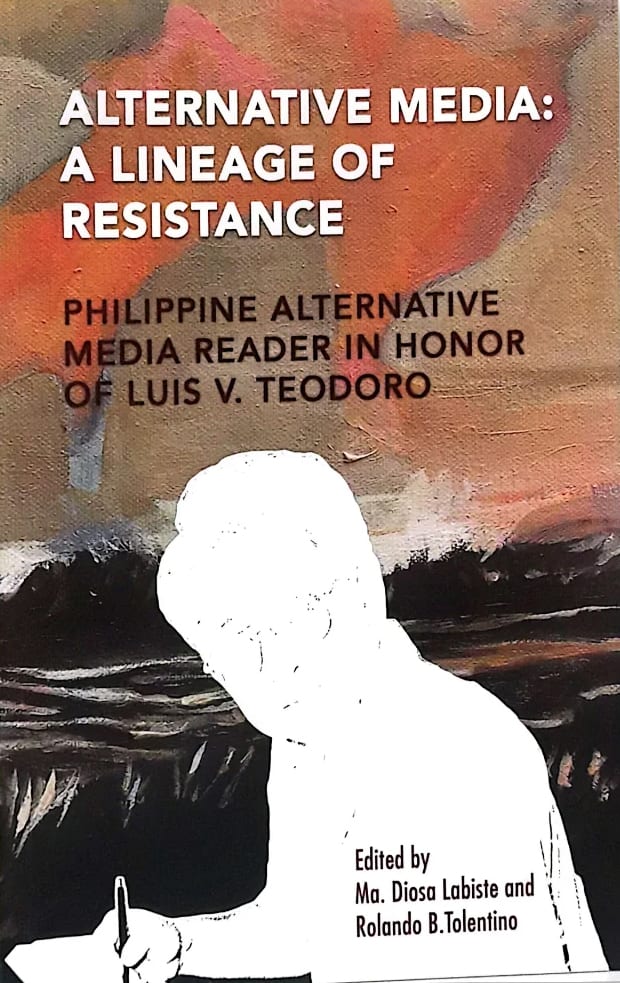
Alternative Media: A Lineage of Resistance begins from Luis V. Teodoro’s deliberately paradoxical claim that what has been called the alternative press may constitute the more durable tradition in Philippine journalism. The usual map treats corporate media as the center and dissident publications as intermittent departures from it. Teodoro reverses the map. Labiste’s introduction is careful enough to acknowledge the danger: if “alternative press” simply names the newspapers that arose against the Marcos dictatorship, the claim of a long dominant tradition becomes tenuous. Her stronger formulation is genealogical. Resistance recurs across changing political orders, from anticolonial publications through underground and community journalism to contemporary networks, not because all these media are identical but because the need to speak against concentrated power keeps being reproduced.
The volume is most convincing when lineage becomes material rather than ceremonial. Lucia Tangi’s history of Ang Bayan follows changes in editorial practice, reproduction, language, and technology. The newspaper’s early issues were mimeographed; from 1969 to 1981, Tangi writes, it appeared in English, with a Filipino edition beginning in the latter part of 1981, an Iloko edition the same year, then Waray and Cebuano editions in 1982. By 2021, editions existed in several Philippine languages as well as Spanish. Karlo Mikhail Mongaya’s succeeding chapter moves even closer to the mechanics of underground work: correspondents, collective editing, secure distribution, household labor, finance, stenciling and printing. The Maikling Kurso sa Rebolusyonaryong Peryodismo becomes significant not only for its politics but because it treats journalism as an organized production process in which the article cannot be separated from the machinery and people that allow it to circulate.
This attention to production is where the book most substantially enlarges the idea of media studies. A newspaper is not only the sum of its claims. It is a recurring achievement of labor. Someone gathers information; somebody edits under deadline; another person reproduces the pages or uploads the file; somebody accepts the danger of distribution. The politics of media therefore begins before interpretation, inside the organization of the work itself. A publication calling itself alternative but reproducing the exploitative conditions of the institution it opposes would have to answer for that contradiction. Tolentino makes a version of this question explicit when he asks whether alternative media sometimes merely appropriates the modalities of dominant media and whether its own limited active membership prevents sustained innovation. The volume is at its best when “alternative” stops being an honorific and becomes a demand made upon practice.
The profiles in the second half give this demand a body. Baretang Bikolnon emerges from volunteer labor, digital platforms, dormancy, revival, and a small staff spread across a large region; its early contributors drew on Ibalon and tigsik while welcoming literary as well as journalistic work. Radyo Lumad shifts authorship more radically. Lumad volunteers become reporters and anchors, Binukid and Cebuano become working languages, and recorded reports can serve human-rights and environmental documentation. The Indigenous subject is not merely invited before the microphone. Who may hold the microphone begins to change.
That distinction is essential. Representation can leave ownership untouched. A corporate newsroom may expand the range of people visible in its stories while retaining the same economic relation between those who represent and those who are represented. The more radical instances in Alternative Media suggest that communication rights require a redistribution of communicative capacity itself. This makes the book unexpectedly useful to literary thinking as well. A literary culture preoccupied with who gets represented but less attentive to who owns presses, who can afford distribution, what languages reach schools, or who receives payment for cultural labor may reproduce the same inequality at the level of the book.
The volume is not uncritical of the histories it preserves, though it could press that self-critique further. Tangi discusses the CPP’s boycott of the 1986 snap election and records the subsequent recognition of the policy as a tactical error and political blunder. Her account also reaches the “anti-infiltration hysteria” that the Second Rectification document later described as having caused unprecedented devastation, including human-rights violations against close to a thousand people in Mindanao. These passages matter because they prevent resistance from becoming a certificate of epistemic innocence. A publication can oppose state censorship and still have blind spots generated by the organization to which it belongs. To be alternative to dominant media does not automatically make one transparent to one’s own power.
Here the title’s “lineage” becomes both useful and dangerous. A lineage grants historical depth to practices the dominant archive treats as occasional outbreaks. Yet lineage can also encourage us to read discontinuous formations as one family whose disagreements matter less than ancestry. La Solidaridad, an underground party organ, a contemporary multimedia collective, and an Indigenous community radio project do not possess the same relation to authority simply because each can be placed against a dominant formation. Their internal publics differ; the sanctions available to their organizations differ; their means of verification are not interchangeable. What I would want from the idea of lineage, then, is not a family tree but a family argument, one in which inherited commitments are repeatedly tested against new conditions.
The memorial orientation toward Teodoro sometimes makes that argument gentler than it might have been. The book was conceived in his honor and justly gives his thinking central gravity. Its contributors frequently extend or embody his proposition rather than force it into sustained dispute. But the volume’s structure contains the beginnings of a harder conversation. After histories and profiles come an assessment of the state of alternative media, policy recommendations, then Teodoro’s response. The problems named there are stubbornly material: insufficient resources and staffing, inadequate equipment, licensing difficulty, distribution costs, unstable connectivity, red-tagging and cyberattacks. The movement from theory to organizational problem prevents the memorial from ending in reverence alone.
It also changes the next question. If resistance must be printed, broadcast, uploaded, paid for, and kept safe enough to reach another person, then political commitment cannot substitute for infrastructure. But infrastructure introduces another violence: some materials survive while others do not, and scarcity forces somebody to decide what receives care first. The resistant newspaper and the endangered film meet here. Both eventually arrive at the archive, where the moral confidence of saving history encounters the less comforting problem of selection.
Disconnected Media and Other Essays: The Critic at the Door of the Archive
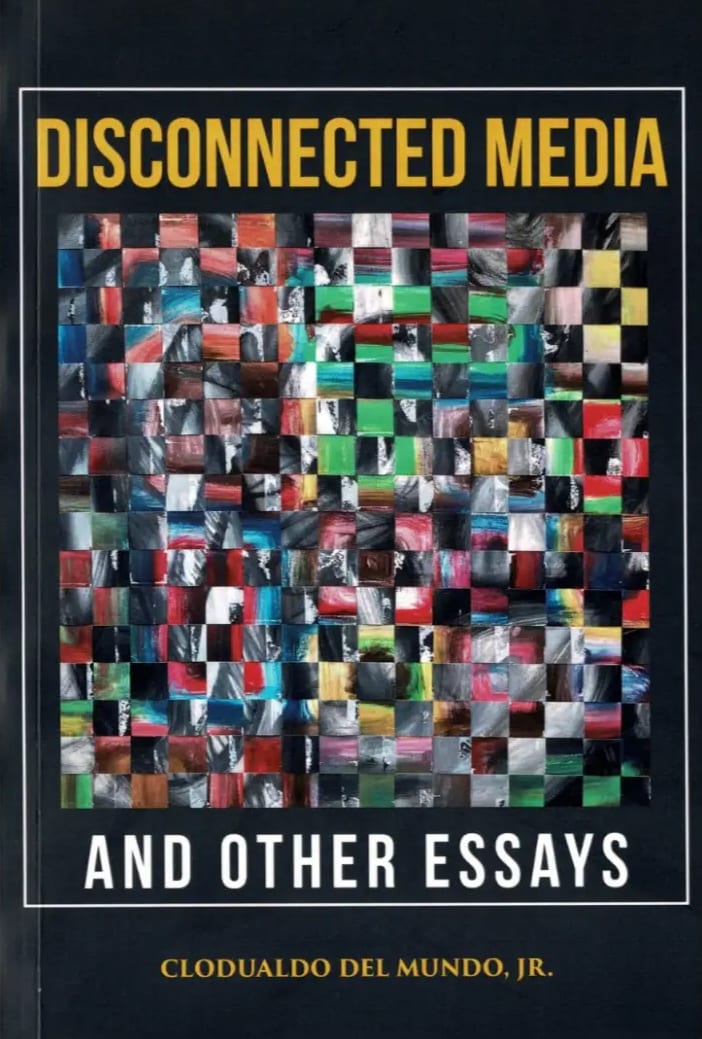
Clodualdo del Mundo Jr. calls Disconnected Media and Other Essays a collection from the “third part” of his academic life, written from the late 1990s into the early 2020s. That description is more important than it initially sounds. The book does not behave like a monograph whose later chapter proves what the first announced. It preserves the recurrence of a mind across decades: cinema history, archiving, indie production, language, komiks, television, human rights, film education, the pandemic. Its repetitions sometimes burden the volume, but they also expose what Filipino media scholarship has had to keep asking because the institutional problem refused to go away.
The historical essays are strongest when Del Mundo changes the standard of comparison rather than merely adding Filipino examples to an inherited account. In “Looking for Philippine Cinema,” he explicitly calls his survey “a very prejudiced history,” interested in filmmakers whose work carries artistic ambition. When he revisits Teodoro Virrey’s 1938 assessment of Tagalog movies, he objects to the comparison that makes Hollywood the master cinema and the local film its primitive pupil. If early Philippine movies are read through the sarsuwela and komedya rather than against the polish of Hollywood genre production, technical difference no longer automatically means aesthetic failure. The decisive decolonial move is not to praise the local because it is ours. It is to ask who supplied the ruler by which inferiority was measured.
Yet the collection does not maintain this suspicion of hierarchy without contradiction. The title essay, “Amado Hernandez Meets Amy Perez,” gives us an almost irresistible image: the noisy Diretsahan broadcast in Plaza Hernandez, Amy Perez in the foreground while the inscribed words and bas-relief of National Artist and labor leader Amado V. Hernandez remain behind her. Del Mundo reads the television event as “electronic graffiti of crass commercialism,” an emblem of media that claims to serve the public while converting the audience into a commodity sold to advertisers. The political-economic argument is sharp. Commercial broadcasting does not simply make programs; it organizes attention into something marketable.
What troubles me is the speed with which that structural diagnosis becomes a hierarchy of cultural seriousness. Gossip and mass entertainment become symptoms of disconnection, while Hernandez holds the position of substantive political memory. The contrast works too perfectly. It can grant seriousness to one form of public speech and triviality to another before asking what grievance or gendered exposure is being commercialized. Humiliation does not become democratic because ordinary people appear on screen, but the failure may lie less in popular speech than in the apparatus extracting value from it.
Del Mundo’s own book provides the best correction to Del Mundo. “Lessons My Father Taught Me about Komiks” remembers Clodualdo del Mundo Sr. as a literary writer who was also at home in popular media. Komiks helped support the family; the house, the son remembers, was the house Prinsipe Amante built and komiks sustained. Stories moved among radio, komiks, and movies. The elder Del Mundo adapted classics for radio and Noli Me Tangere for komiks, while his own serialized works circulated across media. Here popularity does not threaten artistic seriousness. It becomes the condition by which stories travel, mutate, earn money, and enter everyday life.
The tension between those two essays is more generative than either position by itself. If popular form can sustain a writer materially and become the site of significant invention, then the divide cannot simply run between art and entertainment. The harder distinctions concern ownership and labor, but also the uses to which pleasure is put. A form may be formulaic and still become socially revealing; an ambitious film may still rely on exploitative production. Del Mundo’s collection is most alive when its decades of writing prevent a single moral vocabulary from controlling every object.
Nothing in the book, however, carries as much urgency as the archive essays. Their repetition has a reason: Del Mundo kept writing because the films kept deteriorating. “Ukay-Ukay” recalls rusty cans and reels afflicted by vinegar syndrome, titles found too late for their negatives to remain usable. In one inventory, seventy-two titles comprising 1,471 reels were inspected; twenty-four were initially prioritized for rescue, with Jaguar later added, while several master negatives had already been lost through neglect. The essay does not need metaphor. Chemical decay supplies its own plot.
The collection also reveals a dilemma that archival advocacy can too easily hide beneath the moral certainty of preservation. Del Mundo writes that resources will never permit comprehensive archiving and therefore calls for a “ruthless form of selection,” the election and preservation of main works “worthy to be canonized.” The material argument is difficult to dismiss. Storage costs money; climate control needs continuous power; restoration requires specialized labor. But once scarcity is answered by the canon, the archive risks turning historical judgment into a self-reproducing machine. The already prestigious film is preserved because it is prestigious. The neglected work decays. Its disappearance later seems to confirm that it never mattered enough to save.
A feminist or queer archive cannot be satisfied with that loop, nor can an archive attentive to class. Cultural forms once regarded as vulgar, minor, regional, excessively commercial, sexually embarrassing, or technically poor may contain exactly the histories that a masterpiece-centered canon forgets. The same applies to industrial footage and television ephemera, to unfinished experiments, to work made by people whose careers did not acquire the institutional power necessary to nominate their own preservation. Everything cannot be saved, and Del Mundo is right that material limits are real. The harder issue is whether selection can remain conscious that its judgments are temporary, revisable, and shaped by the very inequalities the archive hopes to overcome.
Here an ecological understanding of media becomes unavoidable. Del Mundo’s vinegar syndrome is chemistry, not metaphor. Humidity enters film history; preservation requires electricity, storage, new copies, and migration between formats. The archive unsettles the myth of immaterial culture by forcing criticism to admit its dependence on machines and climate. A national cinema is also an arrangement of vulnerable substances.
As a book, Disconnected Media could itself have been more ruthless about selection. The repeated calls for a national audiovisual archive acquire cumulative force because their occasions change, yet several arguments recur with only modest transformation. Collecting the essays preserves the history of advocacy, but a more interventionist editorial apparatus might have helped readers distinguish productive recurrence from duplication, showing what changed between one plea and the next rather than requiring the essays to restart the emergency. This is not a request that the volume become a monograph. It is a recognition that gathering previously separate texts is itself an act of composition.
Once that is admitted, preservation can no longer be imagined as the neutral rescue of content. The form in which the past is re-presented teaches the future how to perceive it. The archivist decides what survives; the editor decides what sits beside what; the page decides whether an image functions as illustration or evidence. The next book makes this problem visible at the level of design, where the moving image is deliberately slowed into paper and the history of cinema must learn to think with the still.
Philippine Cinematic Art: What a Page Can Do to a Moving Image
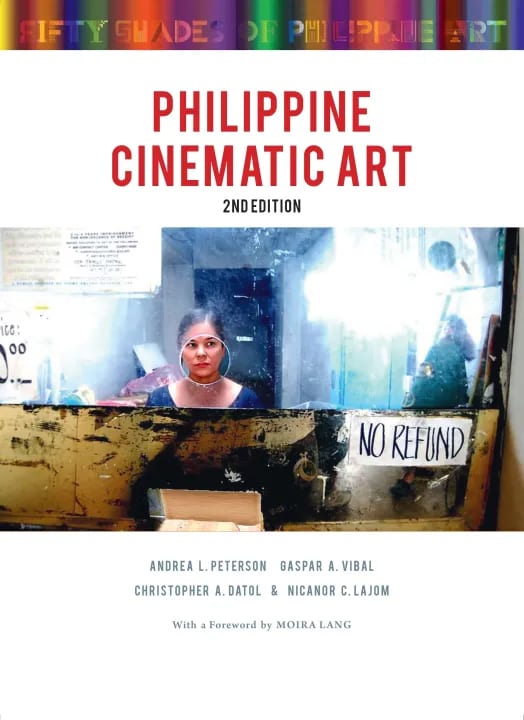
Philippine Cinematic Art announces a different contract with the reader. It is not an institutional memory book, a political reader, or a career-spanning essay collection. Its second edition is a 128-page, large-format introduction to Philippine cinema organized thematically rather than as an exhaustive chronology: cinematic language and material practice, nation, genre and intertextuality, sex and gender, celebrity, audiences, then a new chapter on COVID-19 and the industry’s resurgence. Andrea Peterson’s preface describes the desired vantage as that of an engaged observer rather than a specialist critic or scholar.
Its great advantage is that it takes the page seriously. Photographs are not rewards for readers who have survived the prose. Studio portraits, production stills, advertisements, theater images, and movie frames produce historical arguments of their own. A discussion of mise-en-scène can share the spread with the world being staged. Celebrity is not merely described but shown through the visual machinery that manufactured glamour. The history of audiences includes the built spaces in which audiences assembled. This makes the book pedagogically generous without making it intellectually empty. It teaches readers how to look while quietly demonstrating that the history of moving images also survives through still ones.
The opening explanation of film grammar makes another productive transfer. Terms such as mise-en-scène, cinematography, shot duration, editing, and diegetic sound come from an international vocabulary of film studies, but the examples are persistently Philippine. Gerardo de Leon’s camera angles, Lav Diaz’s duration, Brocka’s performance staging, early film music, and local genre histories become the material through which the concepts acquire sense. This is a more practical decolonization than pretending the conceptual vocabulary did not travel. A borrowed analytic language can be transformed by refusing to let foreign films remain its permanent exemplary objects.
At the same time, the book sometimes allows an attractive proposition to harden too quickly into cultural character. In the discussion of the long take, Lav Diaz’s claim that Western colonial history imposed a concept of time is followed by Patrick Flores’s description of a distinctly Filipino affinity for duration and Agustin Sotto’s observation about the sensitivity of the Filipino face, which allegedly does not require rapid cutting to communicate feeling. These are rich statements about cinematic history and spectatorship. Placed in an introductory volume without much counterpressure, however, they can begin to sound anthropological in the wrong way, as though “the Filipino face” possessed an intrinsic expressive temporality. The more interesting possibility may be historical rather than essential: certain performance traditions, production practices, audience habits, and filmmakers have made particular uses of duration available. That formulation leaves culture capable of changing.
The book is more persuasive when it follows exchange across media. Its section on literary and filmic texts refuses to treat cinema as a self-originating art. Philippine filmmaking draws material from sarsuwela, popular novels, radio drama, komiks, and later online writing. The history reaches from early Tagalog literary sources and radio-derived films such as Prinsipe Amante to Wattpad successes like Diary ng Panget and She’s Dating the Gangster, where online readership becomes both evidence of an audience and part of the economic logic of adaptation. At this point, Philippine Cinematic Art most directly complicates the boundary of a literary division. Literature has been entering cinema throughout the history the book narrates, but it rarely arrives unchanged. Adaptation is also a redistribution of audience, capital, performance, and prestige.
The chapters on bodies and spectatorship similarly broaden what might otherwise have become an illustrated film history. Sex and gender are treated as structures through which the cinematic body can reproduce or trouble dominant desire, while the audience chapter begins with the classed history of the bakya distinction and moves toward the industrial production of audiences. These sections are valuable because they keep the image connected to the social body looking at it. Yet the scale of the book can make some transitions too smooth. More than a century of gendered representation, censorship, erotic cinema, queer performance, and transgender visibility cannot be made fully commensurate inside a short chapter. The sweep is useful as orientation but sometimes produces the impression that one political period neatly hands a dominant sexual form to the next. A reader will need other books to reopen the discontinuities the survey necessarily compresses.
The same problem of compression appears in the chapter on critics and awards. The book usefully places the Manunuri ng Pelikulang Pilipino beside the Young Critics Circle and acknowledges criticisms of canon formation. It then turns hopefully to blogs, social media, and digital communities, suggesting that proliferating online voices can democratize film discourse and perhaps make the old “vanguards of knowledge and cultural production processes” less important. The opening is real, but the formulation leaves the new gate insufficiently examined. Once critical conversation migrates to privately governed platforms, authority has not simply dispersed. Visibility itself is ranked by systems opaque to most users. The older critic may lose monopoly while a less visible architecture acquires the power to determine what appears in front of whom. Even without turning the chapter into a study of platforms, the second edition could have made that exchange of gatekeepers more explicit.
The added COVID-19 chapter demonstrates the difficulty of updating a book about a rapidly changing medium. It follows production shutdowns, altered exhibition, streaming, and the reopening of theaters through material largely reaching into 2022. By the end, streaming has become a dominant feature of the landscape and pandemic ingenuity becomes evidence of cinema’s endurance. Yet earlier in the book the streaming environment is described through services such as Iflix, Hooq, IWantTV, and Netflix, which preserves the temporal layer of the first edition inside the updated one. This seam is not merely a defect. It inadvertently reveals how media history defeats the idea of the fully current edition. A book can be revised and still contain several presents, each aging at a different speed.
That may be the most useful lesson of Philippine Cinematic Art as a book rather than a survey. Its visual abundance and broad accessibility demonstrate why form matters to scholarship, but its compressions and temporal seams show that accessibility is not neutral. To explain is to frame; to frame is to leave something beyond the edge. The literary question therefore returns in altered form. The issue is no longer whether a book on cinema can be “literary.” It is whether we are willing to treat scholarly books as made objects whose arrangement of language, image, sequence, citation, and silence belongs to the meaning they produce.
What the Literary Division Is Being Asked to Hold
Asking whether these books should be in the literary division becomes more interesting once we stop looking for a border patrol. To say yes because criticism uses language makes “literary” nearly meaningless; to say no because media studies belongs elsewhere lets an award category describe the life of books more rigidly than books do. A more useful possibility is that the division can also hold works in which knowledge depends significantly on composition.
This does not mean asking Alternative Media to become lyrical or rewarding Philippine Cinematic Art for visual beauty. Research still answers to accuracy; documentation to usefulness. But information changes when shaped into a book. Arumpac’s chronological montage is not the Gawad database. Del Mundo’s gathered essays expose contradictions unavailable in a single article. Labiste and Tolentino move Teodoro’s proposition from memorial to organizational problem, while Peterson and her collaborators make seeing part of reading. Form here does not decorate knowledge. It determines what can be known together.
This matters to the state of Philippine literary works because literature itself has never been sheltered from the conditions these books study. Philippine Cinematic Art shows stories moving from sarsuwela, novels, radio, komiks, and Wattpad into cinema. Del Mundo remembers a father whose work moved just as easily across literary and popular systems. Alternative Media reminds us that language choice and distribution determine which publics a text can actually reach. Letters from the Future shows that a work’s later meanings depend on whether it survives in a form that can still be encountered. A literary culture concerned only with the intrinsic quality of works risks treating as accidental the very systems that decide whether those works remain available to readers.
The set also opens onto what it does not centrally study. Three volumes are dominated by cinema; one by journalism and multimedia activism. That does not prove Philippine media studies itself is film-heavy, only that these books devote enormous energy to recovering histories while cultural life is being reorganized by platforms and automated systems of visibility. In a country where film cans deteriorate in storage and a documentary survives because somebody remembers a VHS in a cabinet, recovery is not antiquarianism. The harder task is to connect that emergency to the infrastructures now deciding what the future will have to recover.
An ecological question follows. Abo remembers Pinatubo and alternative journalism reports environmental struggle, but Del Mundo’s vinegar syndrome comes closest to treating media itself as matter. Film reacts with heat and humidity; digital circulation likewise depends on electricity, devices, and extractive material chains. Gender and labor create another opening: these books offer queer histories and community authorship, yet leave more room to ask whose care work disappears behind production and whose bodies absorb greater risk. The politics of representation cannot end with who appears inside the frame.
These openings need not become a checklist for future books. More useful is the pressure produced by reading the four together: institutional memory proves partial, circulation demands organization, preservation requires selection, and the page itself frames what can be seen. A question emerges that none has to answer alone: what cultural memory are we building when every act of keeping changes the thing it carries?
This is why I would rather leave “book on media studies” porous than solve it. A field becomes interesting when its objects begin to contaminate its methods. Film forces criticism to think about bodies, machines, and duration. Journalism forces criticism to follow money and risk. Archiving turns aesthetics toward chemistry and storage. Literature reminds all of them that form can think, that sequence can be an argument, that a sentence can carry uncertainty without surrendering rigor. The traffic goes both ways. We do not need media studies to become literature, nor literature to absorb media studies into its prestige. We need the border to remain active enough that each can expose what the other has learned not to see.
The VHS in Mangansakan’s cabinet is useful one last time because digitization did not save House Under the Crescent Moon in the sentimental sense of returning it to an untouched original life. It changed the film’s condition of existence. Once migrated, it could be programmed again, watched by another generation, and confronted by the filmmaker who had spent two decades becoming capable of hearing his own voice differently. The value of the rescue lay not in freezing meaning but in restoring the possibility of revision.
These books likewise slow images, collect arguments, and give endangered histories enough paper to become questionable again. Their failures indicate where the transfer has compressed too much, remembered selectively, or trusted a category before testing it. Completeness is impossible. A more demanding measure is whether, after these acts of keeping, there is more that we can dispute.
There is. The future does not inherit media intact; it inherits what earlier people managed to carry across, along with the marks of that carrying. Criticism’s responsibility begins by looking closely at the crossing.

Edgar Calabia Samar is Associate Professor at the Ateneo de Manila University, where he recently completed a term as Chair of the Department of Filipino. He is Head of the National Committee on Literary Arts of the National Commission for Culture and the Arts and a member of the Filipino Critics Circle. He is the author of the Janus Silang series and several novels, including Teorya ng Unang Panahon. His Filipino translation of José Rizal’s Noli Me Tangere has just been published by Anvil and is now available nationwide. In 2024, he received the S.E.A. Write Award from the Royal Family of Thailand for his contributions to Southeast Asian literatures. He writes about reading, writing, and liberatory education and labor at Silid Santinakpan (patreon.com/ecsamar) and on TikTok and Instagram at @ecsamar.
READ MORE FROM EDGAR CALABIA SAMAR:
The Book Has Already Lived Once: On the Finalists for Best Translated Book at the 43rd National Book Awards
A Person Is Here: On the Finalists for the 43rd National Book Award for Best Book on Drama and Film
By the Spine, or by the Thought: On the Finalists for the 43rd National Book Award for Best Book of Literary History
By Whose Reckoning: On the Finalists for the 43rd National Book Award for Best Book of Literary Criticism or Cultural Studies
The Book Beside the Book: On the Finalists for the 43rd National Book Award for Best Anthology in English
At the Editor’s Own Table: On the Finalists for the 43rd National Book Award for Best Anthology in Filipino
Voices Shaped Beyond Retrieval: On the Finalists for the 43rd National Book Award for Best Book of Poetry in English
The Tongue and the Terrain: On the Finalists for the 43rd National Book Award for Best Book of Poetry in Filipino
Five Doors Into the Real: On the Finalists for the 43rd National Book Award for Best Nonfiction Prose in English
The Dwelling and the Drumbeat: On the Finalists for the 43rd National Book Award for Best Nonfiction Prose in Filipino
What the Novel Remembers When the Nation Forgets: On the Finalists for the 43rd National Book Award for Best Novel in Filipino
What the Novel Carries When It Leaves: On the Finalists for the 43rd National Book Award for Best Novel in English
What the Stories Hold When the Collection Gathers: On the Finalists for the 43rd National Book Award for Best Collection of Short Fiction in Filipino
The Gathered and the Gathered Against: On the Finalists for the 43rd National Book Award for Best Collection of Short Fiction in English
Edgar Calabia Samar is an award-winning poet, critic, and novelist, and an Associate Professor at Ateneo de Manila University. IG: @ecsamar.
View More Articles About: