The Dwelling and the Drumbeat: Nonfiction Prose in Filipino Finalists for the 43rd National Book Award
What do these two books tell us, together and in their very twoness, about the state of nonfiction prose in Filipino?
Published on Mar 22, 2026
Disclosure: Like my previous essays about the finalists of the National Book Award, the criticism and opinions expressed here are my own and do not represent the views of the Filipino Critics Circle as a whole.

TWO FINALISTS. In the other categories I have assessed this year—Best Novel in Filipino, Best Novel in English, Best Collection of Short Fiction in Filipino, Best Collection of Short Fiction in English—the shortlists numbered four or five, enough to map a landscape, enough to see where a form is being contested, where its energies converge, and where they fracture. But nonfiction prose in Filipino sends forward only two books, and this fact, before we open either cover, already tells us something we cannot afford to ignore: that the sanaysay in Filipino, despite being one of the oldest continuously practiced literary forms in the country—older, in its written incarnations, than the Filipino novel—occupies a precarious position in the ecology of contemporary Philippine publishing, a position that the thinness of this shortlist makes visible in ways that a fuller roster might have obscured.
Why only two? One can imagine several scenarios. Perhaps more books were submitted but did not survive the selection process—a possibility that would speak to the rigor of the jury rather than the poverty of the field. Perhaps essay collections in Filipino were published in 2024 but were not submitted for consideration, their authors or publishers unaware of the deadline or unconvinced that the National Book Award was the right venue for their work. Perhaps some books that might have qualified as nonfiction prose were submitted instead to adjacent categories—literary criticism, cultural studies, history—where the essay’s argumentative mode felt more at home. Or perhaps—and this is the possibility I find most productive to think with—the nonfiction prose book in Filipino labors under a burden the novel and the poem do not carry: the burden of justifying its own literariness. Notice the adjectives that cling to this form like qualifications on a résumé—literary nonfiction, creative nonfiction, the personal essay—and notice, too, that the very word nonfiction defines the form by negation, by what it is not, as though fiction were the default condition of literature and everything else must announce its departure from that norm. The novel does not need to call itself “literary fiction” to enter the room; the poem does not need to call itself “creative poetry.” But the essay, because it shares its basic material—prose, argument, the world as it actually is—with journalism, with academic writing, with the opinion column, must constantly distinguish itself from these neighboring forms, must constantly assert that what it does with prose rises above the informational or the polemical into something that can be called art. This ontological insecurity, I want to suggest, has consequences for the essay’s institutional life: it is harder to publish, harder to market, harder to teach as a literary form precisely because its literariness is always in question, always conditional, always dependent on adjectives that the other forms have the luxury of doing without. The Palanca Awards include a Sanaysay category; the National Book Award recognizes nonfiction prose in Filipino; the workshops admit essayists alongside fiction writers and poets. The infrastructure exists. But the form’s uncertain status—is it literature or is it something adjacent to literature that sometimes, under certain conditions, achieves literary force?—may discourage both the production and the submission of essay collections, may lead writers to treat the essay as the work they do between novels, the pieces they publish in periodicals, and never gather into books, the form that does not quite count as a serious literary project.
What I can say with certainty is that both of this year’s finalists are published by UP Press, both under the Philippine Writers Series, and this convergence—whether coincidence or structural consequence—raises the question of what would happen if more publishers, including independent presses and regional publishers, invested in the essay collection in Filipino with the same seriousness they bring to fiction. The diversity that appeared in the short fiction categories—where finalists arrived from Isang Balangay Media, 19th Avenida Publishing House, Milflores, and Ateneo de Manila University Press alongside UP Press—has not materialized here, and one wonders what essay collections might exist if the institutional conditions for their production were more widely distributed.
I name this condition not to diminish the two books under consideration but to situate them honestly, to acknowledge that they arrive not as representatives chosen from an abundance of options but as, perhaps, the only two essay collections in Filipino published in 2024 that met the criteria for consideration, and that this scarcity places on them a burden that a larger field would distribute: the burden of representing what the form can be, of demonstrating its range, of justifying its continued existence as a serious literary endeavor. It is a burden neither book asked for, and that neither should be judged for failing to carry alone. But it is there, and the critic who ignores it does the form no favors.
With that said, what the two finalists do offer, precisely because they are so profoundly different from each other, is something a larger shortlist might not have made as visible: a stark demonstration of the two major traditions within which the Filipino essay currently operates, two traditions that have coexisted for decades but that have rarely been placed in such direct confrontation. One tradition is the personal essay—lyrical, autobiographical, narrative-driven, concerned with the self as site of knowledge. The other is the public essay—rhetorical, occasional, advocacy-driven, concerned with the self as witness to and participant in collective life. Both traditions have deep roots in Filipino literary history; both have produced work of lasting value; and both face challenges specific to the present moment. The question this assessment must ask is not which tradition is superior—a question that would flatten the very plurality it should celebrate—but which book, working within its chosen tradition, achieves more fully the possibilities that tradition affords, contributes more decisively to the ongoing development of nonfiction prose in Filipino, and will matter not only now but when the specific circumstances that produced these books have receded and what remains is the quality of the writing and the depth of the thinking.
The Dwelling, or the House That Remembers You
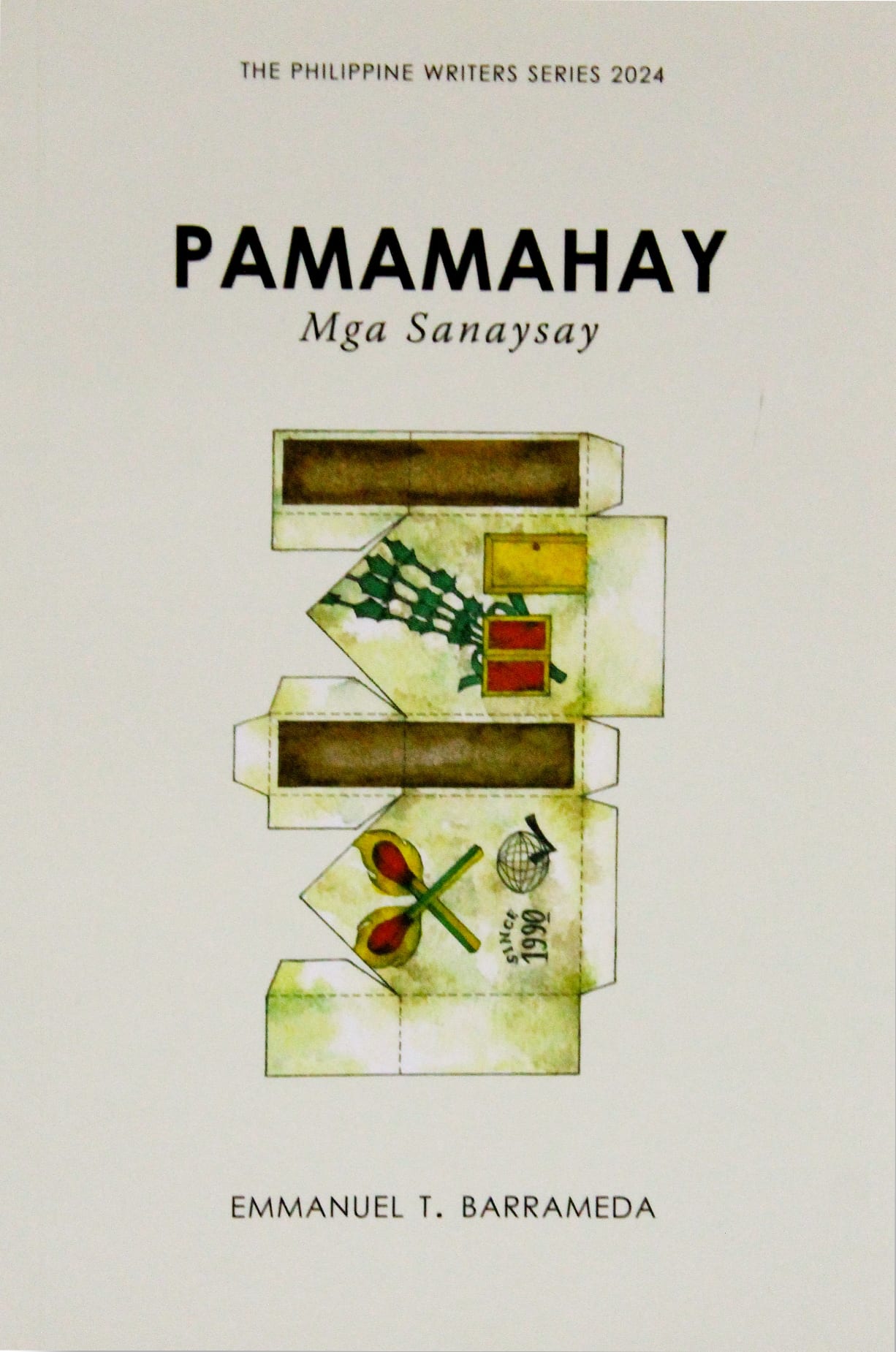
EMMANUEL T. BARRAMEDA’S Pamamahay: Mga Sanaysay, published as part of the Philippine Writers Series 2024, is a collection of eleven personal essays organized around the conceit announced in its title: the act of dwelling, of inhabiting, of making oneself at home in spaces that are never fully one’s own. The book traces Barrameda’s passage through a succession of houses—the house of Lola Mila in Caloocan with its enormous crucifix and its adoration-chapel-cum-office; the house of Lolo in Crame where discipline came in the form of bamboo switches kept beside the altar; the house of Mamalang in Virac where the scent of kusido greeted every arrival from Manila; the rented house in Estrella, San Pedro, Laguna, where he first lived with both his adoptive parents simultaneously; the small house in Imus that shrank and expanded with every emotional weather; the Bahay Laya in Tibang where solitude revealed itself as both liberation and sentence—and through each of these houses, Barrameda maps not merely a geography of displacement but a sustained investigation of how space produces identity, how the arrangement of furniture and the thickness of walls and the proximity of neighbors determine who one is permitted to become.
Allan Popa’s introduction unpacks the productive ambiguity of the word pamamahay itself: it names both the domain of the house and the process of acclimating to it, the struggle to become comfortable in a space that is not one’s own, the effort to belong where belonging is not guaranteed. This is not pananahanan, which implies rest, settlement, the cessation of restlessness; it is pamamahay, which is always active, always effortful, always marked by what Popa calls “ang pagiging estranghero bagama’t may pagsisikap na mapalagay.” The stranger who tries to settle. The settler who remains strange. And Pamamahay is the third in what Popa identifies as an informal trilogy that includes Balager (2020), which organized identity around the trope of mobility and vehicles, and Distrungka (2021), which recorded the devastation of typhoons and the pandemic, the physical destruction of the structures that shelter writing and selfhood. Pamamahay completes the arc by turning to the spaces that preceded the journeying, the houses that formed the consciousness that would later need to move, to be destroyed, to be rebuilt. Chronologically, Pamamahay precedes the other two; architecturally, it is their foundation—though Popa suggests that the experience of destruction recorded in Distrungka was precisely what sharpened the lens through which the essays of Pamamahay could be organized, even if many of them were drafted earlier.
What makes Barrameda exceptional among contemporary Filipino essayists—the claim requires precision, because vague praise helps no one—is his capacity to deploy narrative as the primary instrument of social understanding, to advance ideas through story rather than imposing them upon it, with such fluency that the reader absorbs multiple layers of analysis without ever feeling lectured. Popa names this quality directly: Barrameda is a kuwentista before he is a mananaysay, and the discipline of fiction—the management of temporal frames, the compression of meaning into image, the trust that the reader will complete the interpretive circuit the writer has prepared—is what he brings to the essay form.
“Bahay ni Santa,” the collection’s opening essay, establishes the method. The young Barrameda lives in the house of Lola Mila, a businesswoman whose sala doubles as an adoration chapel crowded with life-sized saints, whose locked cabinet of imported canned goods represents a class aspiration the child can taste but not articulate, whose ritual of dressing as Santa Claus every Christmas is simultaneously an expression of generosity and a performance of economic power. The essay moves through a childhood structured by prohibitions—the telephone that must not be touched, the television locked on religious programming and Middle East war coverage, the streets of C3 too dangerous for a child to explore—and the reader experiences the house not as setting but as argument, an argument about the intertwining of religion and commerce, about the way domestic space encodes hierarchy, about the distinction between sala and opisina and altar and bilangguan that the house itself refuses to maintain. When the narrator recounts how the donation box at the foot of Christ’s crucifix once funded his medical treatment during a childhood convulsion—Mama Jo told him the story later; it was Lola Mila who opened that box when both families had nothing—the connection between salvation and capital is made not through declaration but through narrative juxtaposition, through the essay’s faith that the reader will do the work the writer has prepared them to do.
This technique sustains itself across the collection’s strongest essays. “Sa May Gilid ng Kampo” extends the investigation of discipline and space to the grandfather’s house in Crame, where the thin bamboo switch—manipis na patpat ng kawayan—kept tucked beside the altar acquires a terrible double authority, sacred and sovereign, its proximity to the divine seeming to sanctify the welts it leaves on the cousins’ skin. A single stroke of the bamboo, the narrator tells us, was enough to make him wince from the sting—it cracked like a whip against their backsides. And yet the essay juxtaposes the grandfather’s measured violence with Papa Nhol’s, whose belt beatings the narrator describes elsewhere with the imagery of a typhoon: the warnings that accumulate like weather signals, the landfall of leather on skin, the moment at the storm’s peak when Papa Nhol bites his own tongue in frustration as he swings. The essay’s most devastating passage, though, is not any single account of punishment but the scene where the cousins gather afterward to compare notes, to construct their private ranking of which parent hits hardest, to transform shared violence into competitive game, bonding ritual, collective mythology, and in doing so to reveal that the violence has not merely disciplined their bodies but structured their entire social world, has become the shared language through which they know each other and themselves. Barrameda does not moralize; he lets the scene perform its own analysis.
“Bahay ni Mamalang” achieves a different register: elegiac, sensory, suffused with the kusido whose sour fragrance greeted every arrival by ferryboat, the terrace where Mamalang sat with her plants and told stories of golden ships and friendly giants beneath the sea, the lababo window from which you could once see the ferryboats arriving but which encroaching buildings would eventually wall off. The essay’s structural coup is its ending, where Barrameda returns years later to find the house literally halved—divided between two of Mamalang’s children—and discovers that the partition runs through memory itself: the kusina where Mamalang sat with her bilao of rice is now part of a separate household; the terrace and her chair are behind someone else’s wall. What was whole in childhood cannot be experienced whole in adulthood, and the halved house says this without the essay needing to.
“Estrella Dulo” works because it opens the house onto the dynamics of a marriage rather than merely staging childhood memories. Here Barrameda chronicles his first experience of living with both Mama Jo and Papa Nhol simultaneously—the fights conducted in near-whispers because only a thin plywood wall separates them from Auntie Bubo’s family next door, the argument over a pandesal invaded by a gecko that escalates into something approaching war, the Sacred Heart image Mama Jo installs atop the refrigerator with its electric eyes glowing—and the essay captures with precise tenderness the process by which two people who have spent years apart learn, or fail to learn, how to share a small space, how to calibrate their grievances to the dimensions of the room. “Motel sa Cubao, Isang Gabi” achieves a quietly devastating counterpoint: the motel as anti-home, a space designed for temporary occupation that becomes, for the peripatetic narrator, a recurring site of existential reckoning—the place where the maps out of the city, out of his job, out of his relationships are drawn during hours purchased from indifferent front desks. And “Bahay Laya” chronicles the paradox of the first solo dwelling, where freedom from family regulation gives way to the deeper challenge of solitude, a solitude so complete that during the pandemic lockdown, a stray dog named Ambon becomes the narrator’s primary companion, and a radio purchased for news becomes the substitute for human conversation—until Typhoon Rolly arrives and demolishes even this fragile independence.
The collection’s final essay, “Lipat-Bahay,” achieves a kind of synthesis, retracing the entire arc of displacement through the recurring image of packing and unpacking—the backpack that grows heavier with each move not because the possessions increase but because the self that must be folded into it accumulates more grief, more aspiration, more unresolved attachment—and culminating in the image of Mama Jo as hoarder, the woman who cannot discard the fast-food cutlery and election-season fans and chipped figurines because these small objects constitute her only tangible record of ownership in a life spent in houses that were never hers. Barrameda understands, without needing to state, that her hoarding is not pathology but mourning—mourning for the house she and Papa Nhol never managed to build, for the promise of stability that migration and poverty and bad luck conspired to deny.
NONE OF THIS means the collection is without limitation, and the limitations are worth naming because they suggest where the work might go next.
The first limitation is structural, and it concerns the collection’s relationship to its own conceit. The house-as-organizing-principle is powerful and generative, but by the later essays, the pattern has become, if not predictable, then perhaps too settled in its own method. Each essay follows a broadly similar arc: the narrator arrives at a new house, describes its physical and social topography, discovers something about himself or his family through the spatial arrangement, and departs. The departures accumulate into a rhythm that begins to feel, paradoxically, like its own form of stasis—repetition rather than progressive deepening. The strongest essays escape this pattern by taking the concept of dwelling into unexpected territory—the motel essay succeeds precisely because the motel resists dwelling; “Estrella Dulo” works because the house becomes a portal into the dynamics of marriage—but others settle too easily into the established grammar.
The second limitation is analytical. Barrameda is exceptional at deploying narrative as the vehicle for social understanding, but there are moments when narrative reaches its limit, when the material demands engagement that pure storytelling cannot provide. The question of class is everywhere in Pamamahay—the collection is, at its deepest level, a meditation on what it means to grow up without property in a society organized around property, to pass through houses that belong to others—but Barrameda never quite names this as a structural condition, never quite connects his personal experience of displacement to the broader political economy that produces millions of Filipino families in identical situations. “Bahay na Maliit,” with its account of the row house in Imus, the subdivision built for retired police and military, the neighborhood where everyone is from somewhere else—Bikolano, Ilokano, Cebuano, Bisaya—comes closest to this structural analysis, but even here the essay remains at the level of lived experience rather than structural analysis. The personal essay need not become a treatise on housing policy, but the form at its most ambitious finds ways to move between the specific and the systemic, to let the particular life illuminate the general condition without sacrificing intimacy for abstraction.
The third limitation concerns the collection’s treatment of adoption and identity. Barrameda’s discovery that Papa Nhol and Mama Jo are not his biological parents—a revelation narrated across several essays, most centrally in “Bahay na Maliit” and “Bahay sa Lalaogon”—is perhaps the most significant event in the book, the hinge on which the entire meaning of pamamahay turns. If the narrator is not the biological child of the people who raised him, then his displacement is not merely spatial but ontological: not merely a matter of moving between houses but of not knowing which house is truly his, which family is truly his, which name—Emmanuel Barrameda or Jerick Albert Tabinas—is truly his. The collection touches this revelation with restraint and emotional precision—the moment in “Bahay sa Lalaogon” when he learns his real birthday is in February, not under Gemini but Aquarius, “buwan ng mga kulang-kulang,” is handled with characteristic self-deprecating wit. But the book does not fully follow this crisis to its deepest implications for its own central argument. The discovery that identity is constructed rather than given, that the name on the birth certificate may be borrowed, that the family you call yours was assembled by accident and generosity rather than biology—this calls into question the very categories through which the essays have been organizing experience, and Pamamahay does not quite allow the revelation to disrupt the narrative method that the preceding essays have established. I say this not as a complaint but as a recognition that this book points beyond itself, creates the conditions for a reckoning it has not yet fully undertaken.
The Drumbeat, or the Voice That Will Not Sit Down
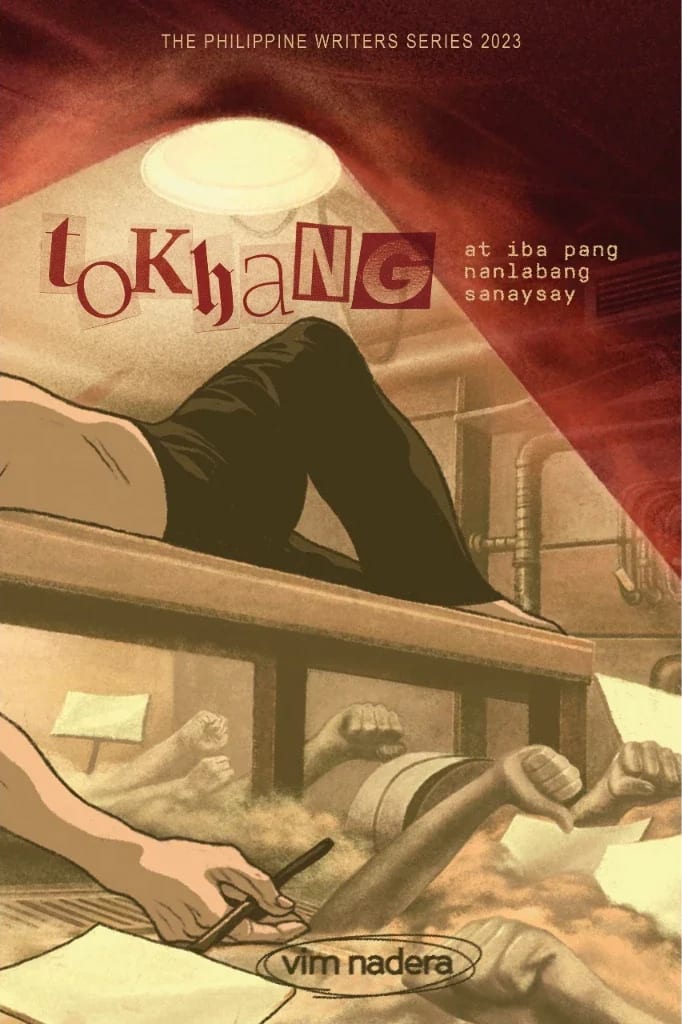
VIM NADERA’S Tokhang at Iba Pang Nanlabang Sanaysay, also from UP Press under the Philippine Writers Series (the 2023 series, though the book carries a 2024 copyright), poses an entirely different set of challenges for the critic, and these challenges begin with the question of what kind of book it is.
The collection gathers over thirty short pieces—most previously published in Rappler, Hataw, Liwayway, and Sanghaya—along with the substantially longer “Performatura: Ang Kaganapang Ginampanan ng Kagampang Panitikan?” with its pandemic-era appendix, “PPE Bilang Performatura Pandemic Edition.” These are framed by a prologue written by Nadera and an epilogue by the historian Zeus A. Salazar. The short pieces are, for the most part, occasional essays in the truest sense: written in response to specific occasions—a death, a festival, a policy announcement, a cultural controversy, a personal milestone—and carrying the marks of their occasional origins in their topicality, their immediacy, their assumption that the reader shares the writer’s moment.
This occasional quality is both the collection’s primary virtue and its most persistent formal problem.
The virtue first. When Nadera writes about tokhang—the title essay and the prologue that frames it—he performs the kind of obsessive etymological and cultural tracking that demonstrates what committed intellectual attention can do with the raw material of political language. The prologue recounts the research of Mark Angeles, who defended tokhang as “Salita ng Taon” at the Filipinas Institute of Translation conference, and Nadera meticulously enumerates Angeles’s findings: the word’s origins as a portmanteau of the Cebuano toktok (knock) and hangyo (request); its regional variants—kapak in Quezon City, patokhang in Bulacan, taphang in Cebu; its migration through police operations, media repetition, social media memes, film adaptations, even a wedding proposal; and its ultimate semantic transformation, captured in PDEA Director General Aaron Aquino’s damning admission that “ang connotation ng tokhang sa karamihan ng masa is killing.” This is valuable cultural criticism—the anatomy of a euphemism, the biography of a word that was designed to make state murder sound like neighborly concern—and it enacts the very kind of linguistic vigilance that the best public essays provide.
The five essays on mental health—“Lusog-Isip,” the three “Literatura at Lusog-Isip” pieces, and “Lakas Maka-Lusog-Isip”—represent another of Nadera’s sustained commitments: the relationship between artistic practice and psychological well-being, the possibility that poetry, performance, and visual art can function as therapeutic intervention. Nadera speaks from decades of practice here—the work with cancer survivors at St. Luke’s Medical Center beginning in the 1990s alongside Dr. Isabel Echanis Melgar, the sessions with drug rehabilitation patients at the Treatment and Rehabilitation Center in Tagaytay under Susan Ople’s Citizens’ Drug Watch in 2001, the CCP Art Therapy Program for children affected by natural disasters across Legazpi, Naga, Daet, Tanay, Borongan, and beyond. The “Lusog-Isip” essays carry the authority of a practitioner who has been in the room, who has watched poetry do things that clinical intervention alone cannot.
And in the “Alim” sequence—three essays that constitute perhaps the collection’s emotional center—Nadera traces his own trajectory as arts therapist through the most devastating personal loss: the death of their third child, Awit. “Halos maulol kami sa aming pagtumba,” he writes in “Alim 2,” and from this collapse, he and his wife Ellay founded the organization whose name memorializes their child—Foundation AWIT, Advancing Wellness, Instruction, and Talents. The reader understands that the advocacy for arts-as-therapy is not merely an intellectual position but a survival strategy, a way of continuing to live in a world that has taken something irreplaceable. When the “Alim” essays move from this personal grief outward to the comfort women—the lolas whose decades-long demand for justice from Japan Nadera has supported through classroom visits and solidarity performances—the essays achieve a connection between private loss and public mourning that is genuinely affecting.
The “Maligayang Pasko Po, Lola!” sequence—three essays that initially seem, from their titles, to promise something intimate and domestic—is, in fact, the collection’s most sustained engagement with the comfort women’s struggle. Here Nadera documents the visits his UP students made to the surviving lolas under the auspices of LILA Pilipina, the organization founded by Nelia Sancho, and traces the history of the movement from Lola Rosa Henson’s courageous testimony in 1992 through the contentious Asian Women’s Fund, to the dwindling ranks of survivors—“kung noon sila ay mahigit isangdaan, ngayon wala pa silang sampu”—and the voice of Lola Estelita Dy, still calling in 2022 for the three things the lolas have demanded since 1994: a formal public apology from the Japanese government, compensation, and inclusion in historical textbooks and curricula. The sequence achieves something the shorter occasional pieces often do not: a cumulative deepening across its three parts, a sense that returning to the subject across time reveals dimensions that a single essay could not capture.
And “Performatura,” the collection’s longest and most expansive piece, attempts to theorize and document Nadera’s practice of performance literature—the synthesis of poetry, theater, visual art, and audience participation that he developed through the Performatura International Performance Literature Festival at the CCP in 2015, 2017, 2019, and 2021—and while the essay is unwieldy, digressive, and catalogs events and participants with the comprehensiveness of an institutional report, it also constitutes a valuable record of an experimental practice that has no equivalent elsewhere in Philippine literary culture.
THE PROBLEMS WITH Tokhang at Iba Pang Nanlabang Sanaysay are different in kind, and in some ways more fundamental.
The most significant is coherence—not merely thematic coherence, which a collection of occasional essays need not possess, but the coherence of vision, of formal ambition, that distinguishes a book from a compilation. Pamamahay is unquestionably a book: its essays build on each other, develop a sustained argument about space and identity that emerges from accumulation and is available only through the experience of reading the collection whole. Tokhang is, more honestly, a compilation: a gathering of pieces whose primary connection is that they were written by the same person and share certain recurring preoccupations. The arrangement does not generate structural meaning. The lusog-isip essays, for instance, are scattered across the collection rather than grouped, and reading them in sequence reveals that they repeat certain formulations and arguments without substantially deepening them; the reader who has absorbed one has largely absorbed what the others offer. The cultural advocacy pieces—“Kulturado Ka Ba?”, “Nasaan ang Mindanao sa Sining Filipino?”, “Araw ng mga Aklat at Akdang Bayan”—share a rhetorical mode (exhortation) and a structural pattern (survey of accomplishments followed by call to further action) that becomes, across the full collection, wearying rather than illuminating.
This matters because the award under consideration is for the best book of nonfiction prose, and a book, in the fullest sense, is not a container but a form—an architecture that shapes how the pieces within it mean. The question is whether these pieces, placed in this sequence, produce something that none of them could produce alone, whether the reader who has read all thirty-plus essays understands something that the reader of any five does not. I found myself uncertain, reading Tokhang, that the answer was yes—though I want to leave room for the possibility that the accumulation works on the reader in ways that are harder to name than the architectural coherence of a book like Pamamahay, that the sheer persistence of Nadera’s presence across these pages constitutes its own kind of argument, even if it is not the kind of argument I am trained to recognize as structure.
The second problem is rhetorical. Nadera writes in short, punchy sentences and paragraphs—often a single sentence per paragraph, sometimes a single phrase—and this style, effective in newspaper columns and online periodicals where attention must be seized against surrounding content, becomes, in the context of a book meant to be read continuously, a form of rhythmic monotony. The staccato delivery, the rhetorical questions that pile without resolution, the dependence on lists and catalogues—these are techniques that serve the column writer but that the book writer must learn to vary, to modulate, to set against other rhythms. The contrast with Barrameda is instructive: Barrameda builds long, fluid sentences that carry the reader through multiple temporal and spatial frames, sentences that trust the reader to hold several threads simultaneously; Nadera fragments, insists, repeats, declaims. Both rhythms are valid; both have their uses; but across the nearly two hundred pages of Tokhang, I found the staccato more difficult to sustain than the long breath Barrameda asks of his reader across Pamamahay’s hundred and fifty.
The third problem is the collection’s relationship to its own author. Nadera is an inescapable presence in every essay—as participant, advocate, witness, organizer, performer, foundation founder, panelist, workshop director, host, and, as the recurring phrase has it, “inyong abang lingkod.” This presence reflects genuine commitment to cultural work, decades of tireless labor in the institutional spaces where Philippine literary culture is produced and sustained. But across a full collection, the reader comes to feel less that they are reading essays about their ostensible subjects—tokhang, mental health, performance literature, indigenous weaving, the comfort women—and more that they are reading essays about Vim Nadera’s involvement with these subjects. This displacement of subject by author produces a curious flattening: every topic comes to seem roughly equivalent because every topic is ultimately a vehicle for the same story, the story of the practitioner who was there, who participated, who made things happen.
I want to be careful here, because there is a version of this critique that is simply unfair—Nadera writes from experience, and experience requires a self, and the self that has done the work has earned the right to say so. Salazar’s epilogue praises precisely this quality: “Masalimuot na manunulat si Vim Nadera, malawak ang orisonte at tingin ng kaniyang diwa.” The essays are not egotistical; they are testimonial. But testimony is not yet inquiry, and the essay at its most powerful is an instrument of inquiry—a form that asks questions it does not already know the answers to, that follows its material into territory that surprises the writer as much as the reader. Nadera’s essays tend to begin with convictions and marshal evidence in their support, tend to know where they are going before they depart, tend to confirm rather than complicate, and this tendency, however well-intentioned, limits what the essays can discover.
WHAT DO THESE two books tell us, together and in their very twoness, about the state of nonfiction prose in Filipino in 2024?
They tell us, first, that the field—or at least the portion of it that arrives at the National Book Award—is narrower than one might hope, narrower than the richness of Filipino intellectual and literary culture would lead one to expect. The novel categories produced five finalists each; the short fiction categories produced four and five; nonfiction prose in Filipino produced two. Whether this disparity reflects a genuine scarcity of published essay collections in Filipino, or a gap between what is published and what is submitted, or the essay’s persistent ontological insecurity—its need to prove, through adjectives and qualifications, that it belongs among the literary forms at all—I cannot say with certainty. But the thinness of this shortlist, whatever its causes, is itself a provocation, and perhaps the most useful thing a critic can do with a provocation is not to explain it away but to let it stand as a question addressed to the institutions and writers who will determine whether next year’s shortlist is longer.
They tell us, second, that despite this thinness, the two major traditions of the Filipino essay—the personal and the public, the meditative and the occasional, the lyrical and the rhetorical—are both alive and producing work of genuine ambition. This duality is not weakness but range, not impoverishment but breadth, and a healthier ecosystem would include not only more books in each tradition but books that combine them, that bring the personal essay’s depth of attention to the public essay’s breadth of concern, that find in the structures of collective life the same intimate complexity that Barrameda finds in the structures of domestic space.
They tell us, third, that the personal essay in Filipino has, in Barrameda’s hands, reached a level of formal accomplishment that extends the form’s possibilities. What Barrameda adds to the tradition of the Filipino essay is a narrative fluency borrowed from fiction—the fiction writer’s capacity to manage multiple temporal frames, to compress meaning into image, to trust the reader—that allows the essay to move with the suppleness and momentum of a short story while retaining the essay’s distinctive privilege of stepping outside narrative to think. The Filipino essay has long been capable of lyricism and reflection; what Pamamahay demonstrates is that it is also capable of the kind of sustained, architecturally complex storytelling that one more typically associates with fiction, and this expansion of the essay’s technical vocabulary is a contribution that will outlast any individual judgment about any individual book.
And they tell us something about the question every assessment must finally confront: which of these two books contributes more to the state of literature, and in particular to nonfiction prose in Filipino, in 2024? I have tried to be specific about the strengths of both—Barrameda’s narrative precision, his structural intelligence, his capacity to make the personal resonate beyond the personal; Nadera’s linguistic vigilance in the tokhang material, his decades of arts-therapy practice documented in the lusog-isip essays and the “Alim” sequence, his record of the comfort women’s ongoing struggle in the “Maligayang Pasko Po, Lola!” essays, his documentation of the Performatura practice. And I have tried to be equally specific about their limitations—Barrameda’s analytical reticence, his occasional structural repetition, his reluctance to follow the adoption revelation to its fullest implications; Nadera’s compilation-over-book problem, his rhetorical monotony, the displacement of subject by author that flattens the collection’s range.
When I weigh these achievements and limitations, what I find is that Pamamahay is the more fully realized book—more formally coherent, more capable of sustaining the reader’s attention across its length, more revelatory of what the essay in Filipino can become when it trusts its own materials and methods. Barrameda has written a book that earns its existence as a book, that achieves through accumulation and arrangement a meaning no individual essay contains, that demonstrates the essay’s capacity to hold what the houses it describes could not: the memory of how it felt to live there, the knowledge of what the rooms meant, the understanding that space is never innocent, that every house is an argument about who deserves to dwell and who must move on.
But I want to end not with a verdict but with a recognition, one that the twoness of this shortlist makes unavoidable. The sanaysay in Filipino deserves more than two finalists. It deserves the kind of ecosystem in which collections argue with each other, expand the form’s possibilities, bring new voices and new methods and new subjects into the conversation—an ecosystem robust enough that the shortlist, whatever its final number, reflects genuine contest rather than scarcity. The essay in Filipino has the tradition, the practitioners, and the language to support such an ecosystem; what it needs are the material conditions—the publishers, the platforms, the readership, the institutional support — that would allow that tradition to flourish. The two books before us, for all their differences, agree on this much: the essay in Filipino matters, deserves the sustained attention that literary culture reserves for its most serious forms, and is capable, when that attention is given, of holding truths that no other form can hold in quite the same way. Two finalists are not enough. And yet these two, different as they are, suggest a form far wider than the thinness of this year’s shortlist would imply.
Edgar Calabia Samar is Associate Professor and Chair of the Department of Filipino at Ateneo de Manila University. He is the author of the award-winning Janus Silang series and of several other novels, including Teorya ng Unang Panahon, a Palanca and National Book Award winner currently being translated into English as Theory of a Long Time Ago by PEN Presents x International Booker Prize winner Christian Benitez, under a National Book Development Board translation grant. His first novel, Walong Diwata ng Pagkahulog, received the NCCA Writer’s Prize in 2005, and its English translation, Eight Muses of the Fall, was longlisted for the 2009 Man Asian Literary Prize. He previously served as Visiting Professor at Osaka University from 2017 to 2022 and as Writer in Residence at the University of Iowa in 2010. He is the Head of the National Committee on Literary Arts of the National Commission for Culture and the Arts and a member of the Filipino Critics Circle, formerly the Manila Critics Circle, the Filipinas Institute of Translation, and LIRA, where he served as President from 2001 to 2003. In 2024, he received the S.E.A. Write Award from the Royal Family of Thailand for his contributions to Southeast Asian literatures. He develops literature and novel-writing guides and maintains a growing Filipino komiks archive through Santinakpan Otherwise on patreon.com/ecsamar.
READ MORE:
What the Novel Remembers When the Nation Forgets: On the finalists for the 43rd National Book Award for Best Novel in Filipino
What the Novel Carries When It Leaves: On the finalists for the 43rd National Book Award for Best Novel in English
What the Stories Hold When the Collection Gathers: On the finalists for the 43rd National Book Award for Best Collection of Short Fiction in Filipino
The Gathered and the Gathered Against: On the finalists for the 43rd National Book Award for Best Collection of Short Fiction in English.
Edgar Calabia Samar is an award-winning poet, critic, and novelist, and an Associate Professor at Ateneo de Manila University. IG: @ecsamar.
View More Articles About: