The Tongue and the Terrain: On the Finalists for the 43rd National Book Award for Best Book of Poetry in Filipino
These books tell us that the poetry collection in Filipino is capable of ambitions it is not always given credit for.
Published on Apr 19, 2026
EVERY ONE of these five books knows where it stands. Not metaphorically—though metaphor will arrive soon enough—but geographically, bodily, in the manner of feet on particular ground. One stands in a guerrilla camp in the mountains of Bikol, where the ground is mud and root and the forest closes behind you like a door. Another stands by the river in Macalelon, Quezon, where the water carries the dead and the living in the same current. A third stands on the asphalt of Manila, where a homeless man’s body is dragged across the concrete of Avenida Rizal and the city forgets him before his coins stop rolling. A fourth stands on a mountain where cloud swallows the summit and the distinction between drowning and ascending dissolves. And the fifth stands in a cockpit in southern Quezon, where a figure with a belly and a stitch on his side sits on a bench and the crowd begs him for winning numbers rather than salvation.
I begin with ground because ground is what these five collections share, and because the relationship between the poet’s tongue and the terrain it names is, I think, the most productive way into the question of what poetry in Filipino achieves in 2024—more productive, at least, than the questions of form or theme or tradition that might organize a different kind of assessment. In my earlier essays for this year’s National Book Awards—on the novel in Filipino and English, on the short story collection in Filipino and English, on nonfiction prose in Filipino and English—I have approached each set of finalists through the question that seemed most urgently posed by the form itself: what the novel remembers, what the collection gathers, what the essay opens. For poetry, the question that presses hardest against me as I read these five books is not what the poem says but where it speaks from, what ground it stands on when it opens its mouth, because a poem in Filipino is always already a claim about territory—about whose Filipino, from what province, from what body, from what class position and education and history of loss, and these territorial claims are never innocent, are always shaped by the centuries of violence that determined which tongues were allowed to speak and which were silenced, which grounds were mapped by the colonizer and which were left as ilang, as wilderness, as the unmapped space where other kinds of knowing persist.
The five finalists under consideration are Duongan by Mikka Ann V. Cabangon, Kampuhan by Ma. Cecilia C. de la Rosa, Landas sa Ilang by Ronald Araña Atilano, Lubog sa Ulap by Emmanuel Quintos Velasco, and Volto Santo by Pat Baloloy Jr. They come from different corners of the institutional landscape that sustains poetry in Filipino: two from the University of the Philippines Press (Kampuhan and Volto Santo), one from LIRA (Landas sa Ilang), one from Balangay Books (Duongan), and one from San Anselmo Publications (Lubog sa Ulap). These different sites of production matter—they tell us something about the infrastructure that makes poetry in Filipino possible, about the university presses and literary organizations and independent publishers that decide which voices reach the permanence of a book—but what matters more, for the purposes of this assessment, is what happens when you hold these five books together and ask not only whether they contain good poems but whether they achieve the more difficult ambition of being good books, whether each collection constitutes a project that produces knowledge no individual poem within it could generate alone. This is the question that the form of the award invites, perhaps without always knowing it invites it: not whether these poets can write good lines—all of them can—but whether they have built books, whether the arrangement and accumulation produce something that no individual poem could produce alone.
The World Entire: Ma. Cecilia C. de la Rosa’s Kampuhan
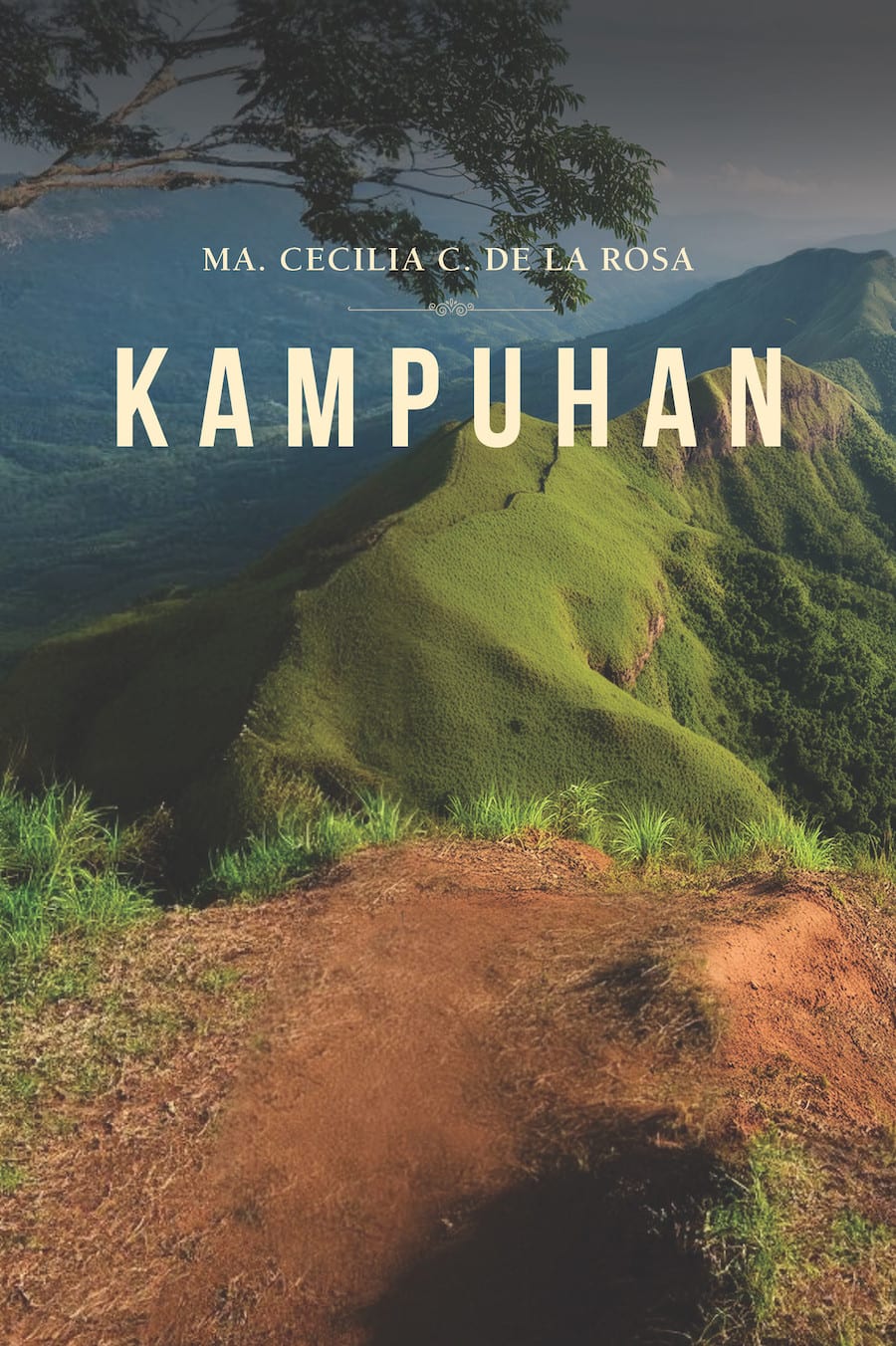
Let me begin with what I believe to be the most singular achievement among the five finalists, a book that invents its own form so thoroughly that by the time you finish reading you understand that no other form could have held what it needed to hold. Kampuhan by Ma. Cecilia C. de la Rosa is a collection of poems set in and around a guerrilla camp in the mountains of Bikol—a revolutionary kampuhan whose organizational vocabulary (Partido, Hukbo, kadre, gawaing masa, Ang Bayan) leaves no ambiguity about the political formation it documents—and the fact that this description might immediately activate certain expectations, expectations about propaganda or polemic or the romanticization of armed struggle, is precisely what makes the book’s actual achievement so remarkable, because what De la Rosa has written is neither propaganda nor polemic nor romance but something far more honest and far more difficult: a testimony of daily life in the revolution that attends to what daily life always attends to, which is the irreducible particularity of bodies in specific places doing specific things, loving specific people, eating specific food, feeling specific cold, and mourning specific dead.
The collection’s governing formal decision — each poem titled after an object, a practice, a creature, or a condition of camp life: Sundang, Radyo, Duyan, Ismagol, Natóng, Plastik, Blakbord, Pugon, Kabiba—transforms the book into something like an anthropology of a world that most readers will never enter and that the state has spent decades trying to destroy. By organizing around objects rather than events or arguments, De la Rosa allows the poems to accumulate into a picture of a lifeworld—not the lifeworld of revolution as ideology but the lifeworld of revolution as daily practice, as the work of cooking and teaching and loving and being afraid and being cold and being lost that constitutes the texture of life in the forest, and this texture is what gives the collection its devastating power, because it is precisely the texture that political discourse—whether from the left or the right—tends to erase in favor of abstraction. The collection also moves between voices and perspectives—the radio operator, the medic, the cultural worker, the new recruit, the lover, the one left behind—and this choral quality gives the kampuhan the depth of a community rather than the flatness of a single consciousness.
Consider “Sinaing,” which might be the collection’s most complete enactment of its own logic. The speaker rises before dawn to cook rice for the platoon, reaches under a comrade’s hammock for the sack of bigas, and wakes the sleeping Ka Mon, who introduces himself with a handshake in the formal manner of comrades meeting for the first time. The speaker thinks: Teka lang, sa loob-loob ko, / Hindi kita kilala. Teka lang, / Sa loob-loob ko, ang aga-aga pa—Wait, I think, I don’t know you; wait, I think, it’s so early—and in that utterly human reluctance to receive a stranger’s confession before dawn, the entire edifice of revolutionary heroism is both honored and complicated. But the poem does not stop there. The speaker recognizes Ka Mon as someone rumored to have come from the university, and then asks: ikaw ‘yong nagmungkahi / Kay Ka Melchor?—and the parenthetical that follows is one of the most quietly devastating lines in the collection: (Unang halimbawa ka / Ng lalaking nagmahal sa kapuwa / Lalaki sa buong larangan, sa buong probinsiya, / Malamang sa buong rehiyon.) Ka Mon is the first man known to have loved another man in the entire zone, perhaps the entire region—and the poem does not dwell on this, does not explain or celebrate or condemn, simply names it as fact and moves on. And then Ka Mon retreats into his hammock, wraps himself in his malong: Ilag sa tanong. In a single poem, De la Rosa has rendered the pre-dawn intimacy of a kitchen encounter, the awkwardness of meeting a stranger when you would rather be alone, the revolutionary’s tenderness and reticence, and the queer life that exists within the revolution but cannot yet be fully spoken—all in the time it takes rice to cook. And then, in a devastating section break: Sa agahan natin itutuloy / Ang susunod na labing-apat / Na taon— In breakfast we will continue the next fourteen years—collapsing decades of shared struggle into the space between two meals.
This is what the collection does again and again: it finds in the small the enormity that the large obscures. “Kontrata,” the wedding poem, is set in the kitchen— Ang kubo ng mga kubo— / Ang kusina —because in the kampuhan the kitchen is the center of communal life, and the ceremony involves raising fists rather than exchanging rings, and signing invented names on old paper, and the speaker’s vulnerability is not that the marriage might fail but that the beloved will hear this voice— Pasensiya na, Kasama, kung sasabay pa ako. / Ngunit nasa tinig na ito ang naipong ligaya. / Tiisin mo sana ang garalgal kong harana!— Bear with my hoarse serenade!—and this roughness of voice, this accumulated joy that cannot be sung prettily, is the detail no propagandist would think to include and no poet who has not lived this life could invent. “Laptop” achieves something different but equally remarkable: the speaker opens the encrypted laptop of an absent comrade— someone lost after a siege— and discovers not revolutionary documents but a doubly encrypted folder of self-help articles and videos: Paano makipagkapuwa? / Paano makitungo sa mga katrabaho? / Paano maging mabuting boyfriend? / Paano maging mabuting tao? / Bakit malungkot ang mag-isa?—and the poem becomes an elegy not for a revolutionary but for a human being who was struggling, as we all struggle, with the basic questions of how to be in the world with others, and who sought answers in the same clumsy, desperate way that anyone with internet access and a private shame might seek them.
If the collection has a limitation, it may be one that is inseparable from its strengths. The voices, while varied, all speak from within the revolutionary formation, and there are moments when the masa— the masses whose lives the revolution claims to serve—might have been allowed fuller presence as subjects with their own complexity rather than as figures who welcome or fear the guerrillas. “Akyu,” in which the speaker gives acupuncture to a suspicious old woman who gradually warms to them, gestures toward this possibility but does not fully inhabit it. And the later poems, particularly “Relief Map” and “Pasulong,” occasionally move toward a register that feels closer to the organizational vocabulary the rest of the collection so effectively resists. These are minor reservations about a collection that achieves something major: a book that transforms the kampuhan from a political abstraction into a habitable world, a world with natóng and duyan and a dog named Rebo who gets high sniffing the latrine, a world where a panadero joins the revolution and bakes pandesal in the forest and then leaves one dawn because he believes no one loves him—Hindi totoo ang akala niya—What he believed was not true—and in that single line, the speaker’s grief and the community’s failure to communicate its love are held together without resolution, without comfort, without the false assurance that the revolution makes everything bearable.
The Labyrinth and the Clearing: Ronald Araña Atilano’s Landas sa Ilang
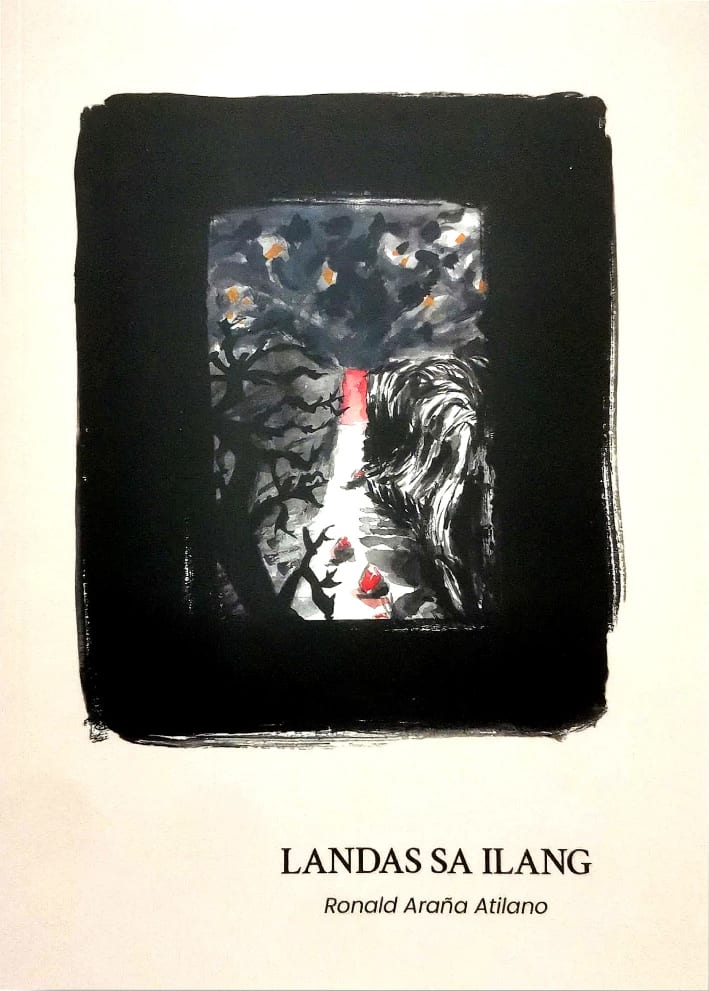
If Kampuhan derives its power from the singularity of its world, Landas sa Ilang derives its own from the breadth of its formal range. This is the most technically accomplished collection among the five finalists, a book that moves with striking confidence between metered verse, free verse, prose poetry, and concrete poems, between the intimate lyric and the sweeping political allegory, between the streets of Manila and the temples of Kyoto, between the deep past of Philippine mythology and the immediate present of drone warfare and the Kramatorsk railway station massacre. The collection is organized into five sections—“Laberintong Lungsod,” “Mga Bagong Mito,” “Ang mga Estasyon,” “Mga Ibong Itim,” and “Ningas sa Ulap”—and each section represents a different mode of poetic attention, and the cumulative effect is of a poet who has spent decades refining his craft and now possesses the resources to address virtually any subject from virtually any angle.
“Isang Pulubing Natagpuang Patay sa Sta. Cruz” achieves something difficult in poetry about poverty—it renders the death of a homeless person on a Manila street with both precision and dignity, without sentimentality and without the pornography of suffering that lesser poems about destitution tend to produce. The poem’s power comes from its refusal to moralize: it simply describes what happens when a body is found on a sidewalk—the rubberneckers, the kicking to see if the corpse might rise tíla Kristo sa bunton ng mga basahan, the dragging across concrete—mistulang palapà ng niyog o lumang linolyum—and then the avenue returning to its rhythms, the traffic light changing, the devastating final observation: Kayrami pang mga kanto’t katawan / Bago makarating sa Monumento—so many more corners and bodies before reaching Monumento.
“Dalawang Bersiyon ng Alamat ng Kanin” is perhaps the collection’s most devastating juxtaposition—a prose poem in two sections that juxtaposes the mythological origin of rice (the gods offering white grains to suspicious ancestors who mistake them for worms) with a contemporary news segment in which a street child, asked what food he dreams of for Noche Buena, confounds the reporter by answering “kanin” instead of the expected McDo or Jollibee, and then the camera lingers as the children roast three white, soft, almost sticky grubs over a makeshift fire, and the poem’s final image completes a circle that is both mythologically resonant and politically unsparing, because it shows that the foundational myth of nourishment has been reversed: it is no longer the gods who must convince us to eat what looks like worms, but capital that has arranged the world so that children eat actual worms while rice remains a dream. “Pagbabalik-loob sa Paraon” extends this political vision into allegory—a poem ostensibly about the Israelites’ temptation to return to Pharaoh but unmistakably about the Philippine electorate’s return to the Marcos dynasty—and Atilano handles the allegory with sufficient restraint that it sustains its mythic register throughout, allowing the reader to arrive at the connection rather than being directed to it. The concrete poem “Arkipelago,” which shapes its text on the page to resemble the fragmented body of the Manaul—the mythological bird whose destroyed body became the Philippine islands—demonstrates that formal innovation in Filipino poetry need not be an imported gesture but can emerge organically from indigenous material.
The collection’s range is also, perhaps inevitably, the source of its one vulnerability as a book. Where Kampuhan achieves the coherence of a singular world sustained from first page to last, Landas sa Ilang occasionally reads as the selected poems of a career rather than a unified project, and there are moments—particularly in some of the travel poems in “Ang mga Estasyon”—where the poet’s considerable skill operates in the service of observation that, while finely rendered, does not carry the urgency that charges the best poems in the collection. The Kyoto and Ayutthaya poems are beautiful but feel at times like the work of a different, more composed poet than the one who wrote “Nang Ipagbawal ang Paputok sa Bagong Taon,” whose final image—of bodies appearing nightly in canals and eskinitas now that the firecrackers no longer ward off the agents of darkness—carries a force that the temple poems, for all their grace, do not approach. “Gabí ng mga Orador,” the long poem about the midnight speakers at Luneta, may be the closest the collection comes to fusing formal ambition with political vision in a sustained way, and its final image—the orators waking at dawn sa nagliliwanag na mga damuhan ng Getsemane—suggests what the collection might have been if more of its poems had dared this level of reach. But this is the cost of ambition, and on balance, the ambition is worth paying for, because what Landas sa Ilang demonstrates is that a Filipino poet can work at the level of formal mastery we associate with the most accomplished poets in any language, and can do so while remaining rooted in Philippine material.
The River as Archive: Mikka Ann V. Cabangon’s Duongan
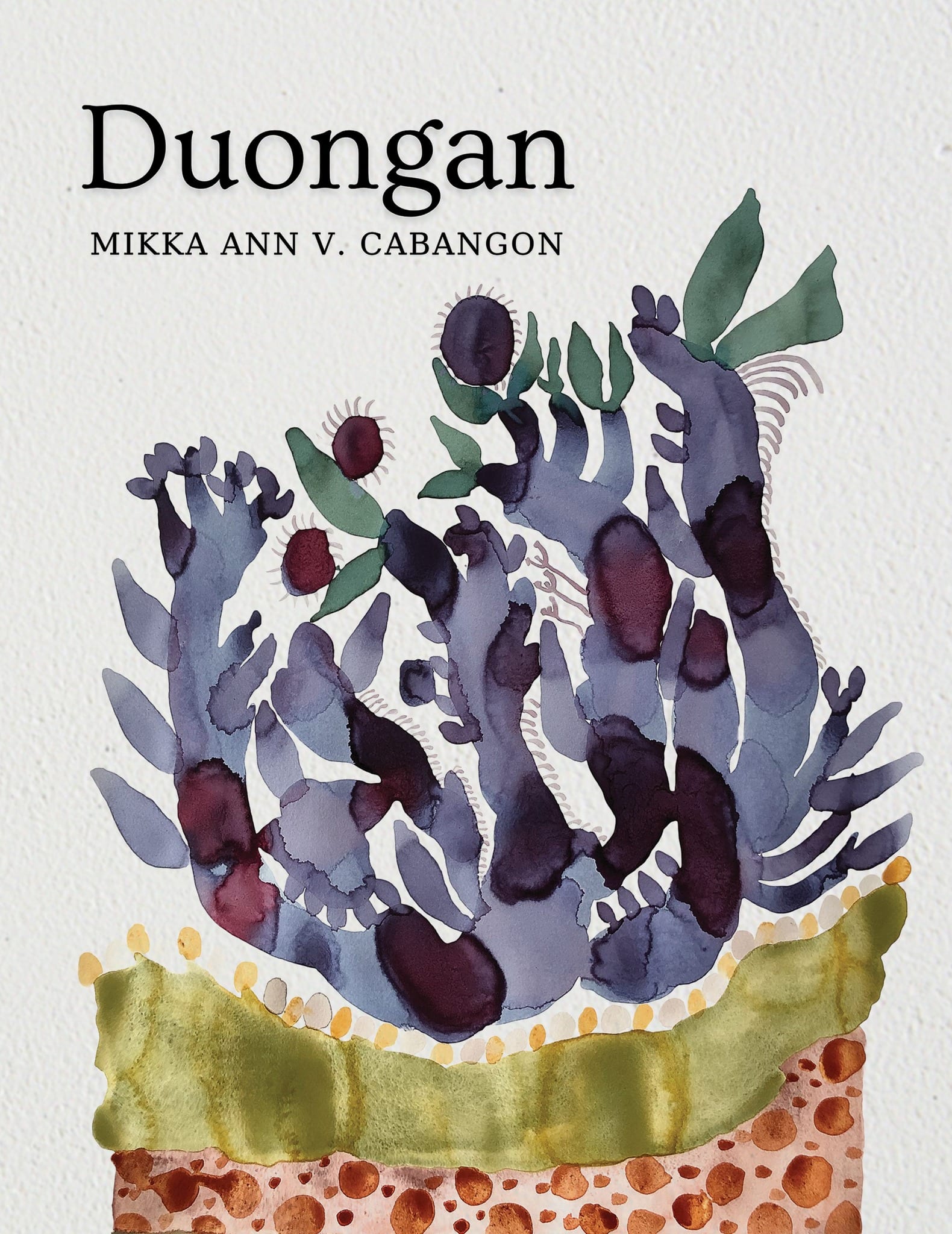
Duongan is the quietest of the five finalists, and its quietness is both its distinction and its limitation. Cabangon’s collection is rooted almost entirely in the town of Macalelon, Quezon, and specifically in the Duongan—the stretch of river that gives the collection its name and its organizing metaphor. The river is mother, memory, witness, and portal: in the opening poem “Bong-aw,” a creek speaks in the first person, recounting how it was once a dying sapa until a grieving young man arrived at its banks, sang a song of the dead, wept, and loved the stream into becoming a river—Ako’y naging ilog / sa kaniyang pag-ibig—and then leapt into its depths and did not resurface, and the creek reveals its name: ako ang Bong-aw, / ang dungawan / sa kabilang mundo—I am the Bong-aw, the window to the other world. In this revelation the collection announces its governing concern: the permeability of the boundary between the living and the dead, between the human and the more-than-human, between the material world and the spirit world that inheres within it.
The poems that follow unfold as a series of returns—to childhood, to the river, to the provincial landscape of palayan and niyogan and kakahuyan that constitutes the speaker’s foundational world. “Pisukan,” about smoking out wild bees to harvest their honey, achieves a sensory precision that carries you into the experience: the golden house revealed, the incomparable sweetness, the speaker’s confession that the taste has lingered as intoxication—lumikha ng bahay sa aking dila / ang pisukan—the honeycomb built a house on my tongue. “Paninima,” about a grandmother gathering shellfish in the ebbing river, renders the older woman’s body as a site of knowledge—the hands that know the riverbed, the patience that is itself a form of transmission—and closes with the grandmother in a wheelchair, tahimik mong pakikinggan ang ilog, listening silently to the river, and the reader understands that what is being transmitted across generations is not information but a mode of attention, a way of being with the non-human world that Filipino modernity is systematically destroying.
“Sa Aking Palad,” addressed to a figure— mother or grandmother—who used to place frogs in the child’s unsuspecting palm, achieves genuine emotional force in its final turn: At ang inilagay / mo sa aking palad ay mga gunita, / tumatalon tuwing ibubukás / ko ito sa aking pag-iisa—And what you placed in my palm were memories, leaping each time I open it in solitude. The metaphor works because it has been earned by the specificity of the scene—we believe in the frog before we are asked to believe in the memory. Cabangon is also a visual artist (working under the name Maya Leon), and the book includes her paintings, and this dual practice suggests a sensibility attuned to the material world in ways that the poems at their best honor.
Where the collection struggles is with the challenge of sustaining this intimacy across an entire book without the poems beginning to repeat their gestures. Several poems rely on similar structures—the childhood scene rendered in sensory detail, the turn toward loss or absence in the final lines, the invocation of the natural world as repository of what has been taken—and while each poem may succeed individually, the cumulative effect sometimes feels circular rather than progressive, as though the collection is returning to the same emotional territory rather than deepening it. The poems set outside Macalelon—“Superlines,” about a bus journey; “The Sleeping Gipsy, 1897,” an ekphrastic poem after Rousseau—sometimes lack the grounded authority of the river poems, as though the poet’s power is genuinely tethered to the landscape that nourishes it and diminishes when transplanted.
And yet Duongan is a first collection, and it announces a voice worth following—a voice that knows where it comes from and is not embarrassed by the provinciality of that knowing, a voice that insists, against the metropolitan biases of Philippine literary culture, that the river-town is not the periphery but the center. The strongest poems here—“Bong-aw,” “Paninima,” “Bangka,” “Anag-ag ng Duongan”—suggest a poet for whom the collection-as-book problem may resolve itself over time, as the voice deepens and the river, which already knows so much, is allowed to teach its poet what it has not yet finished saying.
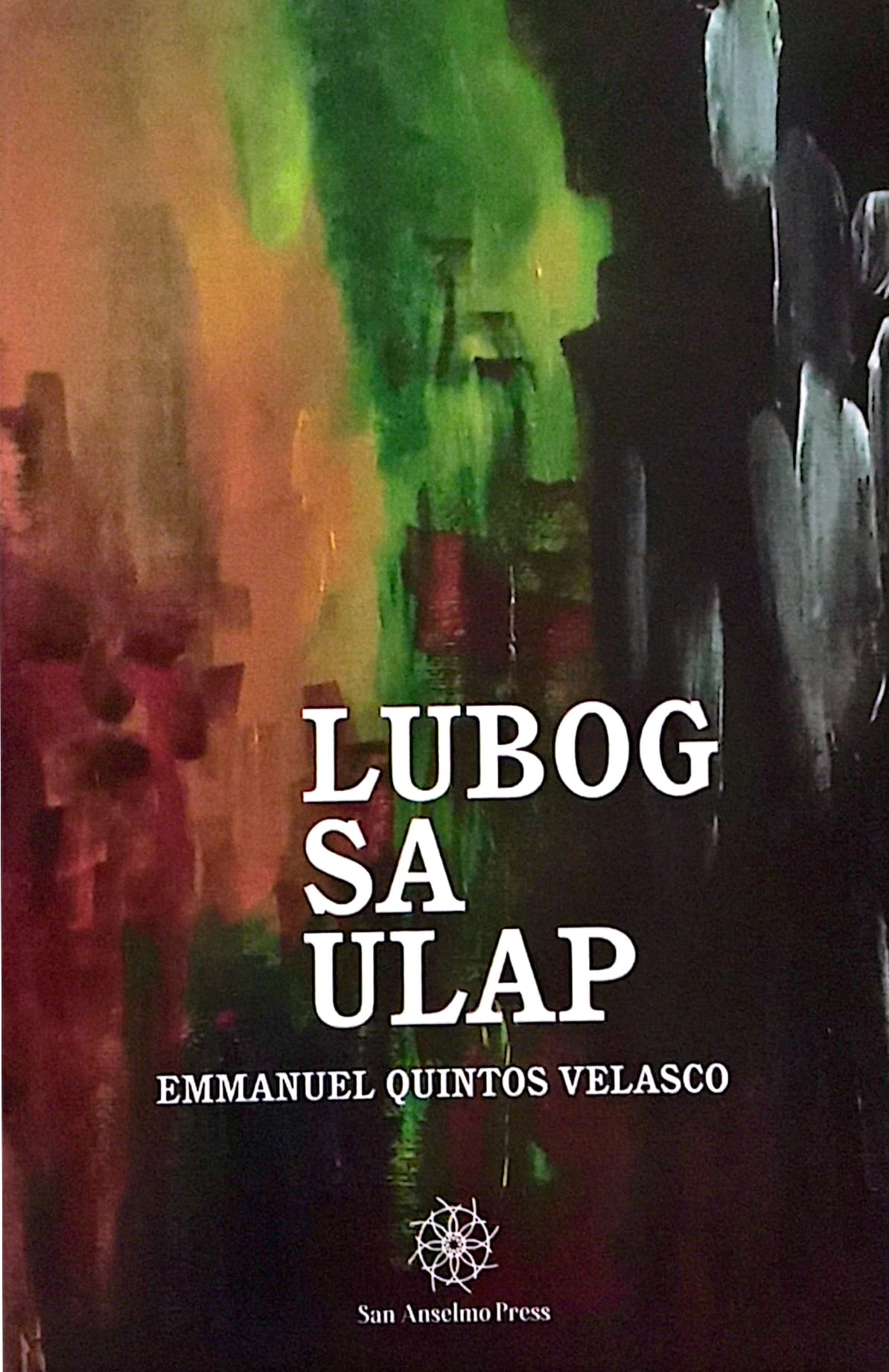
The Cloud That Drowns: Emmanuel Quintos Velasco’s Lubog sa Ulap
Lubog sa Ulap—submerged in cloud— is the most meditative of the five finalists, organized around recurring images of light, darkness, and the paradox of drowning in what should be weightless. The book is dedicated to the poet’s brother Roland Quintos Velasco, who died of COVID-19 in 2021, and this dedication casts a particular shadow across the poems that follow, many of which can be read as attempts to find orientation in a world that the pandemic revealed as fragile and contingent, where the structures that promised to hold you— the job, the routine, the certainty of tomorrow—collapsed and left you standing in the rubble of your own assumptions.
The collection is organized into five sections—“Mabangis na Hayop ang Salita,” “Pagyao ang Pakiramdam,” “Sidhi at Rupok,” “Marahil, May Araw,” and “Pagtahan”—suggesting a movement from linguistic violence through emotional numbness through fragility toward the possibility of light and, finally, rest. The strongest poems are those that engage the material world with the phenomenological attention that Gary C. Devilles, in his introduction, associates with New Materialism and ecocriticism. “Tula ng Porselanang Unggoy,” in which the speaker perceives a poem hovering around a porcelain monkey’s face in a museum and reaches toward it only to be startled by the guard’s voice, at which point the poem vanishes—this is a small masterpiece of compression that enacts its own argument: the institution that houses beauty also polices access to it, and the guard’s voice—the voice that says do not touch—destroys the encounter the institution ostensibly exists to facilitate. “Taga-Isla,” the long poem in six sections about a person living on the streets, extends this concern into the social register, and its central metaphor—the homeless body as an island surrounded by indifferent traffic—sustains the poem’s considerable length.
“Kinabukasan Pagkapasara ng ABS-CBN” demonstrates Velasco’s gift for rendering the textures of Filipino ordinary life—the taho vendor, the barking dogs, the bald man playing old music, the broken Toyota—and the poem’s refusal to mention the event of its title, the shutdown of the country’s largest broadcast network, except in the title itself, is a formal choice that works: the poem shows a morning whose noises persist regardless of what has been silenced, and the political weight accumulates in the gap between what the title names and what the poem describes. The final words—Patayin mo nga ‘yan! / Ang ingay!—Turn that off! The noise!—echo with unintended resonance, the domestic command to silence a cellphone radio carrying the shadow of the state’s command to silence an entire network.
Where the collection falters is in its more overtly philosophical poems, where meditation on light and darkness can tend toward abstraction that lacks the sensory grounding the best poems achieve. The five-section arc does not always feel earned at the level of individual poems: there are pieces that invoke light and darkness as though the invocation were itself sufficient, without doing the difficult work of making the reader see what the poet sees. The title poem achieves the compression the collection aspires to—ang daluyong ng liwanag / na lumulunod sa atin / at dapat languyin—the surge of light / that drowns us / and must be swum—and in that final line the paradox of the whole collection is crystallized: the light is real, the drowning is real, and the only response is to move through it. But other poems do not match this compression, and there are pieces where meditation on light and darkness floats free of the sensory grounding that the best work insists on. The collection also occasionally resolves in final lines that close poems rather than opening them—the declarative ending that tells you what to feel, where the stronger poems trust you to feel it without instruction. And yet Lubog sa Ulap remains a serious and often moving book, one that engages the pandemic not as subject matter but as epistemological crisis, and at its best—in “Taga-Isla,” in “Kapatid Ko ang Karamdamang Ito,” in the compressed brilliance of “Bunsod ng Atomo”—it achieves a compression and clarity that deserves recognition.
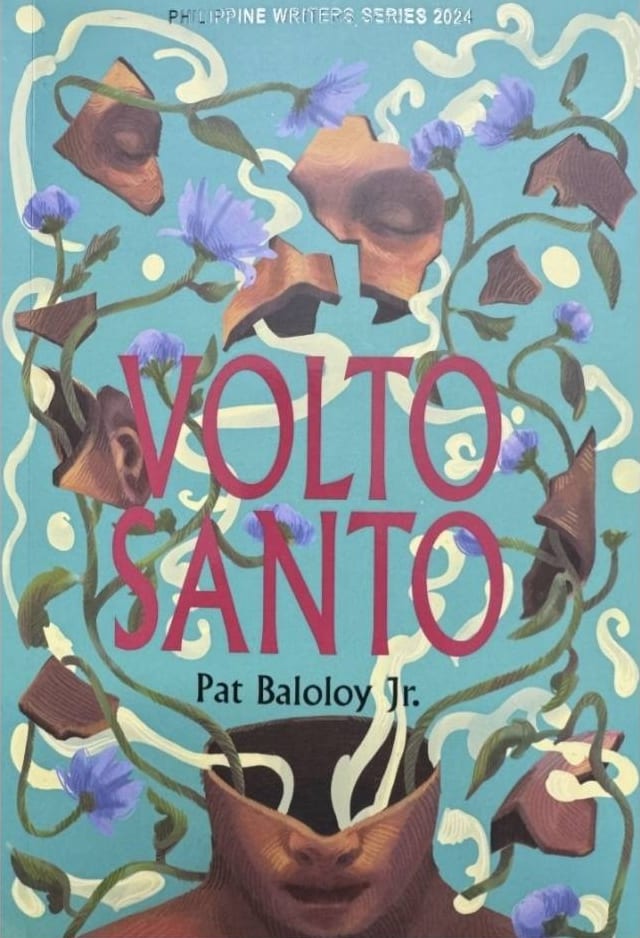
The Many Faces: Pat Baloloy Jr.’s Volto Santo
Volto Santo—holy face—is a collection organized around the question of where holiness resides when it is not found in the expected places, and this question, which is genuinely compelling, produces the collection’s best poems but also exposes its most significant unevennesses. Baloloy, who grew up in the Calauag-Gumaca area of southern Quezon, trained as a seminarian, and is known locally as a water diviner—a detail that Niles Jordan Breis recounts in his foreword with a mixture of skepticism and wonder—is uniquely positioned to ask where the sacred lives outside the church, and the book’s three-part structure (which Baloloy himself describes in his introduction) moves from personal and domestic holiness to indigenous Yaganak spirituality to the secular world’s hunger for the sacred.
The opening poem, “ang kristo sa sabungan,” establishes the governing paradox: a Christ figure seated in the cockpit, belly out, wearing denim shorts, bearing a stitch on his side—an image simultaneously irreverent and reverent, finding the sacred in the profane without insisting that the profane is sacred. “banal na bote” renders domestic violence with compressed force: the spirit emerging from the liquor bottle, the mother kneeling in the next room clutching the mysteries of sorrow, the child woken by crashing plates and thundering screams, the spouse sobbing in the grip of the brutish drunk, and the poem’s recognition that the bottle is both demon and angel—that when the alcohol passes, dumapo na ang anghel / sa mukha ng suwail— the angel alights on the face of the defiant one—captures the terrible liturgy of the cycle without pretending that naming it constitutes healing. “nakubang kaharian”—the hunched kingdom—extends this domestic darkness into a portrait of a patriarch whose voice fills the house but whose spine is curved, whose kingdom is furnished with slain bottles and peeling walls, a chair bowed to the shape of his back, a chipped glass that clinks with fleeting smiles—until the voice weakens, the skull drops to the cold floor, and the kingdom he had molded at his back dissolves into absence.
The Yaganak section represents the collection’s most ambitious reach—an attempt to render indigenous spirituality not as anthropological object but from within a worldview in which the forest’s sacredness is assumed and the categories of sacred and secular that organize Christian thought do not apply. “may lagusan ang gubat”—the forest has a passage—and “hindi parisukat ang hugis ng gubat”— the shape of the forest is not a square—gesture toward a way of knowing that refuses the geometric rationality of colonial mapping. That Baloloy is currently pursuing a PhD in Indigenous Studies at UP Baguio suggests these poems emerge from sustained engagement rather than touristic appropriation, and this commitment deserves respect even where the poems themselves do not fully achieve the epistemological shift they propose.
Where the collection struggles most is in the unevenness of its craft. Baloloy’s line, as Breis observes, tends toward the syncopated and clipped— singkopado, in Breis’s word, “mas mahingal na boses kaysa sa napakaligoy na taludturan”—a more breathless voice than the languid versification of other poets— and while this brevity can be effective in poems like “bendita” and “dapil,” in longer poems the truncation can feel less like a deliberate compression than an inability to sustain the line, as though the poems have been cut short rather than shaped. Several poems in the later sections feel underworked, and there are moments where the theological vocabulary— kabanalan, pagdarasal, pagpapala—accumulates without being sufficiently interrogated, so that the collection sometimes risks reproducing the piety it claims to question. A more rigorous editorial process might have produced a leaner, more powerful book—fewer poems, but each one pushed to its fullest formal realization.
And yet there is something in Volto Santo that none of the other collections attempts: a genuine engagement with the spiritual life of ordinary Filipinos that is neither dismissive nor uncritical, that takes seriously the possibility that the old woman praying over the liquor bottle and the Yaganak elder reading the forest are both engaged in practices of knowing that our secular literary culture has been too quick to disregard. The book’s final poem, “pillow,” is written in English—the language of the seminary—and Baloloy reveals in his introduction that it is also the oldest poem in the collection, written thirty years ago during his seminary formation, and that it is the pinagsimulan ng lahat—where everything began, the seed from which the entire collection grew. This structural decision—to place the origin at the end, to close a Filipino collection with the English poem that started everything—creates a haunting circularity: the seminary experience that the collection spends its pages questioning is also the experience that made the collection possible, and the foreign language that the collection’s Filipino poems implicitly resist is also the language in which the poet first discovered he could write. That this paradox remains unresolved is, perhaps, the most honest thing about the collection.
Five Grounds, One Year
What do these five collections, taken together, tell us about poetry in Filipino in 2024? They tell us, first, that the guerrilla camp and the cockpit, the Manila underpass and the Quezon river, the museum and the mountain can coexist as grounds for poetry without sharing a single aesthetic program—that Filipino poets are not converging on a style but dispersing across terrains that each demand their own formal solutions, and that this dispersal, far from weakening the field, is the condition of its vitality. They tell us, second, that the poetry collection in Filipino is capable of ambitions it is not always given credit for—that testimony need not sacrifice art for politics or politics for art, that formal range and political commitment are not opposing values but can inhabit the same book, and that the strongest work here does not need to be measured against anyone’s tradition but its own.
They also tell us something about what remains difficult. The question of editing—of the willingness to cut poems that do not serve the project, of the recognition that a collection of thirty-five strong poems is more powerful than a collection of fifty poems of which ten are merely adequate—remains largely unaddressed in Philippine poetry publishing, and several of these finalists might have been stronger books with fewer pages. The question of the collection-as-book— of what makes a poetry collection a project rather than an accumulation—is answered most persuasively by Kampuhan, whose world is so tightly circumscribed that every poem earns its place, and by Landas sa Ilang, whose formal range disguises whatever unevenness exists.
But I want to close not with what these books lack but with what they hold, because what they hold is considerable. They hold the names of the revolutionary dead: Ka Ronel, Ka Amado, Ka Pedro. They hold the taste of natóng cooked in gunáw and ladâ. They hold a grandmother’s hands in the ebbing river. They hold the coins of a dead man rolling across the Avenida. They hold a porcelain monkey whose poem was destroyed by a guard’s voice. They hold a Christ with a belly and a stitch, sitting in a cockpit, taking no bets. They hold a man who loved another man in the mountains of Bikol when no one else in the whole province had dared. These are not small things. These are the things that poetry holds in the way only poetry can—in the compression of a line, in the image that refuses to dilute itself with explanation, in the name that arrives without the narrative scaffolding that prose would build around it—and the ground— this ground, here, now, in the Philippines, in 2024—against the forces that would render it abstract, forgettable, unmapped. The terrain is vast. The tongues are various. And the clearing, where the poem stands and speaks, is always being reclaimed by the overgrowth, which is why we must keep reading, keep listening, keep asking what the line builds when it opens its mouth on ground that is never quite stable enough to hold it, and yet holds.

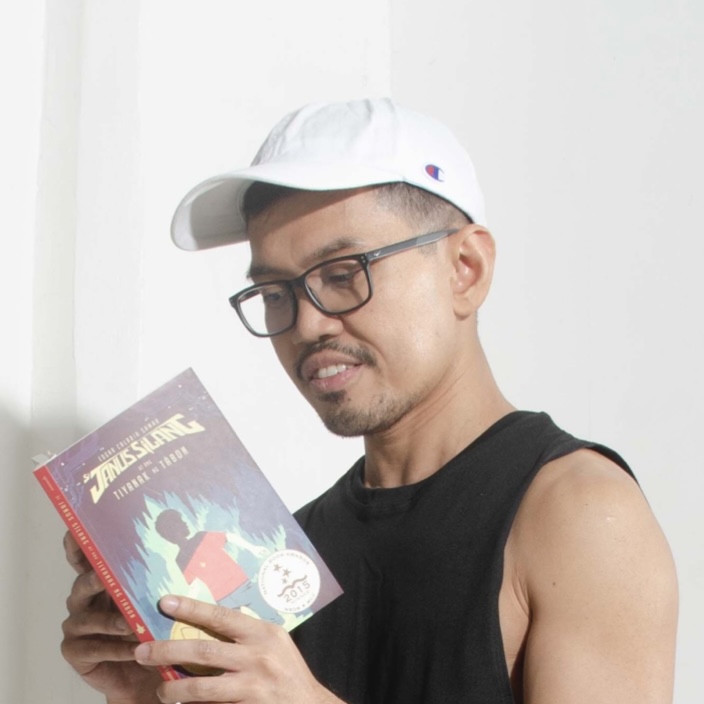
Edgar Calabia Samar is Associate Professor and Chair of the Department of Filipino at Ateneo de Manila University. He is the author of the award-winning Janus Silang series and of several other novels, including Teorya ng Unang Panahon, a Palanca and National Book Award winner currently being translated into English as Theory of a Long Time Ago by PEN Presents × International Booker Prize winner Christian Benitez, under a National Book Development Board translation grant. His first novel, Walong Diwata ng Pagkahulog, received the NCCA Writer’s Prize in 2005, and its English translation, Eight Muses of the Fall, was longlisted for the 2009 Man Asian Literary Prize. He previously served as Visiting Professor at Osaka University from 2017 to 2022 and as Writer in Residence at the University of Iowa in 2010. He is the Head of the National Committee on Literary Arts of the National Commission for Culture and the Arts and a member of the Filipino Critics Circle, formerly the Manila Critics Circle, the Filipinas Institute of Translation, and LIRA, where he served as President from 2001 to 2003. In 2024, he received the S.E.A. Write Award from the Royal Family of Thailand for his contributions to Southeast Asian literatures. He develops literature and novel-writing guides and maintains a growing Filipino komiks archive through Santinakpan Otherwise on patreon.com/ecsamar.
ALSO READ:
Five Doors Into the Real: On the Finalists for the 43rd National Book Award for Best Nonfiction Prose in English
The Dwelling and the Drumbeat: On the Finalists for the 43rd National Book Award for Best Nonfiction Prose in Filipino
What the Novel Remembers When the Nation Forgets: On the Finalists for the 43rd National Book Award for Best Novel in Filipino
What the Novel Carries When It Leaves: On the Finalists for the 43rd National Book Award for Best Novel in English
What the Stories Hold When the Collection Gathers: On the Finalists for the 43rd National Book Award for Best Collection of Short Fiction in Filipino
The Gathered and the Gathered Against: On the Finalists for the 43rd National Book Award for Best Collection of Short Fiction in English
Edgar Calabia Samar is an award-winning poet, critic, and novelist, and an Associate Professor at Ateneo de Manila University. IG: @ecsamar.
View More Articles About: