The Book Beside the Book: On the Finalists for the 43rd National Book Award for Best Anthology in English
These books capture the diverse possibilities of English-language anthologies: ranging from sourcebooks and workshop collections to seminar proceedings.
Published on May 31, 2026
EACH OF THE FIVE FINALISTS for Best Anthology in English exists because an institution paid for the gathering. The University of the Philippines’ Enhanced Creative Work and Research Grant funded Mapping New Stars. Sponsorship from the National Committee on Literary Arts of the National Commission for Culture and the Arts, with Women in Literary Arts–Cebu, produced Disaster. The UP Press commissioned Encantada. Likhaan: UP Institute of Creative Writing convened the 2018 seminar that became Kumustahan. A Commission on Higher Education research program, implemented by the University of Southeastern Philippines, funded Panumtuman. None of the five was made because a commercial publisher placed a bet on the anthology’s market; all were made because an institutional sponsor required the form to exist, and the sponsor’s mandate shaped each book as much as its editor’s vision did.
This shapes what the English-language anthology can now be. Institutions fund what advances institutional goals—research outputs, teaching resources, retrospectives of major figures, founding gestures for emerging literatures—and rarely the conventional literary anthology, which is hard to justify to a grant committee without a research or curricular rationale. The hybridity across this shortlist follows. Mapping New Stars is a sourcebook about speculative fiction rather than a gathering of its stories. Disaster harvests two Cebu workshops and prefaces its contributors with a long stretch of panelist lectures. Encantada distills one writer’s half-century across three genres. Kumustahan publishes a 2018 seminar’s proceedings. Only Panumtuman, gathering thirty-three writers across thirteen Bangsamoro ethnolinguistic groups, performs the conventional anthologizing act—and even it doubles as a state-funded textbook. The shortlist is also geographically wider than its Filipino-language counterpart: Cebu’s WILA, Davao’s USeP, and the Augustinian-affiliated Santo Niño de Cebu Publishing House reach it alongside the UP Press, which here accounts for three of the five. The finalists, in the order I take them up: Mapping New Stars: A Sourcebook on Philippine Speculative Fiction (edited by Gabriela Lee, Anna Felicia Sanchez, and Sydney Paige Guerrero); Disaster: Creative Non-Fiction by Women (edited by Erlinda Kintanar Alburo); Encantada: The Essential Cristina Pantoja Hidalgo (edited by Ruth Jordana Pison); Kumustahan: Creative Writing in the Philippines (edited by J. Neil C. Garcia); and Panumtuman: Anthology of 21st Century Bangsamoro Literature (edited by Gutierrez Mangansakan II).
Mapping New Stars: Meta-Discourse Before the Stories
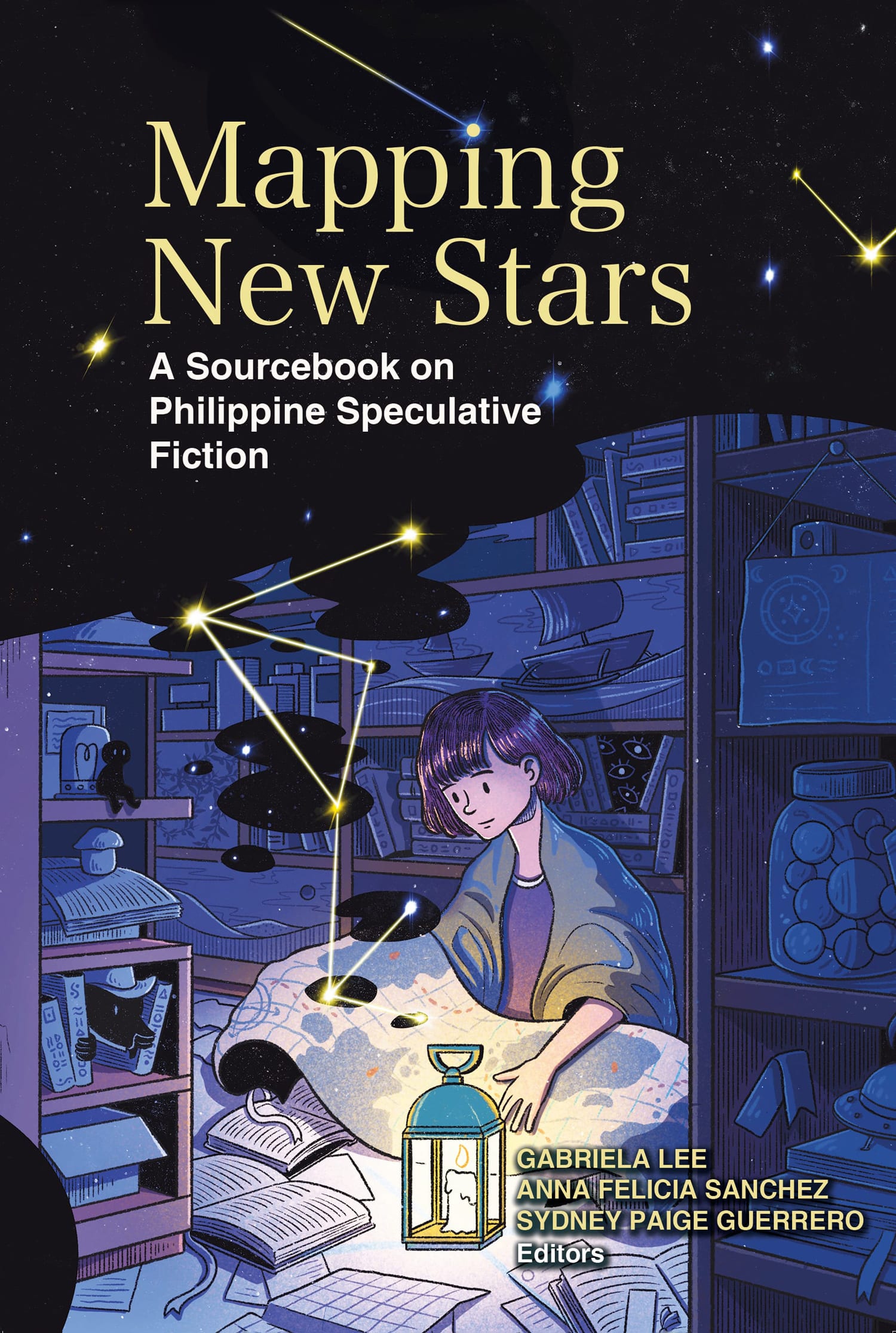
The book that most explicitly declines to call itself an anthology is Mapping New Stars. Its editors—all of whom teach at UP Diliman—name it a sourcebook, organize it in two sections (Reading and Writing Philippine Speculative Fiction), and add a visual timeline, a bibliography, and a list of further readings. The reading section gathers essays on definition (Atienza, Sicat Cleto), on folkloric sources (this writer), on historical roots (Ocampo), on komiks (Quina), on children’s literature (Lee), and on the international stage (Charles Tan); the writing section gathers craft chapters, each closing with prompts. The result is not an anthology of speculative fiction—the stories are largely absent—but a gathering of meta-discourse about it, addressed to teachers, students, writers, and readers, and proposed as “a starting point for accessing conversations around speculative fiction.”
(A disclosure: I am one of the contributors. The essay “Ang Kagila-gilalas na Haka kay Mariang Makiling Bilang Bukal ng Paglikha,” on the folkloric sources of speculation, is mine. I have tried to read the volume as I read the others; the reader can weigh what follows accordingly.)
What is worth pausing over is that the editors made a sourcebook rather than another anthology of stories. Philippine speculative fiction in English has been gathered abundantly for nearly two decades—the Alfars’ Philippine Speculative Fiction annuals ran for many volumes, with single-author collections and themed anthologies accumulating alongside. What had not been consolidated was the apparatus around the stories: definitions, genealogies, craft frameworks, a teaching resource that could carry the genre into classrooms and syllabi. Mapping New Stars sets out to be that apparatus, and the choice is a telling one. It locates the genre’s present need not in more stories but in the scholarship that would let the existing ones be taught and studied with rigor—which is also to say that two decades of creative output had not yet secured speculative fiction a settled place in the academy’s account of what counts as literature worth teaching. A genre is being argued into curricular legitimacy by writers who are also its practitioners, and the research-grant infrastructure of UP Diliman is the argument’s enabling condition.
The book’s argumentative center is Anna Felicia C. Sanchez’s “Waiting for Victory: Toward a Philippine Speculative Fiction,” first delivered at a junior faculty conference and published in 2010, here lightly revised. Sanchez argues that the establishment’s long suspicion of speculative fiction—dismissed as escapist, for the young, derivative of foreign tropes—obscured a tradition older than its detractors realized, present in our epics and metrical romances before it was present in our English-language fiction; and she proposes the accumulation of a counter-megatext, an indigenous repository of icons and tropes, as the condition for the genre to grow without merely imitating Anglo-American models. The argument has real force. Its instruments are worth noticing as instruments, though: defamiliarization descends through Shklovsky and Suvin, and the megatext the counter-megatext answers is Damien Broderick’s, extended from Brooke-Rose. The essay argues for a speculative fiction that escapes Anglo-American imitation through a vocabulary drawn largely from Anglo-European theory—a tension the volume holds rather than resolves, and part of why its decolonial commitment reads, by its editors’ own candid account, as something they “grapple with... even though we don’t explicitly name them.” The writing-craft chapters that follow are organized around world-building, magic systems, and the rest of a recognizably Anglo-American craft idiom, which they mostly inhabit rather than interrogate—understandable enough, since they are teaching tools and not polemics. The decolonial here names a horizon the book moves toward more than a method it enacts; that is, an honest place for the field to be, and naming it is not the same as faulting the book for it.
Victor Fernando R. Ocampo’s chronology and the visual timeline are the other major contributions, rendering Philippine speculative fiction as a continuous lineage rather than a series of isolated experiments—from the seventeenth-century Ibong Adarna through Galauran’s Doktor Kuba (1933) and Gurrea Monasterio’s Cuentos de Juana (1943) to the recent annuals. Its principle of selection (works the contributors cite) tilts toward what this particular constellation of writers knows, which is partly why the speculative fiction the book maps reads as largely Manila-based, English-language, and post-2000. The volume also asks a single reader to move between registers: the reading-section essays are pitched to readers already conversant with theory and the institutional history of Philippine letters, while the writing-section prompts are classroom-ready—Yvette Tan’s chapter on horror, for instance, asks readers to create a character sheet for your source of terror (aka monster) and to consider what is it? How does it manifest? What are the rules that govern its manifestation? Whether one classroom can hold both registers will depend on the teaching as much as on the book.
Hidalgo’s afterword, “Energized, Enthusiastic, and Exhilarated,” is among the more substantive moments here, partly because it does not fully agree with the book it concludes: she disputes Ocampo’s account of magical realism’s relation to Filipino fiction and notes gaps in the timeline. That the sourcebook publishes the afterword that partly disputes it is its own kind of editorial generosity. What the volume makes available is a substantial consolidation of vocabulary, history, and craft for a field whose teaching materials had been scattered—a reference apparatus to accompany a body of work that has been gathering since the mid-2000s. Whether it secures the curricular foothold it argues for will be settled in classrooms, not in the book.
Disaster: Nine Years from Workshop to Book
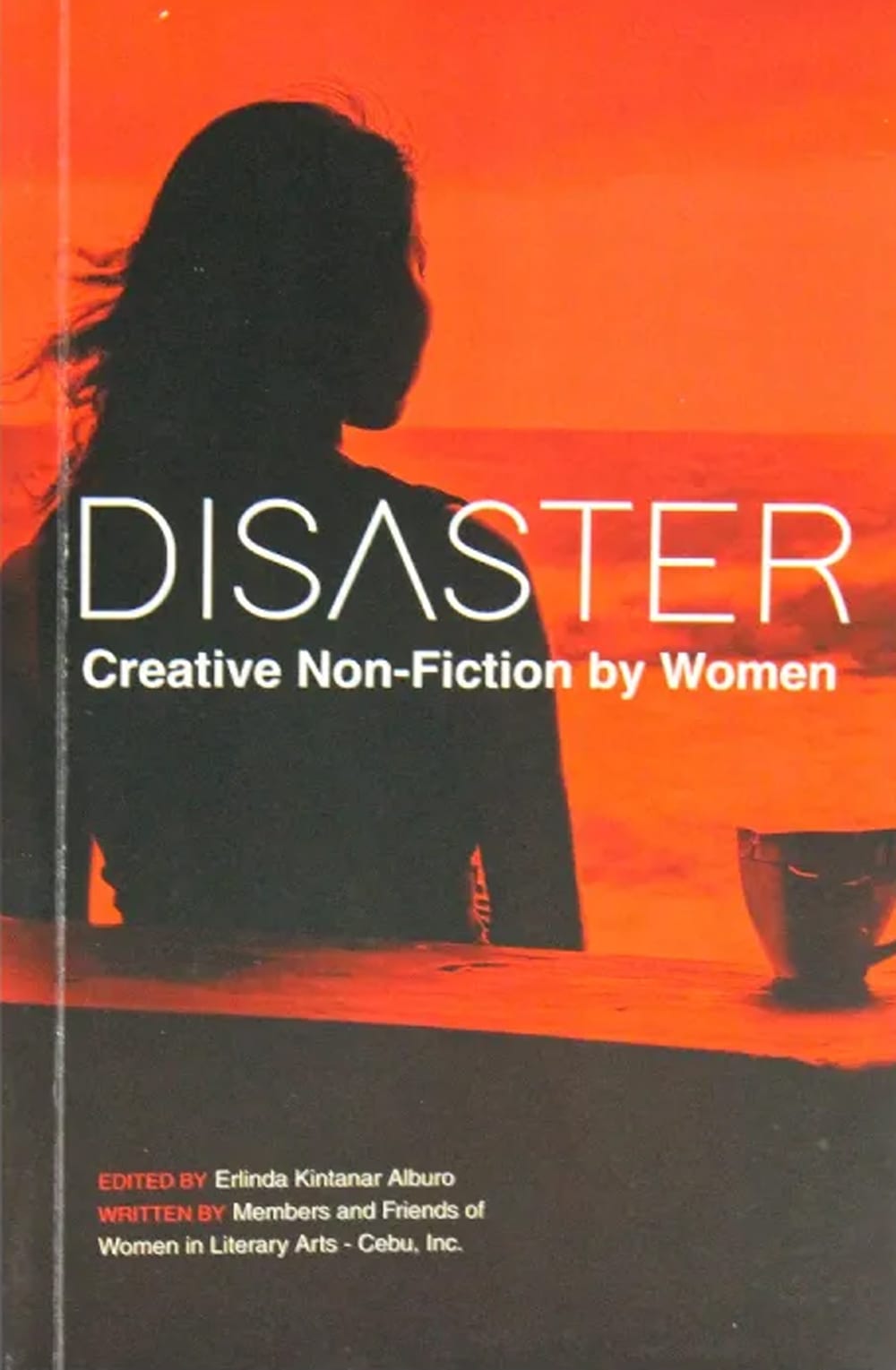
Disaster: Creative Non-Fiction by Women, edited by Erlinda Kintanar Alburo, is the only finalist not from a university press. It emerges from two workshops held by Women in Literary Arts–Cebu—the first in 2015, a second at UP Cebu years later—and reaches print nearly a decade after the first. The contributors, drawn overwhelmingly from Cebu and the Visayas, write about catastrophes that need no introduction here: the 1990 Baguio earthquake, the 1991 Ormoc flood, the 2013 Bohol earthquake, Supertyphoon Yolanda the same year, Supertyphoon Odette in 2021. It opens with a long sequence of craft lectures from the original panel (Evasco, Dumdum, Lara, the late Jose Victor Peñaranda, and Alunan) before the contributor essays begin, so that by the time the reader arrives at the first essay, Evasco has already proposed—drawing on Greg Bankoff’s Cultures of Disaster and Matthieu Ricard’s distinction between empathic distress and empathic concern—a poetics the contributors are implicitly asked to perform. The book thus publishes, in one volume, both the workshop’s pedagogy and its product.
Here I must name a limit of my own. The contributors write in English, Cebuano, and Waray, and the Cebuano and Waray pieces appear without translation. I do not read Cebuano or Waray, and several of the volume’s most substantial pieces—Hope S. Yu’s “Saksi,” Cindy Velasquez’s “Hinungdan,” and others—are in Cebuano. Whatever I say about Disaster, therefore, cannot do justice to the book as its contributors made it; a reading confined to its English pieces is a partial reading of a multilingual volume, and I would not want my own inadequacy mistaken for a limit in the work. That partiality also raises a question the book poses simply by being here: a volume substantial portions of which are in untranslated Cebuano has been entered, and shortlisted, in the category for anthologies in English. The choice not to translate is defensible—it keeps the Cebuano pieces’ intimacy with their first readers and declines the mediation that English-language Philippine publishing usually demands of its regional contributors—but it sits uneasily with the category, and it leaves a reader without Cebuano on the outside of a community’s testimony to itself. The discomfort seems to me worth keeping rather than resolving.
Of the pieces I can read, Gea Marie Iana F. Abellana’s “Wherever She Went” is the one I return to. Abellana writes about her mother, a local treasurer in Carcar called away from the family at the height of Supertyphoon Odette to attend to the city’s relief preparations: the daughter watching her leave the kitchen, the family around a candle as the signal fails, the mother returning soaked through a city already reshaped by the storm. The essay’s quiet question—what does a daughter learn when her mother is also the person the city most needs?—is one the preface’s emphasis on documentary fidelity does not quite anticipate. Worth marking is the position the writer occupies: she is the witness, not the public-service performer; the woman whose disaster-labor the essay tracks is not the woman writing it. Several of the English pieces, Johanna Michelle Lim’s “Rosewood” among them, work this kind of indirection, the writer attending to another woman’s labor rather than narrating her own. What the English pieces suggest, taken together, is that the volume’s most accomplished writing does not simply execute the poetics the lectures lay out; it finds its own questions inside the experience the preface frames, and is the better for it.
Two contexts frame the whole. The first is the publisher: the Santo Niño de Cebu Publishing House is owned by the Philippine Augustinians, and the book is co-copyrighted with WILA-Cebu. The Catholic infrastructural presence runs through the volume—the foreword’s “spiritual stamina to suffer with others,” Peñaranda’s lecture on summoning the spiritual—and there is a political-economic point in it: the Church is among the few institutions in the Visayas with the capacity to fund cultural work at scale, and the relative thinness of secular literary infrastructure in the region is part of why women’s disaster writing has found a home with a religious press. The second is the title’s premise, that women’s disaster writing is a distinct body worth gathering as such. Whether it is—what such writing distinctly carries—is not a question I am well placed to settle, reading only the volume’s English pieces and reading them, besides, as a man from outside the experience the title gathers. What I can say is that the pieces I read attend with particular closeness to the relations a disaster reorganizes: a mother’s public duty set against her family’s need, the kinship and care a storm at once threatens and lays bare, seen from inside specific lives. What Disaster preserves, in the end, is the harvest of a workshop that never stopped being a workshop—a working document, variously polished and raw, recording both the pedagogical labor that prepared its writers and the aesthetic labor of the writing itself, which the difficulty of Visayan publishing might otherwise have let dissipate.
Encantada: Across Six Decades, Three Genres, One Writer
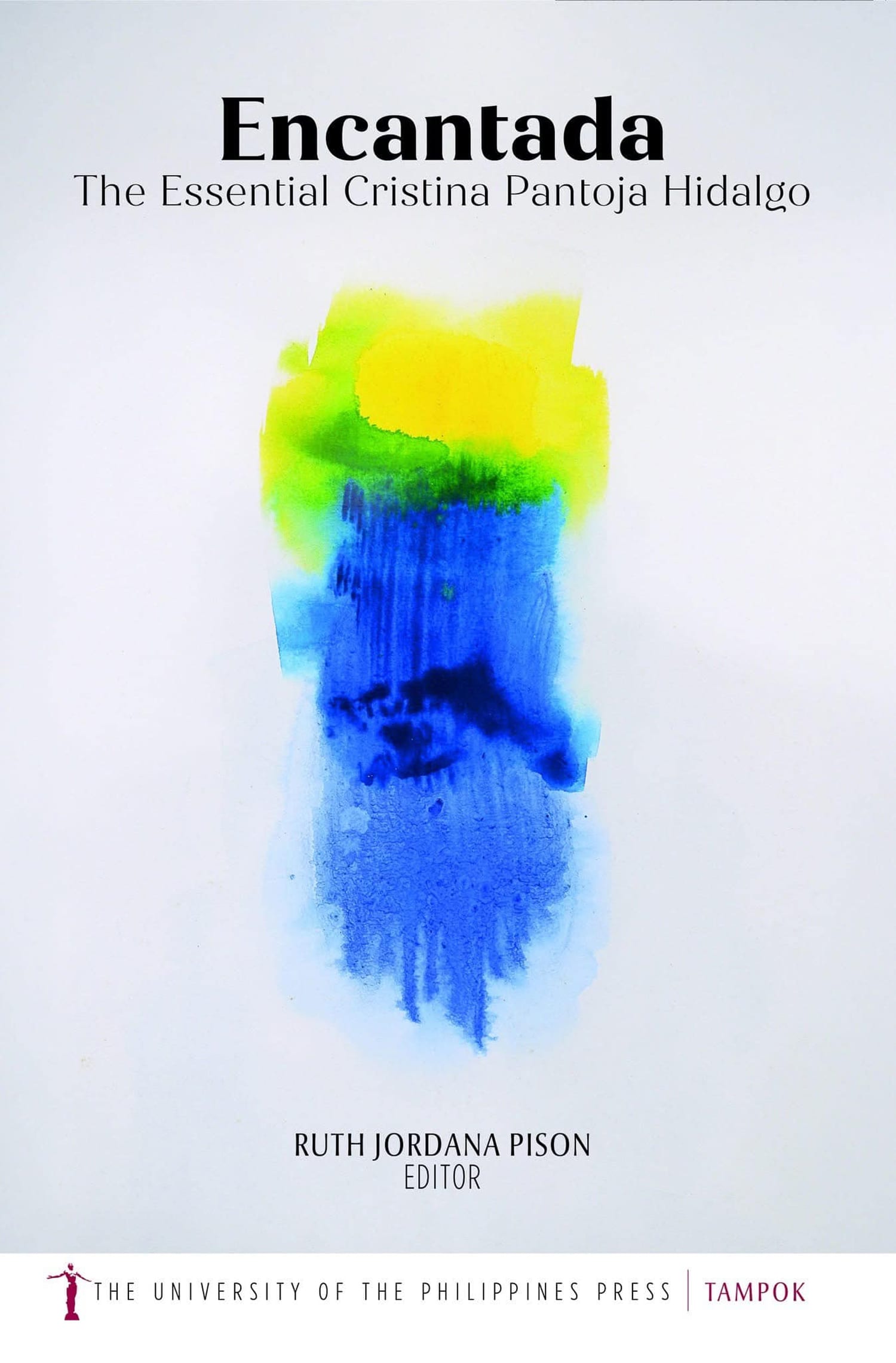
Encantada: The Essential Cristina Pantoja Hidalgo, edited by Ruth Jordana Pison, is a curated retrospective J. Neil C. Garcia, the UP Press’s former director, first broached as an idea—Hidalgo’s preface thanks him for it—and which Pison undertook with the writer’s collaboration. (The title, the editor’s note records, was Garcia’s suggestion, chosen over the initial “The Best of Cristina Pantoja Hidalgo.”) The selection gathers ten stories and tales, excerpts from the novels Recuerdo and A Book of Dreams, two profiles, two memoirs, nine travel essays datelined across Korea, Lebanon, Thailand, Burma, the United States, and the Philippines, and ten critical commentaries. It is organized not by chronology but by genre—Fiction, then Creative Nonfiction, then Critical Commentary—and the organization is itself an argument: that Hidalgo’s range across forms is the figure worth foregrounding, that the body of work coheres laterally more than progressively.
The organization has its costs. The Hidalgo of the early realist stories and the Hidalgo who turned to the modern tale in the 1990s feel, in their separate genre-bins, almost like different writers rather than one writer across the periods of a life. A chronological arrangement would have made the shifts and returns visible—realism toward fabulation, the deepening travel voice across her years abroad, the late turn to feminist literary historiography. What the selection cannot quite render is the career as a history, and the word is worth pausing on, since Hidalgo’s own criticism has spent decades attending to how women’s life-writing has been kept outside the genres that confer that name. To arrange her by synchrony rather than development spares her the linear, cumulative arc that “history” has so often reserved for its canonical and largely male subjects; it also withholds the developmental account her work has plainly earned. Both the sparing and the withholding are real, and the editorial choice has taken the first without quite arguing against the second.
The travel essays register the issue most concretely. Written largely while accompanying her husband Antonio’s overseas postings, they carry a particular vantage—Hidalgo names it herself, with characteristic frankness, as “fifteen years of living like gypsies”—and the volume presents them as travel writing rather than as the writing of a particular class encounter with the postcolonial world. Her eye is sharp and unguarded, from the Burmese hotel’s cobwebs to the unrest she watched in Rangoon; what the framing leaves to the reader is the position from which the eye looks. The deeper question is categorical. Encantada is a single-author retrospective, a body of work by one writer rather than a gathering of many, and the editorial energy here curates a career rather than a constellation of careers. Pison’s selection is genuinely an editorial intelligence, not the writer’s self-presentation, and she proposes one account of which Hidalgo most deserves to be carried forward; the writer, her preface allows, might have chosen differently. The Selected Works form has appeared more than once on this year’s anthology shortlists, and the award category may yet need language for what it has come to hold.
The critical commentary is where the volume’s argument about Hidalgo comes most clearly into focus. The essays here—on Edith Tiempo’s “Ironic Double,” on Gilda Cordero-Fernando’s modern tales, on Solita Camara-Besa, on autobiographical writing as a genre Philippine criticism has been slow to credit—position her as a feminist literary historian as much as a fictionist, and gathering them in one place clarifies a body of thought that had been distributed across her earlier collections. It also makes audible a quiet continuity between her two vocations. The criticism is preoccupied with how women have written themselves into being—through autobiography rendered as fiction, through memoir reframed as record, through the modern tale as covert feminism; the fiction is preoccupied with the encantada, the woman enchanted by, and enchanting, the world she attends to. The two are not identical, but they rhyme, and the genre-organization, by housing them in separate sections, makes the rhyme harder to hear than a reader who knew only one side of her work might wish.
What makes the book possible now is itself worth reading. Encantada could not have been assembled in 1985, or even 2005: it exists because Hidalgo has written across five decades, because her work is dispersed across at least six publishing houses, and much of it is now out of print, and because the UP Press has lately taken up the work of consolidating major writers whose books have become hard to find. The retrospective is, in this sense, what we have because the maintenance was not—because Philippine literary publishing did not build the reprint editions, library copies, and classroom adoptions that would have kept the earlier books in circulation. What it makes available is the range itself: what one Philippine writer’s career in English can sustain across half a century—the realist story, the modern tale, the historical novel, the memoir, the travel essay, the feminist literary historiography. That it renders the range more clearly than the development is the cost of what it does well, and the book is worth its cost.
Kumustahan: A Seminar Preserved, Six Years On
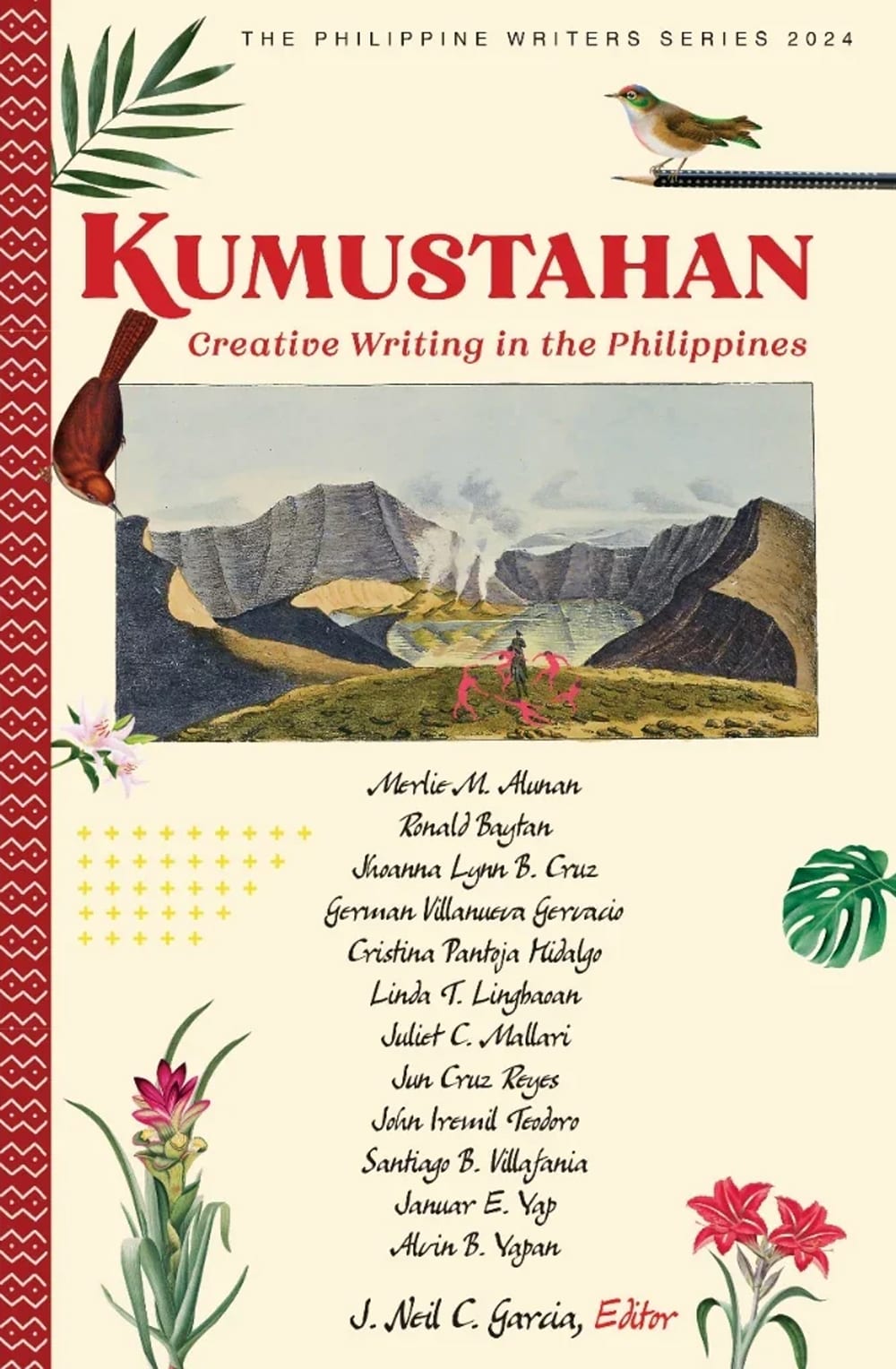
The seminar that gives Kumustahan: Creative Writing in the Philippines its name was held in Tagaytay in October 2018 by Likhaan: UP Institute of Creative Writing, gathering twelve writers and creative-writing teachers to take stock of the field across the country’s major linguistic traditions. The volume J. Neil C. Garcia edited reproduces their written-up presentations alongside a long, theoretically assertive introduction of his own. The contributors—Alunan on Eastern Visayas, German Villanueva Gervacio on writing in Mindanao, Hidalgo on Philippine writing in English, Linda T. Lingbaoan on a Tinguian writer’s choice of Ilokano, Juliet C. Mallari on Kapampangan, Jun Cruz Reyes on writing inside and outside the National Capital Region, John Iremil Teodoro on Kinaray-a, Santiago B. Villafania on Pangasinan anlong, Januar E. Yap on Cebuano, Alvin B. Yapan on Bikol—are joined by two chapters Likhaan solicited afterward, Jhoanna Lynn B. Cruz on Davao and Ronald Baytan on digital writing during the pandemic. (Villafania died in 2024; the last time I saw him we were roommates at Reading the Regions in Pangasinan in 2023, organized by Mallari, then the outgoing chair of the NCLA and also in this anthology. The field these essays survey is small enough that to read it is, often, to read one’s friends.)
The book’s center of gravity is Garcia’s introduction, best read as a discipline-founding essay rather than an anthology preface. He argues that Philippine creative writing has always been translational—that the formalism inherited from the Iowa workshop was “appropriated and translated” by instructors and fellows whose own languages complicated its New Critical assumptions—and he takes up the recent critique of the Tiempos’ Silliman workshop, that its allegiance to New Criticism made it politically regressive, defending the workshop’s affordances without dismissing the critique’s grounds. It is generous in its citation, alert to the difference between orality and literacy, and patient with the institution’s national history. The thesis matters because it reframes the inheritance: the Iowa workshop arrives in his account not as a colonial imposition to be repudiated but as a method that Filipino writers have bent to their own languages and ends, which is a more useful way of holding a complicated genealogy than either nostalgia or wholesale rejection allows.
The introduction’s assertiveness sets a frame the contributors’ essays then sit inside: they describe, the introduction theorizes. The arrangement is common to edited volumes, but it is worth naming here, because so much of the book’s content is itself about center and periphery in Philippine writing, and the form reproduces what the content describes. A related feature is the seniority of the contributors—these are among the most established figures in their traditions—so that the account that emerges is the field’s official self-account, given from a particular vantage. It is an account well worth having; it is also, necessarily, not the one a younger writer formed through online platforms, mother-tongue pedagogies, or the last decade’s fellowships would give. The commitment to linguistic plurality, too, lives in the book’s content more than its form: the chapters are about the country’s vernacular literatures but are written, with few exceptions, in English, the poems and narratives they discuss appearing in translation or in gloss.
The years between the 2018 seminar and the 2024 book are the other condition. Baytan’s pandemic chapter was solicited to cover an emergency the seminar could not have anticipated; the others were not similarly updated. A reader arriving in 2024 must take the older chapters as documents of a 2018 moment rather than accounts of the present. What Kumustahan preserves is the field as it was being theorized just before the pandemic reshaped how writing is taught and shared here—a record whose permanence is what the long delay has paid for, and whose currency is what the delay has cost.
Panumtuman: Naming a Literature Into Recognition
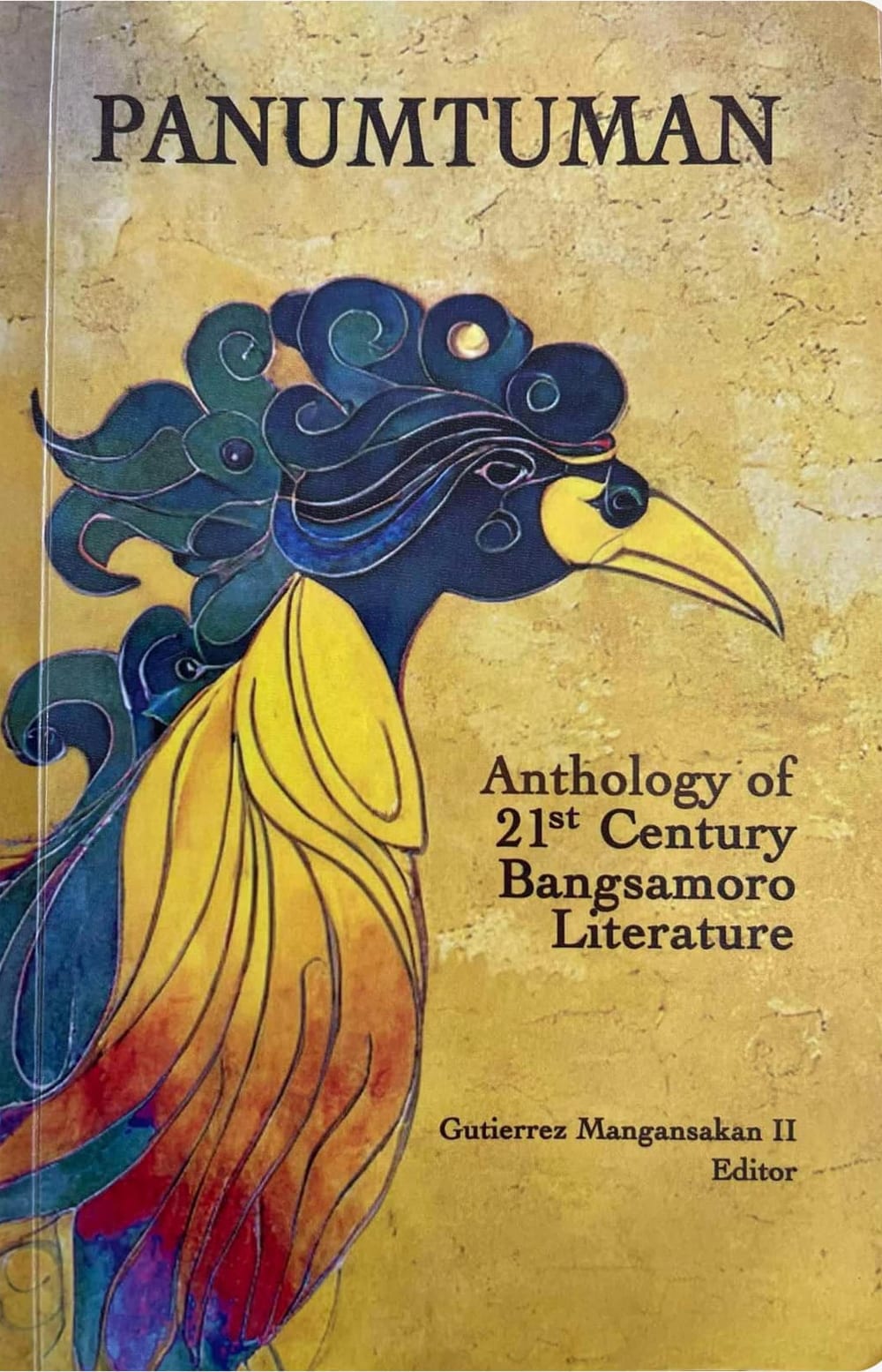
Of the five, Panumtuman: Anthology of 21st Century Bangsamoro Literature, edited by Gutierrez Mangansakan II, performs most clearly what anthologize conventionally names: gathering many writers under a shared rubric and offering them as a constellation that makes new sense together. It grew out of the first International Conference on Bangsamoro Literature, held at USeP in 2022, and gathers thirty-three writers across the thirteen Muslim ethnolinguistic groups Mangansakan names—Badjao, Iranun, Jama Mapun, Kaagan, Kalibugan, Maguindanaon, Meranaw, Palawanon, Molbog, Sama, Sangil, Tausug, Yakan—in three sections of poetry, fiction, and essay. It is published by USeP as a deliverable of a CHED research program, and so is at once an anthology and a textbook for classrooms in Mindanao and beyond—a doubled identity the award category does not quite accommodate.
Mangansakan’s introduction does something unusual for an anthology editor: it begins by doubting the category the book names. “As a writer for more than thirty years,” he writes, “I had never encountered the term Bangsamoro literature until I was asked to be the editor of this anthology.” He works through the hesitation—the risk of “putting the carriage ahead of the horse”—by way of Calbi Asain’s scholarship on Muslim folk literature and Bienvenido Lumbera’s framing of regional literatures as imagined communities, after Anderson. What emerges is the book’s deepest claim: that Bangsamoro literature coheres not because its writers share a program but because they share an evolving relation to a community whose imagining is itself part of the work. “The Bangsamoro is not only an imagined community,” he writes, “but a community capable of imagining.”
A word on my own access before the readings. The volume is largely in English, with the Bangsamoro-language pieces given in translation, so what I can say attends to the English and the translated texts and not the originals—and the translation, in poetry especially, is part of what I am reading. With that caveat, the poetry held my attention in ways I did not expect; whatever comparative claim I might be tempted to make, I can at least say that little else I have read in Philippine poetry in English moves quite the way these poems do. Mohammad Nassefh R. Macla’s “Children of Homeland” opens on children sheltering behind their mothers as the bullets find them anyway—the children, too, become “the birds of paradise”—and turns, in its second movement, to a memorial dance, living children performing the Papanok sa Surga while their watchful mothers / Clasping hands with one another remember “the previous nights.” It holds massacre and ceremony together without resolving either. Elin Anisha Guro’s “The Last of the Torogans” works a longer, sardonic register over the destruction of the Meranaw ancestral house in the shadow of Marawi—Family salsilas... / Are on fire—it is like torching 500-year old libraries—and its irony cuts hardest at the honor bestowed on the war’s destroyers: “When the zealots die, they are martyrs. / When the men in uniform die, they are heroes.”
The fiction extends the range. Calbi Asain’s “Repentance,” set aboard a boat bound for Jolo on the night of July 8, 1978, tracks a businessman’s confession—his earlier cruelty to a sea gypsy who had begged help for his wife’s emergency surgery, and the gypsy’s return years later as the rescuer who chooses whom to save and whom to leave to the sea—and ends without consolation: Too late a repentance. The damage has been done, and it can’t be undone anymore. Pearlsha Abubakar's “Hegira” surprised me by turning to science fiction—the surprise generic rather than formal—setting a Sama community in the West Philippine Sea of 2067 and lets its science-fictional apparatus—a wristwatch that knows the answers, AI orbs that translate for visiting foreign tutors—sit beside an older cosmology, Tuan, “a god from inside the body,” without either displacing the other: a demonstration that this writing can hold a speculative future without surrendering the cosmology that grounds it—the kind of demonstration Mapping New Stars, two finalists away, would have been glad to claim, had the books been able to speak to each other. In the essays, Shariful Hashim S. Mansul reads the present Tausug condition through the afterimage of a maritime polity dismantled since Spanish times, asking how a people might move from afterimage to revival; Potri Norania Hadji Jamel’s “Ustadha Kamote” simply watches a Meranaw teacher distribute sweet potato to madrasah students for whom it is the day’s only meal, refusing both triumph and victimhood.
A first anthology of a many-community literature is, necessarily, one editor’s particular view: Mangansakan is Maguindanaon, the thirteen groups are not evenly represented, and a later editor with other networks would gather differently. The title half-acknowledges this, since panumtuman names not memory in general but the particular memory a rememberer holds. The temporal scope is similarly particular—most contributors are of the 1980s and 1990s, so a reader new to Bangsamoro writing meets it here as largely post-2010 work, the longer arc through martial law, the MNLF and MILF, and Marawi available mostly by implication. And the book has had to be more than one thing because the scholarly infrastructure that would carry its tasks separately—journals, conferences, a literary historiography—does not yet exist at scale; Mangansakan has served as both editor and theorist, and the volume’s hybridity reflects that absence rather than any failure of vision. Its largest effect may exceed its contents: it has put Bangsamoro literature into circulation as a term one can now point to and test, and the testing has been made possible by the gathering having happened.
SET SIDE by side, the five “anthologies” do not compete in the ordinary way, because they are not doing the same thing. A sourcebook arguing a genre into curricular standing, a workshop’s long-delayed harvest, a half-century career distilled into one volume, a seminar’s preserved proceedings, a literature gathered into recognition for the first time: these are different kinds of cultural labor, asked here to answer to a single rubric built for a different kind of book. The judgment is possible, but it is necessarily comparative across modes rather than within them, and the strain belongs to the form, not to any one book.
What the shortlist lets me say, without claiming to have surveyed the year’s publishing, is that the books strong enough to reach it are all institutionally underwritten—by research grants, workshop sponsorships, a press’s consolidating mandate, a state program—rather than placed by a publisher betting on the form’s market. Whether the conventional literary anthology survives elsewhere in the field, under other names, is a question for a different kind of survey. What this one shows is that the institutional anthology is, at present, the form most able to find both the money and the editorial labor that anthology-making requires—labor largely absorbed by the day jobs of academics and paid, when paid at all, at a fraction of its cost. Pison’s curation, Garcia’s introduction, Mangansakan’s gathering across thirteen communities, Alburo’s long stewardship: the form persists because writers and scholars keep doing this work for fields and communities whose support remains more rhetorical than material.
And what the work accomplishes is real. Bodies of writing once scattered have been made findable; fields that had not been mapped have been given a shape to argue with; gatherings that would have lived only in their participants’ memory have been kept. If the literary anthology proper—the gathering of new writing as its own justification—is hard to find on this shortlist, that is less a verdict on these books than a description of the conditions under which they were made: an institutional ecology doing the cultural work no commercial form has been built to carry, with the resources institutions can spare.

Edgar Calabia Samar is Associate Professor and Chair of the Department of Filipino at Ateneo de Manila University. He is the Head of the National Committee on Literary Arts of the National Commission for Culture and the Arts and a member of the Filipino Critics Circle. In 2024, he received the S.E.A. Write Award from the Royal Family of Thailand for his contributions to Southeast Asian literatures. He also creates online content on reading, writing, and liberatory work and education on patreon.com/ecsamar and Instagram at @ecsamar.
READ MORE:
At the Editor’s Own Table: On the Finalists for the 43rd National Book Award for Best Anthology in Filipino
Voices Shaped Beyond Retrieval: On the Finalists for the 43rd National Book Award for Best Book of Poetry in English
The Tongue and the Terrain: On the Finalists for the 43rd National Book Award for Best Book of Poetry in Filipino
Five Doors Into the Real: On the Finalists for the 43rd National Book Award for Best Nonfiction Prose in English
The Dwelling and the Drumbeat: On the Finalists for the 43rd National Book Award for Best Nonfiction Prose in Filipino
What the Novel Remembers When the Nation Forgets: On the Finalists for the 43rd National Book Award for Best Novel in Filipino
What the Novel Carries When It Leaves: On the Finalists for the 43rd National Book Award for Best Novel in English
What the Stories Hold When the Collection Gathers: On the Finalists for the 43rd National Book Award for Best Collection of Short Fiction in Filipino
The Gathered and the Gathered Against: On the Finalists for the 43rd National Book Award for Best Collection of Short Fiction in English
Edgar Calabia Samar is an award-winning poet, critic, and novelist, and an Associate Professor at Ateneo de Manila University. IG: @ecsamar.
View More Articles About: