Voices Shaped Beyond Retrieval: On the Finalists for the 43rd National Book Award for Best Book of Poetry in English
What these five books make visible, finally, is not only what Philippine poetry in English is but how much of it there is right now—and how much of it could not be gathered here.
Published on May 3, 2026
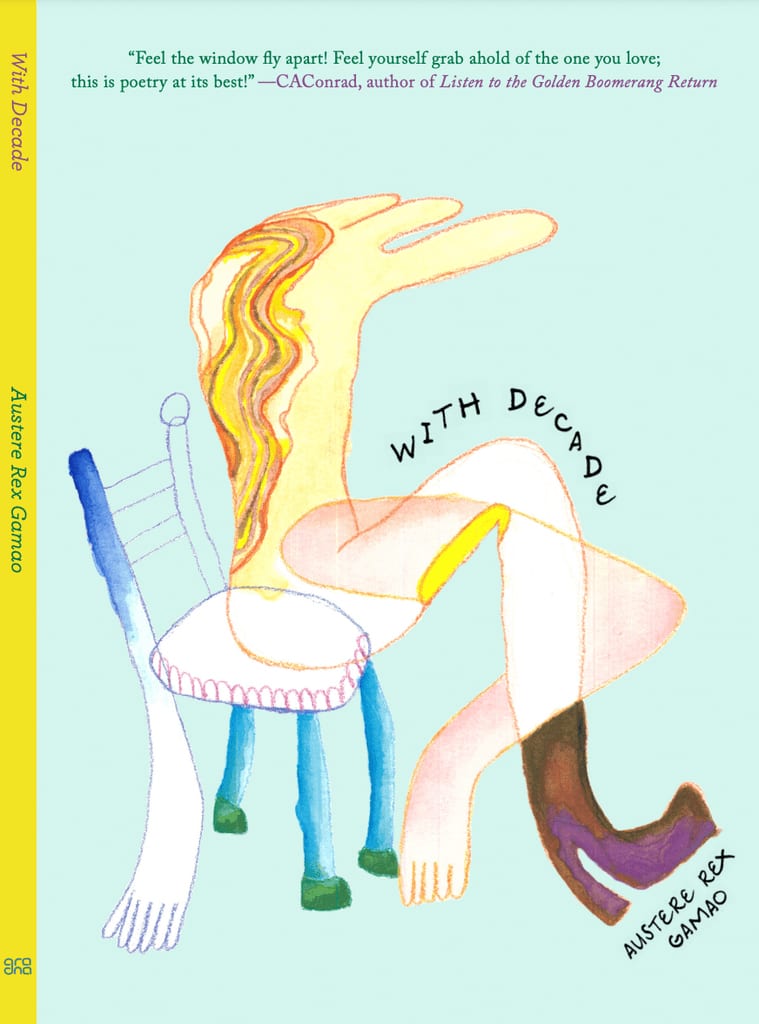
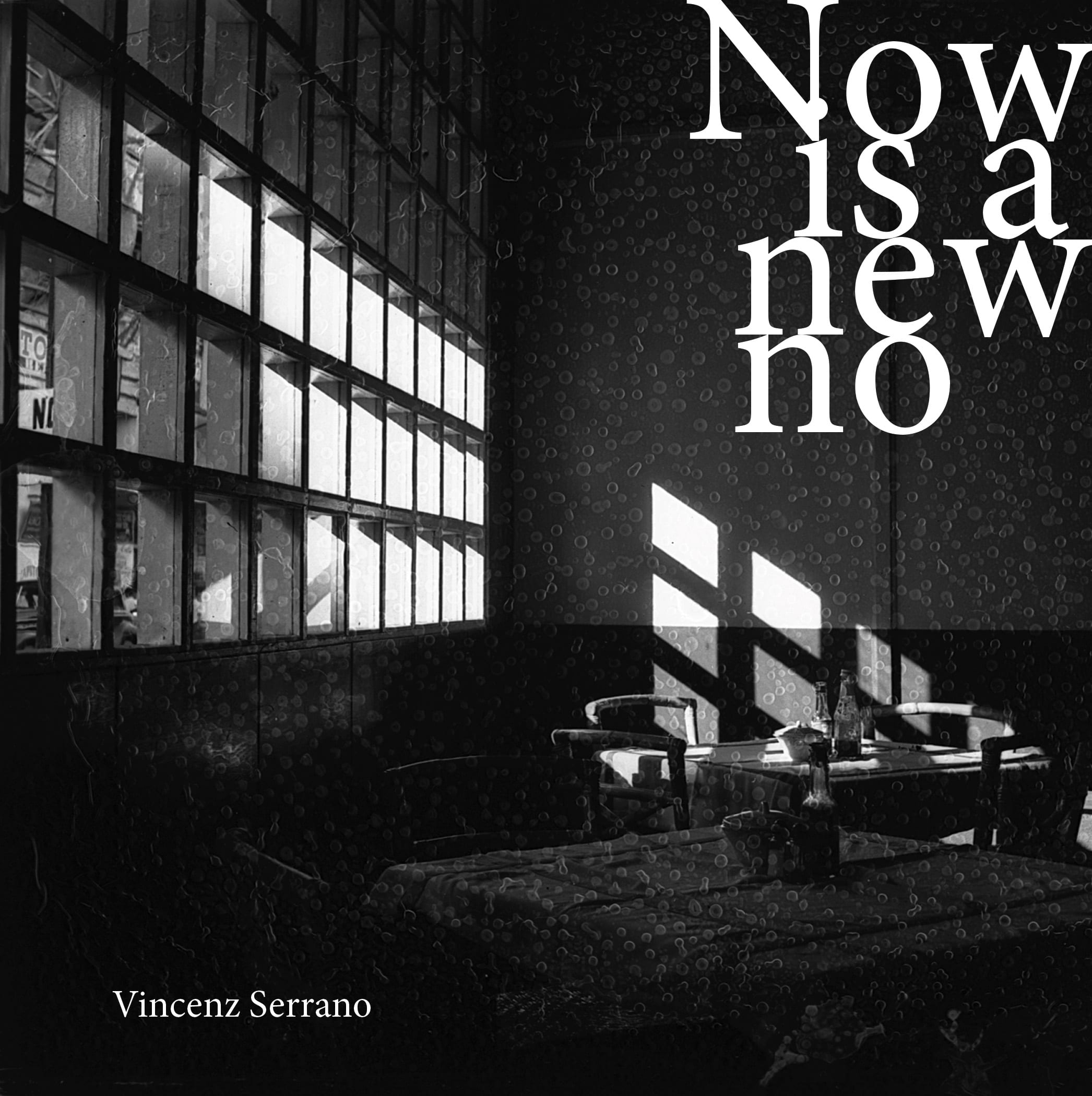
ONE OF THE BOOKS gathered here was written more than twenty years ago, in New York City, in the aftermath of what the Americans call 9/11, and it arrives now in its expanded Philippine edition—revised, sent back across the Pacific to the audience the poet has always believed to be his truest one. Another book was written while its author was pursuing a doctoral degree in Australia, first published by an Australian press before being reprinted for Philippine readers with a new critical afterword that does as much argumentative work as the poems themselves. Another emerged from a teaching hospital in Manila, from the hours between surgeries and patient rounds, from the consciousness of someone who has sutured wounds and informed relatives of deaths and continued, in the same hours, to think about mythology and climate catastrophe and the end of the world. Another comes from the smallest press of the five—a Cavite-based publisher, the cover art painted by the author himself—and moves in a register so formally strange that its nearest relatives in Philippine poetry in English are genuinely difficult to name. And the fifth is a book so carefully made that the word precision barely contains what it is attempting: it interleaves historical photographs of Manila, prose poems about the esteros and the factories and the bridges blown up during the war, a meditation on long-distance love conducted in the language of photography and architecture and the grammar of things that arrive either too late or never. They are, in this order, the five finalists for the 43rd National Book Award for Best Book of Poetry in English: Eric Gamalinda’s Amigo Warfare, Mark Anthony Cayanan’s Unanimal, Counterfeit, Scurrilous, Alyza Taguilaso’s Juggernaut, Austere Rex Gamao’s With Decade, and Vincenz Serrano’s Now is a new no.
The lyric poem begins, in its most traditional understanding, with the fiction of a single voice. This fiction has served Philippine poetry in English well and badly in approximately equal measure—well, because the lyric’s compression allows a kind of intensity that the novel must dilute across hundreds of pages; badly, because the singular voice, in a country whose plural voices were systematically silenced, can become its own kind of colonial inheritance, the educated individual speaking in a language designed to produce exactly that kind of speaking. What is interesting about the five books gathered here is not that they are aware of this—but that they have found five entirely different ways to inhabit the awareness without being paralyzed by it. Gamalinda makes the singular voice a kind of double agent. Taguilaso floods it with medical procedures until the individual dissolves into the system that operates on her. Cayanan encrypts it inside a fictional persona until even they cannot tell, or will not say, where the persona ends. Gamao invents a creature to carry it. Serrano submits it to the logic of the photograph, which promises presence and delivers only its trace. Five different answers to the question of what to do with a voice that has been shaped, beyond retrieval, by a language it did not choose—and the answers do not agree, which is why reading these books together is more unsettling than reading any of them alone.
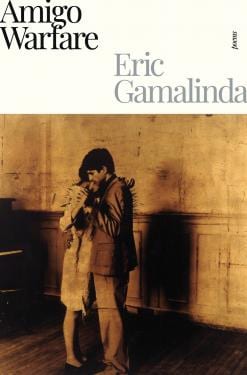
The Returned Book: Eric Gamalinda’s Amigo Warfare
Begin with the title, which is borrowed from history: amigo warfare was what the Americans derisively called the Filipino style of resistance during the Philippine-American War, the strategy of appearing friendly to the colonial soldier during the day and becoming a guerrilla at night, the art of a people who had learned that direct confrontation with an occupying force was suicidal and who had learned instead the more complex and more morally ambiguous practice of the double life, the performed self and the unperformed, the smile in daylight and the disappearance into the dark. And what Gamalinda has done, across the four sections and expanded Philippine edition of this book, is suggest that this figure—the amigo warrior, the one who speaks the occupier’s language while dreaming in another register entirely—is not simply a historical strategy but a condition, a way of naming the doubled consciousness that belongs to the Filipino writer who has lived in America and written in English and been neither fully of either world and is therefore, in a certain sense, always a guerrilla.
The book has four sections, organized not chronologically but by tonal and thematic pressure. The first and most politically charged gathers the post-9/11 poems of New York—xenophobia, anti-immigrant violence, the American empire’s self-deceptions, the horror that is also spectacle, the grief of the immigrant body in a country that has decided to fear it; the second reaches into the body and into the Philippines, into sexuality and sorrow and history’s long attrition on the people who live inside it; the third opens outward toward cosmology and formal experiment, toward the Dante-inspired canzone, the cave meditations, the careful attention to what it means to disappear—and this third section is the new section dedicated to the poet’s mother, prefaced by the Bergman epigraph on knowledge and death; the fourth, prefaced by Tarkovsky’s assertion that the aim of art is to prepare a person for dying, reaches, sometimes haltingly, toward the divine, toward questions of life after death that grief has made suddenly urgent.
The political poems work through formal aggression rather than moral exhortation—they do not argue the case against empire; they make the reader inhabit it, and then leave the reader there. “9/12” is a masterpiece of inhabiting the xenophobic imagination in order to indict it, its catalog of immigrant “offenses”—“having sex, absconding with our taxes, / looking over our shoulder on the train, / eating our burgers and fries, learning the process / of democracies”—building to its devastating conclusion, the list of names—“Wei-sing, Hamil, Irais, / Parisa, Musfiqur, Sixiang, Duc”—that are themselves the indictment, that transform the paranoid accusation into a roll call of the human. The title poem achieves something similar through its sustained anaphora of Because, the colonial grievances accumulating with a kind of liturgical inevitability toward the image of a people who “dream the dangerous / in which the world is fertile / with remembering, subversive / with desire”, and the insistence that the dream itself is political act, that to persist in desiring a world otherwise organized is itself a form of amigo warfare, is among the clearest statements this tradition has made about what poetry, dreaming, and resistance share.
The canzone “To Every Captive Soul” is the book’s formally ambitious poem, following the intricate structure that Dante elaborated in La Vita Nuova—three main parts subdivided into sections, each tackling a specific theme, the final stanza serving as “handmaiden to the others”—and using it to carry a meditation on the captive soul, on loneliness, on the Taino belief that the dead linger in the grief they occupy while the living soul, goeíza, is a beautiful fiction that can fly. The form holds, and the decision to use a Dantesque structure to accommodate indigenous Caribbean cosmology alongside the poet’s own loneliness is itself a kind of amigo warfare, a smuggling of what the Western form cannot quite contain into the very form that has historically presumed to contain it.
But there is a question the book’s own history raises and does not quite answer. The poems in Amigo Warfare were written in the early 2000s, and while the Philippine edition is expanded with new poems and a new preface, the core of the collection belongs to a moment more than twenty years in the past. The preface acknowledges this—Gamalinda notes that the conditions he was responding to have, if anything, worsened—and this is true, and the relevance of the poems has not diminished. But the limited availability of his poetry to the Philippine reading public is itself a political fact, a fact about whose work gets distributed and to whom—those of us writing poetry in Heights in the early 2000s were already besotted with Zero Gravity, an earlier collection also published abroad, which we found in the Rizal Library and passed among ourselves the way important books do, from hand to hand, and yet what reached us through a university library never quite reached even the smaller readership that poetry in this country commands (his novels, it should be said, were a different matter—Anvil had published them long before). Naming this matters as an observation about the conditions under which Philippine poetry in English circulates, and the particular difficulty of poetry published abroad finding its way back. It is part of the condition under which Amigo Warfare enters Philippine literary history, and pretending otherwise would be its own kind of amnesia.
What the collection asks the reader to accept—and what the reader who has felt the full force of the political poems will resist—is that the movement toward cosmology and wonder in its later sections is not an escape from that force but an extension of it, that grief requires not just justice but the universe that makes justice imaginable, that desire and cosmological hunger are not luxuries to be deferred until the revolution arrives but are themselves part of what the revolution is for. This is a serious argument. It is also one the collection earns unevenly: there are moments in the newer material where the poems cross from difficulty into a consolation the earlier sections do not easily permit, where the transcendence arrives too quickly, before the darkness that would justify it has been fully inhabited. But the poems that hold both at once—“Amigo Warfare,” “9/12,” “The Remembered World,” “Yellow Tang,” “No Fly Zone,” the canzone—hold them without resolving them, and they belong among the important poems in Philippine literature in English of the last quarter century.
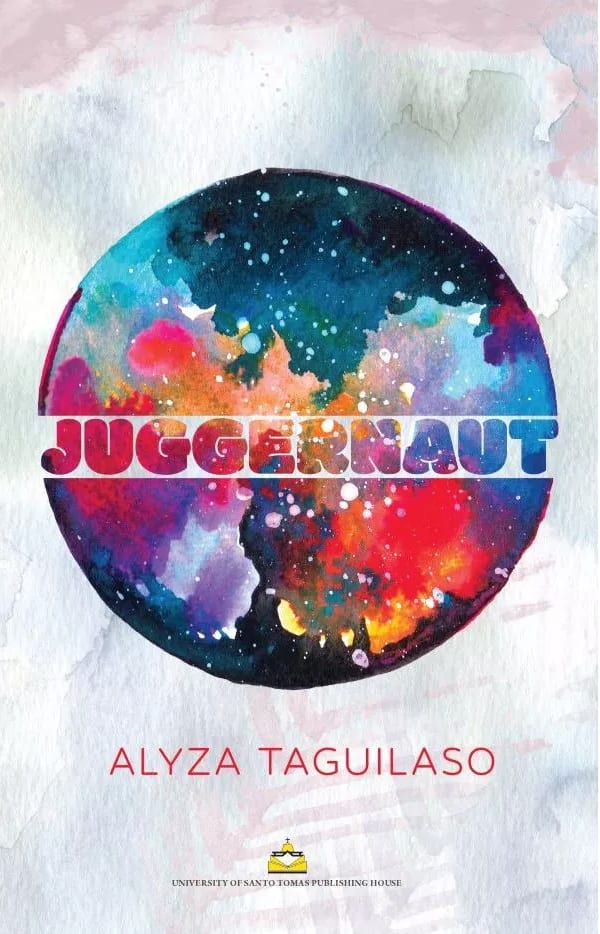
The Surgeon’s Witness: Alyza Taguilaso’s Juggernaut
The word juggernaut carries inside it a colonial encounter: it derives from Jagannātha, Sanskrit for Lord of the Universe, a form of Vishnu worshipped at the great temple in Puri, whose annual Rath Yatra—the chariot procession—was first described for European audiences by the fourteenth-century Franciscan friar Odoric of Pordenone, who reported that devotees threw themselves under the chariot wheels as acts of religious self-sacrifice. Whether this actually happened, and at what scale, remains contested—some historians argue the deaths were accidental, caused by the crush of the crowd, while others note that intentional self-immolation was not unknown but was almost certainly exaggerated far beyond what occurred. What is not contested is what European missionaries did with these accounts: Rev. Claudius Buchanan, an Anglican chaplain in colonial Calcutta, used them to portray Hinduism as a religion of blood and superstition, and by the mid-nineteenth century the word—which had entered English in its literal sense as early as the seventeenth century—had acquired its figurative meaning as a metaphor for a merciless, unstoppable, crushing force, carrying inside it the colonial judgment that had shaped it. Whether or not Taguilaso had this history consciously in mind, the word she has chosen to name her book arrives trailing that judgment, and the book she has written turns it against its original direction: in Juggernaut, the unstoppable crushing force is not Hindu devotion but the systems—medical, state, military—that claim to move in the name of something sacred, and the bodies beneath the wheels are not devotees but the casualties of institutions that have forgotten they were built for people.
Taguilaso is a general surgeon, and the vantage point this gives her is the book’s irreplaceable epistemological condition, one that no amount of research or imagination can replicate from the outside. Juggernaut is organized into two titled parts—“All Fright and Laughter” and “The Air We Used to Inhabit”—each containing multiple numbered sections, and the titles are themselves a map of the book’s tonal arc: the first part grounds itself in the specific weight of the medical and political, the second reaches toward the speculative and the mythological, and the distance between these two registers is where the book’s central tension lives. Consider what the first part’s vantage point makes visible: the infant born with an omphalocele—a condition Ambrose Paré first described in 1634, the poem tells us, in the clipped notation of a clinical timeline (though Paré died in 1590, which raises the question of whether the date refers to a posthumous edition of his works or is simply an error the poem absorbs without apology, and either way the absorption is interesting: the poem borrows the authority of medical record-keeping while the record itself may be unstable, which is perhaps the point, perhaps the fiction of attribution that all documentation carries inside it)—or with gastroschisis, which James Calder described in 1733, both conditions in which the body arrives in the world already open, already requiring intervention before it has had time to declare itself alive. It makes visible the fellow surgeon who makes a joke, with some difficulty, about his single-ventricle son’s life expectancy while they clamp and ligate another tiny vessel. It makes visible the friend’s father, who arrives dead on arrival at the hospital, his identification cards buried in the rubble and metal of whatever killed him, so that the speaker only finds out what has happened a full day later. The medical perspective brings to the book not just medical content but a medical epistemology, a way of knowing the body that is simultaneously intimate and instrumental, that holds together the procedural and the grief, the clinical and the human.
“SVRGERY” is the book’s most relentless manoeuvre. Across twenty numbered sections it assembles a kind of alternative anatomy of medical training in the Philippines: the resident surgeon whose heart collapses after seventy-two hours on duty; William Halsted, who set the precedent for the superhuman sleeplessness that still governs residency culture by infusing his veins with cocaine and continuing to function without rest; the grandfather who nods, in silence, when asked if he wants to live, his thin fingers weakly squeezing the speaker’s hand while the ventilator punctuates the air; the question the sequence poses and re-poses in different registers—“Answer these questions and you may proceed: / A. How to operate? / B. When to operate? / C. When not to operate?”—with that third question, C, the one the profession barely creates space for, the one that bears on all violence done in the name of care and all care withheld in the name of scarcity and policy. The sequence also holds the moment when a mentor instructs the speaker to call an accident a crash, because all accidents are preventable—a lesson that is at once medical protocol and political philosophy, the book’s argument that what looks like tragedy is almost always the consequence of choices that someone made.
The book’s second part, “The Air We Used to Inhabit,” moves into science fiction tropes (TRAPPIST-1e, the Methuselah star, the binary code embedded in “Seizure”) and fantasy registers (the siren’s captivity, the multiple historical incarnations of “Fragments: In Which We Are—“), and here the transition is less a bridge than a rupture. The speculative material, though sometimes achieving genuine strangeness, often moves too quickly through its conceits to accumulate the weight the medical poems carry naturally from their subject matter. The collection is called Juggernaut—the unstoppable divine force, the object dragged over bodies—and it enacts its title in ways that are not always intended: it is massive, unstoppable, and it crushes some of its finer material under its own momentum.
What holds the two parts together—or tries to—are the poems that serve as its bookends. “Suwerte,” which opens the collection, and “The Story of Love,” which closes it across eighteen sections numbered from 0, frame nearly two hundred pages of work that reads, at times, less like a single book than like two books pressed between the same covers: one that knows exactly what it is doing and one still finding its shape. “Suwerte” is among the assured political poems in the collection: a catalog of the specific indignities visited on the Filipino body—the face shields and curfews demanded of a people while hospitals swelled, the dictator’s exhumed corpse reimplanted in the heroes’ cemetery, the demand that healthcare workers consider themselves lucky to be “underpaid, but alive”—refusing the usual consolations without abandoning the specific anger that names them. It is a poem that arrives fully formed, that knows the weight of what it is carrying. “The Story of Love,” by contrast, is the book’s sustained and most unresolved attempt at synthesis, moving through physiology and the history of love and war and the atomic bomb and the question of what it means to need another person in a world designed to keep people separate—and arriving, across all those sections, not quite at an answer. This irresolution is not a weakness but the poem’s honest gesture: some questions resist closure, and Taguilaso keeps them open with a persistence that is itself a kind of argument, and a kind of faith that the book’s two halves, however uneasily they share the space, are pressing toward the same thing.
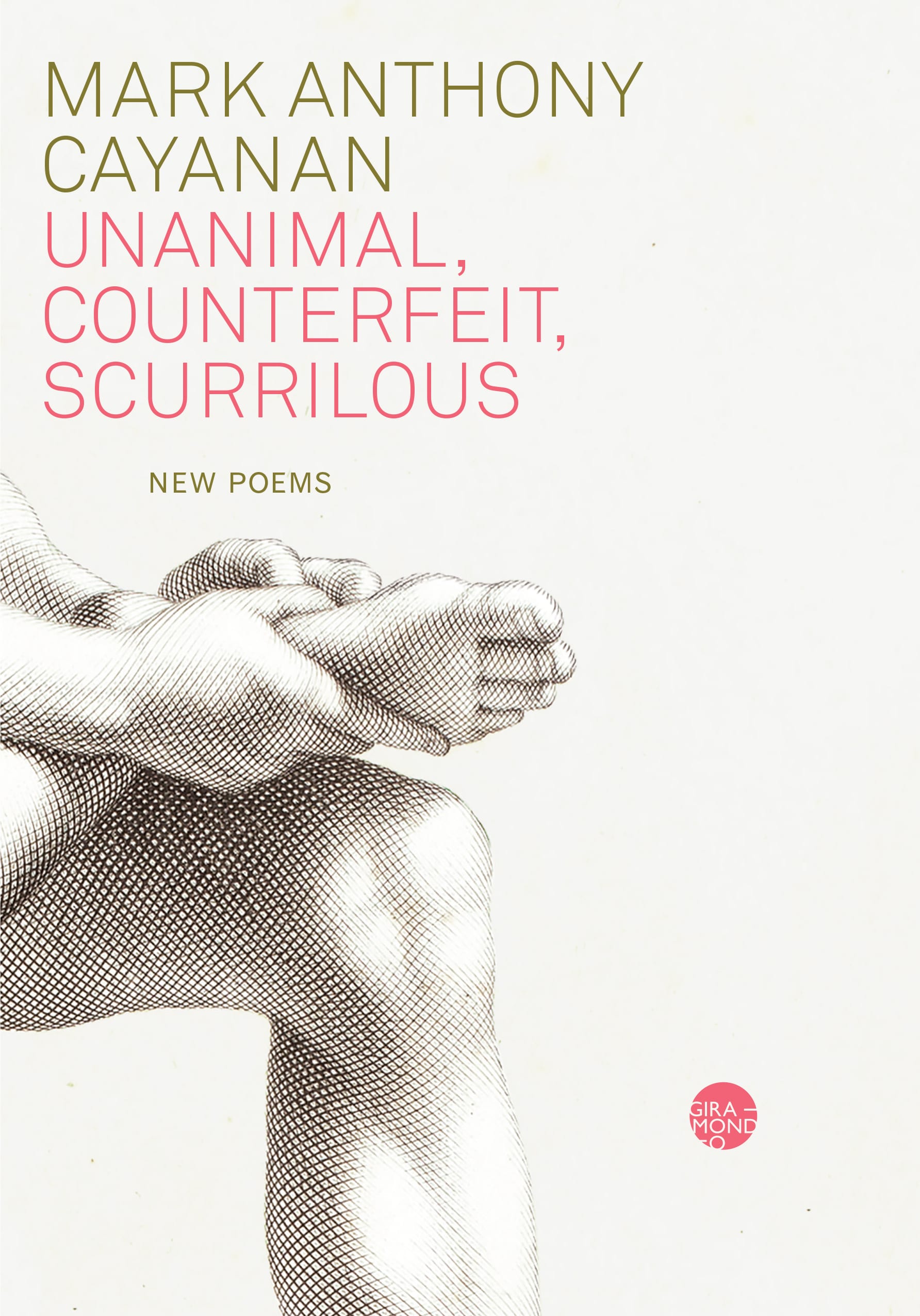
The Code and the Impasse: Mark Anthony Cayanan’s Unanimal, Counterfeit, Scurrilous
What Cayanan has done in Unanimal, Counterfeit, Scurrilous—a title filched and refashioned, the afterword tells us, from George Long’s translation of Marcus Aurelius’s Meditations—is to build a trap for the attentive reader: they have written a book that argues, with considerable formal intelligence, for the value of not speaking directly about the things that matter most, and then has spoken directly about those things in the book’s extraordinary afterword, “Impasse: An Afterword.” The trap is not a failure of consistency, but the book’s central argument made structural: if you could not fully enter the poems without the afterword, then you are precisely the reader the poems were warning against—the one who moves through opacity toward illumination and calls the journey understanding, who consumes another’s political suffering and feels, afterward, that something has been paid. The impossibility the book is staging is not merely rhetorical; it is the impossibility of speaking both inside and outside a literary economy that converts political engagement into cultural capital, that rewards the queer Filipino writer’s candor with a recognition that is never quite the recognition being sought.
The book was first published by Giramondo in Australia in 2021, where it was Cayanan’s doctoral dissertation and earned the University of Adelaide’s Doctoral Research Medal; the Philippine edition adds the afterword, which transforms the reading experience considerably. The collection’s central conceit is a shadowy persona channeling Thomas Mann’s Aschenbach—middle-aged, desiring, unable to act on that desire, watching beauty approach and recede—and this Aschenbach persona is both a mask and a mirror, both the German writer’s crisis and the Filipino queer writer’s crisis written during the Duterte drug war. The afterword speaks explicitly of this context: Project Tokhang, the 42,286 raids—the overwhelming majority conducted without warrant—and the 20,322 deaths recorded within the same period, and Cayanan’s sense that they could not write directly about any of this without accumulating the kind of literary-political capital that felt, to them, like a form of complicity.
The sequence refuses to settle into a single mode, and this refusal is not restlessness but argument—each poem’s form enacts a different relationship to the act of witnessing, a different answer to the question of how close the poem can get to the suffering before the getting-close becomes its own kind of appropriation: “Motus animi continuus” moves through colonial forced labor, extrajudicial killing—a body bludgeoned and stuffed into a culvert, “noisy miners flying in and out of the field”—queer longing and intimate observation in a single, continuous, vertiginous flow; “One among” follows 1.6 million workers through the city—flight attendants, cab drivers, government clerks, food sellers, promodisers—linking them to each other and to the speaker through proximity and contingency alone; “Ode to boy” half-caresses and half-savages the desiring gaze it inhabits; “Variations on the word ‘pass’” accumulates scenes of things passing, yielding, slipping by unrecorded—the mass grave intricate as a honeycomb, the victim whose mother insists on trimming his fingernails, the body identified only by cardboard and a tattoo (“They remove the cardboard / and know it’s him through the thorny heart on his forearm”)—with a logic that refuses to separate these acts of passing from each other because, in the Philippines of that moment, they are not separable. And “Ben Ben Ben Ben Ben,” the long poem that closes the collection proper, is its most confessional and most theoretically self-aware moment simultaneously: the speaker performs the removal of the Aschenbach mask—stages what unmasking would look like, what autobiography sounds like when a poet trained in persona attempts it—and the poem moves between Mann’s biography and Filipino political history—Dovie Beams, the Marcos dictatorship, the newly elected senators of the present—between self-deprecations and genuine grief and longing, between the mask now partly lifted and the uncertainty of whether what lies beneath it is a face or only another mask. That this uncertainty is unresolvable is not a failure of candor but the book’s honest admission that the literary self, shaped by so much reading and so much performance, may no longer be able to locate where the persona ends.
This is the most theoretically rigorous collection of the five, the one explicitly engaged with what poetry can and cannot do under conditions of state violence—and that engagement is itself a contribution that may outlast the specific political moment the poems refuse to name directly. The afterword is more accessible than the poems, and this creates a dependency the reader may initially experience as a limitation—needing the essay to fully enter the sequence—but perhaps this is less a limitation than a structure the book has deliberately built, the afterword not a key to the poems but a second layer of the same problem: the impossibility of speaking both inside and outside the literary economy at once. What the opacity generates, for the reader willing to stay inside it, is not illumination but implication—the experience of being caught in a system that rewards the very engagement it should be questioning. This is not comfortable, and it is not meant to be. But it raises a further question: of which reader the book is most addressing, and whether the opacity serves all of them equally. The book’s warning seems aimed precisely at the reader who would consume Philippine political suffering as literary content—the international literary market, the prize circuit, the one who moves through difficulty toward illumination and feels, afterward, that something has been paid. The Filipino reader who lived through Project Tokhang, who lost someone to it or witnessed its operations or fled its reach, is implicated differently: not as consumer of another’s suffering but as witness to their own, and what the opacity might open for that reader—whether the distance the poems keep becomes a space for a different kind of recognition, one that does not require the suffering to be made legible in order to be honored—is perhaps the generative question the book leaves unanswered.
The Creature and Its Creator: Austere Rex Gamao’s With Decade
With Decade arrives with a voice so formally original that describing it risks making it sound gimmicky. It is not. This is a book that has made itself, in the most fundamental sense, assembled from materials that Philippine poetry in English does not often work with: mythological cosmology that is simultaneously Filipino and invented, the metafictional address, the prose poem as theatrical stage direction, the section header as ironic developmental narrative, the author as character who addresses the reader directly and confesses to having lost control of the creation.
Decade is a creature of time—mythological, referred to predominantly as it across the text, though she surfaces at moments when the creature’s relation to the human becomes more intimate, the pronoun refusing to settle permanently into either register—born from contradictory and simultaneous origin stories: from the air between / the first split bamboo, from an egg the gravedigger cracked open in a crowded cemetery, from a riverside parking lot flooding with amniotic fluid. The book’s five major parts are organized around sub-section headers that map a life—Formation, Family, School, The Tasting, City, Flight, Work, Shopping, Gig, Hometown, Love, Friends, Food, Church, Spacetime, Solutions—tracking the recognizable stations of a developmental narrative (institution, migration, labor, love, faith) while also admitting sections that refuse that narrative’s tidiness: The Tasting, Gig, Hometown, Solutions, names that do not resolve into the expected arc but accumulate beside it, complicating what a life in this country is supposed to look like. The tracking is constantly disrupted, the institutions satirized and complicated, the developmental narrative revealing itself as a series of structures that Decade can neither fully escape nor fully accept.
The “Time of the Flood” sequence is the collection’s political feat: nine prose-poem sections in dense, unpunctuated blocks, tracking the phenomenology of a typhoon and its aftermath from multiple perspectives and across time. The sequence refuses the sentimentality that disaster writing so often reaches for—instead attending to the structural inequalities that determine who bears the weight of the flood: the squatter’s area that bears the water longer with its unplanned maze of houses, the walls that keep a record of the flood’s height each year—“last year it was an adult, this year a toddler”—and the sugar factory that announces the gating and fencing-in of that squatter’s area not to help the poor but to protect its employee houses from having to see the poor lining up at the communal pump for water. That detail—the fence built not against the flood but against the sight of poverty—is the sequence’s most devastating political observation, arriving without commentary, simply named and left to stand in its full ugliness. And “Time of the Flood V” reaches its strangest and most self-aware moment when it denies the flood any narrative at all: “there is no person in the flood no identity no place of birth no time of / birth no stars aligning to witness anything... no story arcs no character / developments no autobiographies masquerading as poetry”—that last phrase a joke at the collection’s own expense, or at its readers’ tendency to read it autobiographically, and it tells you exactly what the book is doing with its metafictional intrusions.
The Plaza Monologues scattered throughout—each titled with an emotional instruction in brackets: [stubbornly], [painfully??], [cowardly], [panting], [flirty], [confidingly]—are the collection’s riskiest formal decision, reaching for the disorganized expressiveness of actual thought as it is happening rather than after it has been arranged. At their best, they achieve something rare: the thought thinking itself before it is organized into argument, the self surprised by what it finds when it reaches for what it means to say. At their most unmoored—[painfully??] losing the reader in associative loops that stop being productive, [cowardly]’s crude humour tipping from provocation into jarring arbitrariness—the looseness of thought that is the form’s greatest resource becomes its liability, the disorganization no longer expressiveness but simply disorder. But the risk is real, and the best of them earn it.
What earns everything, finally, is the book’s philosophically interesting formal choice: the author hosting a show in the bathroom—stage directions, lighting, a boom mic under the showerhead, Decade sitting on the toilet—that functions simultaneously as comedy, as philosophical inquiry, and as a meditation on what happens to a creator when the creation exceeds the frame given for it. “No more you in me. I makes myself,” Decade says—the grammar broken deliberately, I makes myself rather than I make myself, as if the creature’s new autonomy has not yet found the syntax for it. And the grief of this moment—the grief of the author who has made something that no longer needs them—is real, earned, one of the stranger and more quietly devastating emotional achievements in this gathering of books, and in recent Philippine poetry in English.
The City and What Remains: Vincenz Serrano’s Now is a new no
If Gamao’s book is the most formally experimental, Serrano’s is the most formally concentrated—concentrated in the sense that a poem is concentrated when it trusts its materials, when the pressure comes from within the form rather than being applied from outside. Now is a new no is a poetry collection that works primarily in prose, organized around photography, around Manila’s history of dispossession and colonial accumulation, and around the phenomenology of a long-distance love that ends—and around the question, stated and restated in different registers throughout, of what metaphor is, what it does when it collapses the distance between two things, what happens when the collapse of distance that metaphor enacts is also the thing you most desire from a person who lives in another time zone and will not come back.
The book’s four movements are organized with a care that extends to the level of individual sentences, where the prose poem meets the lyric essay meets the critical note meets the architectural history meets the love poem. “Fog” opens the first movement, “The Collapse of What Separates Us,” with a working definition of metaphor—“the collapse of what separates us”—and this definition becomes both a formal program and an emotional condition for everything that follows: if metaphor is the collapse of what separates two things rather than their merger into one, then the book is a long meditation on the human desire to close that distance—to be as near to another thing, another person, another city, as language will allow. “Short Walks,” later in the same movement, is the collection’s explicitly self-reflexive piece about method, staging a dialogue between a scholar who loves the city’s ache of opposites—“crowd and solitude, old and new, beauty and decay, feeling and fact, silence and noise, grasp and emptiness”—and a walker who wants to take the city apart, to let dismantlement lead to the new, to use “a method akin to derangement: arriving at the unknown after a long period of poison, suffering, disorder.” These two figures—the scholar of the city’s coherence and the walker of its derangement—are in tension throughout the book, and the formal double-columns of “Static”—where the left column carries a lyric meditation on the speaker as static, as the sound between stations, while the right column draws on Cronenberg’s The Fly—enacts through form what the city demonstrates through its history: that things can coexist without resolving, can share the same space without becoming the same thing.
“Itinerary,” the book’s second major movement, opens into a long meditation on the Manila Hotel as a site where colonial desire, architecture, and exclusion converge—where Manileños learned about the world through proximity to its affluent guests but “were forbidden to be part of that world”, and where once the guests left, “Manileños grew dizzy with immobility”. The third movement, “When a map is folded cities come closer, when clothes are unpacked cities fall apart,” interleaves historical photographs from the American Historical Collection at Ateneo de Manila with prose that thinks about what it means to photograph a ruin, to use an archive, to speculate from images that are already mediated, already the product of decisions about what to frame and what to leave outside the frame. The movement’s dominant mode is reflection—on photography, on language, on what the archive preserves and what it loses—and contemporary Manila enters it fleetingly, in glimpses: an eskinita where stalls sell dragon fruit and tofu, a neighbor’s adobo bleeding through the wall. The historical archive is the book’s primary material here, and when the prose attends to the built environment of old Manila—its factories, bridges, esteros, the plant whose whistle set the city’s time—the human lives that moved through those structures tend to appear as shadows rather than presences. This is a question of mode, not of failure, and it is the kind of question a book this careful raises precisely because it has taught the reader to ask it.
“Now is a new no,” the final and emotionally immediate movement, is a long meditation on a love that ends, structured through an obsessive return to the same images (the clocktower, the bread, the laptop screen, the clothes in the laundry basket) and the same phrases (“before this”, “again, but when”, “there is another X but it is in this one”)—and this repetition, which might seem mechanical, turns out to be the point: the way a love persists past its ending in the habits it installs in the body, in the syntax of a mind that has learned to think in terms of two people even after one has left. The title phrase—“now is a new no”—arrives late in the sequence and earns its weight not through argument but through accumulation: the sound of time restarting after loss, the now that is not continuous with the now that preceded it, the refusal that contains, barely, a form of beginning.
It is a fitting note on which to end not just Serrano’s book but this assessment. What these five books make visible, finally, is not only what Philippine poetry in English is but how much of it there is right now—and how much of it could not be gathered here. This year’s NBA shortlists were uneven in their fullness: nonfiction prose in Filipino sent forward only two finalists, short fiction in Filipino four. Poetry in English arrived with five, and the five displaced others that, in some other year, against a different field, might well have been finalists in their own right—so they were displaced not because they were inferior but because the particular shape of this year’s conversation, the coincidence of five poetic projects so distinct in form and ambition, meant that anything registering too similarly to one of them would inevitably find itself outside the frame. It is a measure of what is happening to Philippine poetry in English in 2024: a form working at enough intensity, across enough different registers, that its surpluses exceed what any shortlist can hold. These five books—Gamalinda’s reckoning with empire and cosmological grief, Taguilaso’s surgical witness, Cayanan’s encrypted ethics, Gamao’s mythological creature breaking free of its creator, Serrano’s patient architecture of loss—do not represent the field so much as they reveal its pressure. And the pressure, for now, holds.

Edgar Calabia Samar is Associate Professor and Chair of the Department of Filipino at Ateneo de Manila University. He is the author of the award-winning Janus Silang series and of several other novels, including Teorya ng Unang Panahon, a Palanca and National Book Award winner currently being translated into English as Theory of a Long Time Ago by PEN Presents × International Booker Prize winner Christian Benitez, under a National Book Development Board translation grant. His first novel, Walong Diwata ng Pagkahulog, received the NCCA Writer’s Prize in 2005, and its English translation, Eight Muses of the Fall, was longlisted for the 2009 Man Asian Literary Prize. He previously served as Visiting Professor at Osaka University from 2017 to 2022 and as Writer in Residence at the University of Iowa in 2010. He is the Head of the National Committee on Literary Arts of the National Commission for Culture and the Arts and a member of the Filipino Critics Circle, formerly the Manila Critics Circle, the Filipinas Institute of Translation, and LIRA, where he served as President from 2001 to 2003. In 2024, he received the S.E.A. Write Award from the Royal Family of Thailand for his contributions to Southeast Asian literatures. He develops literature and novel-writing guides and maintains a growing Filipino komiks archive through Santinakpan Otherwise on patreon.com/ecsamar.
ALSO READ:
The Tongue and the Terrain: On the Finalists for the 43rd National Book Award for Best Book of Poetry in Filipino
Five Doors Into the Real: On the Finalists for the 43rd National Book Award for Best Nonfiction Prose in English
The Dwelling and the Drumbeat: On the Finalists for the 43rd National Book Award for Best Nonfiction Prose in Filipino
What the Novel Remembers When the Nation Forgets: On the Finalists for the 43rd National Book Award for Best Novel in Filipino
What the Novel Carries When It Leaves: On the Finalists for the 43rd National Book Award for Best Novel in English
What the Stories Hold When the Collection Gathers: On the Finalists for the 43rd National Book Award for Best Collection of Short Fiction in Filipino
The Gathered and the Gathered Against: On the Finalists for the 43rd National Book Award for Best Collection of Short Fiction in English
Edgar Calabia Samar is an award-winning poet, critic, and novelist, and an Associate Professor at Ateneo de Manila University. IG: @ecsamar.
View More Articles About: