At the Editor’s Own Table: On the Finalists for the 43rd National Book Award for Best Anthology in Filipino
Every single one of these volumes is edited by someone who is also inside the world the editing organizes.
Published on May 17, 2026
THE MOST CONSISTENT FACT about this year’s five finalists for the National Book Award for Best Anthology in Filipino—and the fact least often examined as a feature of the form rather than an accident of any individual volume—is that every one of them is edited by someone who is also inside the world the editing organizes. Pansit Luglog, Halo-halo, Atbp. sa Kuwentuhang Malabon is edited by Fanny A. Garcia, whose own essays also close the volume. Liwanag at Itim II: Antolohiya ng mga Malikhaing Akda na Alay sa Alaala ni Teresita G. Maceda is edited by four scholars—Will P. Ortiz, Rowena P. Festin, Maricristh T. Magaling, and Vladimeir B. Gonzales—who themselves work within the literary network the volume documents. Ragasa: Apat na Dekada ng Pagsulong ng mga Kuwentistang Katha is edited by Rolando B. Tolentino, Romulo P. Baquiran Jr., Honorio Bartolome de Dios, and Francine Y. Medina, all four of whom are members of Kuwentistang Katha and contributors to the very volume that documents the group. Sakit, Pasakit, Malasakit: Pagkatha ng Pandemya sa Pilipinas is edited by Tolentino and Rommel B. Rodriguez, both of whom contribute pieces of their own to the closing pages. Never Again, Never Forget: Mga Tampok na Akdang Jun Cruz Reyes, the fifty-year retrospective of Pedro Cruz Reyes Jr., is in effect edited by its subject. The pattern is too consistent to be coincidence and too pervasive to be ignored, and the question this essay wants to ask is what such consistent self-implication does to the form.
The institutional context shapes what the question can be answered against. Four of the five volumes emerge from the University of the Philippines Press, three of those under the Philippine Writers Series of the UP Institute of Creative Writing; the fifth comes from Bughaw, the Ateneo de Manila University Press imprint. The anthology in Filipino is, in this moment, almost exclusively a university-press genre. This narrows the channel through which Filipino-language anthologies reach readers, and the narrowness itself shapes what kinds of editorial gestures are possible. The five volumes here have made it through that channel, and to read them is also to read the conditions of their possibility—which include, among other things, the convention that an editor of a Filipino-language anthology is also someone embedded in the field the anthology documents, because the labor is unpaid or underpaid and only insiders have the motivation to undertake it. None of this disqualifies the books. It does, however, frame what a careful reader is asked to weigh: not whether the volumes succeed at editorial distance, since none claims to attempt it, but what the volumes do given that distance was never on offer—what they manage from inside fields they cannot quite step outside of.

Pansit Luglog, Halo-halo, Atbp. sa Kuwentuhang Malabon: The Class of Memory
Fanny A. Garcia’s Pansit Luglog names its theoretical commitment with unusual directness. In the editor’s foreword, Garcia invokes the organic intellectual of Antonio Gramsci as the figure who has organized her thinking, traces the term through the underground writing of the Marcos period, and uses it to justify her decision to open the volume to seventeen of her former classmates from Jose Rizal High School Batch 1966 alongside her own essays and those of Aurora E. Batnag. The argument is that intellectual work is not the exclusive property of those formally trained as intellectuals and that the literary book, sufficiently open, can carry writing that emerges from the everyday lives of ordinary people. The premise is genuinely uncommon among the year’s anthology finalists. None of the others extends an invitation to writers outside the professional literary class. None makes the question of who counts as a writer the central editorial question.
What complicates this premise, however, is the actual class composition of those invited. The seventeen kamag-aral contributors are alumni of Jose Rizal High School circa 1966—a public high school, certainly, but one that produced college-bound graduates, many of whom became professionals (a doctor, executives, an engineer, an early balikbayan). Their memories of Malabon are middle-class memories: the family with the tornero father and the housewife mother, the Lolo Maning who owned the Leonor and Estrella cinemas, the parents who could pay for college at the University of Santo Tomas or Mapua, and lay an abundant fiesta table of menudo, mechado, and pansit Malabon for the August feast of San Bartolome. The fishpond workers and the taga-bukid are present in these memories, but as figures the contributors observed rather than figures the contributors were. To call this a Gramscian gathering is to take liberties with Gramsci, whose organic intellectual names the figure who emerges from the laboring class to articulate that class’s interests against bourgeois hegemony, not the bourgeois professional whose memories are themselves saturated with the labor of others. The gap matters because the volume’s most stirring moments are precisely the ones where the class boundary becomes visible: Camus’s looban with three mango trees and ten coconut trees and the Mama who allowed her only the morning and afternoon hours for play, Borja’s morning walk past the Concepcion Public Market on the way to JRHS to watch Maria layer the halo-halo of kaong, black beans, garbansos, halaya, langka, and binusang pinipig for customers on the long bench in front of the stall, while across town Lolo Maning owned the cinemas where those same townspeople watched the occasional movie. These are not the same Malabon. The volume gathers them as if they were, and the gathering is itself a class operation that the Gramscian framing does not quite name.
This is not to dismiss what the contributors give us. What they give is something the polished essay would have lost: the topography of a wooden house at 15 Villongco Street, where Florinio Borja was born on a Thursday at seven in the evening of September 30, 1949, the looban of Josefina Camus’s childhood with its kalabaw, piko, and pawpawan mangoes, its sungsong and marosas pomelos, its santol-Bangkok with its thick flesh, the proliferation of names that constitute, when assembled, a botanical inventory of a domestic ecology now mostly paved over. These are not literary essays in the workshop sense—Borja’s piece moves between Filipino and English without apology, marks dates with the precision of a homeowner’s deed, accumulates detail in ways revision would have trimmed—but their refusal of literary compression is part of what they preserve. The form of these pieces is a form of fidelity to the texture of recall, and the texture is what would have been lost in tighter prose.
What the volume’s middle section accomplishes is different again. Aurora E. Batnag’s essays do work the kamag-aral testimonials cannot, and that Garcia’s curated essays do not pursue: linguistic mapping, philological documentation, the kind of salvage operation that requires a scholar’s training. Her “Pansit Luglog ng Aking Ina” moves from culinary memory toward the loss of recipes when matriarchs die without writing them down—an essay that names the inheritance crisis at the heart of any project of cultural transmission. Her “Varayti ng Wika sa Lupaing Walang Lupa” charts the specific lexical features of Malabon’s Tagalog—the sulong pronounced lusong, the pansit Malabon that is properly pansit luglog—as a variety of the language documented in its own terms. Her “Hinugot sa Alaala: Glosari ng mga Katawagang Tangi sa Malabon” is a glossary of vanishing terms (balensiya for what others call turon, alpahor for ginataang halo-halo, ala berde for the free entry to a movie’s second feature) that takes seriously the linguist’s premise that when a vocabulary dies, the culture it carried dies with it. The volume’s most distinctive contribution to Philippine letters may be exactly this register: a model for how the literary book can also be a vehicle of language documentation, how memoir can become philology without ceasing to be memoir.
The volume’s deeper structural problem is its three-part architecture. Kamag-aral writings come first, Batnag’s philological essays second, Garcia’s curatorial-memoiristic essays third. The progression from informal recall to scholarly documentation to polished memoir produces a tonal ascent that subtly reinstates the very hierarchy the book elsewhere works against, even as each section contributes work the others could not. Garcia’s pieces, particularly “Bakla at Tomboy: Iba’t Ibang Karapatan” and the closing essay on the project’s making, are more conventionally accomplished than what precedes them, and their position at the end of the volume can read—against Garcia’s intention—as the real writing toward which the earlier pieces were pointing. An alternative ordering, interleaving the registers and refusing to segregate them by literary credentials, might have made the editorial argument more fully embodied in the book’s form. As the volume stands, the egalitarian gesture and the hierarchical sequence work against each other, and the reader is left to choose which one to credit. None of this diminishes what the volume achieves: a model for the anthology that takes who counts as a literary writer as a question worth asking, a record of a Malabon whose textures the more credentialed forms could not have preserved, and—in Batnag’s section especially—a small-scale demonstration of how language documentation can sit comfortably inside literary memoir.
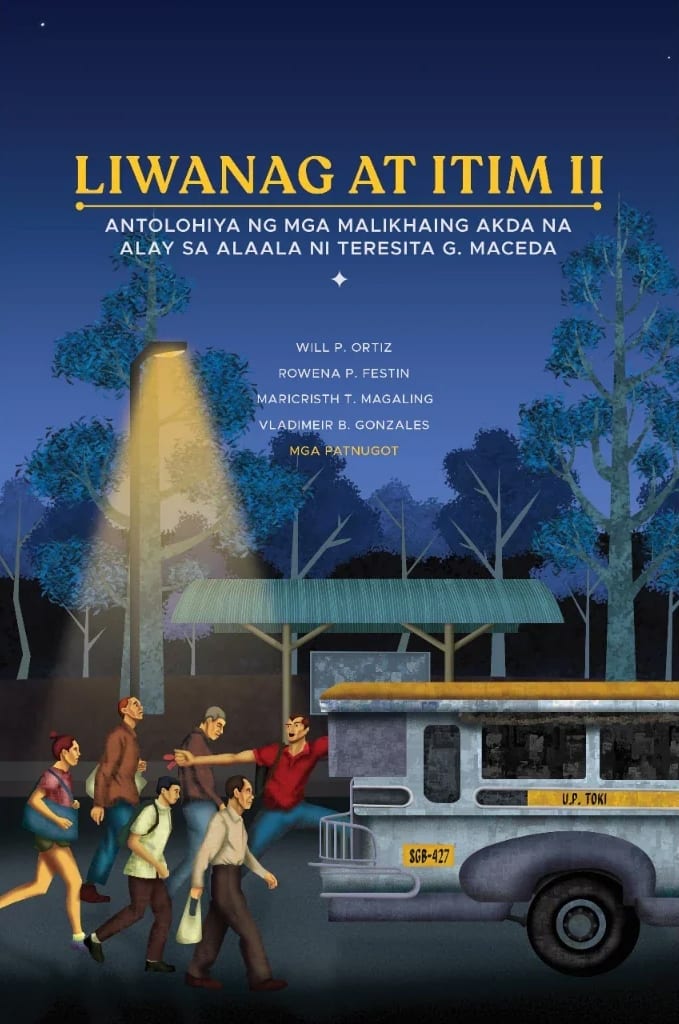
Liwanag at Itim II: A Memorial That Cannot Disagree
Where Pansit Luglog gathers around a place, Liwanag at Itim II gathers around a person, and the person—the late Tet Maceda—is no longer alive to organize the gathering she once organized in life. This is the paradox at the center of any memorial volume: the absent figure must somehow continue to do the curatorial work the book requires, and the editors must either supply that work themselves or trust that the contributors, having been formed by the figure’s pedagogy, will produce pieces that cohere because the formation was itself a coherence. The four editors choose the second path, and the choice is made workable by what Maceda actually was: not only a scholar but a teaching presence whose insistence on the laylayan, on Mga Tinig Mula sa Ibaba, on the dismantling of feudal hierarchies even in the small matter of how a student addresses a professor, shaped a generation of UP Diliman intellectuals whose essays in this volume bear the unmistakable mark of her instruction even when they do not directly cite her work.
The volume’s editorial introduction, “Mga Bubog sa Pagbasag ng mga Muhon at Kanon,” reaches back to Emilio Jacinto’s Liwanag at Dilim and forward to the present moment of the anti-terrorism law and the West Philippine Sea, situating Maceda’s career within a longer Filipino tradition of intellectual labor as anti-colonial practice. The editors are explicit that the volume is the second of a pair—Liwanag at Itim I, published in 2022, gathered creative work; this second volume gathers academic essays—and the pairing performs a position Maceda’s career embodied: that the binary between creative and critical writing is itself an inheritance from foreign academic culture and need not constrain Filipino practice.
What the nine essays do, when they work, is to extend Maceda’s project into terrains she did not herself fully chart but that her methodology made available. Eugene Y. Evasco’s opening essay, “Panunuring Pampanitikan,” reads as a programmatic map of the contestations within Filipino criticism, from Iñigo Regalado and Teodoro Agoncillo through the Veronicans–Philippine Writers’ Guild dispute and the formalism-versus-engagement debates of subsequent decades, arriving at a position Maceda would have recognized: that criticism is itself a site of struggle, that the formalism inherited from American New Criticism cannot serve a literature whose vitality depends on connections to vernacular life and political contest. Raniela E. Barbaza’s “Pagpapalayas sa Maligno” carries this argument toward the regional literatures—Bikol, Sebwano, the sugidanon—Maceda spent decades insisting on as central rather than peripheral. Nelson Turgo’s essay reads parodic Tagalog ballads about seamen as repositories of migrant labor’s specific knowledge, locating kulturang popular exactly where Maceda located it: as a contested zone where the discourse of the bagong bayani meets the daily reality of bodies sold abroad. Romulo P. Baquiran Jr.’s reading of Lope K. Santos’s “Pangginggera” recovers a forgotten verse narrative as a present-tense allegory for a debt-bound nation. Mary Jane B. Rodriguez-Tatel and Mark Benedict F. Lim address ethnicity and indigenous-settler relations through the Ayta in Malolos, Bulacan, and the Tsino-Filipino in cinema and anthology. Anna Cristina G. Nadora and Jimmuel C. Naval return to the Katipunan: Nadora through the talinghaga of katwiran at kapwa, Naval through a hybrid critical-creative essay that walks the avenue named after the revolutionary movement and finds it transformed into a corridor of bourgeois education and incidental death.
What the volume does not quite do, however, is make space for disagreement. The essays cohere because their authors share a methodological inheritance and a political horizon, and the coherence is itself the volume’s argument. But a memorial that consists entirely of contributors who agree with the figure being memorialized is also a memorial that has decided in advance what the figure stood for. The Maceda whose pedagogy emphasized debate and dispute would not, perhaps, have wanted a volume in which her position was defended without complication. Where, in this gathering, is the essay that takes seriously a counterargument to the laylayan-centered reading of Filipino literature? Where is the contributor who works in a different methodological tradition and was nonetheless changed by Maceda’s teaching? The absent voices are not absent because they do not exist; they are absent because the editorial gesture is one of fidelity rather than of contest, and the choice has costs as well as virtues. The unevenness here is not within any single piece but in the volume’s collective unwillingness to let its contributors abrade against one another. Liwanag at Itim II is a confident volume. Its confidence is also its limit. The editors’ decision to preserve the different stylistic practices the contributors brought to their essays is consistent with Maceda’s own anti-standardization position derived from her tenure as the founding director of the Sentro ng Wikang Filipino; but the surface variation does not extend to the deeper register where it might have mattered most: the level of methodological dissent. What the nine essays nevertheless give Filipino criticism is real: Barbaza’s recovery of regional literatures as central rather than peripheral, Turgo’s reading of migrant ballads as repositories of labor’s specific knowledge, Baquiran’s recuperation of Lope K. Santos’s Pangginggera, Nadora’s and Naval’s returns to the Katipunan are pieces that will be cited and contested for years, and the volume that gathers them is the kind of memorial Maceda’s work earned.
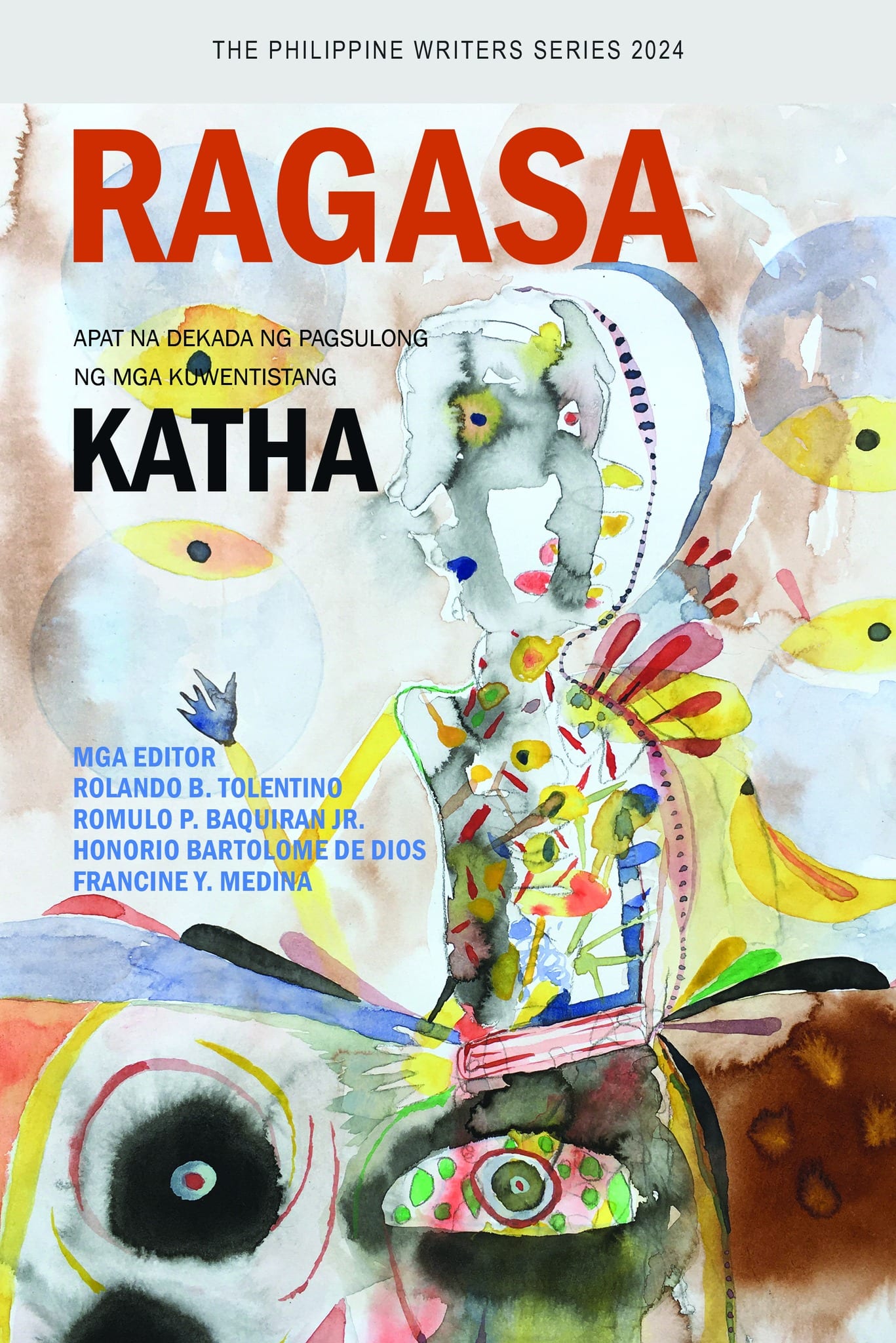
Ragasa: An Organization Anthologizes Itself
Ragasa is the most architecturally self-conscious of the five finalists, and the self-consciousness is built into the structure: Danas-Katha (testimonial essays about each writer’s relationship to the group), Dating Kuwento (the early Katha-era stories), and Bagong Kuwento (new stories written for the present anniversary). The volume documents four decades of Kuwentistang Katha, which began in 1988 as Saturday-morning workshops in Joi Barrios’s house in Kamuning, moved soon after to the basement of the Heritage Art Gallery on Lantana Street, Cubao—where Odette Alcantara, the gallery’s owner and an environmentalist and art patron known to everyone as “Lola O,” hosted the writers among the works of painters such as BenCab and the sculpture benches by Jerry Araos—and was formally founded on September 24, 1989, in a daylong symposium at the Cultural Center of the Philippines. The young writers who passed through those rooms would become some of the most institutionally consequential figures in late-twentieth- and early-twenty-first-century Filipino fiction. The tripartite structure makes the case for the volume’s existence as an anthology by demonstrating that Katha has both a history worth preserving and a present worth documenting—that the Katha spirit continues, that the four-decade trajectory has produced not merely individual writers but a sustained collective project.
The case the structure makes is, in the Danas-Katha section, the volume’s most distinctive contribution. By placing personal essays about the writers’ formation alongside the stories themselves, the editors propose that the writing cannot be separated from the conditions that produced it: the rented gallery basement, the cohort of young writers from places like Santos’s Kalye Abra and other margins of the metropolitan literary establishment, the explicit national-democratic political orientation that shaped both the writing’s content and its sense of audience. Joi Barrios’s “Mula sa ‘Ang Babae sa Hangin’ tungo sa ‘Ang Babae sa Tren’” frames her bookended contributions as a meditation on what changes and what does not in a feminist’s writing across decades. Rolando Fulleros Santos’s “Kuwentong May Kuwenta” traces his path from a chemistry student at UP Los Baños writing anti-Marcos propaganda for the UPLB Perspective into the Katha workshop and out the other side, with a frankness about the split in the movement (Reaffirmists vs. Rejectionists) and its consequences for individual writing lives that few literary memoirs in Filipino have been willing to undertake. Mes de Guzman’s “Testimonya Mula sa Uhuging Utak” begins with the artist-child in the sleepy Nueva Vizcaya towns of Aritao and Bayombong—the komiks he rented for his father, the Hardy Boys and Mills & Boon pocketbooks he pulled from his parents’ modest library—and arrives at the writer’s mature recognition that the tradition he inherited was not the polished tradition of canonical anthologies but the dugyot tradition of dog-eared paperbacks where he first encountered what he would later call serious literature.
What the volume does less honestly is reckon with what the Katha generation has become. The writers gathered here are no longer outsiders. They are professors, prize jurors, series editors, department chairs, and the editors of this very volume, which is itself published by the same UP Press that issues their individual books and that releases other titles edited by the same hands. Katha’s aspiration toward the organic intellectual, formed in the conditions of late Marcos and early Cory-era contestation, has met institutional integration of a kind no one in the original Lantana Street basement could have predicted. To gather forty years of Katha’s stories alongside testimonials from the writers who now occupy the institutional positions Katha was originally formed against is to produce a document that is honest in one sense—it does not pretend Katha members are still outsiders—but unwilling, in another sense, to face what the integration has cost. Santos’s piece comes closest to honest reckoning when he speculates that the post-Habilin Katha, the iterations of the group after he stopped writing for three decades, may have lost something essential of the original spirit, and that the move from face-to-face Saturday workshops to Zoom and email submissions has changed what Katha fundamentally is. But few of the other testimonials follow this thread far enough to ask the harder questions: what did Katha’s national-democratic orientation fail to anticipate? How does a writers’ group whose original political horizon was Cory-era democratization continue to make sense in the conditions of social media, climate emergency, and the post-truth populism that has captured a generation of younger Filipinos? The newer stories do not, on the whole, take up these questions with the urgency the longer testimonials might have made room for; they are more often exercises in continuity than in transformation, and the volume’s most important claim—that Katha still matters—would be more persuasive if the volume were willing to entertain the possibility that Katha might no longer matter in the way it once did, that what survives of it now is something different from what was being built then, and that the difference is the question worth asking. What the volume nevertheless preserves, especially in its Danas-Katha section, is something irrecoverable: the texture of a formation no Filipino anthology had previously documented in this depth, with a candor about ideological splits and personal cost that few literary memoirs in the language have been willing to risk. The architecture is the most self-conscious of the five volumes, and the self-consciousness is earned.
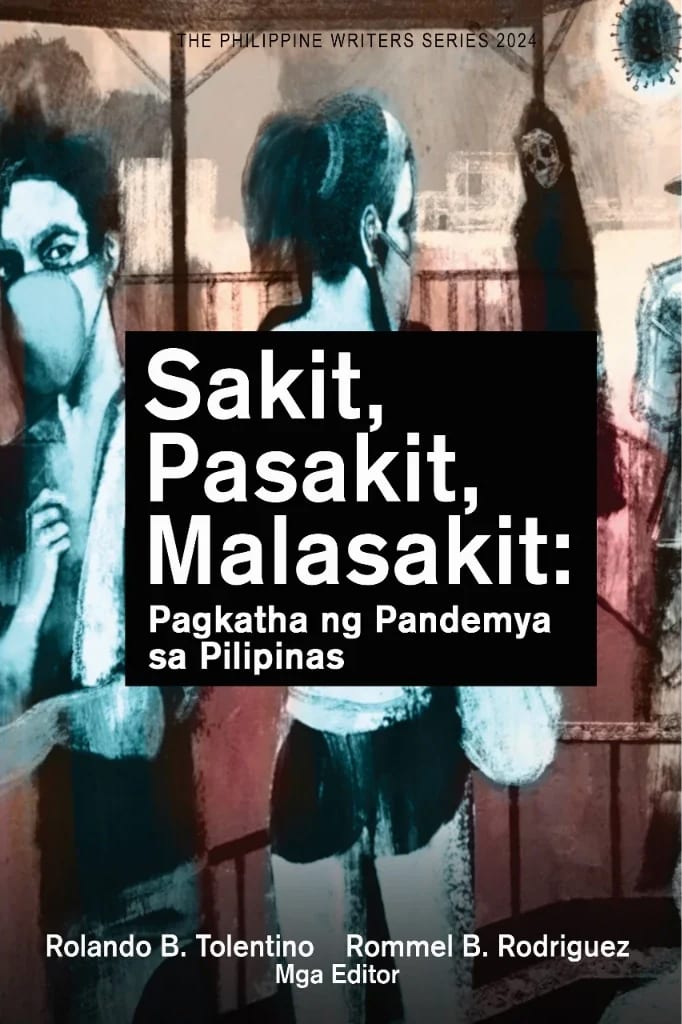
Sakit, Pasakit, Malasakit: The Pandemic Pre-framed
Sakit, Pasakit, Malasakit gathers around an event that, in 2024, can scarcely be called past—the COVID-19 pandemic in the Philippines—and produces, through the gathering, a hybrid form the more conventional anthologies do not attempt. The book opens with an unusually elaborate editorial introduction by Tolentino and Rodriguez that runs many pages and is itself a documentary collage: presidential pronouncements from Rodrigo Duterte spanning 2020 through 2022, drawn from press conferences and photo opportunities and assembled into a chronological accusation; news articles from the Inquirer and Nikkei Asia summarizing the policy failures the pandemic exposed; tweets from public health officials caught in moments of moral failure; writing prompts that punctuate the documentary excerpts and invite the reader to imagine herself into the scene. Only after this introduction do the twenty-some creative pieces (short fiction, essays, dagli, hybrid forms) begin. The volume insists, in its very form, that the pandemic cannot be addressed without addressing the political conditions that determined who lived and who died, and the editorial framing makes those conditions not merely context but co-text.
The dedication that opens the volume is part of the editorial argument. Twenty Filipino writers and artists who died during the pandemic emergency are named in chronological order—Juan S. P. Hidalgo through Mila Aguilar—and Jenny Ortuoste is named separately as a contributor to the volume who did not live to see its publication. The list functions both as memorial and as ledger: it documents the literary cost of a public health failure, names the writers whose works will not be added to the national archive because the state could not protect them, and frames what follows as writing produced under the threat of further loss.
Within this framing, the contributions themselves vary widely in form and ambition. EJ Betita Villena’s “Imagining Postpandemic Futures Assessment Test: Isang Sapantaha” is among the most formally ambitious pieces, constructing four speculative case scenarios—Techno-SMART Democracy, Kapuwa or Peer-to-Peer Democracy, Corporate Techno-Feudalism, and Participatory Socialism—each rendered through a day in the life of a single character (an unemployed worker, a food collector, a personal-services rider, a teacher) whose biography illustrates the political form’s actual texture. The piece is not exactly a story and not exactly an essay; its inclusion announces that the volume will admit writing whose generic identity is itself a formal response to the pandemic’s disruption of inherited categories. R. B. Abiva’s “Si Bittung, ang Saresa, at ang Ilog Abusag” works in an entirely different mode, an Ilokano peasant pastoral that locates the pandemic within the rural geography of Caraballo and Sierra Madre, far from the metropolitan center the documentary material assumes—a peasant tied by usury to land that is not his, whose body the river cleanses and whose imagination the saresa tree sustains. Chuckberry J. Pascual’s “Kuwentong Katawan” is a first-person account of the pandemic body the writer cannot quite escape: testing positive in his condo, calculating what cremation will cost (perhaps more, he worries, because his body is large), deciding to wear briefs in case the hospital takes him, imagining what his father will find when he comes to clean the unit after his death and what he will then tell his mother about it. John Carlo S. Gloria’s Mga Dagli sequence offers some of the volume’s most condensed political imagination, including a piece in which a vulture-headed and one-eyed President Marcos presides over a long table where servants extract from a single prepared corpse the clenched fist of an activist, the leg of a farmer, the spleen of a lumad, a painted placard, and a journalist’s pen—a figure of state predation that the dagli form’s compression makes more rather than less unbearable.
What deserves attention, however, is the editorial framing itself, which does work the creative pieces do not. The Duterte quotes assembled in the introduction speak as their own indictment: the threats to imprison the noncompliant, the curses against community pantries, the boast about COVID containment, the bizarre instruction to disinfect masks with gasoline. The selection is itself a curatorial act, the chronological arrangement an interpretive one, the juxtaposition with news excerpts and writing prompts a piece of political-aesthetic argument in its own right; the clarity the framing builds is exactly the kind of indictmental imagination the historical moment requires, and a less assertive frame would have left the reader to construct that indictment alone, or never to construct it at all. The editors are explicit that they understand the volume as continuous with their other anti-Duterte cultural work, and the editorial form makes that continuity its strength. The cost of the strength is paid elsewhere. By the time the reader reaches the first creative piece, the editorial argument has been built; what follows can extend, complicate, or vary the frame but cannot quite stand outside it. The strongest creative pieces—Pascual’s, Villena’s, Abiva’s, Gloria’s—work both within and against the frame, doing more than the frame asks of them; the weakest sit closer to illustration. The writing prompts compound this dialectic rather than resolving it: read one way, they are political pedagogy at work—exactly what an anthology produced by activist-editors should perform; read another way, the curriculum sits uneasily with the autonomy of imagination the strongest contributions assert. Both readings have purchase, and the volume’s form requires the reader to hold them together. And what the volume insists on naming, finally, is something Philippine letters has not previously named at this scale: the literary cost of a public health failure, the deaths the state refused to account for, the ongoing pandemic the literary community has not finished reckoning with.
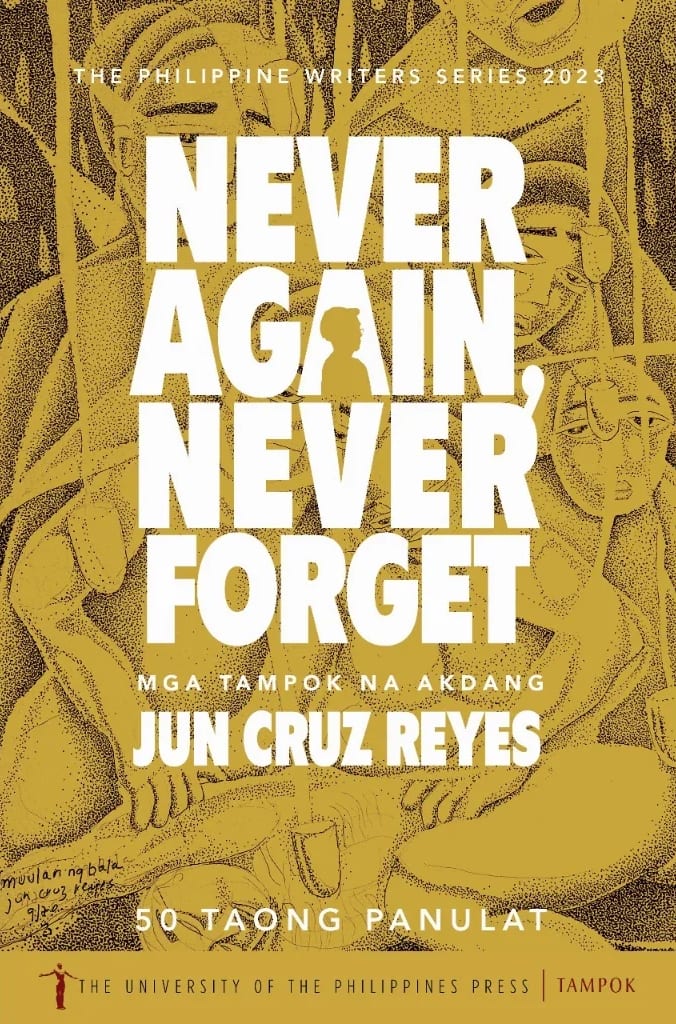
Never Again, Never Forget: The Subject as Editor
I come last to the volume that most strains the very category under which it has been nominated, and I come last to it because the strain is itself one of the things the volume has to teach. Never Again, Never Forget is a 708-page retrospective of Pedro Cruz Reyes Jr.’s fifty-year career, and the principle of assembly is not place, person memorial, organization, or event but a single body of work and the critical reception that has accumulated around it. Whether this constitutes an anthology is a question worth asking openly. The conventional definition would suggest that an anthology gathers work by multiple authors; Never Again, Never Forget gathers work by Jun Cruz Reyes alongside critical writing about Jun Cruz Reyes by many other authors—essays, reviews, interviews, blurbs, the 2012 institutional letter Tet Maceda once wrote as Department Chair to the UP president urging an extension of Reyes’s service past mandatory retirement, the Gmail National Artist Bienvenido Lumbera sent in support of the same—both writers who themselves appear in adjacent volumes on this same shortlist, Maceda as the subject of Liwanag at Itim II, Lumbera among those mourned in Sakit, Pasakit, Malasakit’s dedication. The book is, in this hybrid sense, an anthology of reading: it gathers not multiple writers but multiple readers, alongside the body of work they have read.
A disclosure before continuing: I am one of those readers. The essay on Ang Huling Dalagang Bukid at ang Authobiography na Mali that appears in Apendiks A was first published in 2011 in Tapat Journal, which I edited and published. The relationship reaches further than the contribution. Sir Jun—as I have always called him—was the reader of my first novel, wrote blurbs for several of my books, and served as my dissertation adviser when I wrote my second novel at UP. The reader can decide what weight to assign what follows. I have tried to be useful rather than diplomatic; what I write here reflects what I believe the volume could have been at its most ambitious, not what I owe to a relationship I am grateful for.
The hybrid form has real interest. The critical reception of a major writer over fifty years does constitute a kind of collective text, and reading the works alongside their reception lets the reader see what was made and what was made of it on the same page. The introductions by Bob Ong and Luna Sicat Cleto frame the gathering through two registers. Bob Ong’s piece is personal and anecdotal; he positions Jun Cruz Reyes as a kind of literary tatay—the father who fought with the principal to admit a student short on requirements—and the affective relation he performs, younger writer to older one, stands in for a wider relation Reyes has occupied in the imagination of two generations of Filipino writers. Sicat Cleto’s introduction is more analytically pitched, placing Reyes within a longer history of Filipino fiction’s engagement with what she calls historical materialism and the Walter Benjaminian suheto ng kaalamang pangkasaysayan—the subject of historical knowledge as the suffering, struggling, oppressed class itself. The two introductions, together, propose Reyes as both popularly accessible and seriously literary.
The works section, comprising about half the volume, draws from Reyes’s poetry, stories, essays, novels, and biographical studies. The selection includes the early stories of Utos ng Hari at Iba Pang Kuwento, the verse of Negros, the political biographies Mga Daluyong, mga Unos: Sa Panahon ni Rolando Olalia, Ka Amado, and Armando, the novels Etsa-Puwera, Tutubi, Tutubi, ‘Wag Kang Magpahuli sa Mamang Salbahe, and Ang Huling Dalagang Bukid, and excerpts from later works such as Hu U Rizal and Lagnat-Laki. The chronological arrangement allows the reader to track the development of Reyes’s commitments and methods across decades. The Sabi ng mga Kritiko section is even more capacious, gathering twenty pieces of criticism from Allan Derain’s career-spanning study, Linda Ty-Casper’s notice, Neferti X. M. Tadiar’s reading of “Modern Refuse in the City of Man,” Christoffer Mitch Celino Cerda’s reading of Tutubi, Tutubi through the spaces of the dictatorship’s surveillance, and Isagani Cruz’s two early reviews, alongside more recent and more occasional pieces by reviewers and bloggers. The appendix extends this further with another fifteen critical pieces.
The arrangement makes visible the breadth of the critical attention Reyes’s work has accumulated. Reyes’s place in Philippine letters is, to my mind, unquestionable: he has shaped generations of writers through his teaching, and his political biographies of figures from the Philippine Left, his fiction’s sustained confrontation with martial law and the dictatorship, and the postmodernist interrogations of canonical Filipino texts in Ang Huling Dalagang Bukid and Hu U Rizal have produced a body of work that continues to teach younger readers in the present. The honor this volume seeks to render him is one I share without reservation. I would have wanted more conversation around the work: an editorial position external to the writer himself, and equally the writer’s own voice on the table—an introduction in which Reyes responded to the assessments gathered around his work, including those that might have given him pause. The retrospective form, when it becomes a memorial-to-the-living, makes critical distance harder to hold; the writer is honored by being assembled, and to introduce reservation becomes to refuse the honor. What the volume nevertheless makes available is essential, especially for younger readers who no longer have ready access to Reyes’s earlier work in print: his range across genres and decades, fifty years of critical reception, the introductions by Bob Ong and Sicat Cleto themselves substantial pieces. That this gathering now serves, in part, as the most accessible point of entry to a body of work that should have been continuously available in print is a fact about the publishing infrastructure for Filipino literary writing—one that makes the gathering more rather than less important.
The other question the volume cannot quite answer is the categorical one: should this book have been entered for Best Anthology, or might it have been more appropriate for some category that does not yet exist in the National Book Award taxonomy—a Reader category, perhaps, or a sustained-contribution recognition that the proliferation of such retrospectives may eventually require. I raise this not to disqualify Never Again, Never Forget but to note that its presence on the anthology shortlist itself opens a useful question about how the form should be defined and what it can usefully include. If a single-author retrospective with a critical apparatus counts as an anthology, then the category begins to encompass works that the more conventional anthology shortlist would have excluded. The expansion has costs as well as benefits: the category’s distinctive critical questions—about editorial selection, about the relationship between contributors and the editorial frame, about what assembly means when the assembled are multiple writers rather than one—become harder to ask of any specific volume because the volumes themselves are doing such different things.
Read together, the shortlist reiterates the editorial condition I named at the start: in each book, the editor sits inside the world the volume documents. The field also circles back through itself across the five—Tolentino edits two volumes and contributes pages to a third, Baquiran edits two, UP Press publishes four, and the figures honored in one volume reappear as letter-writers, mourned names, or supporting voices in others. The density is part of what makes sustained anthology work possible at the present scale of institutional support; it is also part of what makes editorial distance harder to come by. This is a comprehensible response to material conditions: the labor of anthology editing in Filipino is unpaid or underpaid, the institutional reward is small, and only those already inside a field have the motivation to do the work. The cost is that the kinds of disagreements that might most productively be staged within an anthology—between contributor and editor, between included and excluded, between the volume’s official frame and the actual texture of what it contains—rarely surface in any forceful way. The form, at this moment, has come to be thought of primarily as a self-organizing genre, a way for communities of practice to publish themselves, rather than as a critical genre in which an outside intelligence intervenes in a field to make new sense of it.
One can imagine the absent volumes: a pandemic anthology edited by someone outside the Manila literary establishment, a Malabon anthology edited by someone who never lived there, a Katha anthology edited by someone who was never a member, a memorial volume for Tet Maceda edited by people outside her direct intellectual genealogy, a Reyes retrospective with editorial distance from its subject. None of these imagined volumes would necessarily be better than the books we have, and they presume a kind of spatial exteriority—editors from outside the field—that the present economics of the form make difficult to sustain. What I want to leave open is the harder question: whether the anthology in Filipino can develop forms of editorial distance that do not depend on physical exteriority but build distance into the editorial method itself. An editor who is also a contributor can still ask: who is not in this volume? An editor who is also a friend can still write an introduction that names what the contributors do not yet do. An editor who is also a colleague can still solicit a contribution that disagrees with the volume’s premise. The five books on this year’s shortlist did not undertake that work, and I have tried to read each on its own terms, even where its terms left out what I most wanted the volumes to provide. Other readings are possible, and other readings should be sought; my account of these books is offered as one entry into a conversation these gatherings have only begun to make possible.

Edgar Calabia Samar is Associate Professor and Chair of the Department of Filipino at Ateneo de Manila University. He is the Head of the National Committee on Literary Arts of the National Commission for Culture and the Arts and a member of the Filipino Critics Circle. In 2024, he received the S.E.A. Write Award from the Royal Family of Thailand for his contributions to Southeast Asian literatures. He develops literature and novel-writing guides and maintains a growing Filipino komiks archive through Santinakpan Otherwise on patreon.com/ecsamar.
ALSO READ:
Voices Shaped Beyond Retrieval: On the Finalists for the 43rd National Book Award for Best Book of Poetry in English
The Tongue and the Terrain: On the Finalists for the 43rd National Book Award for Best Book of Poetry in Filipino
Five Doors Into the Real: On the Finalists for the 43rd National Book Award for Best Nonfiction Prose in English
The Dwelling and the Drumbeat: On the Finalists for the 43rd National Book Award for Best Nonfiction Prose in Filipino
What the Novel Remembers When the Nation Forgets: On the Finalists for the 43rd National Book Award for Best Novel in Filipino
What the Novel Carries When It Leaves: On the Finalists for the 43rd National Book Award for Best Novel in English
What the Stories Hold When the Collection Gathers: On the Finalists for the 43rd National Book Award for Best Collection of Short Fiction in Filipino
The Gathered and the Gathered Against: On the Finalists for the 43rd National Book Award for Best Collection of Short Fiction in English
Edgar Calabia Samar is an award-winning poet, critic, and novelist, and an Associate Professor at Ateneo de Manila University. IG: @ecsamar.
View More Articles About: