

Four Decades of Championing Filipino Fiction in Ragasa

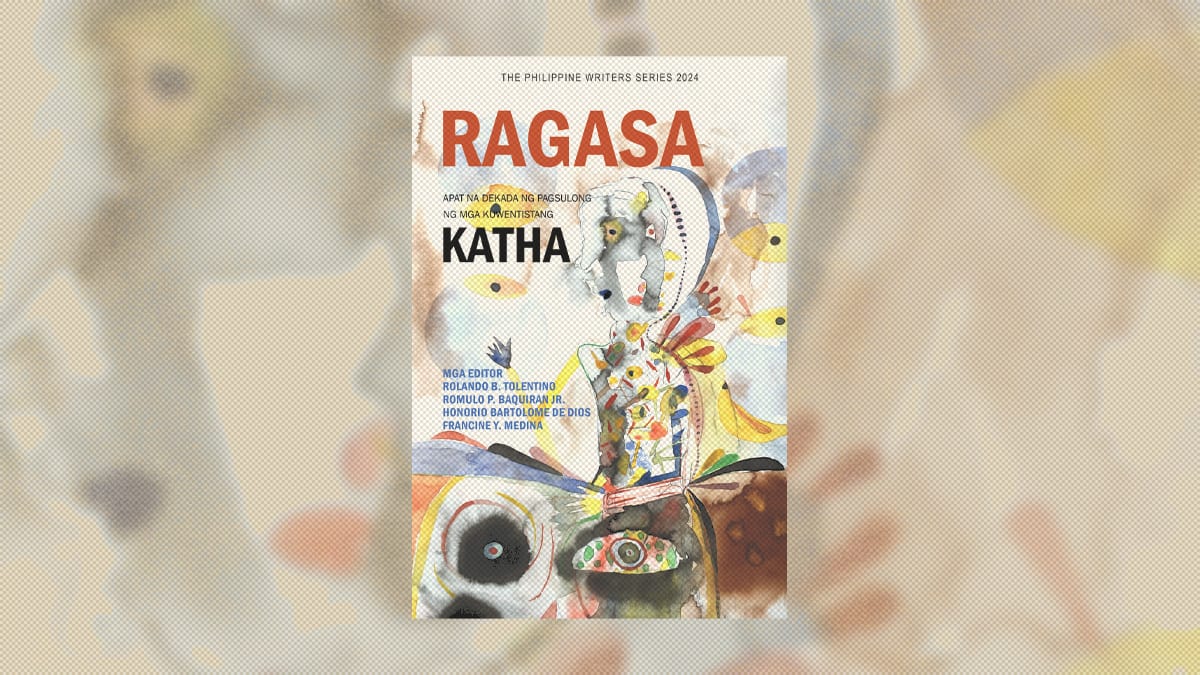
Seasoned fictionists declare “we still can” in Ragasa, an anthology spanning four decades of championing Filipino short story writing, proof that these writers continue to wield their pens with vigor and creativity.
True to its title, the word "ragasa" (a swift, powerful movement) is an apt metaphor for the anthology’s stylistic dynamism and thematic breadth. The featured works traverse a wide range of narrative forms and concerns, highlighting how Philippine short fiction remains attuned to shifting sociopolitical realities.
ALSO READ:
Why Men Should Read Literary Fiction
5 Must-Read Works of Fiction That Illuminate Philippine History
The collection features stories written by Joi Barrios, Rolando B. Tolentino, Luna Sicat Cleto, Honorio Bartolome de Dios, Romulo Baquiran Jr., Bomen Guillermo, Vim Nadera, Rolando Fulleros Santos, Mes De Guzman, Rowena P. Festin, Francine Y. Medina, Anna Maria M. Gonzales, Rommel B. Rodriguez, and Danny Zabala — all members of Katha, a writers’ group dedicated to advancing socially relevant literature.
The book opens with a brief historical overview of Katha, which began in 1988 as a gathering of young writers exchanging ideas on their craft. Formally established on September 24, 1989, Katha became a platform for publishing members' works in anthologies for over 15 years. Its vision: to produce fiction that advocates for Filipino welfare while shaping new literary aesthetics for the nation.
The 42 stories in Ragasa are grouped into three sections, each containing 14 entries: "Danas-Katha," "Dating Kuwento," and "Bagong Kuwento."
The first section, "Danas-Katha," features 14 essays by Katha pioneers reflecting on their journey with the group, its advocacies, poetics, and role in shaping socially engaged literature. These narratives offer a historical account that highlights how Katha provided a platform for marginalized voices and helped establish standards for Filipino fiction. Rooted in the writers’ political experiences, the essays emphasize that storytelling is both a personal act and a form of cultural intervention, one that challenges dominant narratives, preserves memory, and expands the creative possibilities of Philippine literature. Collectively, these Katha fictionists affirm that lived experience, or danas, is vital in crafting meaningful and socially resonant fiction, or katha.
The second section, "Dating Kuwento," gathers 14 stories written and published during the authors’ early years in Katha, many of which have become “classics” or established “standards” among Filipino fiction writers. These narratives continue to shape Philippine fiction through themes grounded in memory, trauma, gender, politics, diaspora, and pop culture. Each story captures a distinct facet of lived experience, from feminist resistance, religious repression and guilt, and mental health, to queer desire, social conformity, and migration. As a collection, it challenges dominant narratives and affirms fiction’s power as a space for social critique, cultural memory, and formal innovation in contemporary Philippine literature.
The final section, "Bagong Kuwento," presents 14 new stories by Katha writers, including works published in other collections, including Luna Sicat Cleto’s "Tatlong Proposisyon ng Putting Buhangin," Romulo Baquiran Jr.’s "Sirena," and Rowena P. Festin’s "Tulay." The stories reflect a marked evolution in craft and perspective, building on earlier themes and techniques while staying grounded in the belief that fiction is a vehicle for ideology and social consciousness. Tackling urgent realities including urban precarity, queer identity, labor, diaspora, and feminist resistance, the stories exhibit greater formal experimentation, deeper ideological insight, and a more nuanced portrayal of contemporary Filipino life. Collectively, they show how these writers have refined their craft and expanded the scope of Philippine fiction, continuing to push the boundaries of both form and sociopolitical discourse.
The curatorial choices in the collection reflect the authors’ literary rigor and deep understanding of the historical and cultural forces that shape the production of Philippine fiction.
One point that may challenge some readers is that the book can at times feel uneven, its very strength in diversity may pose a challenge for readers who approach it primarily for entertainment.
With stories ranging from as short as five pages to as long as 32, and tackling a wide array of sociopolitical themes, the anthology presents a vast spectrum of voices. Some pieces veer toward the experimental or abstract, requiring multiple readings to fully grasp their depth.
Still, this complexity is part of what makes Ragasa ambitious and compelling. It boldly pushes the boundaries of form and content in contemporary Filipino fiction without losing sight of its core objective: to affirm the power of the short story and the enduring relevance of Filipino fictionists who are attuned to the pulse of the nation’s collective experience.
Beyond its literary merits, Ragasa is a valuable resource for literary enthusiasts, educators, and aspiring writers interested in tracing the evolution of Filipino storytelling over the past 40 years. It also opens doors for scholarly research into how these narratives grapple with questions of identity, language, memory, and power in an increasingly globalized and digitized world.
Ragasa: Apat na Dekada ng Pagsulong ng mga Kuwentistang Katha, published by University of the Philippines Press, is available at UP Press Bookstore, Shopee, and Lazada.
