By the Spine, or by the Thought: On the Finalists for the 43rd National Book Award for Best Book of Literary History
A reflection on Tiongson's and Reyes's volumes, and why these works ask to be argued with, continued, and exceeded.
Published on Jun 28, 2026
Disclosure: As with my previous essays on the finalists of the 43rd National Book Award, the criticism and opinions here are mine alone and do not represent the position of the Filipino Critics Circle. I should add that Dr. Tiongson and Dr. Reyes are two mentors I deeply respect, who have generously offered me not only their wisdom but also their friendship; I have tried to let that gratitude sharpen rather than soften the reading, since a critic owes the people he admires his most careful attention, not his most lenient.

A HISTORY of a literature is supposed to be a forward thing. We imagine it composed the way time is lived, from an earlier moment the historian has chosen as origin toward a present she stands in and reports from, a single sustained motion the reader is invited to ride. The picture is so habitual that we seldom catch ourselves holding it, and we ask of any book filed under literary history that it deliver this motion, that it has already crossed the distance for us.
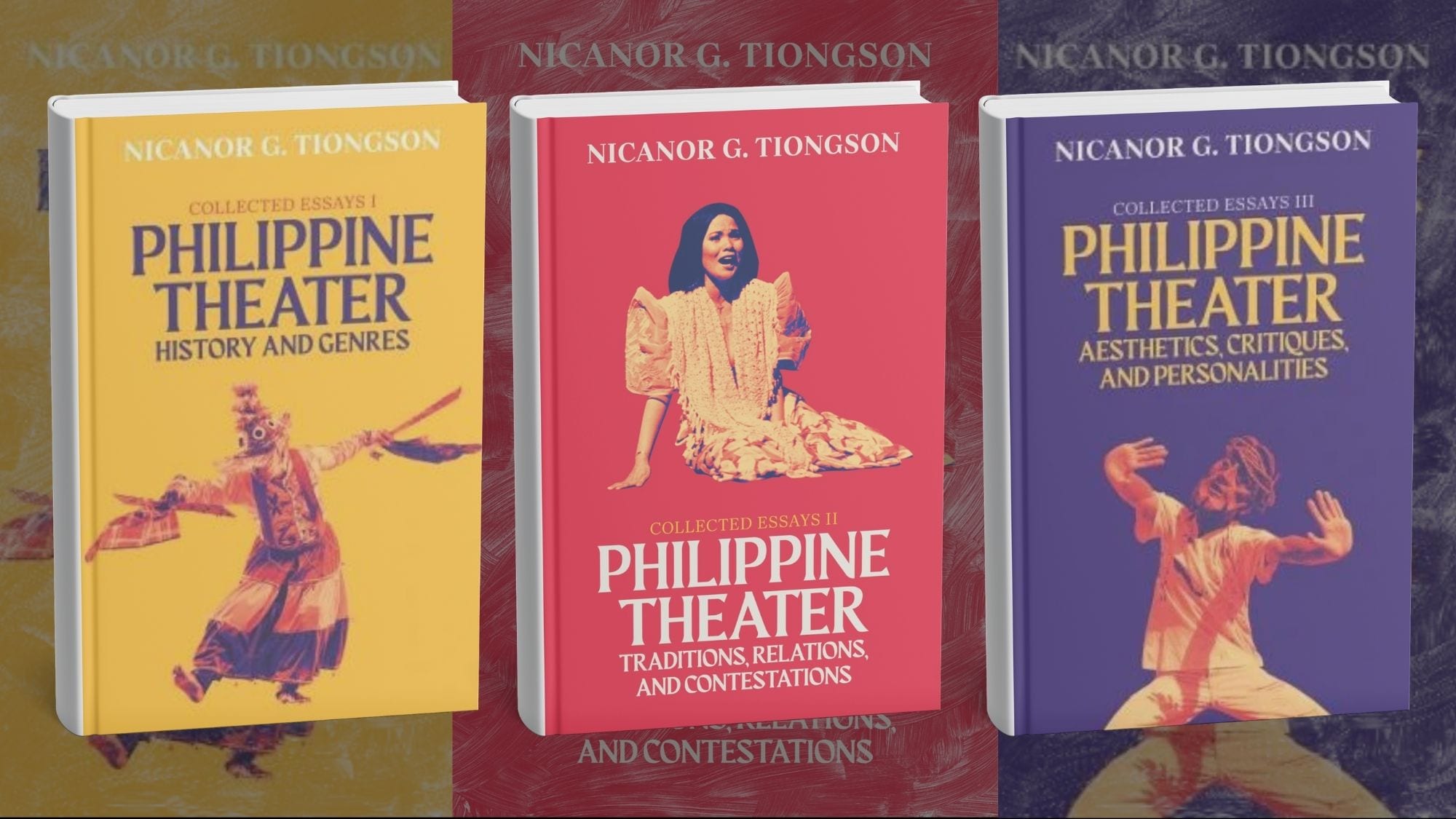
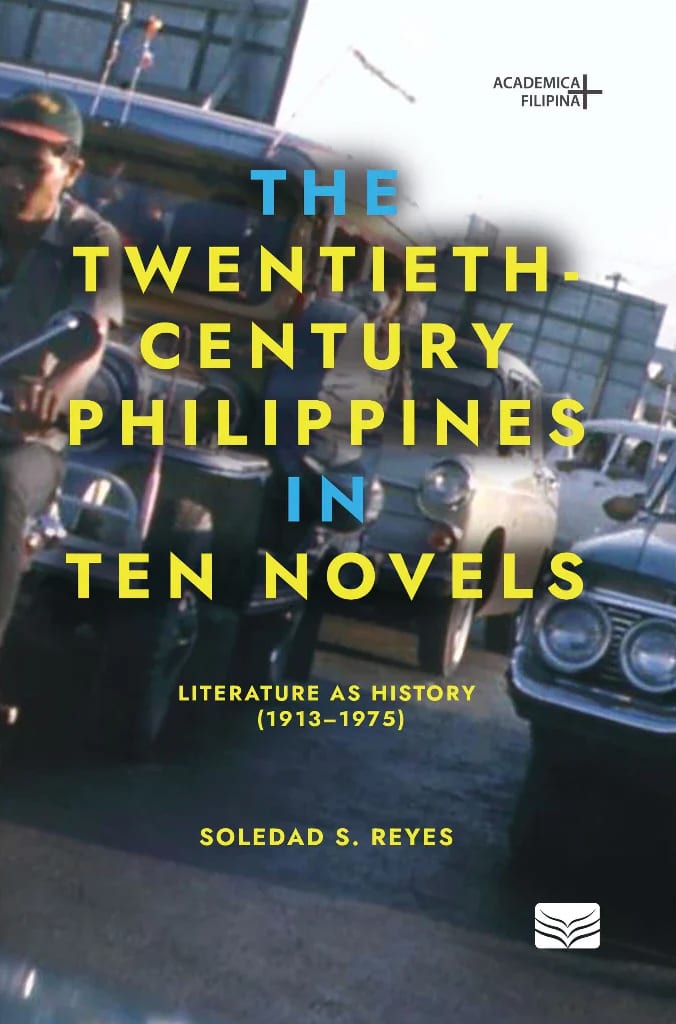
The four books that contended for Best Book of Literary History were not made that way, and the discrepancy is the most useful thing about them. Three are Nicanor G. Tiongson’s Collected Essays on Philippine theater—Volume I, History and Genres; Volume II, Traditions, Relations, and Contestations; Volume III, Aesthetics, Critiques, and Personalities—issued together by the Ateneo de Manila University Press, each gathering work written across a span that runs from 1969 to 2023. The fourth is Soledad S. Reyes’s The Twentieth-Century Philippines in Ten Novels: Literature as History (1913–1975), published by the Vibal Foundation in its Academica Filipina+ series, which collects 10 essays that first served as introductions to Tagalog novels Reyes translated, and which return to ground she first surveyed more than four decades ago in Ang Nobelang Tagalog (1905–1975): Tradisyon at Modernismo (1982). Theater on one side and the novel on the other, the books share no subject. What they share is a manner of coming into being: each was assembled late, out of writing produced for other occasions over a long working life, by a scholar turning to look back across the whole field a career had crossed. Neither was driven from a beginning to an end; both were made by gathering.
I want to hold the books to the standard their own manner sets, rather than to the standard of the forward history they decline to be, because the gathered history has its own difficulty and its own integrity, and judging it against the wrong ideal would miss both. When a literary history is assembled from occasional pieces, a few things become possible that the continuous survey forecloses: we watch a mind revise itself in public, a position taken in one decade and unsettled in the next, the writer in argument not only with her material but with the younger writer who first approached it. Other things become hazardous. The joins between pieces can be sanded away until an accumulation passes for a plan; the interval between the writing and the binding can be made to disappear, so that labor done across 50 years under changing convictions is offered as a single steady intent. The question worth pressing of each finalist is where it lets its assembled character become visible and argumentative, and where it borrows the composure of a history it did not actually write.
A Trilogy Argues With the Man Who Wrote It
Tiongson’s three volumes amount to the largest sustained body of theater scholarship we have, and the scale is not the kind a desk produces. The essays move across the indigenous mimetic performances and the komedya, sinakulo, sainete, sarsuwela, bodabil, and contemporary play; across the transformation of inherited forms and the traffic between Philippine theater and its Spanish, Mexican, Japanese, and American sources; across the contest of ideologies from the anti-imperial drama of 1902 to the protest theater of the Marcos years and, in an essay reedited from his more recent work, the Duterte years; and across the criteria for judging a Filipino play, a long run of theater reviews, and the artists and companies who built the work. To read the sinakulo essay is to be carried to Buhi, Camarines Sur, in 1992, to a cemented stage at the center of a barrio where benches are borrowed from the chapel next door so that old cantors can chant the pasyong Bicol from memory across twenty-three hours spread over three days and nights. It is to find that what a Manila syllabus files under one word fans out into a lexicon of local names—tanggal in the Bikol provinces, pagtaltal in Iloilo, pamalandong in Leyte—the same dramatized passion answering to a different name in each place that keeps it. Tiongson went and watched, and recorded what he saw with the conviction that description is not the throat-clearing before analysis but the place where analysis is forced to become precise.
That conviction is the trilogy’s first gift to our sense of what a book of literary history can do: it refuses to let the history of a form detach from the matter of its performance—the slope a penitent climbs, the cockpit a crowd packs, the meager budget a designer is handed and outwits. A theater history content with the library would have left us scripts and dates. This one leaves us the smoke over the burial of the Senyor and the bougainvillea crowns on three old men playing kings, and by leaving us these, it argues, without pausing to announce the argument, that Philippine theater is not a shelf of texts but a distributed practice, held alive by communities the metropolitan stage spent a century training the educated to find embarrassing. The decolonial charge of the work is exactly there, in the relocation of seriousness from the center to the places taught to doubt their own. Tiongson is candid about his own formation in that doubt—the seminary, the Ateneo, the instruction that the provincial was something to be outgrown—and the labor of the trilogy is the long reversal of that instruction, conducted not by sentiment but by documentary weight, until, as Virgilio Almario remarks in the first volume’s foreword, the careless readings of earlier commentators simply lost their usefulness.
It is worth pausing on the magnitude of this, because everything that follows depends on its being granted first. That a younger scholar who wants to think about the komedya or the sinakulo now has somewhere firm to begin is no small inheritance; it is the difference between a field and a scattering of impressions, and Tiongson is most of the reason the difference exists. He laid much of its floor—patiently, across decades, in libraries and provincial barrios both, willing to leave the academy to follow the traces of the past into communities keeping a dying culture alive—and Almario, himself a National Artist, sets that care beside the lifework of Bienvenido Lumbera and Resil Mojares. The labor did not stay on the page, either: the same scholarship that mapped these forms helped argue them back into legitimacy and sometimes back into performance, and fed the evaluative vocabulary an entire movement of people’s theater took up and used. To the trilogy one should add what stands outside it and shares its purpose, the long editing of the CCP Encyclopedia of Philippine Art across its successive editions, so that the three volumes are not the whole of the project but its concentrated core.
The trilogy’s stranger distinction lies elsewhere, in its willingness to keep the scholar’s discarded selves on the page beside the self that discarded them. Tiongson does not present fifty years of thought as a doctrine reached and then guarded; he lets it be seen under construction, abandonment, and repair. The plainest instance is the framework he named RPN—Repleksiyon, Pangangailangan, Nakararami—by which his essays of 1977 and 1983 proposed to gauge a play’s Filipino-ness: whether it reflects the life of Filipinos, answers their needs, and serves the nakararami, the many. RPN was the issue of its moment, shaped by the National Democratic movement and by Mao’s Yenan talks as the PAKSA workshop adapted them, and it did consequential work; by PETA’s own account, it oriented a generation of people’s theater, and it supplied the measure for the reviews in the third volume. A scholar more anxious for his legacy would have let it stand. Tiongson reopens it instead, telling us he came to see the error of binding “Filipino” to the working class, the way the formula could not register the woman injured by patriarchy, the queer person stripped of standing by a homophobic church and state and movement, the child or the indigenous person driven from ancestral ground. He rebuilds nakararami to mean all Filipinos whose rights are under threat, of whatever class, gender, age, or belief, and houses the rebuilt idea in a new summative essay, “TAPAT: Ang Teatro Para sa TAO,” whose governing proposition is worth carrying: that Filipino identity in theater is not a thing to be searched for, since it is already present in every mimetic act ever performed on these islands, but a place to depart from, toward a society in which each person attains the fullness of their humanity.
The value of this is not that a scholar changed his mind, which is common enough, but that Tiongson declines the false dignity of consistency, showing a framework to be a tool fashioned under conditions, such that when the conditions move, the honest response is to refashion rather than defend. The bodabil essay performs the reversal in little: he once read the variety show as a colonial conduit of Americanization, and later learned to see in it a vehicle of a certain modernity, a stage on which a new kind of Filipino woman—earning her own keep, at ease in her body, in charge of her own life—could stand against the mujer de la casa the dominant culture preferred. The author of the condemnation and the author of the recovery both remain in the book, unreconciled, and their disagreement is left to instruct.
This same instinct, the trilogy’s best, is one a reader may find herself wishing to follow even further than the book does. The candor of the introduction, where Tiongson reopens his own framework with such generosity, is so bracing that one begins to imagine it reaching everywhere—down into the reviews themselves, which were written, he tells us, mostly under the old criteria, valuing plays that depicted workers and finding less in those that revolved “solely around the personal and psychological problems of the middle classes,” or used English, or seemed escapist or self-expressive. The framework that shaped those judgments is held up to the light and turned over; the judgments themselves mostly keep the form they first had. There is nothing false in that—a scholar is not obliged to relitigate every notice he ever filed—but the book’s own example is so generous that it tempts the reader to want the generosity extended, to see what would happen if the argument between earlier and later selves reached a 1975 review of a bourgeois play and asked whether the capacious maka-TAO consciousness might now grant that play’s interior life the seriousness it was once denied. I am not wishing for a different book—I distrust that complaint, which lets the critic flatter himself with a book no one wrote—only noticing that revising a concept is comparatively light work, while revisiting a particular verdict means returning to a particular play, and that the trilogy, by modeling the first so movingly, quietly raises the harder possibility of the second. That it leaves the possibility open rather than closed is itself in keeping with everything generous about it.
When Is a Project a Book?
There is a harder problem the trilogy raises, and it is not Tiongson’s to answer but ours, because it belongs to the category rather than to the critic-historian. These three volumes were submitted, considered, and judged as three separate books, and Volume I was the one given the award—a fact worth sitting inside for a moment, because it puts pressure on the very word the category turns on.
Everything in my reading argues that the three volumes are one project, not three. The framework I have described does not live in any single volume; it completes itself only across all three. RPN is proposed in the genre and historical essays of Volume I. Its revision arrives in the same volume’s “TAPAT,” but the reviews that revision implicates sit in Volume II’s and III’s accounts of criticism and performance, and the contemporary political theater that tests the revised consciousness—the Duterte essay—is in Volume II. To read only Volume I is to receive the origin and the summative correction while being severed from the body of judgment, the correction was meant to act upon. In honoring Volume I, we honored the most self-sufficient of the three precisely by detaching it from the parts that would have unsettled its self-sufficiency. I do not raise this to second-guess a choice I was in no better position to improve—Volume I, taken alone, most resembles a freestanding history, and faced with three objects, one had to be named. The irony underneath is the point: the volume that reads most like a single book is the one whose argument is least complete, and what we rewarded was the appearance of bookhood over the project’s actual unit of meaning.
What the case exposes is that our working definition of a book is bibliographic before it is intellectual: a book is what carries its own ISBN, its own spine, its own cover, whatever the relation of its thought to the thought between other spines. Usually, this is harmless, since most books are also intellectual units. The trilogy is where the two come apart, where a single argument was issued in three bindings—for reasons that have as much to do with the economics of publishing a long manuscript as with any claim that the volumes are independent—and we had no provision for recognizing the argument as the thing being judged. One might say the publisher made the choice by dividing the work, and we only followed. But the deeper difficulty is that the instrument we use cannot, as we have so far built it, tell a book from a volume, a project from the physical fraction of a project that happens to fit between two covers. For a category whose whole business is to ask what a book of literary history is, that blindness is not a footnote: it is the category meeting, in the most concrete form, the question it exists to pose, without yet holding the means to answer it. The trilogy, by being three, asks us what we think a book is, and our answer, by way of one-third, is more revealing than we may have intended.
I leave the problem open because it does not close. Had the volumes been bound as one, the result would have been unwieldy, and the differences among the three groupings would have collapsed into a false continuity—the very temptation that besets any history assembled from parts. There may be no clean resolution, only a choice of which distortion to accept: three books that fracture one argument, or one book that overstates the unity of three. That is worth saying plainly, because it means the category’s difficulty is not an oversight to be patched but a feature of what it is trying to measure, one that the ordinary single-volume monograph keeps conveniently hidden.
The Critic Who Returns to the Scene
Reyes’s single volume carries its retrospection on its face and makes the return its stated reason for being. Her preface says directly that she is going back to novels she first treated in Ang Nobelang Tagalog, the 1982 survey that brought more than three hundred Tagalog novels into scholarly view, to repair what the survey could not afford. In 1982, she explains, each novel was crowded in with its neighbors and given little more than a précis; she could not set the writers in their lives or weigh the novels against their kin at home and abroad, and—the admission that stops me—did not yet hold the critical instruments that the proliferation of Western theory after the 1970s would later place in her hands. Revising a framework, as Tiongson does, keeps the quarrel between a thinker and her ideas. Returning to one’s foundational work to declare that one lacked, at the time, the equipment to read the very texts one had rescued is a quarrel between a reader and her former eyes, and Reyes lets us see the earlier reader’s hands as emptier than the later reader’s—a rarer and more exposed kind of candor.
The novels compose a small history, from Patricio Mariano’s Ang Tala sa Panghulo (1913) to Rosario de Guzman Lingat’s Ang Balabal ng Diyos (1975): from the early American decades, when writers born under Spain summoned the recent past against the colonizer’s promise of a better world, through a social realism that faced Americanization and the agrarian wound, to the convulsive novels of the years bracketing martial law. The “literature as history” of the subtitle is the book’s wager, inherited and resilient—that the novel, bound by literary rather than documentary convention, registers the past as few documents do, recording not the event alone but the feel of living it: a city remade by commerce, a woman’s body made the ground of class and desire, a postwar generation made to harvest what empires had sown. Reyes is at her strongest when she lets a single figure carry this weight. Her Dalisay, in Antonio Sempio’s Ang Punyal na Ginto (1933), whom she calls perhaps the most persecuted heroine of the prewar Tagalog novel, she refuses to leave inside victimhood, following how the woman turns the very body a careless lover once worshipped into the instrument of her revenge, and how the novel solders class to sexual politics so that neither can be read without the other. Her Andres, in A. C. Fabian’s Timawa, she credits as an antihero of a kind the Tagalog novel had scarcely risked, the diaspora’s ferocious and damaged son. Her reading of Macario Pineda’s Ang Ginto sa Makiling draws the figure of gold through its literal and figurative registers until it settles on the gold as the nation’s buried capacity, the kakanggata ng lahi, the heroes, a wrecked postwar country must locate and become.
The wager deserves a harder look than its familiarity invites, because “literature as history” names two different operations, and the book moves between them without always marking the shift. In one, the novel is read as evidence—a source from which the historian extracts the texture of a vanished present, the prostitution that serviced American soldiers in Mariano, the agrarian feud in de los Angeles, the diaspora’s wound in Fabian. In the other, the novel is read as itself a historical act—a thing a writer did at a particular moment, an intervention in the consciousness of its first readers, history not as the novel’s content but as its deed. Reyes is rich on the first and sparing on the second, and the difference matters to her own decolonial stake: to treat the Tagalog novel as evidence is to make it useful to a knowledge that arrives with its questions already formed; to treat it as a deed is to grant it agency, to say that Ang Huling Timawa did not merely record the peasant’s condition but tried to alter how its readers imagined it, and sometimes failed, and that the failure is also history. The book knows the distinction—its readings of the discursive novels of Aguilar’s lineage come close to honoring the novel as deed—but does not press it into a method, so that “literature as history” stays a phrase doing two jobs at once, persuasive in both and fully theorized in neither.
The book’s positive achievement, set against this, is twofold. Reyes performs canon-formation in its least abstract form, by translation: these 10 novels exist in English because she carried them across, and her foreword-writer, David Jonathan Y. Bayot, is right that the writers assembled here gained in canonical standing through that labor. To narrate a literature’s history is one task; to keep that literature readable for those who could not otherwise reach it is another, and a book that does both binds its history to an act of preservation, so that the texts it describes will outlast the description. The volume also stages, more frankly than most criticism will, the meeting of imported theory and the Philippine text—Marxism brought to Ang Huling Timawa, feminism and a measure of Freud to Timawa and Ang Punyal na Ginto, archetypal and myth criticism to Lingat’s Kung Wala Na ang Tag-araw—and it does so without the pretense that the tools were forged here, naming them as borrowed and then putting them to local use.
The friction I want to name is not that a better book hides inside this one, but that the book’s method and its thesis pull gently against each other, and the tension is instructive rather than disqualifying. Reyes returns to these novels in gratitude for tools that arrived from elsewhere; the readings are organized by what those tools can disclose. Yet a tool shapes the hand. When the prose reports that Ang Punyal na Ginto “lends itself to a variety of interpretations,” foremost among them Marxism, or that Timawa “merits an analysis delving into aspects of Freudian psychology,” the grammar quietly assigns the active part to the method and the passive part to the novel: the text is what submits to a frame the critic arrived holding. This sits against the book’s own first conviction, that these novels are history, that they hold a lived Filipino past nothing else preserves. A history convinced its objects are sources of irreplaceable knowledge, yet most comfortable approaching them through categories built to read other literatures’ pasts, has not betrayed itself, but it has left a question unasked at its own center: whether the Tagalog novel might also be a maker of theory and not only its recipient—whether Ang Ginto sa Makiling, braiding the Mariang Makiling myth into a postwar realism, proposes a relation between the legendary and the historical that no imported archetype quite predicts. Reyes’s own pages keep brushing this; she observes, again and again, how these novels weave the documentary and the mythic into combinations her Western categories can name but did not forecast. That a book so certain its texts know something should be content, in method, to let them mostly be known is the most quietly decolonial provocation it contains, raised without settling—an honest record of where the criticism of our older novels still stands.
A second strain follows from the book’s origins. These essays began as introductions—paratexts meant to walk a reader up to the threshold of a novel she was about to enter—and they carry the introduction’s heavy ratio of retelling, with the preface that previews all 10 given over largely to synopsis. Retelling is not nothing; for novels almost no living reader has met, the summary is a generosity. But an introduction is built to precede a reading, not to substitute for one, and when 10 of them are gathered into a freestanding history, they bring a proportion calibrated for a use the new book has outgrown, so that interpretation must work its way out from under the recap that was, in the original setting, the entire point. Reyes sees the limit and names it, writing in her conclusion, with disarming directness, that the studies show—“although not as specific as one might wish”—the ways the novels can be read. I do not read the proportion as a failure, since the book never disowned its origins and a generous synopsis is the right gift to a reader who has never met these novels; I read it as the visible mark of the form, the place where the introduction’s native shape persists inside the freestanding book and reminds us what kind of history we are holding—one assembled from thresholds, each written to open a door rather than to walk the whole house.
The History the Books Did Not Promise
I have been writing as though it were fair to weigh these four books as books of literary history, and now that both are before us, the assumption deserves examining, because none of them was written to be one. A book is composed toward its own ends, and only afterward enters the machinery that sorts it—a publisher choosing where to submit it, and a committee, ours, settling which category it will finally compete in. The label “literary history” is fixed to these books late, by hands other than their authors’, and it is worth asking what we are entitled to demand once we have done the fixing.
The copyright pages are unexpectedly candid on this point. The National Library’s cataloging data records how the books were classed before any award took interest, and the record does not say literary history. Tiongson’s first volume is entered under the subject headings “Theater — Philippines — History,” then “Philippine drama,” then “Philippine essays”; the second carries no “history” heading at all, only “Theater — Philippines” and “Drama — Stories, plots, etc.”; the third is entered first as “Philippine drama — Criticism, interpretations,” then theater history, then “Tagalog essays,” and is shelved by a different Dewey number from its siblings—pulled out of theater and into Philippine literature. The three volumes do not even classify themselves the same way, and where “history” appears, it appears as a subdivision of theater—the history of a performing art—never as the book’s own genre, never as literary history. They are catalogued as essays, as drama, as criticism. Reyes’s book is the sharper case, because its subtitle says the word outright—Literature as History—while its own cataloging entry classes it under “Philippine essays (English)—20th century—History and criticism,” the standard bibliographic formula for any body of critical writing about a literature, its Dewey and Library of Congress numbers placing it among works of literary criticism rather than works of history. Inside the book, Reyes is plainer still, stopping to insist that the novel is a genre distinct from history even as she argues that the one can carry the other. The subtitle is a thesis about what novels do, not a claim that the book itself is a history.
None of this makes the category illegitimate or the assessment void. A book can illuminate the history of a literature without being built as a continuous history, and the prize is right to gather such books and ask which most enlarges our historical understanding of Philippine writing. What it constrains is the kind of fault we may justly find. It would be unfair to convict these books of failing to be seamless literary histories when they never undertook to be—to fault Tiongson’s trilogy for reading like collected essays, which its title and cataloging both declare it to be, or to fault Reyes for the introduction’s proportions when her book never pretended to be anything but a set of introductions raised to a higher power. The presumption that these are works of literary history is the award’s, not the books’. When the assembled form shows its seams, the right response is not to mark the books down against an ideal of historiographic continuity they never claimed, but to ask what the history of a literature looks like when it is delivered in this form—as essays, as criticism, as introductions—because this, and not the continuous survey, is the form in which the work was actually done. The demand we can fairly make is only that they teach us something about the past of our literature we did not know before, and on that demand, the one their authors implicitly accepted, both deliver.
This turns a light back on us. To place a trilogy of collected theater essays and a volume of translated-novel introductions in one category and call them both books of literary history is to assert a definition capacious enough to hold occasional criticism, performance ethnography, translation paratext, and self-revising polemic at once. That is a defensible breadth, even a generous one, but it is ours to defend, and the fairest criticism of these finalists is the one that meets each book on the ground it actually claimed, reading its contribution to literary history as a gift offered obliquely rather than a duty failed.
THE VISIBLE seam is not a defect to apologize for; it is the gathered history’s distinctive resource, the thing the smooth survey cannot offer. When Tiongson dates each essay and annotates the framework he has outgrown, when Reyes confesses the poverty of her younger reading, the books admit that a literary history is not a settled truth handed down from a height but an argument its author keeps having, across decades, with the material and with herself. A history that conceals its own making asks to be believed; a history that shows its making asks to be argued with, and treats the reader as a participant in an unfinished inquiry rather than the recipient of a finished one. Where the books falter, they falter by reaching for an authority the assembled form cannot fairly claim—Tiongson when the corrected framework lets the uncorrected verdicts stand in its shadow, Reyes when the borrowed frame is allowed to remain the only thing that can make the Tagalog novel speak. These are small shadows, and they are cast by large lights.
For what these two critics leave us is not in doubt. Tiongson leaves the ground a whole field now stands on, built across a lifetime in archives and provincial barrios alike, and built for the very forms a colonial education was most eager to teach us to discard. Reyes leaves ten novels carried into a second language and a way of reading them as the country’s own remembered past—canon made, as it can finally only be made, by hand. The one worked across three volumes and the other across one, though the measure was never mass; between them they hand down the larger lesson their books were too modest to announce, that a history of a literature need not pretend to a serenity no real scholarship has ever had, that it may be gathered late and still be true, and that its seams are not its shame but its openings.
And the openings are finally ours to enter. These are not closed books but opened ones, histories that ask to be argued with, continued, exceeded. The komedya and the sinakulo still wait for the scholars who will follow Tiongson into the towns that keep them alive; the Tagalog novel still waits for the readers who will let it theorize and not only be theorized. What Tiongson and Reyes have given us is less a verdict to receive than a labor to take up—and the truest way to honor two critics who spent their lives turning to look back may be to turn, in our own time, and carry the looking forward.
Edgar Calabia Samar is Associate Professor at Ateneo de Manila University. He is the Head of the National Committee on Literary Arts of the National Commission for Culture and the Arts and a member of the Filipino Critics Circle. In 2024, he received the S.E.A. Write Award from the Royal Family of Thailand for his contributions to Southeast Asian literatures. He also creates online content on reading, writing, and liberatory work and education on patreon.com/ecsamar and Instagram at @ecsamar.
READ MORE FROM EDGAR CALABIA SAMAR:
By Whose Reckoning: On the Finalists for the 43rd National Book Award for Best Book of Literary Criticism or Cultural Studies
The Book Beside the Book: On the Finalists for the 43rd National Book Award for Best Anthology in English
At the Editor’s Own Table: On the Finalists for the 43rd National Book Award for Best Anthology in Filipino
Voices Shaped Beyond Retrieval: On the Finalists for the 43rd National Book Award for Best Book of Poetry in English
The Tongue and the Terrain: On the Finalists for the 43rd National Book Award for Best Book of Poetry in Filipino
Five Doors Into the Real: On the Finalists for the 43rd National Book Award for Best Nonfiction Prose in English
The Dwelling and the Drumbeat: On the Finalists for the 43rd National Book Award for Best Nonfiction Prose in Filipino
What the Novel Remembers When the Nation Forgets: On the Finalists for the 43rd National Book Award for Best Novel in Filipino
What the Novel Carries When It Leaves: On the Finalists for the 43rd National Book Award for Best Novel in English
What the Stories Hold When the Collection Gathers: On the Finalists for the 43rd National Book Award for Best Collection of Short Fiction in Filipino
The Gathered and the Gathered Against: On the Finalists for the 43rd National Book Award for Best Collection of Short Fiction in English
Edgar Calabia Samar is an award-winning poet, critic, and novelist, and an Associate Professor at Ateneo de Manila University. IG: @ecsamar.
View More Articles About: