A Person Is Here: On the Finalists for the 43rd National Book Award for Best Book on Drama and Film
What, finally, is a book on drama and film, for us, now?
Published on Jul 25, 2026
Disclosure: As with my previous essays on the finalists of the 43rd National Book Award, the criticism and opinions here are mine alone and do not represent the position of the Filipino Critics Circle. One further note before the books: the category’s name promises drama and film together, but among this year’s four finalists there is no film in either sense—no screenplay, no book about cinema. I flag the fact rather than build an argument on it; what follows is a reading of a category that is, this year, entirely a category of plays.

IN AUGUST of 2022, a book of plays was declared subversive by officials of the Komisyon sa Wikang Filipino, denounced on the broadcast arm of a preacher’s kingdom, endorsed as dangerous by the government’s anti-communist task force, and described in a Senate budget hearing by a senator who said he had read it and feared that his daughter, were she to read it too, would surely become a terrorist. The book did not exist. It had not been printed. The cover flashed on the news was an old design study its author had rejected months before; the real cover had been approved only days earlier, at the tail of an editorial dispute over the spelling in its characters’ mouths. The state had read a phantom, judged the phantom, and sentenced the phantom on television, and the author—Reuel Molina Aguila, then close to fifty years into a life of writing for the stage—could only note the absurdity in the second of the two prefaces he would eventually attach to the real book: Imposible! One is tempted to file the episode under comedy, and Aguila himself files it partly there, but I keep returning to what it accidentally proved. In this country, a book of plays is treated as a live thing before it is even born. It is feared in advance. It is knocked on before it has a door.
The knock is where I want to begin, because the knock is the oldest piece of theater we practice daily without calling it theater. Tao po—the phrase we call out at a threshold—is not a question but an announcement: a person is here. The caller declares personhood before requesting entry; the household answers tuloy po kayo, and the door becomes a stage on which recognition is performed. This small liturgy of the doorway has been deformed in the very years these books were written. Tokhang, the name of the drug war’s method, was built from toktok and hangyo, knock and plead, and under that name the knock stopped announcing a person and started announcing a list; behind many of those doors, by morning, a person was no longer there. Red-tagging is also a knock—on a book, on a name, on a university department. The four books that stand as finalists for Best Book on Drama and Film this year are, each in its own register, answers to the knock: they insist that a person is here, was here, will have been here, whether the person is a widow dancing zumba over her dead, a child-ghost buried in a landslide, a maid in a National Artist’s mansion, or a playwright watching the state condemn a book he has not yet held.
That they should be considered together at all is an accident of the award’s own architecture, and it points to something worth noticing before the books do. Film, once shot, already owns a recording technology built into what it is, so a film book can afford to be pure commentary, a second-order object about a first-order object that survives on its own. A play has no such survival built in; it disappears at curtain unless someone writes it down, which may be the plainer reason these four volumes lean so hard on production notes and cast lists and dates. Film keeps entering these four books anyway, too specifically to force into a single figure: the actual April 2017 Duterte video projected at the start of Varela-Luarca’s Dogsblood, the documentary photographs that structure Manansala’s Tao Po, the spotlight a student director in Aguila’s book runs like a camera lens because his auditorium owns no other kind of light. Three different plays solving three different problems; the coincidence that all three reach for a camera is a detail worth flagging, not a thesis to defend.
There is a second thing worth noticing before the books, and I want to hold it at arm’s length rather than admire it, since it is also the reading these four writers would most like a critic to reach for. Every one of these volumes was published in 2024, and every one carries work substantially older: Aguilar’s Terminal won its Palanca in 2012; Aguila’s Sa Kanto ng Wakas at Katotohanan Extension won its prize in 2009 and waited eight years for a single staging; Manansala’s Big Night first appeared in an anthology in 2013; even Varela-Luarca’s newer plays arrive trailing the record of stagings finished elsewhere. It would be easy to call this the drama book doing memory’s work for an art that cannot otherwise keep itself. But a shortlist assembled from four books that all reward patient, well-connected archiving is not neutral evidence that archiving is what our theater needs—it is evidence of what tends to survive long enough to reach a shortlist. Aguila’s own preface argues, movingly, that almost nothing outside the center gets written down; his book’s existence is its exception, not its refutation. For every play that waited eight years and found a press, others waited and did not, and a category built to reward the writers who outlasted the waiting will keep finding writers glad to supply the theory that justifies it.
I move through the books along a path they themselves suggest, from the center outward—from a volume produced at the heart of our consecrating institutions, through books that carry their advocacies across cities and continents, to a volume written from and for the labas, the outside, that the center rarely records. The path is Aguila’s idea before it is mine; I am borrowing his compass to walk toward his book.
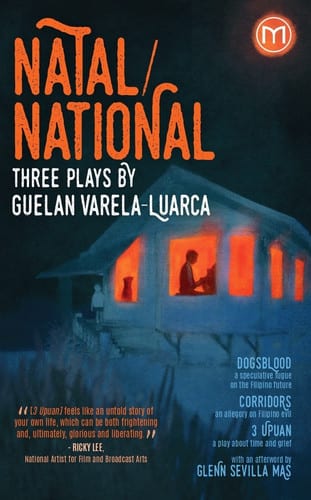
Atras: Guelan Varela-Luarca’s Natal/National
Varela-Luarca’s introduction to Natal/National: Three Plays opens with a theory of the object we are holding, and it is the most precise theory of the drama book any of these four volumes offers. A play, he writes, is congenitally unstable, mutating with every actor and lighting choice; but when plays are published “they suddenly petrify, frozen in the refrigeration of time,” taking on two lives at once—the one that keeps changing on stage and the one that can never again be revised on the page. What moves me is that the book then spends three hundred pages working against that theory, without pausing to say so. Nothing here is frozen. The volume records that Dogsblood and Corridors had their first lives as staged readings at Hunter College in New York, in 2023 and 2024, while their author was completing an MFA in self-imposed distance from a country whose 2022 elections had defeated him; that 3 Upuan premiered not in a theater but in a second-floor dressing room of the Arete in September 2024, directed by the playwright himself; and it closes with an afterword by his teacher Glenn Sevilla Mas that is less an essay than a séance, splicing Palanca judges’ comments, Facebook posts, and time-stamped Messenger messages—including the one from December 27, 2023, in which Guelan, in New York, asks to call because their shared father-figure Ricardo Abad has died—into a structure that borrows the Atras command from 3 Upuan itself and walks time backward through a friendship. A specimen does not grieve. This book does.
The plays deserve the paratext, which is not something one can always say. Dogsblood, “a speculative fugue on the Filipino future,” begins with an epigraph that is not a quotation but a projection: the actual April 2017 video of Duterte telling a hall of Boy Scouts that he kills, followed by a child promising to kill drug pushers and rebels in turn. Everything that follows—an old woman with eighteen dogs shot in her home, an officer whose inexplicable compassion for the orphaned animals unravels the logic of his uniform, a revolution staged as “a hundred, a thousand, a million people strong”—unfolds tomorrow, in a post-Duterte Philippines where the sentence pronounced on that hall of children has come due. The stage directions ask for the impossible on purpose, then turn the impossibility into an instruction: “Condition the audience to see what the theater cannot show”—the play’s real politics, though carefully claimed: it seems to argue the drug war’s violence depended on an uneven visibility, bodies displayed as warning in some cases, kept from the cameras in others, an idea I would rather credit the play with proposing than treat as proven. What the ending does not do is complete the cycle it spends two hours building: the child Vida, holding the baby of the man who killed her grandmother, is asked whether she wants revenge, says yes, is asked whether she will take it, and answers, after a silence the text scores as its own line: “No.” The play earns that monosyllable—the only future in this trilogy of tomorrow that the trilogy permits.
Corridors, “an allegory on Filipino evil,” moves the national into the domestic and is, to my reading, the volume’s darkest achievement. A mansion in a gated village; a ninety-three-year-old National Artist named Angela Abreu sealed in a room the text calls the Sanctum Sanctorum; the women of the house circling; a nineteen-year-old maid, Katte, trafficked into service by an aunt who was a recruiter, unable to leave because the alternative was “the other job.” Time jumps inside empty brackets the notes instruct must be “marked theatrically, and horrifically by the actors’ bodies,” beginning as spasms and ending in breaking bones—the house’s evil convulsing whatever flesh is onstage, heir and hired help alike. Here is a play about the monstrousness of consecration, written by an author whose own book arrives wearing a cordon of blurbs from Palanca jurors and a National Artist, whose bio must now accommodate the Palanca Hall of Fame. Not hypocrisy, but the book’s most interesting tension: the mansion play sits at the volume’s center like a confession the paratext cannot quite absorb, and the question it leaves open—whether our theater can honor its elders without building them sanctums that devour the young, the poor, and the hired—is a question the book poses to the very institutions likely to award it. The play’s one living male character, Yñigo, gets a haunting of his own, but his is a possession, a slow surrender to a dead man’s mind; what Katte and Mita carry instead is interiority tied to a specific, unmythologized position—a trafficked wage, a diminished widowhood—the kind that never quite becomes symbol, and that the play seems most interested in protecting.
3 Upuan, the closing play and the one written mostly in Filipino and Taglish, is the volume’s tenderest and, formally, its most radical. Three siblings—Jers, Jack, Jai—sit with a death the play declines to stage as a single event, distributing it instead across weekdays announced by a stage manager the text calls the tagapagtakda ng panahon, the setter of time: Tuesday, water in the lungs; Thursday, a brother weeping; Saturday, an argument about film school. Grief here is logistics and leftovers, corn muffins and bed sores, until the bereaved discover that time, dislodged, can be traveled, and the play’s last movement is a guided regression—Atras—through the wedding, the births, the parents’ meeting in Kyoto, the war, the friars’ ships, the pure world before corporations and the killing of native peoples, the monsters, the lava, the carbon, the dark, and then the voice in the void saying let there be light, “at nagkaliwanag nga.” This cosmological rewind answers the introduction’s claim that the plays move “from intensity to intensity” by revealing the final intensity is not terror but origin. The epigraph from Rolando Tinio’s “Valediction sa Hillcrest” is exactly placed—Tinio’s Taglish, half a century early, already knew our griefs are bilingual—and the afterword’s revelation that Mas read the play again and again without understanding it, until it returned him to a jeepney in Oton, Iloilo, and the smell of ripening mangoes under the bed at his grandparents’ house, is the finest piece of criticism in the volume: 3 Upuan is a machine for giving the audience back their own dead.
If I press the book anywhere, it is on the question of address, offered as an uncertainty rather than a finding. Two of the three plays were written in English, in New York, first voiced by casts assembled for an American MFA festival; the futures and evils they anatomize are ours, but their first audiences needed the stage directions explained, the Duterte video subtitled, a footnote where a Filipino audience would have needed only a flinch. The introduction is candid about the exile that produced the plays—“The terrorism at home has become the terrorism of the state. The natal has become national”—but candor about distance is not an account of what the distance cost the writing. I am not certain it is incidental: a script calibrated for a room that needs the video explained is a different rehearsal than one calibrated for a room that lived its aftermath. Varela-Luarca places himself, with disarming humility, among the unready: “I am an amateur of hope. So please, be gentle.” The humility is real, but it forecloses the harder question of workshopping a Filipino future inside an American classroom before it existed anywhere else. What the book has already done is bring the plays home in the one form that could carry them, placed in the keeping of the teacher to whom Corridors is dedicated, “who first taught me that the self who writes / is a child in need of Nanay.” Whatever else Natal/National is, it is a son’s book, and its deepest structure is not the trilogy but the lineage it documents: Abad to Mas to Luarca, directorships handed down like heirlooms, the natal not only wounded by the national but sustaining whoever must face it.
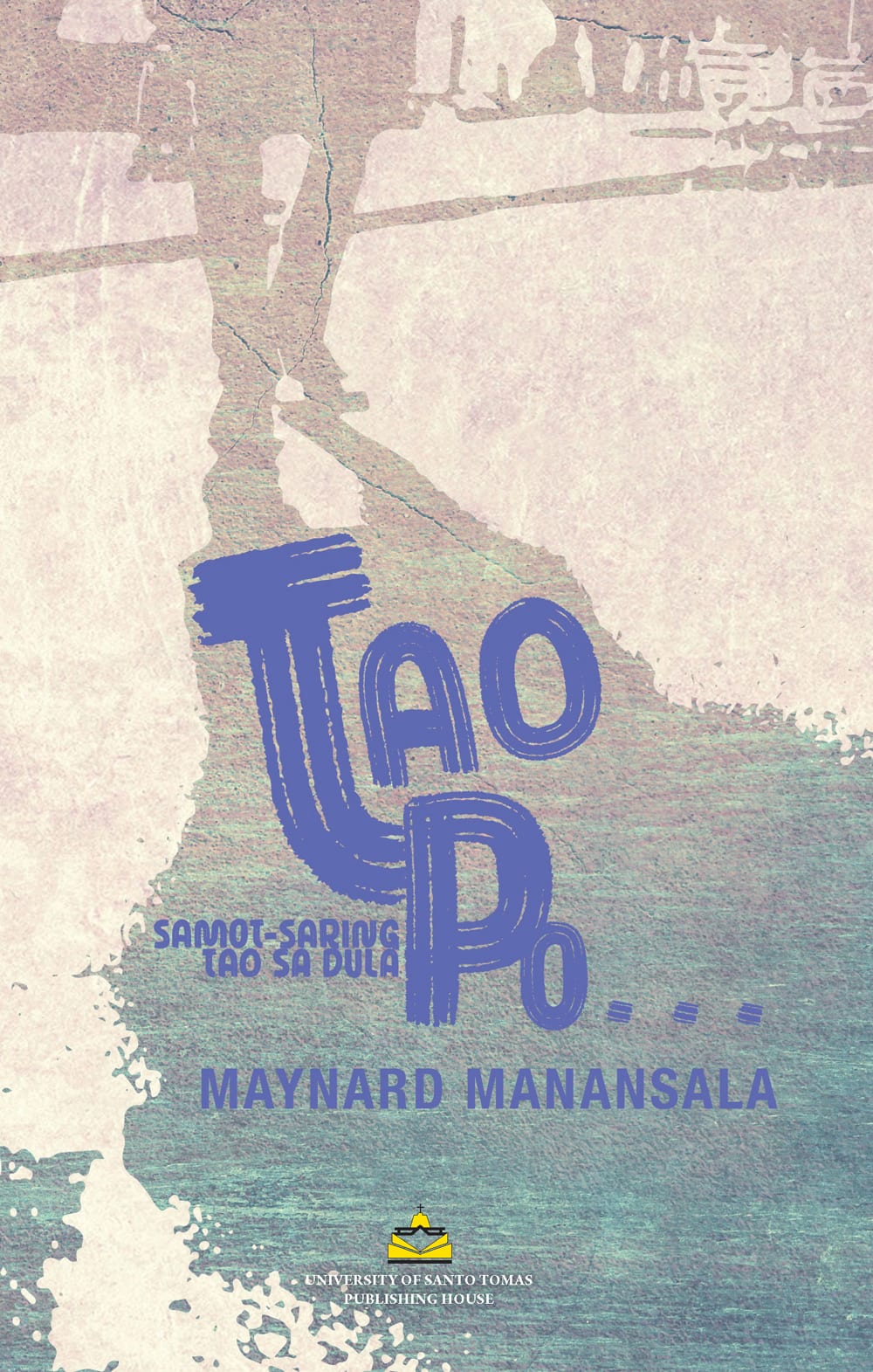
Tuloy Po Kayo: Maynard Manansala’s Tao Po… Samot-Saring Tao sa Dula
Manansala’s collection takes the knock for its title and the answer for its method. Tao po is what the caller says; the book, six plays deep, keeps opening the door, and what enters is exactly what the subtitle promises—samot-saring tao, people of every assortment: two ex-lovers in towels at a Pasay bathhouse’s fifth-anniversary party, a masseur and his client circling each other in a Mandaluyong condominium, a fourteen-year-old valedictorian coming out at the podium, a volunteer teacher on her last day at a Lumad evacuation school, and, in the title play, four voices of the drug war—a photojournalist, a widowed zumba instructor, a killer, a sixteen-year-old orphan—that the script suggests be carried by a single actor, as if to insist a body count’s roles are nearer to each other than anyone wants to believe. The arrangement is the argument: by binding the bathhouse beside the massacre, the massage beside the bakwit school, the book declines the hierarchy that would rank desire below atrocity, and the refusal feels ethical rather than eclectic—the queer body seeking pleasure and the poor body seeking survival answer the same knock. A person is here.
Rody Vera’s introduction gives the book’s craft its name, and the naming is itself a contribution to our critical vocabulary. Talisik, his term for wit, has usually been treated in our dramaturgy as decoration or relief—the joke that lets the audience breathe before the next blow. Vera argues, and the plays demonstrate, that in Manansala’s hands wit is structural: the towel joke in Big Night that carries the entire premise of concealment; the reversal in Dalawang Gabi whereby the one who pleaded in the first night is pleaded with in the second, the whole play pivoting on a symmetry as clean as a proof; and, most dangerously, the zumba class in Tao Po, where a widow’s grief for a husband and son killed by fifteen policemen is choreographed to party music. Vera reaches for a historical analogue—the radio taiso of the Japanese occupation, compulsory cheer as control: Rosing’s aerobics is joy conscripted, the body forced to keep the beat while the mind keeps the wake. Anyone can mourn in a minor key; scoring mourning for a dance class without losing its weight requires exact tonal control, and it is on tone, more than plot or language, that Manansala’s plays stake their claim.
The title play carries the book’s largest ambitions and its most delicate problems, both from the same source: its intimacy with the real. Tao Po is built on documented cases—the Photojournalist’s monologue walks a lecture audience through actual photographs by Raffy Lerma and Bro. Jun Santiago, naming the real dead, among them the five-year-old Francis, killed by a bullet aimed through a window meant for his father. The book preserves the play’s public life in a production history so long it amounts to its own small archive. Performed by Mae Paner, the activist the country knows as Juana Change, the play moved for two and a half years through an itinerary recorded down to the hour: PETA and the CCP in 2017, the Ateneo Law School that November, Melbourne and Canberra the following September, then that December a Human Rights Congress at Ateneo’s main campus and, days later, a Christmas gathering for families of EJK victims at the Office of the Vice President—the zumba scene performed as that gathering’s own entertainment—then Baguio, Quezon City, six European cities, and Cebu. I had assumed a play this intimate with the dead would have played mostly to rooms far from the barangays it describes; the record says otherwise. What I had wanted to ask about the European leg—what a moved spectator in Geneva is positioned to do with the feeling—applies more sharply to that Christmas date: is performing a woman’s zumba-class grief for her murdered husband and son, as entertainment at a party for the actual families of the actual dead, art returned to the people it was taken from, or one more thing asked of the grieving? The play seems alert to this discomfort: the Photog monologue is about the queasiness of aesthetic success amid slaughter, the way a mother’s words at her son’s coffin—“Pinatay nilang parang manok, pinatay nilang parang hayop”—arrive so poetically formed that the photographer must remind his students no one scripted them.
The problems are of a different order, and concern the book more than the play. A solo performance welded to a performer as singular as Paner risks a script whose afterlife is bound to one famous body; the volume’s answer is publication itself, the suggested doubling left open for other actors, other towns. Less resolved is the collection’s unevenness, which I register as observation rather than complaint, since a samot-sari that curated away its slighter members would betray its own title. Valedictorian, a monologue that won an audience award at a festival of short queer works, is charming and single-gestured beside the plays that flank it; its best moment—the fourteen-year-old finding himself inside “Impeng Negro,” a canonical story about a bullied boy, and apologizing to the auditorium for the story’s own language—performs in miniature the book’s procedure of reading one marginalization through another, but the miniature stays miniature. Tser, meanwhile, closes the collection on its riskiest ground: a Manila-based writer voicing Lumad students and their volunteer teacher in a bakwit school in Maragusan, on the day the teacher must decide whether to stay. Manansala interviewed teachers of Lumad schools, following a dictum Vera credits to Aguila—learn the unknown, then write it—and the play keeps its center of consciousness in Rose, the outsider whose position most resembles the playwright’s and the audience’s. Whether that choice is modesty or limitation is unanswerable from the page; a future Mindanaon staging may redistribute the play’s weight in ways the book cannot predict and should welcome.
Manansala’s own preface states plainly what he thinks the book is for. He publishes, he says, first so the students and companies who kept requesting copies of Dalawang Gabi, Tao Po, Valedictorian, and Tser can finally hold them, and second so the volume can serve as a “tala ng aming kolektibong pagsasakatuparan ng isang artistikong bisyon”—a record of a collective realization. Nearly every play arrives trailing its directors’ notes, its cast lists, its festival history; where Varela-Luarca’s book preserves a lineage, Manansala’s preserves a company. It is a warm book to be inside of—the introduction comes from Rody Vera, a mentor whose devotion runs through the whole collection, and the acknowledgments close on his name too, “sa pagmamahal at sa lahat-lahat,” love and everything else. Small fields like ours tend to run on small circles, the same handful of names teaching, directing, and vouching for each other in turn, and I am myself writing from a circle not much larger. That closeness doesn’t make the praise untrue—if anything, it explains how the book got made at all, everyone teaching, directing, and thanking each other because they were the ones in the room. What holds up beyond the room is the writing itself: Tao Po and Big Night command an audience on the page, no vouching required, and that is the more useful thing a reader can be told.
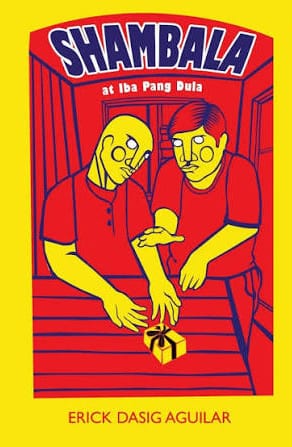
Saglit: Erick Dasig Aguilar’s Shambala at Iba Pang Dula
The stage direction that recurs through Aguilar’s three plays like a heartbeat is a single word: Saglit. A beat, a moment, a breath withheld. His characters live inside the saglit—waiting for a train in a rusting terminal at the far end of the future, waiting under the mud for their bodies to be found, waiting in a small house for the black vehicle that will take one of them away—and Mixkaela Z. Villalon’s brief closing essay names the condition with the right word: liminality, the ritual’s middle, where time suspends and anything remains possible. Villalon’s essay makes the claim on which the whole book stands or falls: Aguilar gives voice to those who should no longer be able to speak (“binibigyan niya ng boses ang mga hindi na dapat nakapagsasalita”): the dead in the terminal, the children under the landslide, the son already walking toward his abduction. She then asks the question a skeptic would ask—“Anong uri ng research ang kailangan para matunton ang saloobin ng mga multo?”—what research could possibly verify the inner life of ghosts—and answers that verification was never the point. The point is the prolonging: theater as the one place where the moment before annihilation can be stretched until it yields its speech.
Of the three plays, Ang mga Bata! Ang mga Bata! is the one I find myself unable to forget, partly because it should not work. The boys Waldo and Buboy, dead for days beneath a landslide that erased their town, watch the living dig in the wrong places and shout what no one hears—“Anak nam’ putek! Hoy! ‘Andito kame!”—we’re here!—in an invented child-speech where curses have gone soft in the mud (putek for the harder word it shadows) and pronouns have slid into a dialect that belongs to no province because it belongs to the grave. The linguistic invention is the play’s mercy and its politics at once: these children announce their presence in a language the nation cannot quite parse, the exact condition of the calamity dead in our archipelago—counted late, named wrong, dug for in the wrong places, their towns rebuilt over them. The play never mentions Guinsaugon or Itogon or any of the buried barangays a Filipino audience will inevitably supply, and its restraint is correct; specificity would have narrowed a grief the play needs to keep general, since the landslide, in a country of deforested slopes and unmoved mining permits, is never only weather. The ecocritical force of the piece lies in what the boys take for granted—that mountains fall, that this is a thing mountains now do—and in the terrible cheerfulness with which they discuss the excavators that may or may not arrive, having possibly been buried themselves on the next mountain over.
Shambala, the title play, is the collection’s most exacting construction, and its violence lands harder for staying almost entirely offstage. Two brothers, Eman and Manuel, have just buried parents “pinaslang ng mga ahente ng militar,” and the play consists of the waiting that follows, since children of the salvaged know themselves listed. The dialogue proceeds by a Beckettian arithmetic: how many mourners drank how many spoons of sugar from how many sacks, while a gift box with a black ribbon sits unopened on the table—grief displaced into inventory, terror managed as bookkeeping. When the vehicle finally idles outside, the play springs its reversal: the elder, who read all the books and prepared all the protocols, breaks; the younger, who learned everything late, straightens his clothes and walks toward the light of the exit with a dignity the script spells out—“Dapat may dangal sa pagkawala”—instructing his brother to read poems at his wake whether or not a body is found, and promising, in the play’s most pitiless line, that the abductors will get nothing from him because there is nothing to get: “Wala akong alam, Kuya Eman. Pangako.” The desaparecido is the wound that cannot close because it cannot be located; Aguilar’s contribution is to dramatize the hour before the wound, when the whole grammar of loss is rehearsed in future tense by the ones who will be lost. That the play’s production history includes a 2017 bar reading staged to raise bail for Maricon Montajes, a detained student, collapses the distance between the play’s fiction and its function more completely than any afterword could.
Two pressures seem to me worth placing on the book, and neither resolves as neatly as a sympathetic reading would like. The first concerns inheritance. Terminal, the earliest play, sets a beggar waiting for a train the way two tramps once waited for a man who never came, and its far-future station, its blind beggar, its 1,299-year-old Antonio, its bride-to-be still waiting to be wed, wear their European absurdist ancestry openly; the Palanca citation praises its philosophical treatment of death, deservedly, but a reader may still ask when the Filipino waiting-room play stops being a dialect of Beckett and starts answering to a tradition of its own. One might say the answer arrives later in the book—Ang mga Bata! fills the room with our own mud, Shambala locks it onto a specific state violence—but a future director could stage Terminal alone, and it would still owe Beckett exactly what it owes him now. The second concerns a different cost: a liminal dramaturgy converts murder into metaphysics almost by definition, and there will be audiences of Shambala who want the state named more plainly. What keeps the abstraction from floating free is less the play’s text than the production note attached to it: the same bail reading for Montajes has earned the play a claim on the real the dramaturgy alone would not have secured—a virtue of the writing, or a debt it owes its context, and I would rather leave that question open than answer it on the book’s behalf.
This is the slimmest of the four books in surrounding matter—no director’s essays like Aguila’s, no touring itinerary like Manansala’s—and what little apparatus it has, it spends on the pasasalamat, an acknowledgments section running for pages, naming, by my rough count, several hundred people, and ending with a line that could stand as the collection’s epigraph: “At sa mga nalimot ngunit hindi.” To those forgotten but not. In a book whose central play is about enforced disappearance, an acknowledgments list that will not let a single name drop is not padding; it is the plays’ own argument, restated as a list of names instead of a scene. The casting notes carry the same instinct further—Terminal may be performed by any combination of genders, its Antonio becoming Antonia as needed, one seat kept vacant for the Matanda to occupy at the end. Aguilar’s book trusts the saglit: it holds the door open and does not tell us who will walk through.
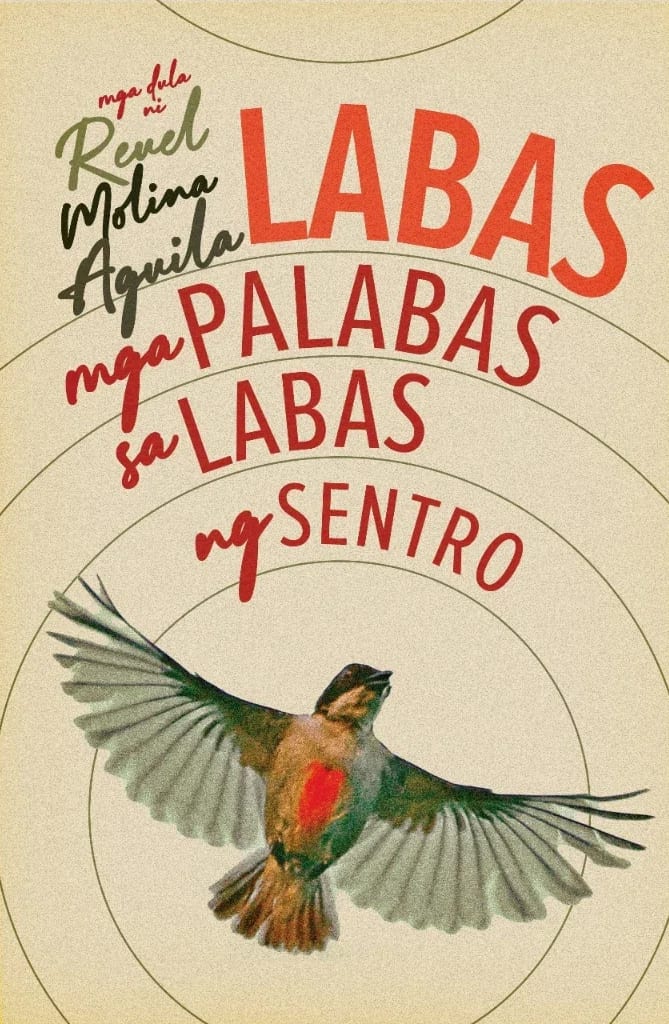
Lalabas: Reuel Molina Aguila’s Labas: Mga Palabas sa Labas ng Sentro
In the printed script of a Filipino play, lalabas is the stage direction that sends a character offstage—she will go out, exit the scene—and the same root gives us palabas, the show, and labas, the outside. Aguila’s title holds all three meanings at once: to leave the stage, in Filipino theatrical grammar, is to step into the labas the book is named for. The book beneath the title is the only one of the four finalists that arrives with an explicit theory of the category it now stands in. His opening essay, “Mula sa Mandudula,” is a short treatise on the geography of our culture: there is a sentro—Metro Manila, the major university presses, the awards—and there is everything else, the traffic running one way, works forever lumuluwas, commuting toward a center that contains further centers within itself. The three plays that follow were staged outside that center’s attention: two in Lucena, by KATAGA, the writers’ organization Aguila founded, in a university auditorium, a mall’s shuttered cinema, an abandoned soft-drinks warehouse; the third in Manila, by a small student company, eight years after its Palanca, rescuing it from the fate Aguila names with a bitter joke of the trade—the “filing cabinet play,” awarded, filed, never staged. His sentence about these productions is the plainest justification for this book’s existence: “Halos walang nagtatala sa mga pagtatanghal na ito.” The critics are in the center; the histories will be histories of the center, unless the outside writes itself down. Labas is the outside writing itself down.
The book’s most original decision follows from this: Aguila hands substantial pages of his own volume to the directors who staged him, and their essays—unpolished in places, and better for it—constitute a literature we almost never get: the production history of the periphery, told from inside. Marco Rodas recounts composing fifteen songs for Klik in two months after his day job, ferrying the cast through weekend rehearsals in a caretaker’s borrowed soft-drinks warehouse; Jonna Reyes, a self-described novice, discovers competition has no place in art, and closes with a line a child told her after Ang Saya-Saya, which happens to contain the book’s title: “Wala po pala sa telebisyon ang ating realidad, kundi nasa labas nito, ang totoong hamon ng buhay.” Kino Kwan’s account of staging Sa Kanto ng Wakas at Katotohanan Extension at a conservative university—an auditorium chosen for its one built-in spotlight, run like a camera lens—ends with an image worth setting beside the plays themselves: a truth the company, like the neighborhood in the play, will kill and bury and be visited by again. When Kwan writes that the staged play “nagkaroon ng sariling buhay na labas sa manunulat at labas sa amin na nagtatanghal,” the book’s title acquires a further meaning: not only a place on the map, but where the work goes when it lives.
The plays themselves are older machines than the volume’s framing, and I think it honors them to say so plainly. Klik sets a rising Manila photographer against a peasant barricade in the first years after EDSA Dos, and lets a single photograph convert him; Ang Saya-Saya, a burlesque, imagines a noontime show’s sixtieth anniversary in a future where the country’s poverty hasn’t changed except in the size of the prizes, until the crowd locked outside storms the studio and holds the broadcast hostage, an act of desperation the medium rewards with its highest ratings yet; Sa Kanto ng Wakas at Katotohanan Extension returns a man to his street corner after twenty-five years of imprisonment for a political murder he did not commit, and lets the neighborhood’s accumulated lies negotiate with the one truth he carries. Their dramaturgy is frontal, their allegories legible from the last row—agit-prop’s honorable lineage, the Second Golden Age Aguila himself lived and names in his essay. Two hesitations, offered as questions a staging might answer. In Klik, the truth that completes the photographer’s conversion is what the military does to the captured Laya—made a soldier’s property, then discarded to a nightclub—and the synopsis leaves open whether the play grants her an interiority equal to her symbolic burden. In Ang Saya-Saya, the satire must trust its audience to taste the poison beneath the candy it delivers; the sold-out runs suggest the candy sold regardless, and the book records the fact without deciding what it means.
Then there is the second preface, occasioned by the red-tagging with which I began, and it changes the temperature of everything that follows it. “Isa Pang Pagpapakilala Matapos ang Red-Tagging” is written in the same wry third person Aguila uses throughout—ang mandudulang ito, this playwright—a device that reads at first as modesty and reveals itself, by the essay’s end, as armor: when the state points at your name on television, there is a sanity in speaking of yourself as a character. The facts he lays out with footnoted care—the commissioners who signed the memorandum, the senator’s fantasy of a daughter radicalized by a book, the broadcast that displayed a rejected cover study as a printed subversive object, the simultaneous editorial pressure to standardize the spelling in his characters’ mouths—assemble into the sharpest lesson any of these four volumes teaches. A book of plays, in the Philippines of the 2020s, is an object the state can find dangerous before it exists, and the danger and the nonexistence are connected: what was feared was not a sentence in the manuscript but the fact of the record itself, a periphery documenting its own theater, its own language, its own version of the last fifty years. That the actual book is—as Aguila jokes—likely to disappoint anyone hunting for sedition only completes the lesson. The plays are not calls to arms; they are calls to attention. It was the attention that was intolerable.
I close this section where the book closes its opening essay, on the proposal Aguila offers instead of resentment: not to storm the center but to multiply the outsides—“lumikha ng maraming sentro sa labas ng kasalukuyang sentro,” to create many centers beyond the current one. It is easier to state than to test, since a book arguing for multiplying centers is still, itself, a single object competing for a single national prize administered from the center it describes—an irony the book lives inside rather than pretends away, the way its author has lived inside larger ironies for fifty years. What the volume can show, more modestly than a manifesto, is one Lucena theater’s decade of work, now on a kind of record that would not otherwise exist. Whether one book of testimony changes anything about where the next center gets built is a question Labas raises and cannot answer; it can only make sure the raising of it is on file.
Ang Huling Katok
Four books, then, and a surprising amount of traffic between them once a reader starts to look. Reuel Aguila’s is the first testimonial printed in Erick Dasig Aguilar’s collection, welcoming the younger absurdist into a tradition the elder helped build; both men stand inside KATAGA’s founding history—Aguila its founder, Aguilar its founding president; Glenn Sevilla Mas, who wrote the afterword closing Varela-Luarca’s volume, appears among the hundreds Aguilar thanks, as does Varela-Luarca himself; Manansala’s Tser was written under a maxim Vera credits to Aguila. This is not four independent assessments of a national theater arriving at the same conclusions by different roads; it is four members of one working generation writing each other’s introductions and thanking each other’s names—the condition, as I said of Manansala’s book, that makes the plays possible and should make a critic slow to call any of it consensus. What the rosters running through all four books prove, more modestly, is a fact about method rather than quality: against the knock that erases—the tokhang list, the abduction, the landslide’s miscount, the red tag—this theater keeps a record of itself by naming its own, children buried but shouting, the forgotten but not. That the naming is also self-interested does not make it less real; it only means the record and the judgment of its worth cannot come from the same set of names.
Assessment owes the reader some plain speech, and the four books do not reduce to the same kind of achievement, a better sign for the category than uniform excellence would have been. Varela-Luarca has written the most technically various playwriting of the four, three plays sharing almost no formal ground, though the book is still working out what it owes to the audience that first heard the plays against the audience they are actually about. Manansala has built the widest human range inside a single spine, from bathhouse to bakwit school, at the cost of the unevenness that same range produces, thinnest at its furthest edge, in the Lumad classroom seen through a departing teacher's guilt. Aguilar has sustained a single dramaturgical idea, the liminal room, across three settings without repeating himself, though the same idea occasionally lets state violence go softer and vaguer than a harder-edged play might allow. Aguila alone has written a book that theorizes its own category, documents what its institutions have failed to document, and survived the state’s attempt to convict it before it existed—an achievement no other book here attempts, purchased at the cost of a dramaturgy some readers will find plainer than the century asks for. I list these unevenly on purpose: a critic who found the same balance of strength and shortfall in four different books would suspect himself of applying a template rather than reading four times.
What, finally, is a book on drama and film, for us, now? On the evidence of these four: it is theater’s way of refusing its own disappearance in a country that disappears things. The performance ends, the mall reclaims its cinema, the mansion seals its room, the mud settles, the broadcast cuts to commercial, the visitors’ vehicle drives off, and then—later, always later—the book arrives at the door of the national memory and knocks. Every book in this quartet is that knock. The category, whatever its name, still owes to an absent cinema, exists so that someone is home to answer. Tao po, each of them calls: a person is here. The plays were performed; the people were real; the record now has a spine. Tuloy po kayo.
Edgar Calabia Samar is Associate Professor at the Ateneo de Manila University, where he recently completed a term as Chair of the Department of Filipino. He is Head of the National Committee on Literary Arts of the National Commission for Culture and the Arts and a member of the Filipino Critics Circle. He is the author of the Janus Silang series and of several novels, including Teorya ng Unang Panahon, and in 2024 received the S.E.A. Write Award from the Royal Family of Thailand for his contributions to Southeast Asian literatures. He writes about reading, writing, and liberatory education and labor at Silid Santinakpan (patreon.com/ecsamar) and on Instagram at @ecsamar.
READ MORE FROM EDGAR CALABIA SAMAR:
By the Spine, or by the Thought: On the Finalists for the 43rd National Book Award for Best Book of Literary History
By Whose Reckoning: On the Finalists for the 43rd National Book Award for Best Book of Literary Criticism or Cultural Studies
The Book Beside the Book: On the Finalists for the 43rd National Book Award for Best Anthology in English
At the Editor’s Own Table: On the Finalists for the 43rd National Book Award for Best Anthology in Filipino
Voices Shaped Beyond Retrieval: On the Finalists for the 43rd National Book Award for Best Book of Poetry in English
The Tongue and the Terrain: On the Finalists for the 43rd National Book Award for Best Book of Poetry in Filipino
Five Doors Into the Real: On the Finalists for the 43rd National Book Award for Best Nonfiction Prose in English
The Dwelling and the Drumbeat: On the Finalists for the 43rd National Book Award for Best Nonfiction Prose in Filipino
What the Novel Remembers When the Nation Forgets: On the Finalists for the 43rd National Book Award for Best Novel in Filipino
What the Novel Carries When It Leaves: On the Finalists for the 43rd National Book Award for Best Novel in English
What the Stories Hold When the Collection Gathers: On the Finalists for the 43rd National Book Award for Best Collection of Short Fiction in Filipino
The Gathered and the Gathered Against: On the Finalists for the 43rd National Book Award for Best Collection of Short Fiction in English
Edgar Calabia Samar is an award-winning poet, critic, and novelist, and an Associate Professor at Ateneo de Manila University. IG: @ecsamar.
View More Articles About: