'Notes from the Last Row' Made Me Afraid of Losing My Own Mind
Would you recognize it if the person manipulating you was yourself all along?

Published on Aug 28, 2026
I was doing that familiar Netflix ritual of looking for the next thing to watch: scrolling through titles, rejecting thumbnails, reading half a synopsis before moving on, when I suddenly recognized a face.
Wait. Is that Choi Min-sik? I know that face. More specifically, I know what that face had been through.
This was Oh Dae-su from Oldboy (2003), the man Park Chan-wook imprisoned for 15 years before unleashing him into one of cinema's most gloriously deranged revenge stories. Choi was considerably older now, but there was no mistaking him.
Then I read the title aloud so my wife could hear it.
“Notes from the Last Row.”
“That sounds like Notes from Underground,” she replied.
She meant Fyodor Dostoevsky's 1864 novella, the Russian classic narrated by an isolated, bitter, contradictory man retreating deeper and deeper into his own consciousness. It was probably nothing more than a coincidence. Still, Netflix now had me twice: Choi Min-sik on the thumbnail and Dostoevsky accidentally rattling around in my head. So I clicked. And I got hooked remarkably fast.
The Man in the Last Row
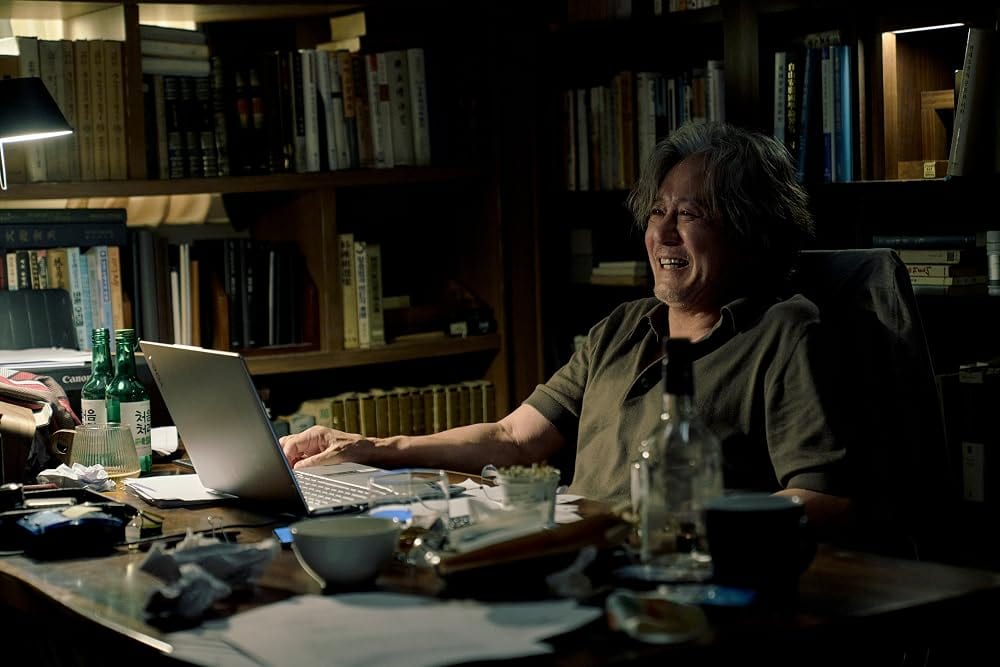
The six-episode limited series follows Heo Mun-oh, played by Choi, a literature professor and novelist whose career never quite became what he imagined it would be. Then he encounters Lee Kang, a student sitting in the last row. There is something unusual about the young man's writing. Mun-oh recognizes it almost immediately. Here is the literary vitality that the older man understands intimately but can no longer seem to summon himself.
What begins as curiosity becomes fascination. Then fascination starts becoming something else. That's about as much as I want to reveal. The less you know about where Notes from the Last Row takes this relationship, the better. What matters is that Lee Kang's writing begins occupying an increasingly large space inside Mun-oh's life. And Choi Min-sik makes that obsession uncomfortable to watch.

Imagine Meeting the Man You Could Have Been
There is something particularly cruel about Mun-oh's predicament that I think becomes more recognizable as a man gets older. It isn't simply jealousy. Lee Kang represents potential. Mun-oh represents what happens after potential has had decades to negotiate with reality. That's a much nastier confrontation.
Most men eventually discover the difference between the person they once expected to become and the person staring back from the mirror. Maybe you thought you'd have the corner office by 40. Maybe the business should have been bigger by now. Maybe that novel remains stubbornly trapped inside a folder named FINAL_DRAFT_7. Life has an annoying habit of keeping receipts.
Mun-oh has knowledge, experience, professional stature. But suddenly he's confronted by a younger man who possesses something none of those things can guarantee: the possibility of becoming extraordinary. Lee Kang still has unwritten books ahead of him. Mun-oh is haunted by the books he hasn't written behind him. That tension gives their relationship much of its bite.
This Isn't the Choi Min-sik I Remember
My strongest association with Choi Min-sik remains Oldboy. It's difficult for it not to be. His Oh Dae-su was feral. Physical. Furious. You remember the hammer. You remember that corridor. You remember a performance seemingly powered by meat, sweat, rage, and an unreasonable tolerance for bodily punishment.
Mun-oh is different. The spectacle isn't Choi's body anymore. It's his face. A stare held slightly too long. A flicker of jealousy. The embarrassment of an older man realizing how desperately he wants something. Irritation transforming into fascination before he has time to hide it. But as I continued watching, I realized there was another connection between these two performances—one far more interesting than physicality. Choi Min-sik is once again playing a man being manipulated.
In Oldboy, Oh Dae-su spends much of the film believing he is making his own choices, only to discover how thoroughly someone else has engineered the circumstances around him. His rage is devastating precisely because beneath all that violence is helplessness. He can beat men senseless with a hammer, but brute force is useless against a manipulation he doesn't yet understand.
There is something eerily familiar about watching Mun-oh. Lee Kang doesn't need a prison cell. He has stories. Mun-oh believes he is the professor, the mentor, the experienced novelist—the man who should hold the intellectual advantage in their relationship. Yet gradually, the balance of power becomes harder to locate. The more fascinated Mun-oh becomes with Lee Kang's writing, the more willing he is to follow wherever those stories lead him, even when doing so pulls him away from the man he ordinarily believes himself to be.
And that's what I admire about Choi Min-sik in both performances. He is extraordinarily convincing at portraying men who possess the outward appearance of agency while something—or someone—is quietly taking that agency away. Oh Dae-su responds with his body. Mun-oh responds with his mind. One lashes outward, smashing through anyone standing between him and the truth. The other seems to turn increasingly inward, becoming consumed by curiosity, jealousy, obsession, and the need to know what comes next. Choi doesn't play either man simply as a victim. That's the trick. He makes us understand why they keep walking deeper into the trap.
And in Notes from the Last Row, that quality becomes even more unsettling once I started wondering whether Lee Kang was the only thing manipulating Mun-oh. Because somewhere around the midpoint of the series, I began to suspect that his own mind might be doing some manipulating of its own.

Halfway Through, I Started Forming a Theory
By about the middle of the six episodes, something started bothering me. Until then, I had accepted what was happening largely at face value.
Lee Kang writes. Mun-oh reads. Mun-oh becomes fascinated. Fascination becomes obsession.
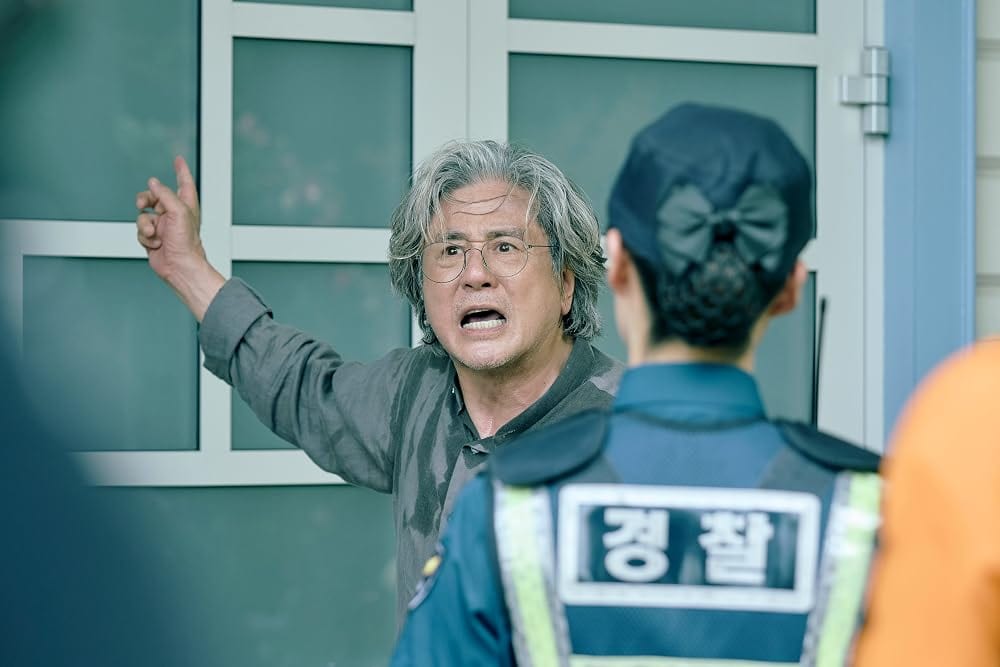
But then the professor begins crossing boundaries that the man we were introduced to shouldn't ordinarily cross. His actions become increasingly difficult to reconcile with the person he appears to be. At one point, he even steals examination papers. That was when a different interpretation crept into my head. What if Lee Kang's stories aren't merely driving Mun-oh's obsession? What if the obsession, his increasingly out-of-character behavior, and the strange instability between what he observes, remembers, imagines, and believes are also telling us something about Mun-oh himself?
I began entertaining a theory. What if we're experiencing parts of Notes from the Last Row through the deteriorating perception of a man beginning to lose himself inside his own mind? More specifically, I started wondering whether Mun-oh might be exhibiting signs of early cognitive decline—perhaps even dementia.
No, I'm Not Diagnosing a Fictional Character
I should put a large asterisk here before Dr. Google barges into the room wearing a lab coat. I'm not claiming Mun-oh has dementia. Nor am I suggesting that the series eventually pulls out a medical diagnosis and declares, “Aha! That's what all this meant.” This is simply the interpretation that began shaping the way I watched the second half of the series. Once the possibility entered my head, however, it was difficult to evict.
Mun-oh's fixation on Lee Kang's stories suddenly felt different. His increasingly strange decisions felt different. Most intriguing was the way fiction, observation, imagination, and reality seemed to rub against one another. Instead of asking only what Lee Kang was doing to Mun-oh, I began asking another question: Can Mun-oh completely trust what his own mind is doing to him? That question transformed the series for me.
The Scariest Part of Dementia Isn't Forgetting Your Keys
We tend to imagine dementia through its most visible symptoms. Someone forgets a name. Someone can't remember where he put something. Someone walks into a room and forgets why. Those things are frightening enough. But there's another existential horror underneath them: the possibility that your mind—the thing you've relied upon your entire life to tell you what is real—may become unreliable.
And consider who Mun-oh is. He's a professor of literature. His professional identity depends upon reading, memory, language, interpretation, and the ability to distinguish meaning from noise. What happens when a man who has spent his entire adult life interpreting stories begins having difficulty interpreting his own? A carpenter can fear losing the use of his hands. A singer can fear losing his voice. For an intellectual, perhaps the equivalent nightmare is losing confidence in his own mind.
Seen through that lens, Notes from the Last Row becomes something considerably more frightening than the psychological thriller I thought I had clicked on.
Maybe the Stories Are Giving Him Something He Is Losing
Mun-oh doesn't merely enjoy Lee Kang's writing. He needs it. He waits for it. Thinks about it. Organizes increasingly large parts of his life around it.
And under my admittedly speculative reading, that obsession raises another possibility. Perhaps Lee Kang's stories aren't simply feeding Mun-oh's envy. Perhaps they're providing structure.
Narratives take chaos and arrange it into something comprehensible. There is a beginning. Something happens. One event leads to another. People have motivations. Actions produce consequences. Stories make sense. Life frequently doesn't.
And if Mun-oh's confidence in his own perception is beginning to fracture, perhaps Lee Kang isn't merely giving his professor literature. Perhaps he's giving him coherence. That's the idea I couldn't shake.
ALSO READ:
If Someone Handed You a Gun Right Now, Who Would You Kill?
Teach You a Lesson: The Show That Punches Bullies—and Still Gets It Wrong
Francis writes about film, culture, and how humans talk to each other and to machines. Email: [email protected]
View More Articles About: