Barcelona: Where Spanish Was Never the Language
In this part of the Bicol Region, the locals speak Waray-Sorsogon, a language mutually intelligible with Waray, which is spoken across the sea on the island of Samar.

Published on May 28, 2026
Tourists move among locals, DSLR cameras and smartphones in hand, hoping to witness its rich cultural and natural heritage up close and capture fragments of it through photographs and videos.
A van swung its doors open. Foreign tourists stepped into the late morning light, beaming at the centuries-old church.
Cars lined the side of the road. Motorbikes hummed along the pedestrian lane.
The tourists turned and walked toward the church, the salty breeze tugging at their hair.
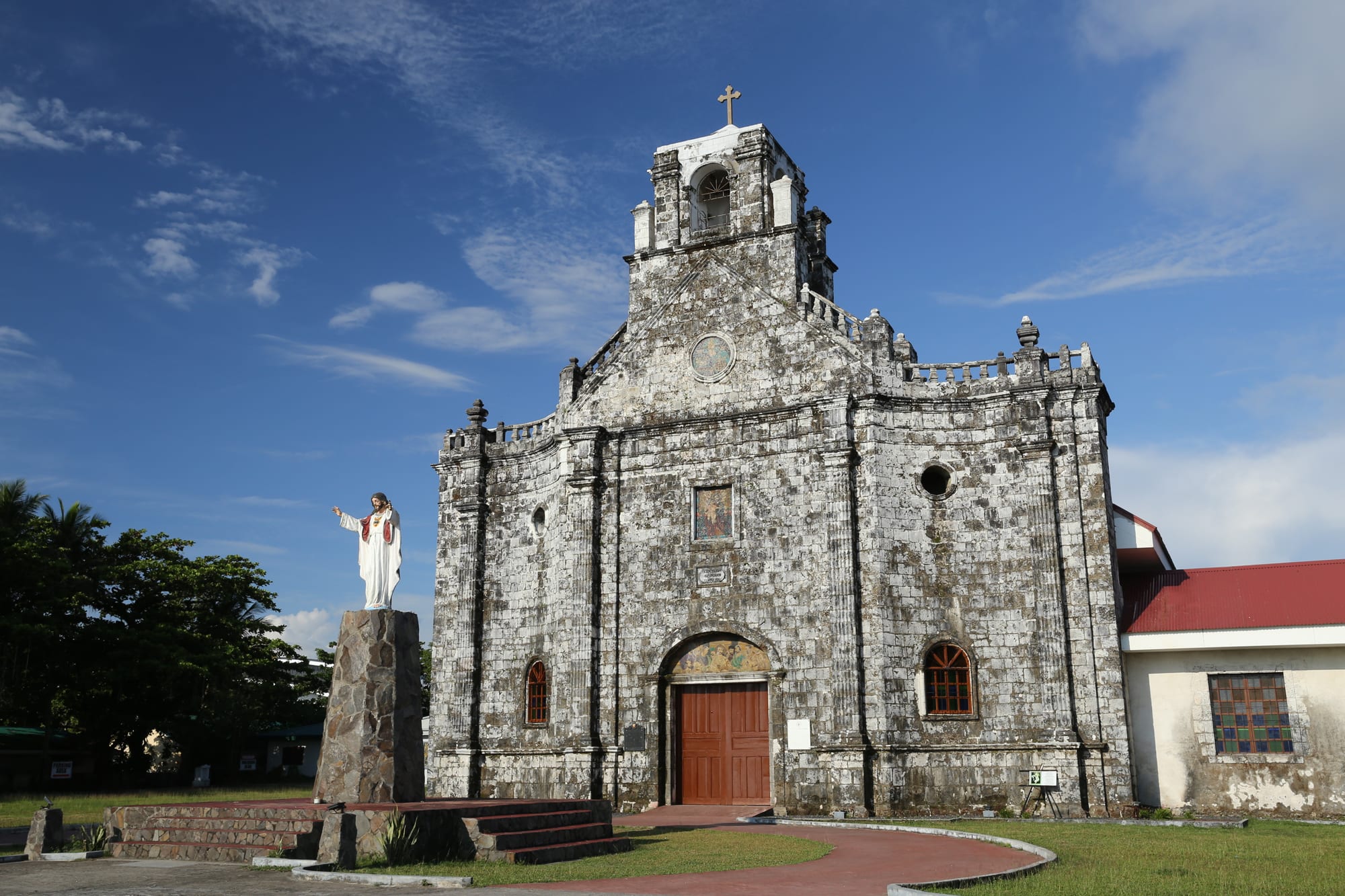
Up close, moss and wild vegetation crept across the weathered walls of the church, its structure hewn from blocks of coral stone.
Then, they gazed at the arched portal, their eyes tracing the seams between blocks of coral stone before stepping inside one of the province’s best-preserved churches.
Facing the sea, the church, built in honor of Saint Joseph, could hold a thousand faithful, seated and standing.
Exposed to the full force of the sea, it withstood fierce winds and typhoons for more than a century.
Behind the church and nearby communities, green and golden stalks swayed as the wind swept across the vast plains. Coconut groves stretched across wider expanses.
The foreigners stepped out through the portal. Squinting against the sun, they crossed the road toward the ruins on the other side.
Locals and foreigners ambled across the park. In 2016, a stage rose there for the Miss Earth fashion show, where beauty queens from around the world drew thousands of spectators.
To the left, tourists paused at the ruins of the gobernadorcillo’s office—the Presidencia—where moss and wild plants crept through the seams of weathered coral stone.
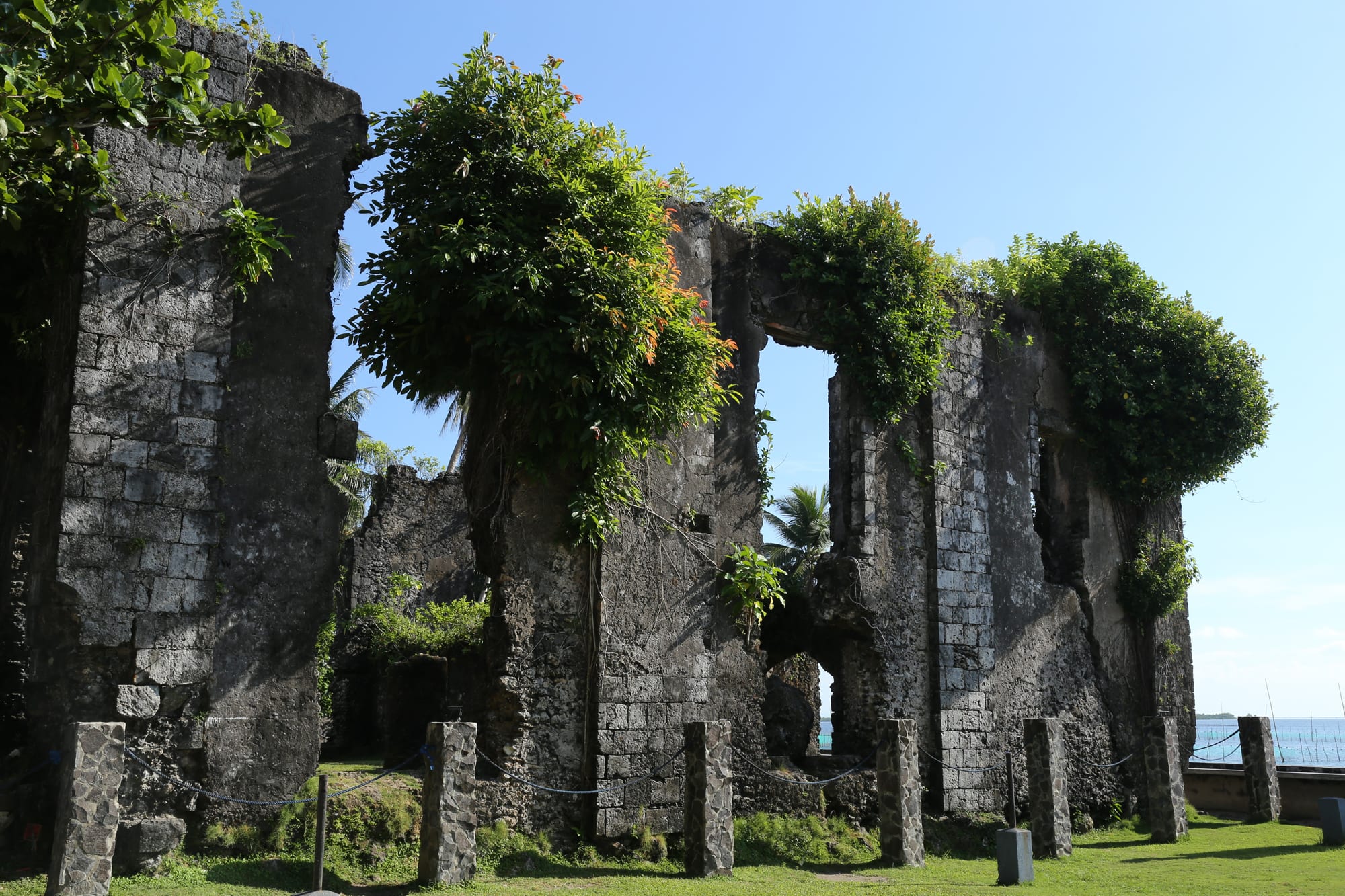
To the right stands an old school—the Escuela Pia—built from the same coral stone. Behind it, a row of outlets offers food and drinks. Outside the park, mobile vendors also sell snacks and refreshments.
In nearby homes, locals cook ginat-an — langka shreds, cassava, kamote, and small rice-flour balls simmered in coconut milk for merienda. They also prepare linumpan na kalunggay — malunggay leaves with tinapa shreds or dilis cooked in coconut milk for meals.
As the foreigners drew near the thick wall shielding the park from the waves, the breeze grew heavy with salt.
Double-outrigger boats rocked gently as the waves rolled toward the shore.
Sitting atop the seawall, two locals looked at the church across the road. Then they shifted their gaze toward a group of foreigners talking while scanning the expanse of the sea.
The two glanced back at the church.
“May mga endangered na kita na surumaton.” (We have endangered words.)
“Atog mao ngani.” (Yes, really.)
“Maski baga an mga surumaton na hudam sa Espanyol bihira mo na mabati niyan—sugad san habon, espeho, nan lyabe.” (Even words borrowed from Spanish are rarely heard now — like jabon, espejo, and llave.)
“Mao. Lalo na kun an mga taga dini nag-iristar sa Manila sin awat na panahon.” (Yes, especially when the locals spent long periods living in Manila.)
Their conversation went on, reminiscing about their childhood in the 1980s. They never went to the next village at night to play with friends there. Elders had always warned them that a coffin carrying the dead would float across the small bridge.
Another tale was that of the asuwang. Children were always warned that the creature followed those who lingered in the streets at night. These stories frightened children, but they gave parents peace of mind.
Today, teenagers gather around that bridge, chatting and smoking until midnight. The lolos and lolas who once kept children off the streets with stories are long gone.
The wind shifted.
A vendor balancing a nigo on her head called out.
“Sinapot!”
At the edge of the park, a family stood watching the church across the road.
A local on a motorbike slowed through the pedestrian lane, the long sickle feathers of a rooster sticking out from the box strapped at his back.
A man in blue on the side called. “Diin an bulang, padi?” (Where’s the cockfight, pare?)
The man pulled over, turning his head. “Sa Tagdon. May tupada. Hamos!” (In Tagdon. There’s a tupada. Let’s go!)
“Ambot dumalagan na naman an manok mo,” the man in blue said, waving his friend off. (Your rooster might run away again.)
“Nagbabagring ini kun napakol san siki! Asi umupod ka. Singkwenta mil an pago ko sini!” (This rooster goes wild once it throws its foot! Come on. I’m putting fifty grand on it.) The man on the motorbike burst out laughing as he started to drive away.
Atog and asi are affective particles spoken by locals with multiple functions.
“Atog kumanhi ka.” — persuading someone to come over.
“Atog mahulog ka doon.” — warning someone that he might fall.
“Asi isarado mo an pinto.” — persuading someone to close the door.
“Asi madapa ka doon.” — warning someone that he might trip.
These particles carry tones of persuasion, warning, urgency, and emotion that are difficult to translate directly into Tagalog or English.
Some accounts say the town was named in honor of a Spanish king. Others claim the landscape reminded Spaniards of their city.
It is the only town in the country named after its older counterpart on the Iberian Peninsula.
The language is Waray-Sorsogon (or Southern Sorsogon), spoken in the southern towns of the province—Barcelona, Gubat, Bulusan, Sta. Magdalena, Bulan, Matnog, and Irosin. Though located in the Bicol Region (which has its own Bikol language), their language belongs to the Warayan Bisayan subgroup, mutually intelligible with Waray, spoken across the sea on the neighboring island of Samar.
At the cockpit, Spanish influence survives in cockfighting terms like llamado (the rooster with the higher bet), dejado (the rooster with the lower bet), and sentenciador (the person who declares the winner).
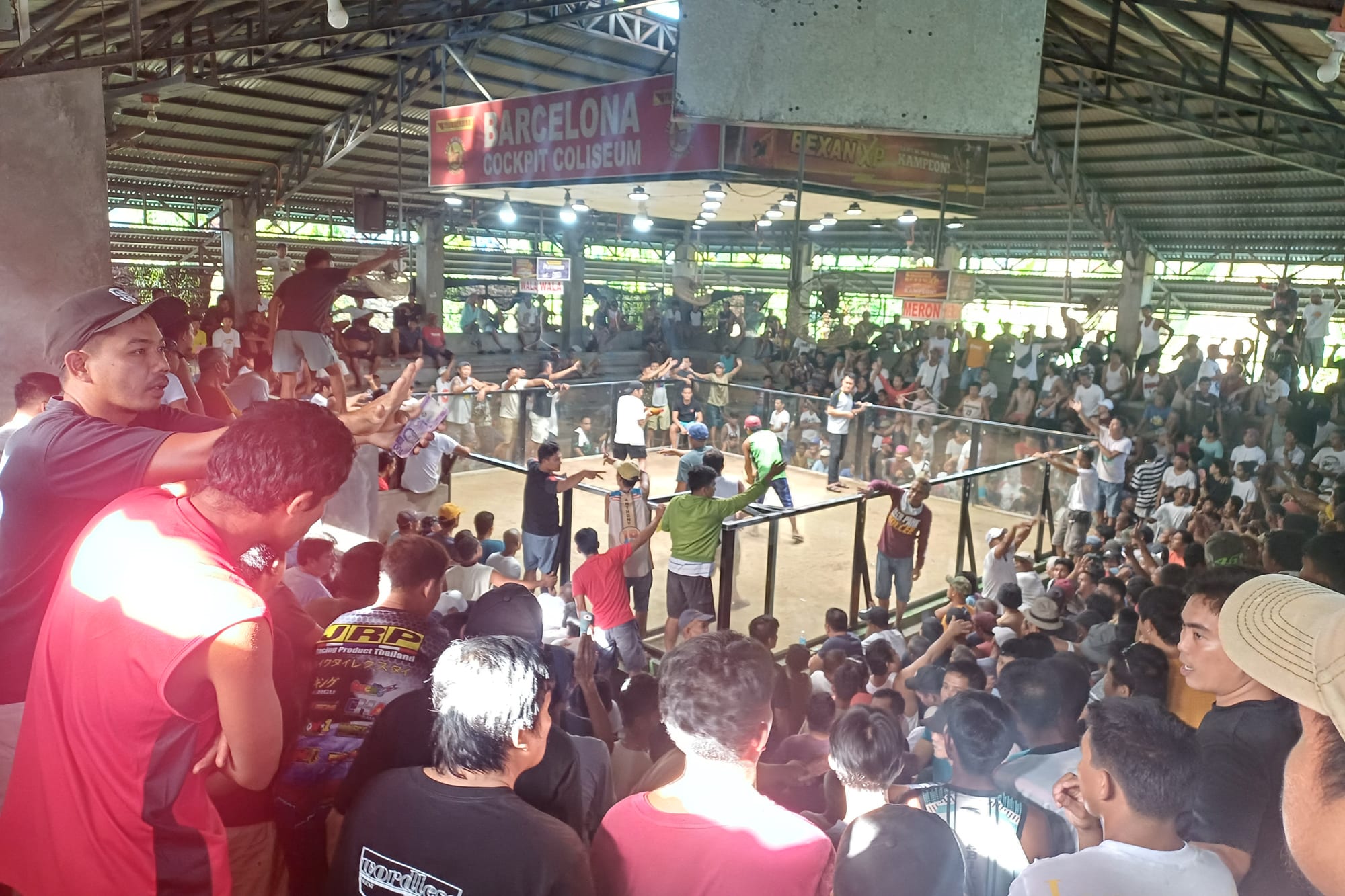
When an aficionado loses a fight, he says, “Pyerde an manok,” from the Spanish pierde. When the rooster wins, it is “Gana an manok,” from the Spanish ganar.
That imprint survives in the local language through words like asukar (sugar), kubyertos (cutlery), labakara (face towel), antipara (eyeglasses), and hurar (to register for elections).
In the local tongue, kubyertos does not mean cutlery in general, but specifically a fork — as in: “Haen an kubyertos kay kutsara hamok ini?” (“Where’s the fork? There’s only a spoon here.”)
When something is new or newly talked about — like the latest phone model — one would say, “Estudyare daw ini,” meaning “Check it out” or “Look into it.”
Among older generations, one could still hear expressions such as “apesar,” likely derived from the Spanish phrase a pesar de (“despite” or “in spite of”), but adapted into local speech patterns.
“Apesar na mauranon, nagpabungto pa siya.”
(Despite the rainy weather, he still went to town.)
The phrase render kwenta could also still be heard today. Since there is no standardized written tradition, the spelling here follows local pronunciation. The phrase may have roots in the Spanish expression rendir cuentas, which means “to give an account” or “to be accountable,” though its exact origins remain uncertain. In the town, however, the phrase carries a different meaning — “as a result” or “consequently.”
“Nagparabulad siya sa sudang. Render kwenta, kinalintura.”
(He stayed under the sun. As a result, he developed a fever.)
But among younger generations, these local expressions already appear to be fading, as many now feel awkward using them in everyday conversation.
Despite generational changes in language, younger people in the town still use words with Spanish roots in everyday speech. One example is “abredo” (from Spanish abrir, “to open”), as in “Abredo an pinto” (“The door is open”).
They also casually use “abre lata” to refer to a can opener, often without perceiving these expressions as foreign or unusual. Younger generations do not feel awkward using words like “abredo” and “abre lata” in everyday conversation.
In public speeches by local leaders, especially politicians — both old and young — words with Spanish roots still echo. Spanish-derived terms continue to surface in public discourse, reflecting how Spanish linguistic influence remains embedded in everyday speech and civic language. Politicians, in particular, seem to be among those who continue carrying these Spanish-rooted expressions into public life.
Examples from localized speech:
“Mag-participar kita sa eleksyon sa aga.”
(“Let’s participate in the election tomorrow.”)
“Salamat sa pag-elegir niyo sa ako.”
(“Thank you for electing me.”)
“Magsunod kita sa ley.”
(“Let’s follow the law.”)
“Igalang ta an derechos san kada sayo.”
(“Let’s respect one another’s rights.”)
The town proper also echoes Spanish influence. Its three barangays are named Poblacion Norte, Poblacion Central, and Poblacion Sur.
Spanish influence lingers even in the names of some villages. Among the town’s barangays are Luneta, meaning “little moon”; Alegria, meaning “joy”; Fabrica, derived from the Spanish word for “factory”; and Lago, meaning “lake.”
More than 600 kilometers southeast of Manila by land travel, the town of Barcelona in Sorsogon covers 25 barangays across coastal and upland communities.
The natives called the place Danlog before.
The language never became Spanish. But traces of Spain remained—thriving in memory, streets, cockpits, marketplaces, and the speech of people who no longer notice where the words came from.
ALSO READ:
The Contentious Origins of Bicol Express
The Secret Places in Bicol Only Locals Know About
Oliver Samson is a Philippines-based journalist covering environment, church, and social issues. His work has appeared in Global Sisters Report, Radio Veritas Asia, World Mission, and other publications.
View More Articles About: