

The Contentious Origins of Bicol Express

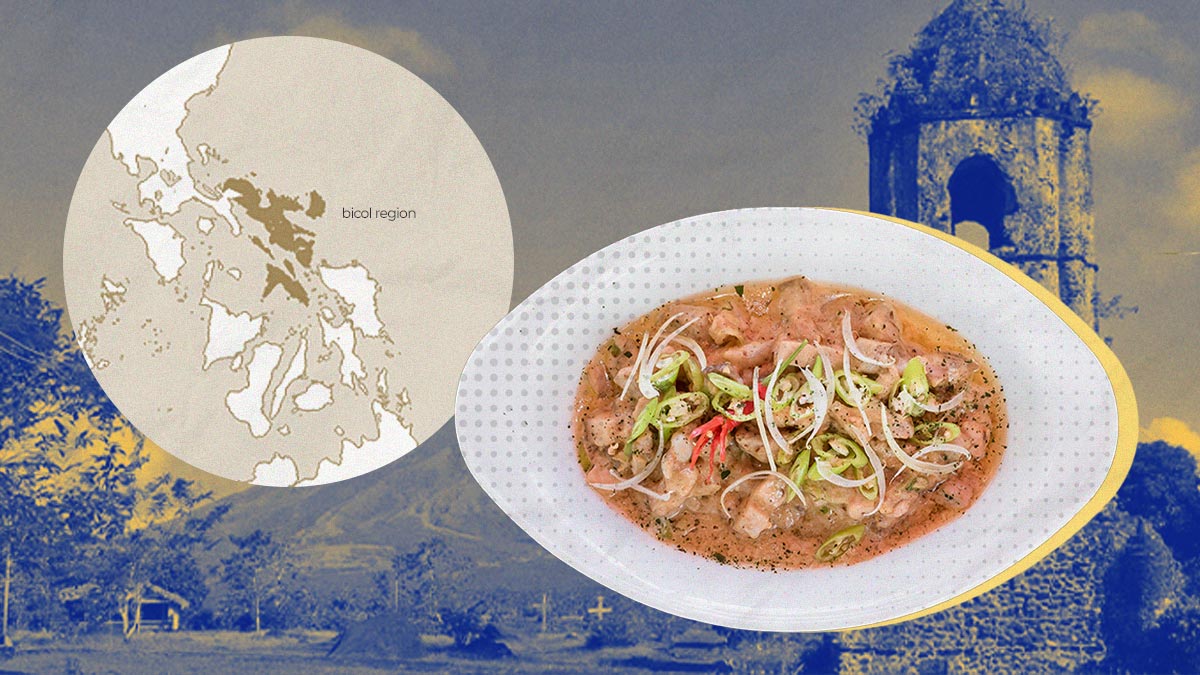
Like many of our most notable cuisines, Bicol Express' history is strongly tied with legend, folktale, evolving sensibilities, and regional pride. A stew traditionally made with pork, gata, balaw, and siling labuyo, the dish, of course, is famously ascribed to the Bicol region. If we sift through the narratives of its origins, we'll find that it's a lot more complicated than we realize. Suffice it to say, we've had plenty of theories, and we still aren't exactly sure which one to believe. Most of them, we may argue, do have some truth to them.
One such narrative of its origin story, which would be one of the more common ones, is that Bicol Express' name is attributed to a Laguna native who grew up in Bicol and moved to Manila. Bicol Express owes, not necessarily its name, but its popularization to a woman named Cely Kalaw.
Growing up in Naga City, Kalaw was said to have been heavily influenced by the spicy coconut milk-infused flavors of the region. So much so that it would lead to her own creation during her cooking competition days in the '60s, aptly naming it Bicol Express, based on the PNR train route from Manila to Legazpi. Kalaw owned a restaurant in Malate, Manila at the time. There, she served laing, another coconut milk-based dish with taro leaves. From there came Bicol Express. Hence, the dish's reemergence in contemporary Filipino cuisine.
Coincidentally, even before there wasn't a moniker for the dish yet, locals in the Bicol region were said to have already been making and selling a similar dish at the Sipocot station, Camarines Sur. They would sell it to passengers on trains, stored in plastic bags and wrapped in a bundle of taro leaves, whenever they made their stop. Unfortunately, trains would start prohibiting selling and buying on PNR train lines. Kalaw would then take it to new levels of fame in Metro Manila and beyond.
Bicol Express, we meet again.

ALSO READ:
The Convoluted Histories of Mechado, Afritada, Menudo, and Kaldereta
The Fascinating History of Kare-kare
She is maybe better known as a brander to some people though. If we track old legends, we'll run into another theory that posits that Bicol Express is derived from an Indonesian dish Malay traders brought to the region more than 2,000 years ago. Given the similarities (heavy use of coconut milk in Indonesian food), it's not a stretch to say that gata-heavy dishes are an export that we've grown to own and redefine in our cultural identity.
We could also say that Bicol Express' roots come from a similar Ilocano meal called gulay na may lada, which was common in the region. It sort of possesses the same gata-ridden recipe, only with vegetables. Components like pork and shrimp paste would be added by Bicolanos. With it was the inclusion of the native siling labuyo in Bicol (it's far spicier than other varieties in various regions, after all). Likewise, the Bicolano's ginataang sili, another local delight, may well have just laid the foundation for Bicol Express.
Perhaps the dish is just a culmination of decades of Bicolano cooking and its attached influences and topography. It makes sense that we associate Bicol Express with the Bicol community because of the abundance of coconut and chili peppers in the region. Bicol has more than 50 million coconut trees because of its suitable wet conditions.
Meanwhile, the region has some of the spiciest peppers in the Philippines; the most notable of which, siling labuyo, was introduced by Spanish settlers a few centuries back. In Bicol, their supposed Scoville Heat Unit for their peppers ranges from 50,000 for siling haba to 100,000 for siling labuyo. Bicol Express from Bicol just hits different, we suppose.
Rica Buenfalor, who established the non-profit group Best of Bicol, collaborated with Chef Margarita Fores in 2018, to reintroduce Bicolano recipes to Manila. According to her, what primarily attracted Fores to the idea of reimagining Bicolano cuisine is the fact that it is “one of the most unique in the country and the most authentic in the sense that it has the least influence from our colonizers.”
Sure, its origins are still contentious. Much of our dishes' origins are. Legend, of course, has a way of distilling truth sometimes. But one thing is for certain: Bicol Express is an inherently distinctive Filipino dish. And at the very least, maybe that's something we can all agree on.
