Diving for Gold: Seabed Mining in Panaon Island
In a remote village in the town of San Ricardo in Southern Leyte, a small group of miners braves the sea every day in pursuit of gold and survival.
by Jeric Olay
Published on Feb 19, 2026
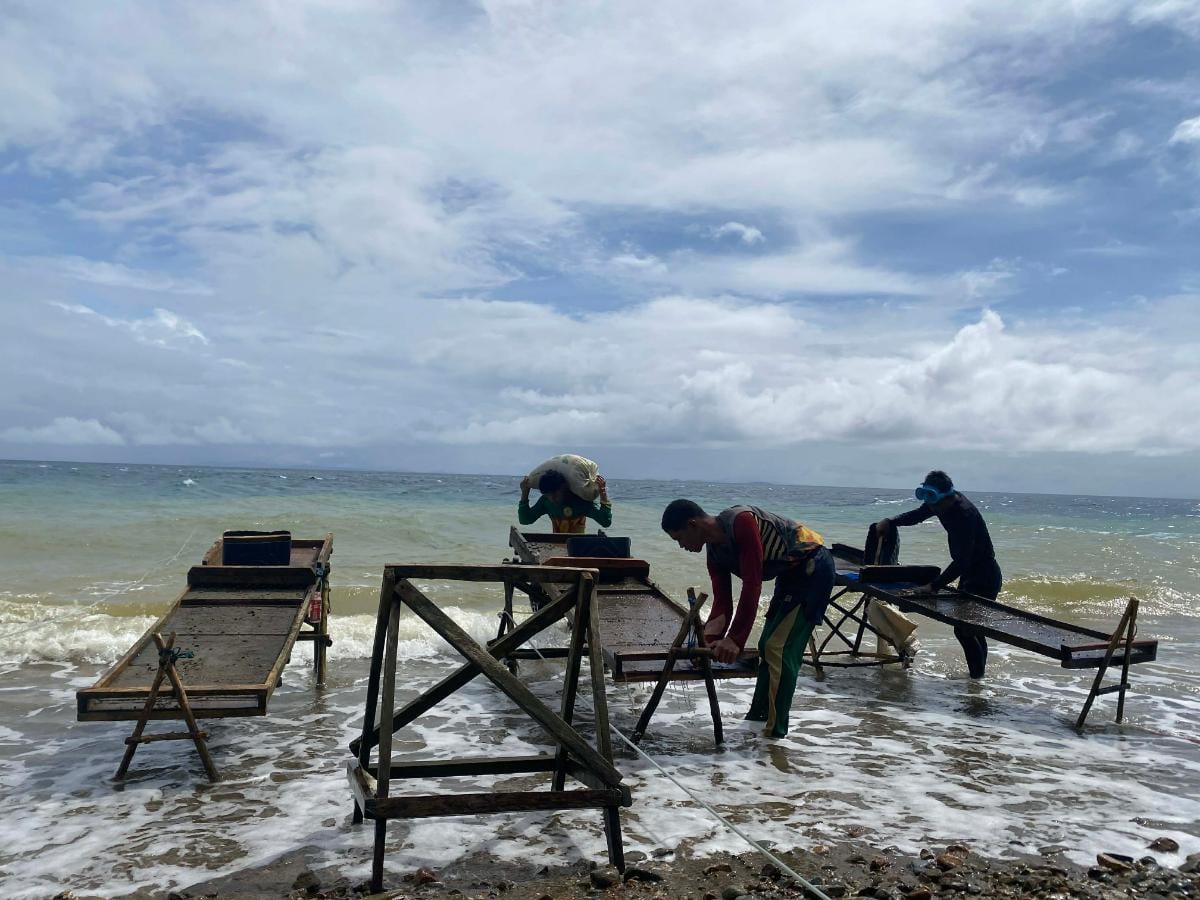
If you boarded a provincial bus and chanced to pass through this part of an isolated village, you might ask why several people were congregating or lining up on the beach. You’d notice some of them pouring gravel onto wooden structures along the shoreline and hear the throb of an engine. Only then would you realize they were not there waiting for a fishing boat carrying its regular catch. Something unusual—if not illicit—was going on here, you might surmise. And you’d be right.
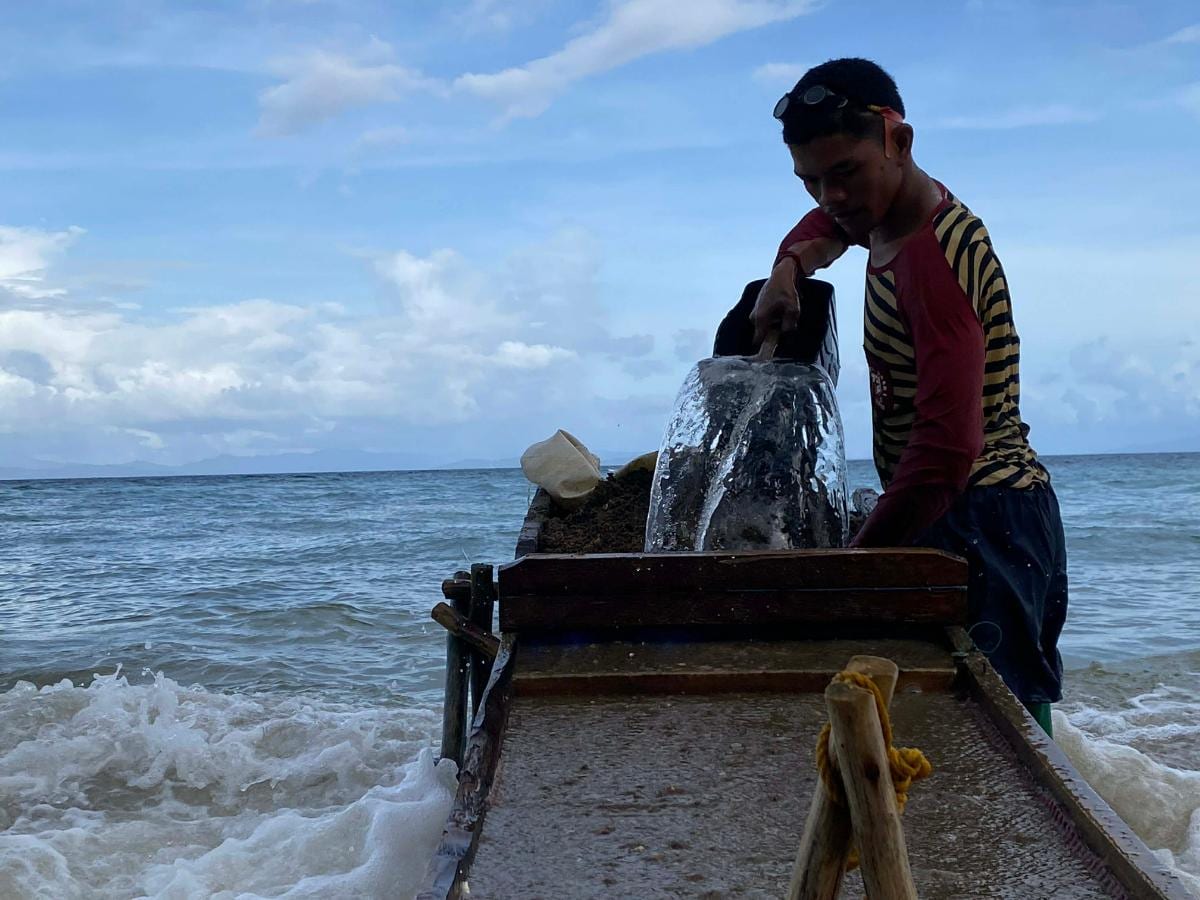
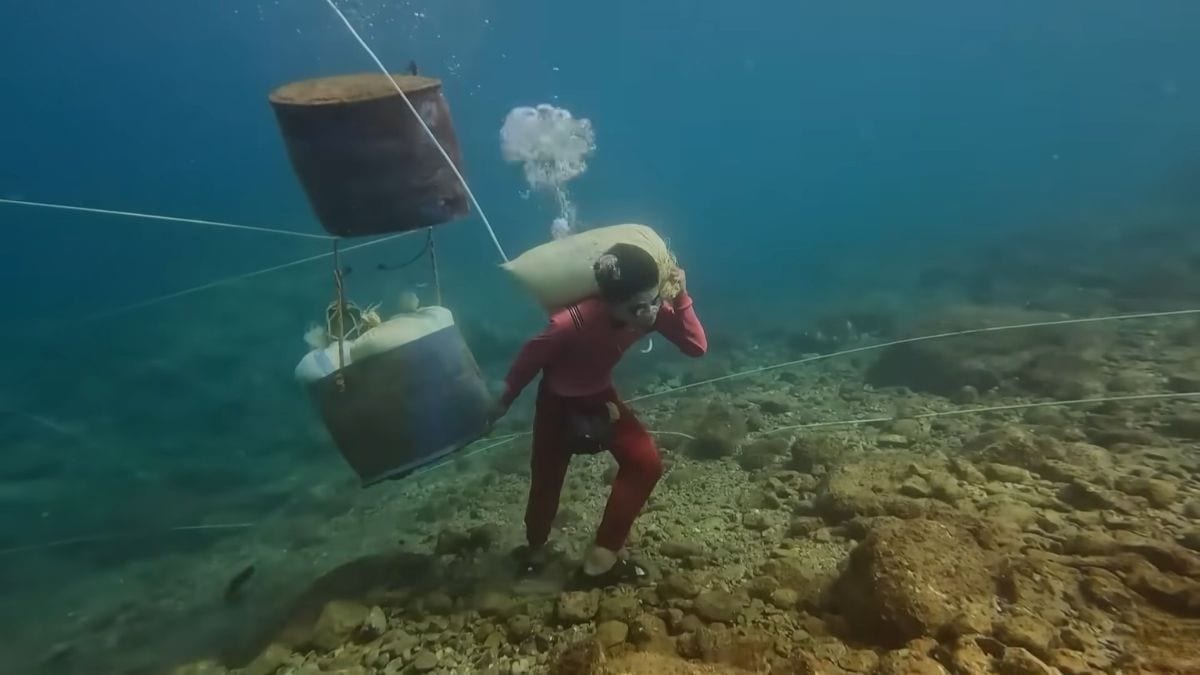
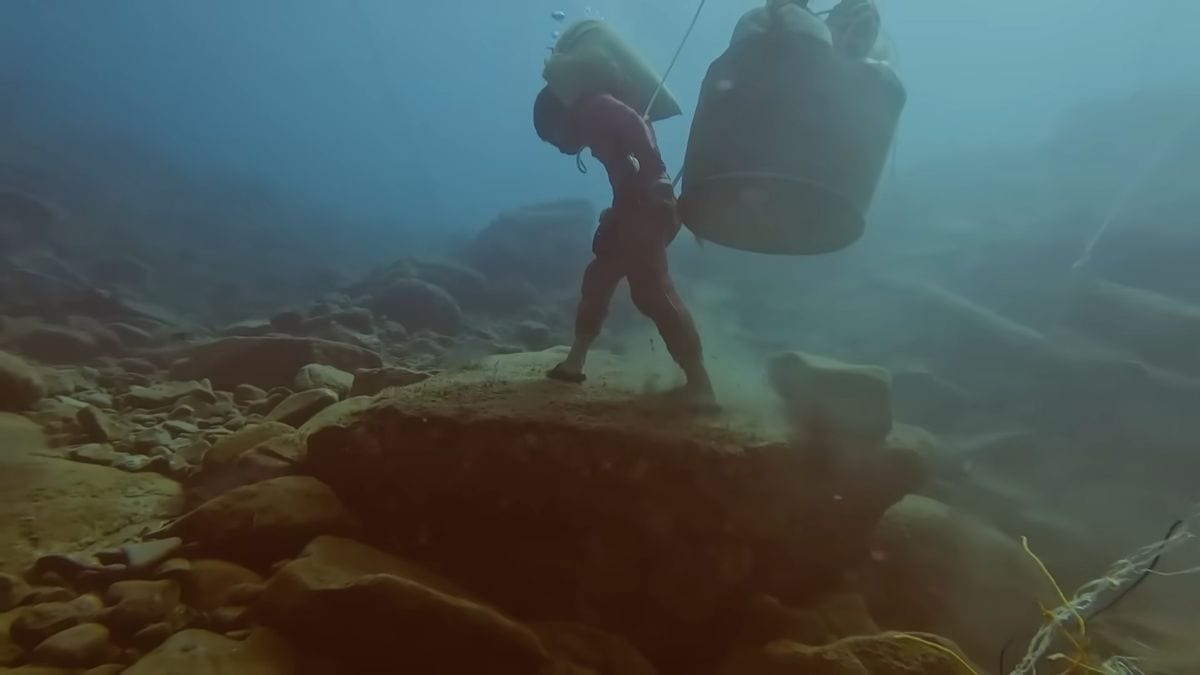
What really transpires in the area is seabed mining. The wooden structures are sluice boxes, and the throb comes from a diesel compressor supplying air through narrow hoses to miners shoveling gold-bearing sediments from the seabed.
This community-driven mining takes place in a remote village in the town of San Ricardo, on the southeastern side of Panaon Island in Southern Leyte. Mining in this village spans several decades, but in the past, it was performed on land by large companies such as Benguet Exploration Inc., which operated in the 1980s.
Over the years, however, rock formations containing the precious metal became scant, prompting all firms to vacate. The only remnants they left were the ubiquitous shafts and tunnels. Since the closure meant no job for the hired local miners, they scavenged other spots and later discovered placer gold on the beach, which went further into the shallow water.
Life Beneath the Tides
The discovery generated another gold fever, enticing miners from the northernmost provinces of Mindanao. One of them goes by the name Severino. He is a veteran in the field. Nicknamed “Sever,” he migrated from Surigao City in Surigao del Norte more than a decade ago and settled in this village because gold translates to wealth, which, according to him, is decidedly hard to resist.
Since his arrival, he counts himself among some 50 or so locals who throng the shore most days for the extraction process. Sever, despite being a senior citizen, takes on the role of a diver. At 65, he is sturdily built, his muscles shaped perhaps from years of labor.
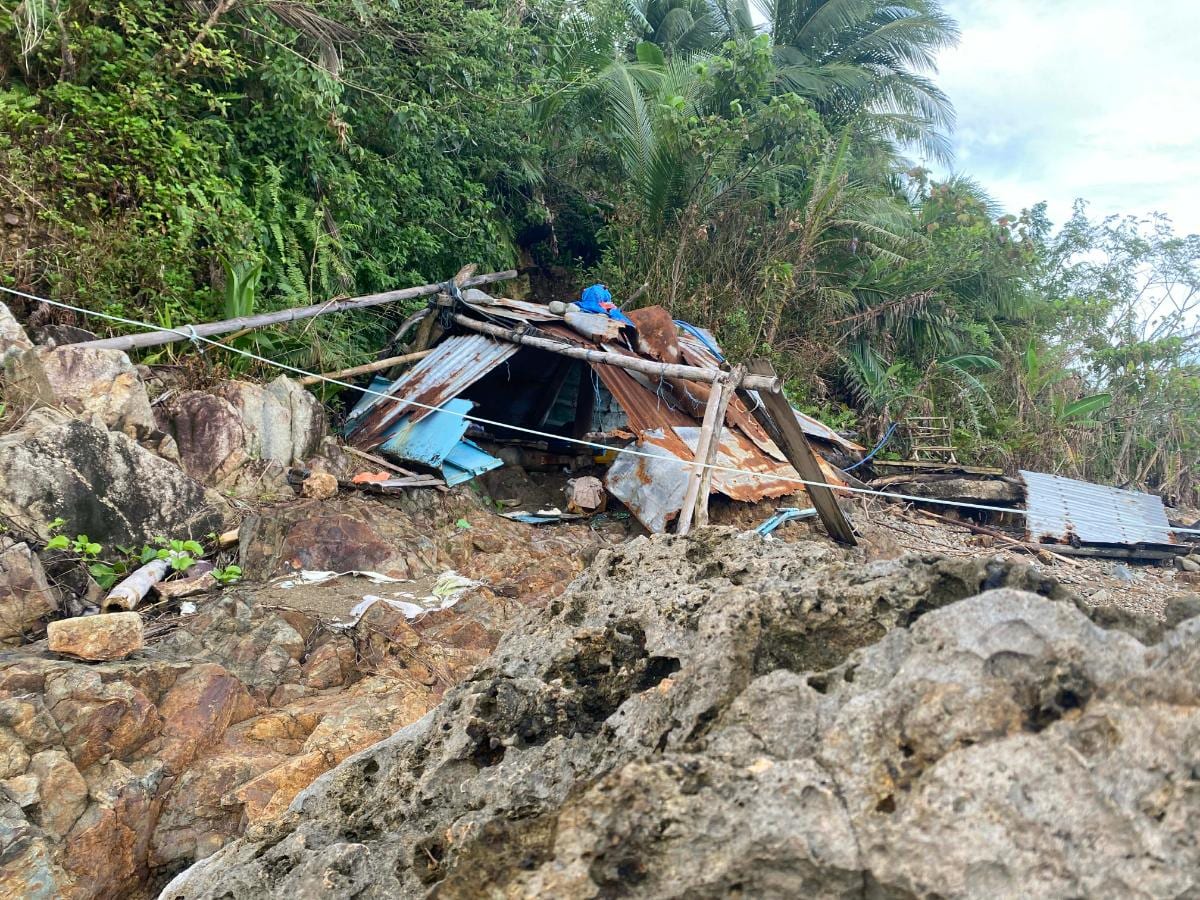
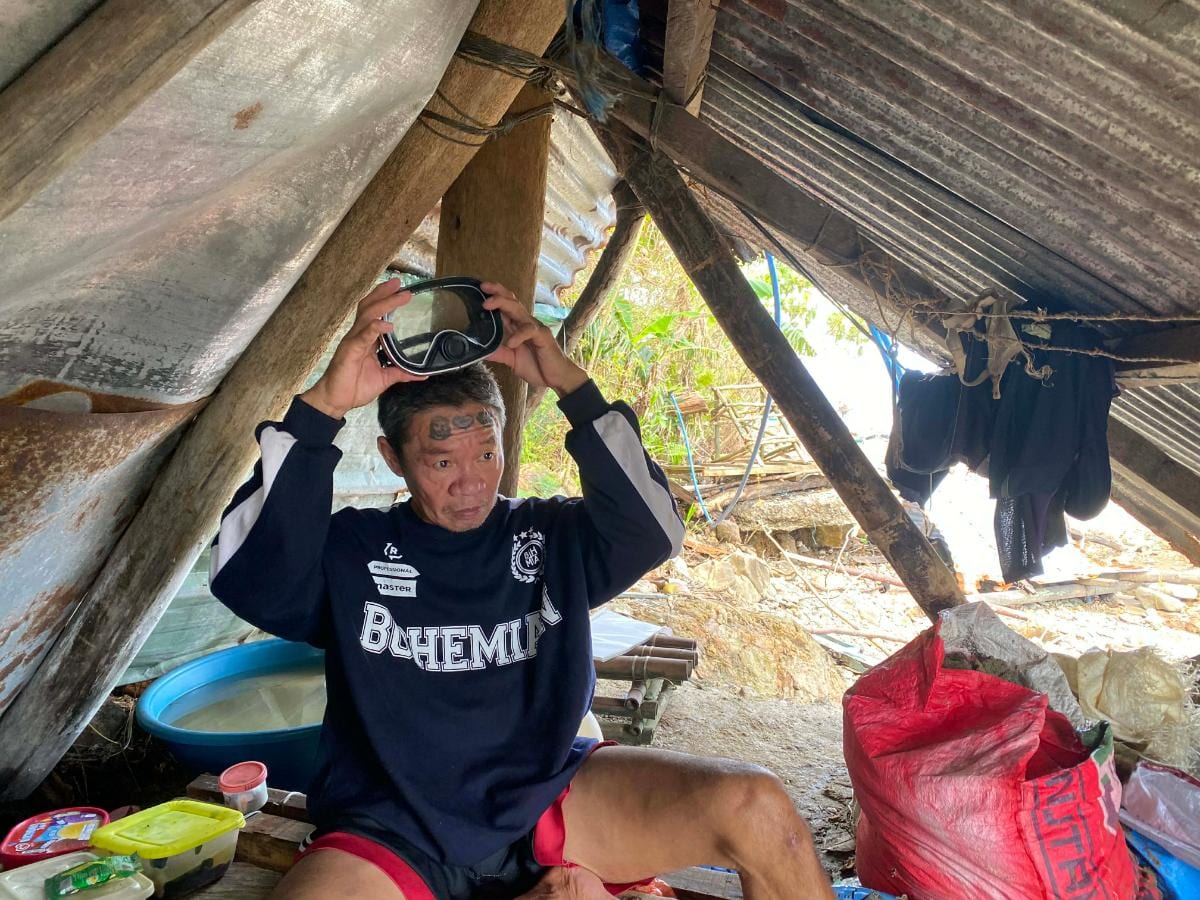
I first saw him sitting in his dilapidated hut perched on a rock. He was deep in his thoughts. As I was approaching, Sever looked at me with a flat expression. His most telling feature was the tattoo on his forehead, where one might misjudge him as a former member of a purok gang.
Because of the tattoo, villagers gave him the cognomen “Patikan.” Patik means tattoo in the local language. It’s a timaan, or “marker,” he explained, that confirms he was baptized as a member of a sect in the town where he was born and raised. The group is a cult, I wanted to clarify, but I kept it to myself, afraid he might take offense since the term is taboo in our country.
I took a closer look at his forehead. There were three major imprints on it. One is an image of Jesus, the second a heart, and the third a rectangle that encloses the initials JM, or Joseph Mary.
More than a marker, the tattoo, according to Sever citing the dogma of his group, provides the bearer immortal life. Regardless, he still carries a small container of pills for times when he might catch a cold or suffer fatigue from too much work. When I asked if he had any minor or serious respiratory problems, he said, “Thank God, none.”
He was in his hut for a brief rest after hours spent underwater.
The Daily Grind
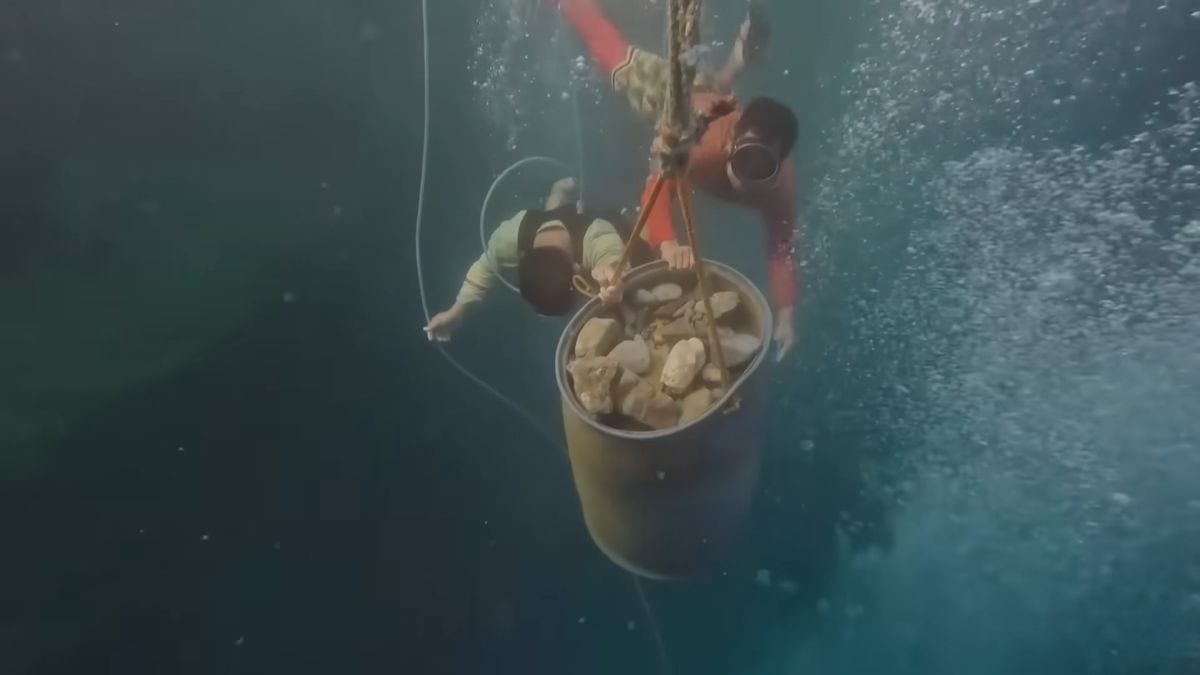
On a working day, Sever dives three times, two hours per dive. He wears thick sweaters, adds another layer of tank top to avoid the risk of hypothermia, and dons a handmade mask to see through the muddy water. The mine is estimated to be ten meters deep. For him to submerge to the bottom, he straps a piece of wood—or sometimes a heavy stone—around his waist. The air-fed hose becomes his lifeline, and if it is cut or the noisy machine on the shore encounters mechanical failure, his life is at stake. While at the seafloor, he digs and scoops sediments using his square shovel onto the sacks. He needs to fill five before supplying air into an improvised drum to lift the loads to the surface easily. If there’s anything he fears, it is the rocks around the mine burying him alive or getting cramps. In my mind, I said, maybe in this kind of labor, gender matters. But there were adult women divers, too.
Every day, Sever experiences such harsh conditions. The wealth he imagined back when the gold fever hit the village remains out of reach.
In the middle of our conversation, he showed his Class A watch and smiled broadly, revealing his incomplete upper teeth. “If you think I had jewelry forged from my own harvested gold, you’re mistaken,” this time he laughed.
He earns little, barely enough to feed his family and send his two children to school, one in high school and the other in elementary school. His technique is to wait until his gold harvest reaches one gram, selling it for 4,400 pesos. While waiting, he will ask the gold merchant, who also happens to own a retail store, for some groceries on credit. If there is any amount left from his usual cash flow, or if he has saved, he buys mining paraphernalia at Visayan Marketing in Surigao, his birthplace, less than a two-hour boat ride from Benit Port in San Ricardo. But this rarely happens.
“I don’t have a house I call my own,” he said softly, implying that the greatest investment of his life would have been building one. In 2021, Super Typhoon Odette (Rai) barreled through the island and destroyed his home. Ever since, 15 families, including his own, have stayed at the evacuation site, an abandoned national high school.
Law and Limits
For miners like Sever, meager income and dangerous working conditions might be at the core of their story, but the very nature of the industry is just as important.
The site is 300 meters from the cluster of homes. Miners only occupy a small expanse, and, according to divers, the water is devoid of marine life. However, labeling the mining as artisanal, simply because no heavy machinery is involved, or describing it as low-impact, or using any other euphemism, does not legitimize it. “I know, but I couldn’t think of any other job. I don’t have land to till or livestock to raise,” Sever conceded.
In the previous year, the national police, no matter how far the place was from the provincial or regional office, made several crackdowns to discourage the village miners from their activity. “Those were after some vloggers had documented the underwater mining,” Sever suspected. So it became clear to me why he and his fellow miner gave me skeptical looks and were uncommunicative at first. They thought I was there to take videos and broadcast them on social media.
Authorities seized their prized compressors. What became a saving grace was the strategic location of their working site, because officers had to make their way downslope, only to discover that the miners had already outrun them to either side of the shore. But for the unlucky ones, they were asked to pay, according to Sever, a hefty P30,000 in exchange for their freedom.
According to the Mines and Geosciences Bureau, the local miners cannot obtain a permit because the revised IRR of the Philippine Mining Act of 1995, the country’s primary mining legislation, explicitly bans mining activities in “offshore areas within five hundred meters from the mean low tide level.”
Another obstacle to their livelihood is the recently signed Republic Act No. 12238 designating the marine waters around Panaon Island as a protected seascape.
Mr. Baco, MGB’s science researcher, said that Sever and other miners working in the seabed mine have a choice: find a plot away from the shore and process the Environmental Compliance Certificate (ECC) and other necessary papers for it to be recognized as a Minahang Bayan or People’s Small-Scale Mining Area. Only in this approved area are they allowed to extract minerals.
But Sever showed no interest. “The process is time-consuming, difficult, and costly,” the old man said.
He also added that if big companies had stopped drilling the land area of the village because the deposits were depleted, and, for the record, no new company has applied for a new exploration permit, then why waste one’s energy digging using only traditional equipment?
The government will, of course, continue its crackdowns. “It is expected because our small activity is branded an outlaw,” he said.
At the end of our conversation, Sever was preparing to dive.
The possibility of death always lurks underwater, but much of his confidence, I’m convinced, comes from his faith in the “divine” promise he associates with his forehead tattoo.
Jeric T. Olay is a teacher, poet, and opinion writer born in Macrohon, a small town in Southern Leyte.
View More Articles About: