

Today I Learned: One of the Country’s Largest Gold Mines is in Nueva Vizcaya

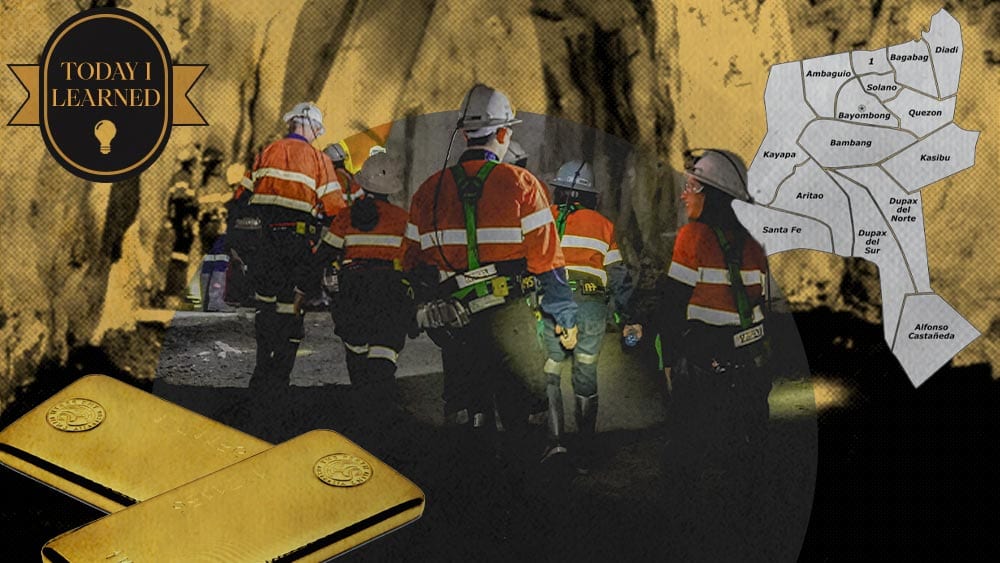
The fastest way to get to the municipality of Kasibu in Nueva Vizcaya is to take an hourlong flight from Manila to Cauayan, Isabela and then take a three-hour drive south. The alternative is to drive six hours or more, passing through multiple cities and provinces, including Bulacan, Pampanga, and Pangasinan.
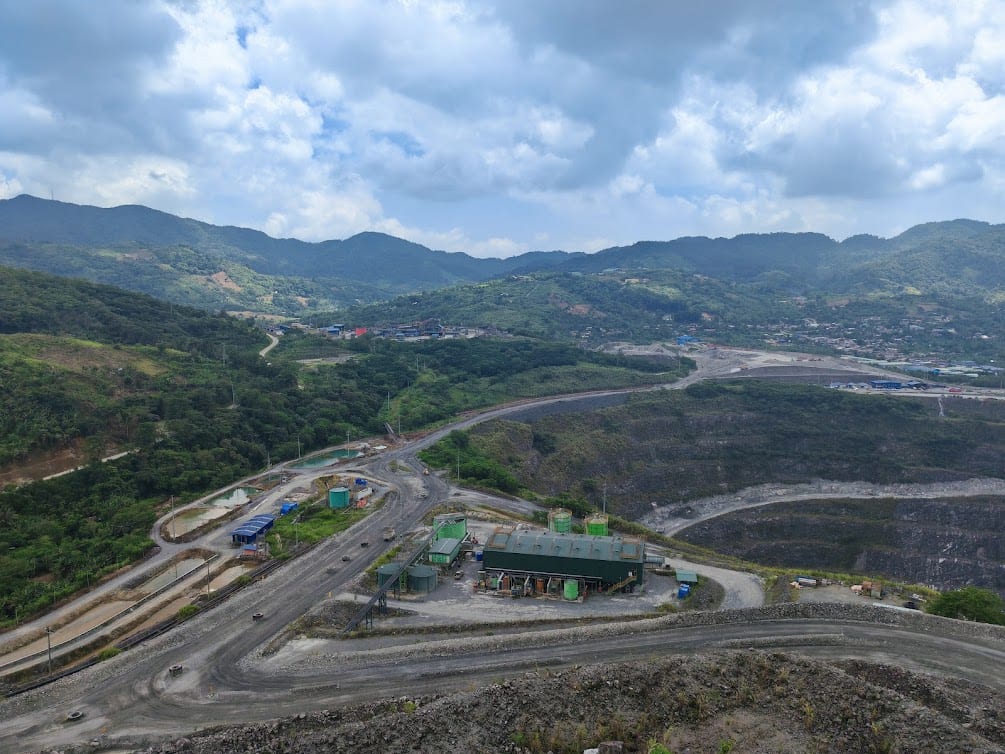
Kasibu is a sleepy municipality that is home to geological wonders like the Capisaan Cave and the Lintungan Falls. But the town is perhaps best-known as the home of the Didipio mine, located in the namesake barangay that straddles the provincial line between Nueva Vizcaya and Quirino. The mine is special for being the country’s second largest producer of gold and copper in the Philippines.
A bird's-eye view of a portion of the Didipio gold mine in Kasibu, Nueva Vizcaya
In 2023, the Didipio mine reported total production of 138,500 ounces of gold, over 22 percent from the 113,200 ounces it mined in the previous year. That’s roughly 11,541 ounces of gold per month. On the other hand, copper production declined slightly to 14,200 metric tons from 14,400 it reported in 2022.
Thanks in large part to the operations of the mine, Barangay Didipio in Kasibu has been transformed into a slightly more progressive community, with a busy commercial area, and better work opportunities for its residents. However, as a mining company, questions and concerns linger about the long-term effects its operations have on the environment and the people living in and around the area.
ALSO READ
The Best Gold Watches Project Power and Elegance
A Gold and Copper Mine in the Philippines Is Reopening, But Protests Against It Continue
History of the Didipio gold mine
Gold was first reported in Didipio in the 1970s. By the mid-1980s, a local geologist made extensive explorations in the area and, by 1989, private companies entered into more formal partnerships to further conduct exploration programs. The Philippine government first granted the Financial or Technical Assistance Agreement (FTAA) for the Didipio mine in 1994. Two years later, the company was officially incorporated as Australasian Philippines Mining Inc., which later changed its name to OceanaGold Philippines Inc (OGPI). This company, is, in turn, a subsidiary of the Canada-based OcenaGold Corp.
The FTAA, which was initially valid for 25 years essentially granted a private company exploration and mining rights within a fixed time period, and share the revenues with the government. The FTAA with OGPI was renewed for another 25 years in July 2021, although the new agreement officially commenced in 2019.
Entrance to the mine
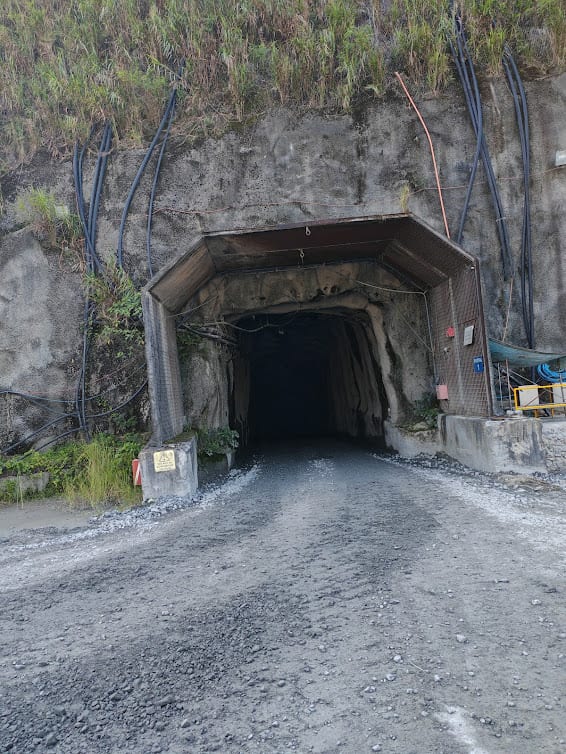
The government and OGPI split the revenues of the mine 60-40, with the majority going to the government. Commercial production began in 2013. Didipio mine initially operated as an open pit mine until it shifted to underground operations in 2015. Between 2012 to 2023, approximately 2.3 million ounces of gold and about 315 kt (thousands of tons) of copper were extracted from the mine. The gold is then sold in the world market through ABC Refinery of Australia.
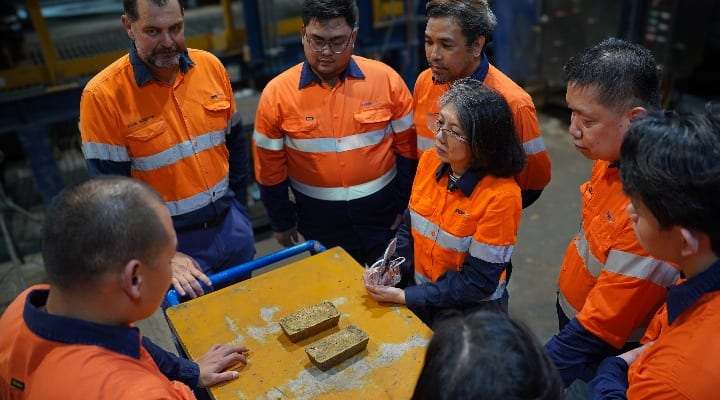
Interestingly, OGPI is required to sell at least 25 percent of its annual doré (or the unrefined alloy bar it produces onsite) to the Bangko Sentral ng Pilipinas (BSP). On average a typical gold doré bar contains 50 to 75 percent of pure gold. In 2023 and 2022, the company sold 12,865 ounces and 9,453 ounces of gold to the BSP, respectively. This is equivalent to 26.8 percent and 27.89 percent of its total gold production for the covered year, exceeding the 25 percent minimum requirement of the FTAA.
According to the company’s own financial reports, the Didipio mine is a “highly profitable and cash-generative” mining operation, generating free cash flow of $113.1 million (about P6.3 billion) in 2022 and $110.2 million (P6.1 billion) in 2023. Total revenue for the full year of 2023 was at $371.1 million (about P20.7 billion), up from $308.7 million the previous year.
Earlier this year OGPI launched a successful initial public offering, raising about $106 million or about P6.08 billion. It was the first IPO in the Philippines Stock Exchange for 2024 and the first for a mining company in 12 years.
OGPI estimates that the Didipio mine’s total measured and indicated resources include about 60 million tons of ore with about 1.03 g/t (grams per ton) of gold and that its estimated mine life, or the underground mine and processing of stockpiled open pit ore, will last until 2035, although an extension is possible.
Inside Didipio Mine
Visitors to Didipio mine are checked into a modern camp that has all the features of a regular hotel—comfortable bedroom, toilet and bath, TV, access to Wi-Fi, and turn-down and cleaning services. There is a mess hall where all meals are taken, and food options are often divided between typical Filipino cuisine and Western fare, to cater to the palates of the expats who also work at the facility.
Mine operations are 24/7
Besides the camp, the Didipio mine facility includes a tailings storage facility (where materials left over are processed and stored), workshops, a water treatment plant, paste backfill plant and ore processing facilities. The entire mine covers an area of about 7,750 hectares.
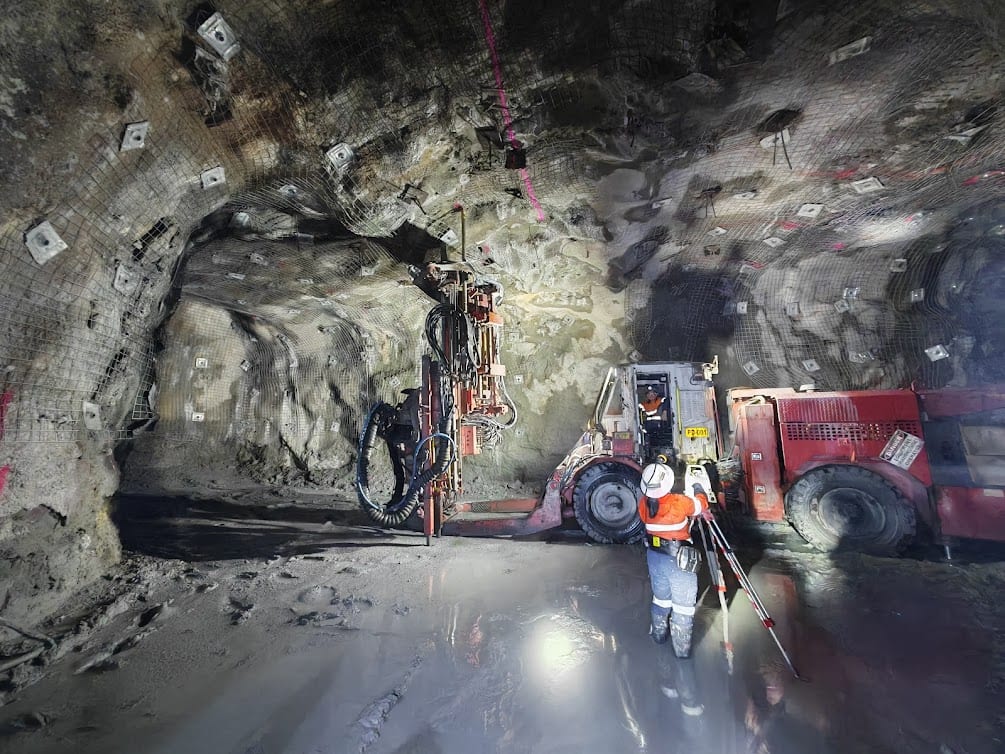
The mine operates 24 hours a day, seven days a week, with workers often completing 12-hour shifts. There are some 3.5 kilometers of roads inside the underground mine, which reaches a depth of about 501 meters.
Anyone not used to entering an active mine might experience feelings of panic or anxiety when they begin the descent onboard special off-road minibuses, but officials say they have instituted numerous measures that make the Didipio mine as safe as possible. This includes constant monitoring of oxygen and carbon monoxide levels inside the mine, emergency escape hatches, several refuge chambers equipped with life-saving features and amenities that staff and crew members can use until they are rescued, numerous safety drills, and many others. In fact, in 2023, the Didipio Mine was awarded Safest Underground Mine for the past two years at the Annual National Mine Safety and Environment Conference (ANMSEC), and was a runner-up in the safest mineral processing-concentrator category.
However, it’s worth noting that, in June this year, just a couple of weeks after Esquire Philippines’s visit, OGPI reported a fatality at the mine. A worker was found unresponsive near the paste plant. The company did not provide further details about the incident except to say that mine operations were suspended for 24 hours while an investigation was conducted.
A gigantic processing facility for the extracted ore

OGPI officials have also highlighted the mine’s strict adherence to environmental laws and how it is limiting its impact on the area’s ecosystem. One proof of this is the manmade lake formed near the water treatment facility built to treat the TSF outflow. Officials say that clear proof that the lake is healthy and free of pollutants is the presence of migratory birds and other animals in the area. Building the water treatment plant and the consequent outflow of water that was then reintroduced to the area’s natural landscape was a complicated and, no doubt, costly endeavor, but one that the company says was worth it to ensure that the mine operations pose as little harm to the environment as possible.
Still, OGPI and Didipio mine aren’t totally immune from controversy. Some residents of Brgy. Didipio and other nearby barangays have been protesting the presence of the mine for years, accusing them of destroying the once pristine landscape in this part of the province, as well as displacing numerous residents through evictions and demolitions of community homes in the area. The website MongAbay.com has written an extensive piece detailing the issues against Didipio mine and OGPI. There have also been protests from the communities around the mine in Nueva Vizcaya and Quirino that have been going on for nearly two decades, particularly from indigenous communities.
Even the Special Rapporteur of the United Nations Office of the High Commissioner on Human Rights wrote to OceanaGold to inquire about alleged human rights violations against the IPs in the area. Police also reportedly evicted around 180 families from their homes in June 2008.
Gold doré produced inside the Didipio gold mine. Each one is worth about $500,000
But OGPI has at least one powerful official on its side. Brgy. Didipio chairman Henry Guay has established cordial relations with the mining company, which supports its host barangay and other communities in both Nueva Vizcaya and Quirino with multiple social projects. Last April, OGPI turned over a new administrative building and health center for the barangay worth P2.5 million, which the barangay said is part of the company’s commitment projects under the memorandum of agreement signed in 2013 between both parties. The company has also assisted the barangay, which has a population of about 4,000 residents, with things like roads, school buildings, and a water system for the community.
OGPI also remitted a total of P1.1 billion to the government last April as part of its FTAA addendum and renewal agreement. This is on top of the top of the costs, taxes, duties, fees, and other expenses already paid by OGPI to the government.
Indeed, a casual stroll along the main commercial area of Brgy. Didipio, which is located just outside the gates of the mine’s compound, reveals strong support for OGPI and the presence of the mine. Most of the residents we talked to said the mine has generally been good to the community and to the municipal and provincial governments as a whole.
There’s no denying that mining as an industry is far from being a black-and-white issue. It undoubtedly plays a pivotal role in the country’s economy and is of enormous benefit to many sectors of society. On the other hand, there are far too many stories of huge mining corporations that have bulldozed their way to immense profits, with little regard to the feeble and powerless they hurt and obliterate along the way. One can only hope we can eventually find a middle ground where precious natural resources are extracted responsibly, and their riches distributed equitably to as many stakeholders as possible.
