

Today I Learned: The Bangko Sentral ng Pilipinas Sold the Most Gold Worldwide in the First Half of 2024


The Bangko Sentral ng Pilipinas has reacted to this story. Read the statement here.
Just how valuable is gold nowadays?
As of August 2024, gold topped $2,500 (about P140,000) per ounce for the first time in history. That means a large, 400-ounce gold bar is worth around $1 million. The precious metal has never been more valuable, with its price steadily rising over the past few years. In fact, as of Friday (September 20), the price already went up to about $2,636 per ounce.
Gold has traditionally been seen as a safe haven asset, or a commodity that’s low-risk and highly liquid. This is why many sovereign countries have kept huge gold reserves; according to most investment professionals, gold has proven to be a hedge against inflation, preserving the real value of assets when other prices rise. For central banks, gold is also a stable asset that provides a safeguard in times of financial crises and market volatility.
ALSO READ
Today I Learned: One of the Country’s Largest Gold Mines is in Nueva Vizcaya
Consequently, many countries make it a point to fatten up their gold reserves by purchasing gold elsewhere. But which ones are buying and selling the most golds?
Online brokerage aggregator BestBrokers tracked the gold purchases of countries reporting their activities to the World Gold Council to see which ones have been producing and selling the most gold and which have been building their reserves.
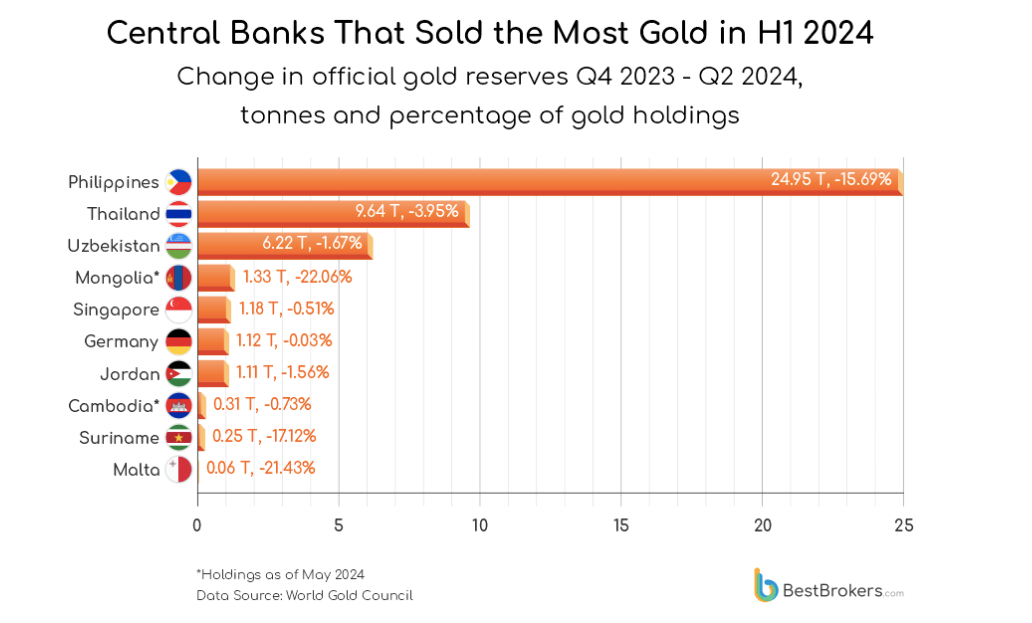
For the first half of 2024, the Philippines was found to have sold the most gold among all the reporting countries. While the country’s gold reserves increased by 1.33 tons last year, the country sold nearly 25 tons between January to June, decreasing the country’s reserves by 15.69 percent to just 134.06 tons.
The Philippines is also a gold producer and the Central Bank is required by law to purchase locally mined gold from miners in the country. For example, OceanaGold Philippines Inc., which operates the Didipio gold mine in Nueva Vizcaya, is required to sell at least 25 percent of its annual doré (or the unrefined alloy bar it produces onsite) to the Bangko Sentral ng Pilipinas (BSP). On average a typical gold doré bar contains 50 to 75 percent of pure gold. In 2023 and 2022, the company sold 12,865 ounces and 9,453 ounces of gold to the BSP, respectively. This is equivalent to 26.8 percent and 27.89 percent of its total gold production for the covered year, exceeding the 25 percent minimum requirement of the FTAA (Financial or Technical Assistance Agreement).
According to the WGC, gold reserves in Philippines averaged 187.99 tons from 2000 until 2024, and reached an all-time high of 274.42 tons in the first quarter of 2003. On the flipside, reserves reached a record low of 126.89 tons in the third quarter of 2007.
In 2020, the BSP said that it would shift to active gold trading amid the continuous rise of the prices of the precious metal.
“The BSP has been buying gold especially from small-scale miners and selling gold to the BSP has been encouraged in recent years,” Rizal Commercial Banking Corp. Chief Economist Michael L. Ricafort told Businessworld back then.
Besides the Philippines, other countries that have sold the most gold in the first half of the year are Thailand (9.64 tons or 3.95 percent of its total reserves), Uzbekistan (6.22 tons, 1.67 percent), Mongolia (1.33 tons 22.06 percent), and Singapore (1.18 tons, 0.51 percent).
On the flipside, the country that has built up its gold reserves the most in the first six months of 2024 is Turkey. According to the Bestbrokers report, the country that straddles Asia and Europe bought a total of 44.74 tons during the first half of the year, with June being the 13th month in a row of buying.
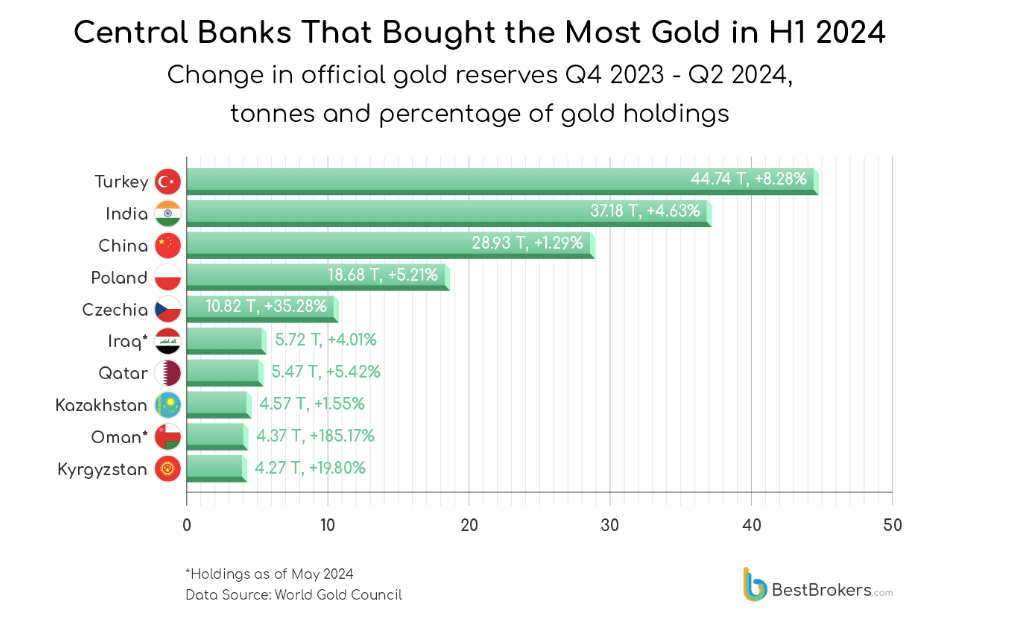
Second in the list is India, which added 37.18 tons within the first six months of 2024. In comparison, its central bank acquired only 16.22 tons of gold in the entire 2023, while for 2022, its purchases totalled 33.27 tonnes. Currently, the country holds 840.76 tons of the precious metal in its official reserves.
In third place is China, which acquired a total of 28.93 tons of gold in the first half of the year.
Other countries building up their gold reserves this year include Poland (18.68 tons or an additional 5.21 percent added to its official reserves), and Czechia (10.82 tons, plust 35.28 percent to its reserves.
To date, the country with the most known gold reserves in the world is the U.S.A. As of August 2024, the U.S. owns 8133.46 tons, which is roughly 72.41% of its total foreign reserve, based on prices at the time of reporting (June 2024).
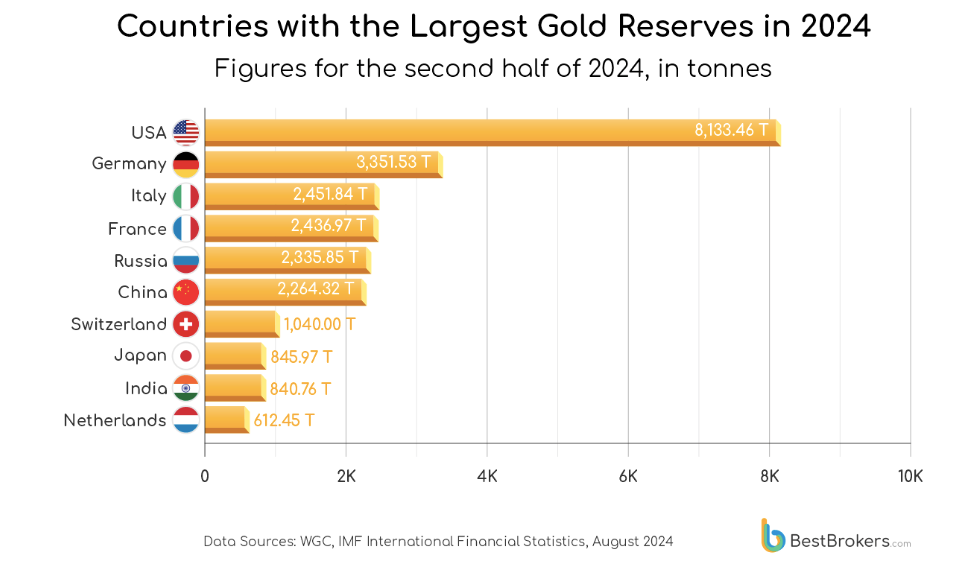
According to the Bestbrokers report, the other countries with impressive gold depositories, save for China, which holds roughly 2,264.3 tons of gold, are European. Germany ranks second (3,351.53 tons) globally for gold holdings, followed by Italy (2451.84 tons), France (2436.96 tons), and Russia (2335.85 tons), while China comes in sixth position.
