Japan and South Korea Remain Top Spring Picks for Filipino Travelers
Klook’s Spring Readiness Index shows how people are navigating cherry blossom season.

Published on Mar 12, 2026
As the 2026 cherry blossom season approaches, Japan and South Korea continue to dominate the travel plans of Filipinos. According to the latest Spring Readiness Index from travel platform Klook, these two destinations remain the primary choices for those looking to experience "time-limited natural spectacles." The survey, which polled 900 travelers across nine Asian markets, including the Philippines, highlights a fundamental shift in how Filipinos are approaching their spring vacations—moving toward intentional planning, multi-city itineraries, and a strong desire for guaranteed sightings.
Michelle Ho, General Manager of Klook Philippines, emphasizes that spring travel is always a must for Filipinos looking to escape the summer heat and to enjoy unique seasonal experiences. She notes that what the platform is seeing through this Spring Readiness Index is a renewed confidence in planning and exploring destinations around these experiences, and a more intentional approach to how they travel. Filipino travelers, she adds, prioritize comfort and affordability just as much as they value meaningful and memorable experiences.
The Peak Season Timeline
This year, the cherry blossom (sakura) forecast suggests a staggered bloom, allowing for flexible planning across the region. In Japan, blossoms are expected to start in Kyushu on March 30 and reach as far as Hokkaido by May 10. For those heading to South Korea, the season begins slightly earlier, starting in Jeju Island and Busan on March 25 and reaching Seoul by April 10.
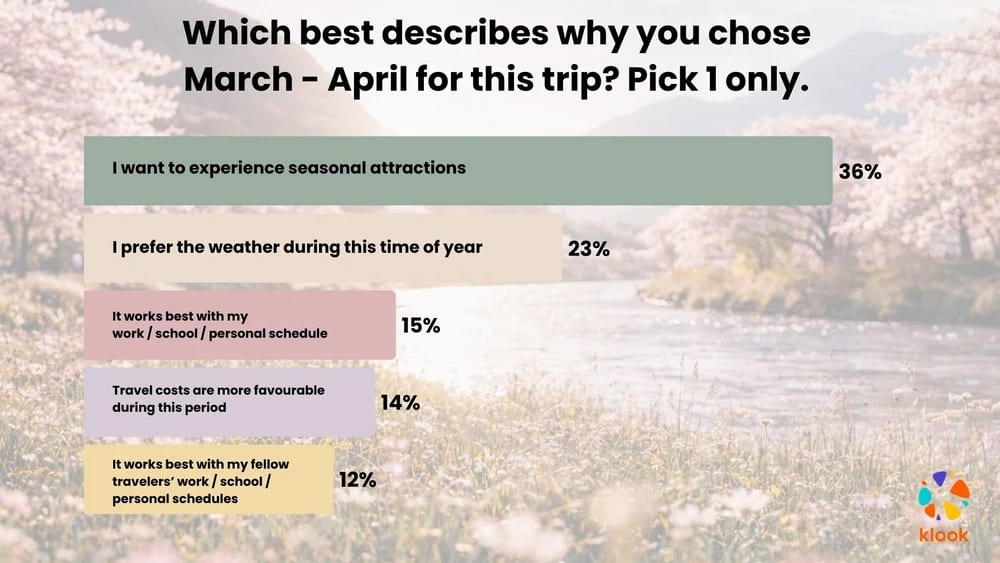
The primary reason travelers choose to visit these destinations during the March–April window is clear: to experience seasonal attractions. This aligns with Klook’s Travel Pulse 2026 findings, which show that time-limited natural sights or spectacles, including flower blooms, rank among the top experiences travelers are most likely to pursue in 2026. This "experience chase" is driving Filipinos to seek out specific moments in time that cannot be replicated during other months of the year.
The Rise of Second Cities
Department of Tourism data from 2025 showed a massive appetite for North Asia, with over 852,000 Filipinos visiting Japan, marking an eight percent year-on-year increase. Similarly, over 240,000 visited South Korea, representing a 12.12 percent growth. However, Klook’s data reveals that Filipinos are no longer sticking strictly to the "Golden Route" of Tokyo, Osaka, and Seoul. There is a significant trend toward discovery-driven travel, where travelers look to maximize the value of every journey.
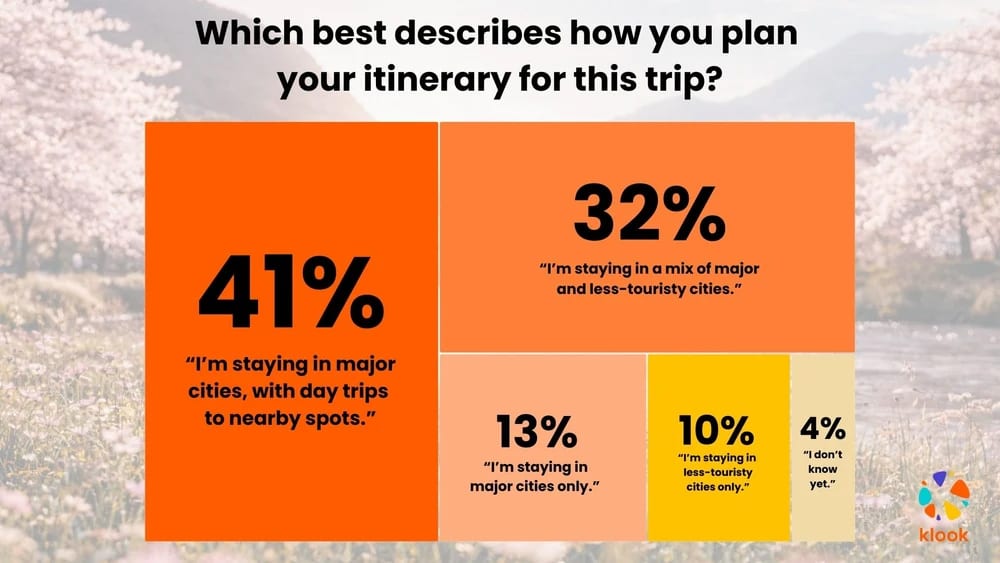
Rather than choosing between major cities or less-touristy cities, many are combining both within multi-destination trips. According to Klook’s Travel Pulse, two-thirds of travelers plan to visit multiple destinations per journey, signaling a shift away from single-stop itineraries. Major cities are no longer the final destination; instead, they are becoming gateways that enable travelers to extend their journeys beyond familiar hotspots.
In Japan, Filipino travelers are increasingly exploring second-city locales with significant growth recorded in regional gems such as Sennan, Nagoya, and Hiroshima, alongside scenic escapes like Sapporo, Fukuoka, Oono, and Kobe. In South Korea, they are venturing into the heart of Korean culture and nature, with Gyeonggi-do, Gangwon-do, and Jeju leading the rise, followed by historic Gyeongju, Chungcheongnam-do, and Jeollabuk-do.
Navigating Crowds
Despite the excitement, the peak travel season brings its own set of challenges. When asked about their potential concerns, 47 percent of Filipino respondents cited crowding at popular attractions—including long queues or wait times—as their top worry. This was followed closely by the risk of missing peak seasonal moments such as cherry blossoms, a concern for 41 percent of travelers.
Marcus Yong, Vice President of Global Marketing at Klook, explains that spring travel today reflects a more intentional mindset. Through the Spring Readiness Index, the company sees how travelers are infusing greater flexibility into their planning while prioritizing experiences that matter most, from cultural sightseeing to trying local food. He notes that these insights help shape how Klook supports travelers, both online and on the ground, throughout the season.
To help travelers navigate these complexities, Klook even formed a "Council of Chief Spring Officers"—a group of experts deployed across Japan, South Korea, and Mainland China to provide real-time guidance and recommendations. Beyond these human insights, the platform is using data to turn seasonal worries into actual solutions.
Klook's "Bloom Back Guarantee"
With missing peak cherry blossom moments ranking among the top concerns, Klook has introduced the Bloom Back Guarantee to give travelers greater confidence. This Klook-only guarantee offers a 30 percent refund on selected cherry blossom tours if the flowers do not bloom during the official forecast periods. The company states that this reflects their commitment to turning seasonal insights into actual solutions that help travelers plan spring journeys with greater flexibility and peace.
The index also showed that most travelers feel largely neutral or unconcerned about other travel stressors, such as weather uncertainty and higher prices during peak periods. This suggests that for the modern Filipino traveler, the value of the experience outweighs the logistical hurdles of peak-season travel.
A More Intentional Filipino Traveler
The data paints a picture of a more sophisticated and confident Filipino traveler. Seven in ten respondents said they plan to book spring activities, tours, and attractions within two months of departure. This relatively short booking window suggests that travelers are maintaining flexibility to respond to evolving bloom forecasts and seasonal conditions rather than sticking to rigid, long-term plans.
This trend is part of a broader shift where discovery is no longer driven by novelty alone, but by values, access, and depth. Whether it is through an exclusive night tour of the "Secret Garden" at Everland in South Korea or a deep dive into the history of Hiroshima, Filipinos are seeking out authenticity.
As Marcus Yong concludes, travel has remained resilient despite the rising cost of living. What we are witnessing is a fundamental shift in how travelers evaluate value. Instead of cutting back, they are spending smarter, prioritizing richer experiences, flexible itineraries, and deeper discovery.
ALSO READ:
Jeju, South Korea: The Island Forged Twice by Fire
Nagasaki and Hiroshima: From Tragedy to Reconstruction
View More Articles About: