Today I Learned: Wearable Tech in Footwear Is Over 40 Years Old
In 1984, the first shoe able to track running stats was introduced. This is what happened then and since.
by JV Emmanuel
Published on Jul 8, 2026
Super Mario. The Cold War. Thriller. People Power 1. Hairspray. Brightly-colored neon spandex. As other brands tried to hang in the congested '80s sneaker airspace with the ever-ascending Air Jordan, Puma and Adidas had more earthbound goals, focusing instead on integrating technology with running shoes.
And in 1984, one of those two German brands finally had a solution. Sort of.
In 1984, Adidas released the Micropacer, a performance runner that had a small tracker. This early pedometer, however, was detachable and was slotted in and out of the tongue of one shoe—the Micropacer was essentially a pedometer holder. But the distinction of being the first publicly available wearable tech would go to Puma and their aptly-named RS-Computer Shoe, released in 1986, which had an actual microchip in the shoe that could be plugged directly to a home computer.
Puma 1, Adidas 0.
The Little Computer That Almost Could
The Micropacer sought to end the tyranny of pen, paper, and watch in tracking runs, and what it lacked in computing power to accomplish that, it made up for in ambition and the simplicity of its solution.
The genesis of today’s smartwatches can be traced to mid-'60s Japan, when engineer Juri Kato created a rudimentary pedometer to encourage more Japanese people to get their 10,000 steps in daily. As the microchip improved, and computers went from being the size of whole rooms to being the size of a calculator, so followed the pedometer, and this set the stage for Adidas’ bid to release a futuristic shoe for the 1984 Los Angeles Olympics.
The making of the Micropacer was more a design problem than a tech problem —how could you put a pedometer in a shoe without breaking the pedometer or causing discomfort to the wearer?
The solution was to produce the smallest possible pedometer, with the smallest possible screen, to track just the most essential statistics, and place it snugly into the tongue of the shoe. The placement of the pedometer was so nondescript that, when taken out, the Micropacer looked just like a regular low-top trainer.
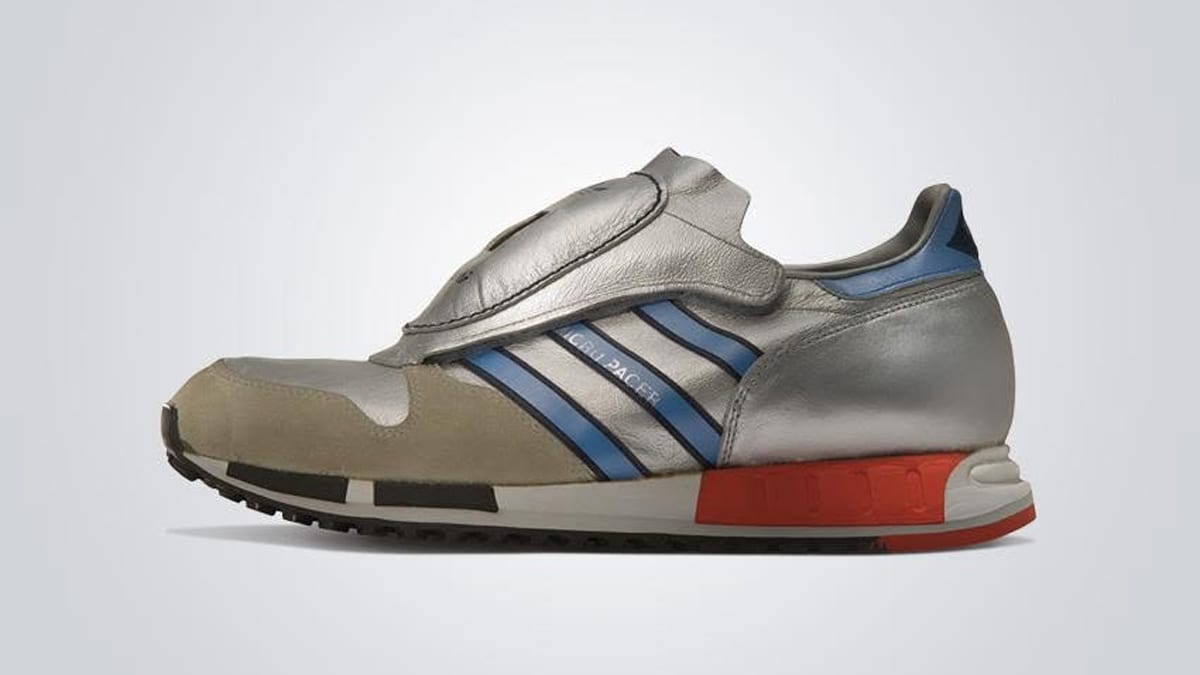
The result was a sleek, groundbreaking sneaker that looked the part… but didn’t exactly play it.
The pedometer being compact meant that its equally small batteries didn’t last as long. The pedometer was also prone to breakage and inaccuracies due to its size (or lack thereof), and gave wearers difficulty reading its comically small screen. The many headaches that held back the Micropacer ensured that the premium price tag wasn’t justified, inevitably relegating the model to niche status.
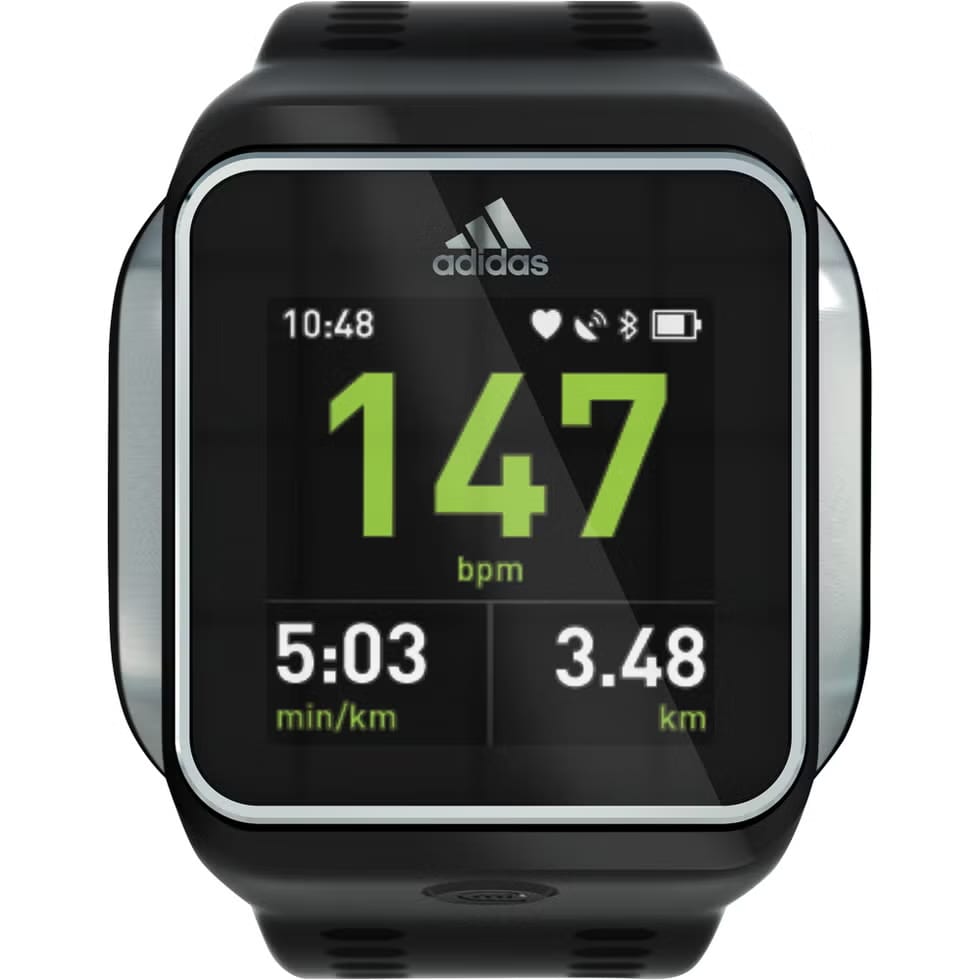
But the idea of having a pedometer in a shoe definitely had staying power, as Nike would reprise the concept in 2009 with Nike+. Adidas too would circle back to what the Micropacer started, launching a similar line of integrated wearable tech under their miCoach program in 2010. Both lines centered on having a small chip you could put into a shoe—under the footbed this time—and sync up with an app to track your performance. However, better wearable tech coming to market as early as 2012 gave Nike+ and miCoach an earlier expiration date, ultimately leading to their discontinuation in 2018.
The quote about doing the same thing again and expecting a different result comes to mind. Puma must have had that as a motivational poster somewhere in their offices in 1984.
The Big Computer That Also Almost Could
Before fully fixating on putting computers in shoes, Puma began their tech-driven research on athletic performance in 1984, using motion capture technology to study a runner’s movements. From this came the Running System—a line built around the Multiplex IV, a proprietary midsole with four kinds of cushioning compounds that provide better energy return and shock absorption.
With a cushioning system named like a tower in a '70s sci-fi movie set in the year 3000, the next logical step for Puma was to start work on their shoe of the future to go with their cushioning of the future. With the help of the University of Erlangen and Dr. Peter Cavanagh, Puma did just that, and in 1986 they would debut the world’s very first smart shoe, the creatively named RS-Computer.
Marketed by Puma as a shoe for "serious runners," the RS-Computer boasted full Apple, IBM, and Commodore 64 and 128 compatibility, and a gate array with 600 transistors. All that to say that the RS-Computer wasn’t just a mere pedometer, but a beast of a computer that adjusted to running styles and distance goals. The shoe even beeps to indicate a target distance. But most impressive of all was the RS-Computer’s ability to store data for up to six years, allowing for unprecedented analysis of someone’s performance over a period of years.
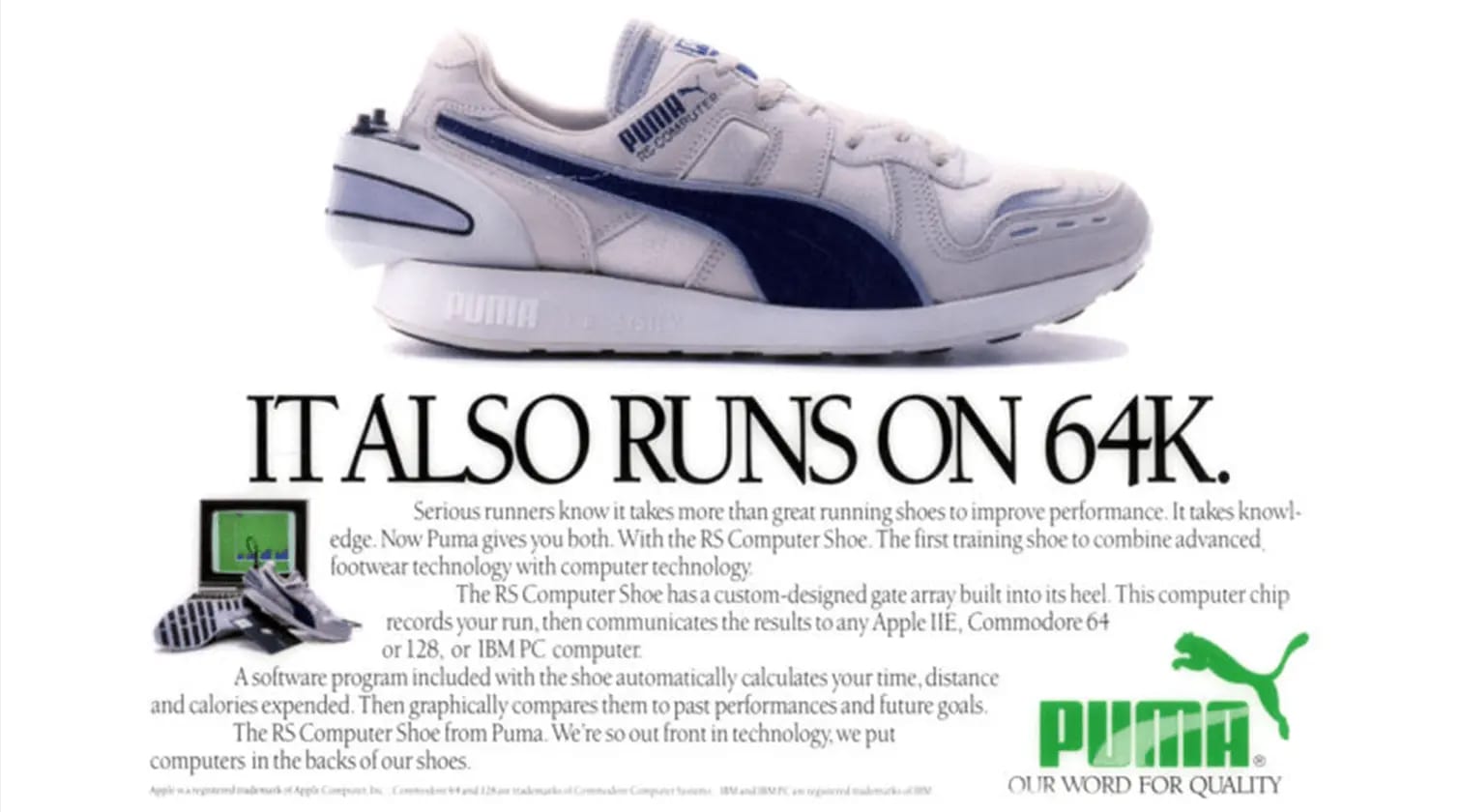
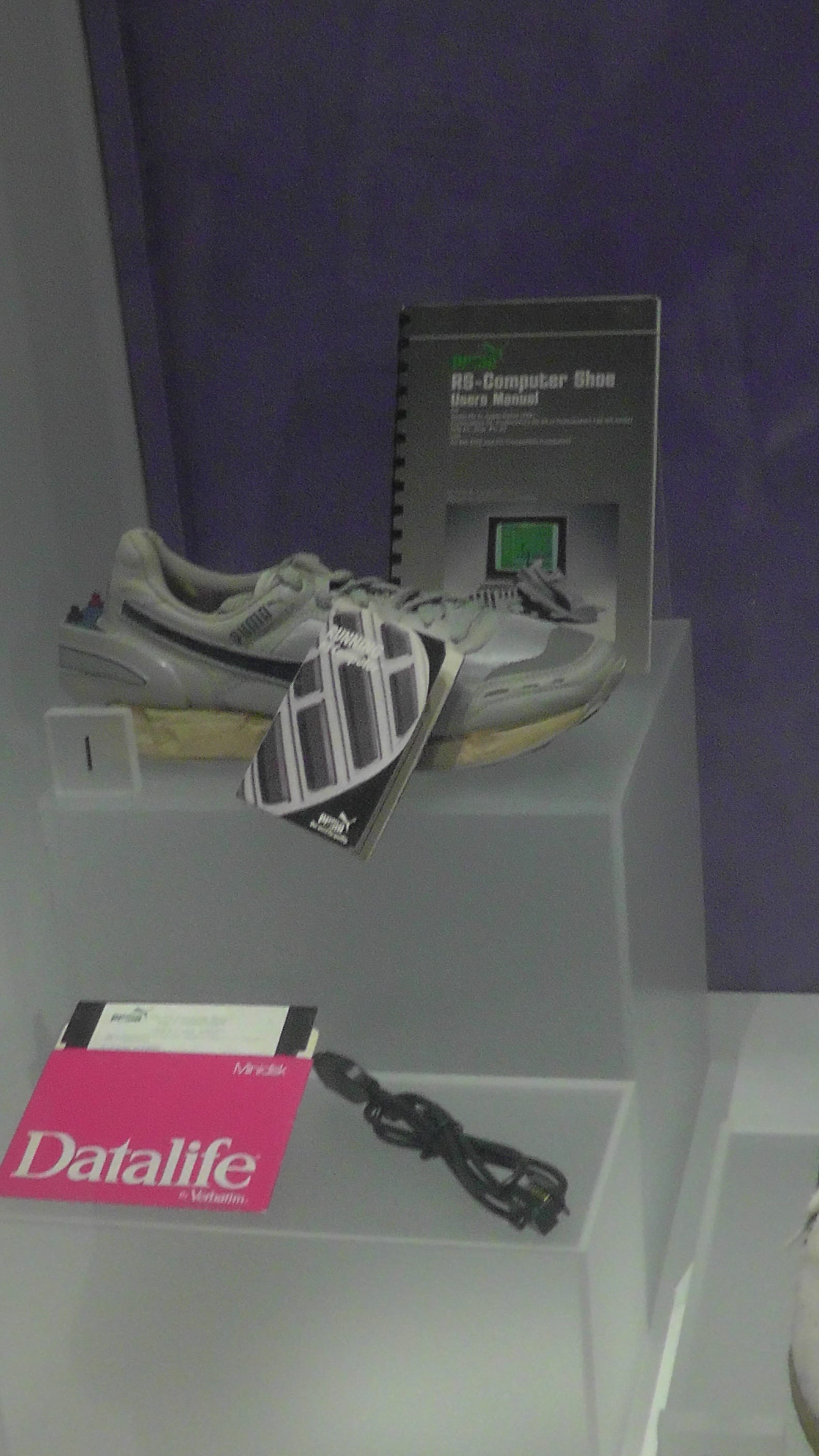
All you had to do to harness the RS-Computer’s precious data was to plug your shoe into a compatible home computer, then pop in the official Puma floppy disk with the official Puma software to extract the data, after which you’d be presented with a plethora of graphs showing your running progress. Oh, and you also had to have just U.S. $200 to spare to buy the shoes. That would be over U.S. $600 in 2026.
If you can somehow manage all that, you would then have to deal with the weight and balance issues of the RS-Computer. All that tech had to go somewhere, so they conveniently placed that hunk of circuitry right on the heel of both shoes.
If the future Puma was envisioning began and ended in 1986, then the RS-Computer certainly fulfilled its mission, but even that is debatable at best, as the shoe failed to gain traction after its initial run, owing to its overall inconvenience that made an already bad price tag look even worse.
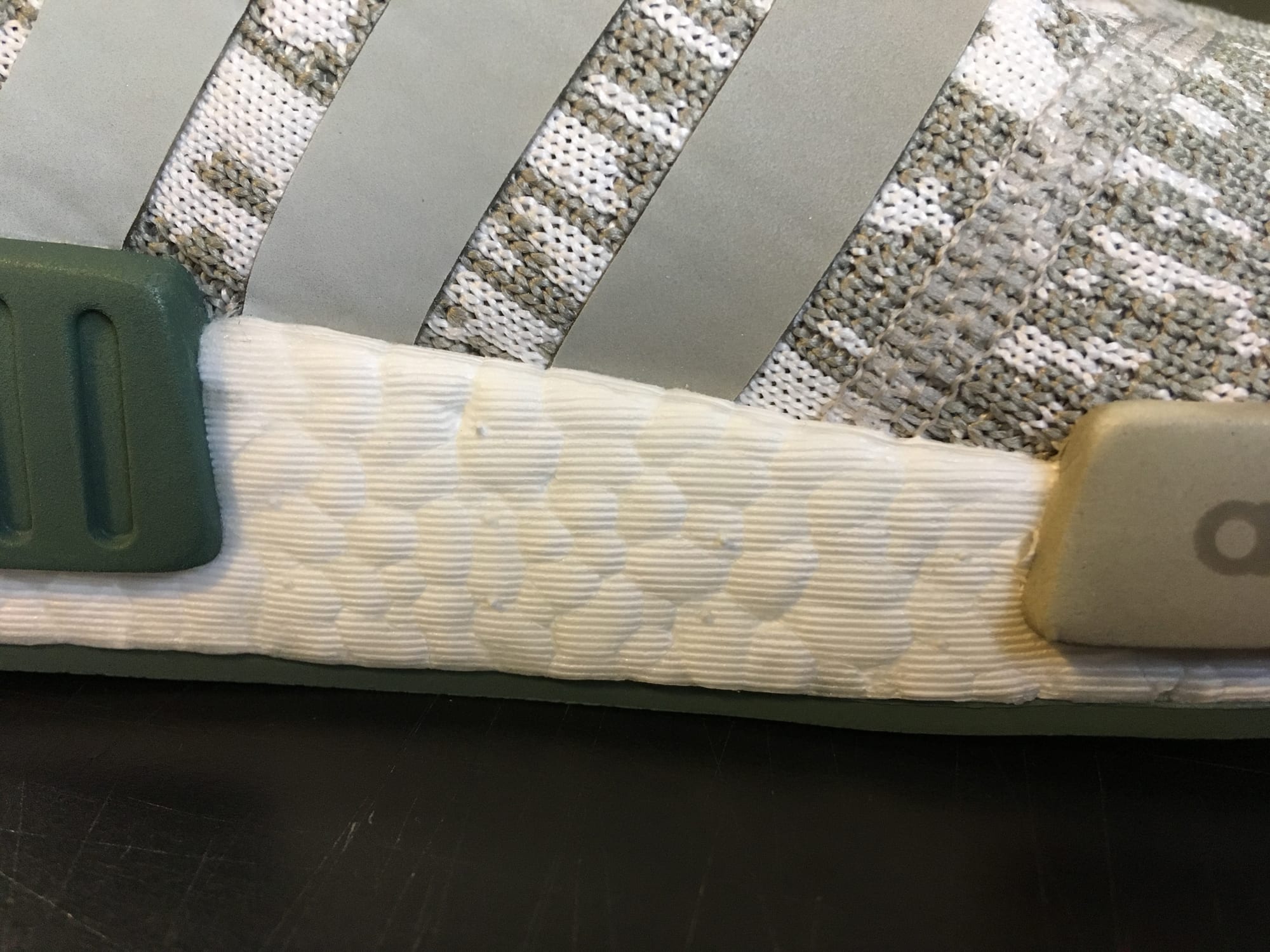
Puma would never touch wearable tech ever again, and the brand’s relationship with footwear innovation has been rocky since, perfectly crystallized by Puma curiously abandoning its 2009 project with chemical producer BASF. BASF would take its business to Adidas, where the two would finally see the project to its conclusion, producing Boost foam.
Puma 1, Adidas 1.
But Wait, There's More
Learning from their mistakes in the '80s that may or may not have included haircut choices, Adidas pivoted from using tech to deliver real-time performance tracking to developing adaptive cushioning that reacted to an athlete’s footfalls.
Brands big and small were always enamored with footwear with a "custom fit." But attempts at this have only really involved tightening or loosening the uppers, either with variable lacing systems or pump bladders that blew up or deflated a shoe’s upper.
But never has a shoe’s cushioning itself ever been adjustable. And laces and pumps all involved hands and the use of them. Adidas wanted cushioning that adjusted to the wearer. And Adidas wanted to do away with using your hands (again).
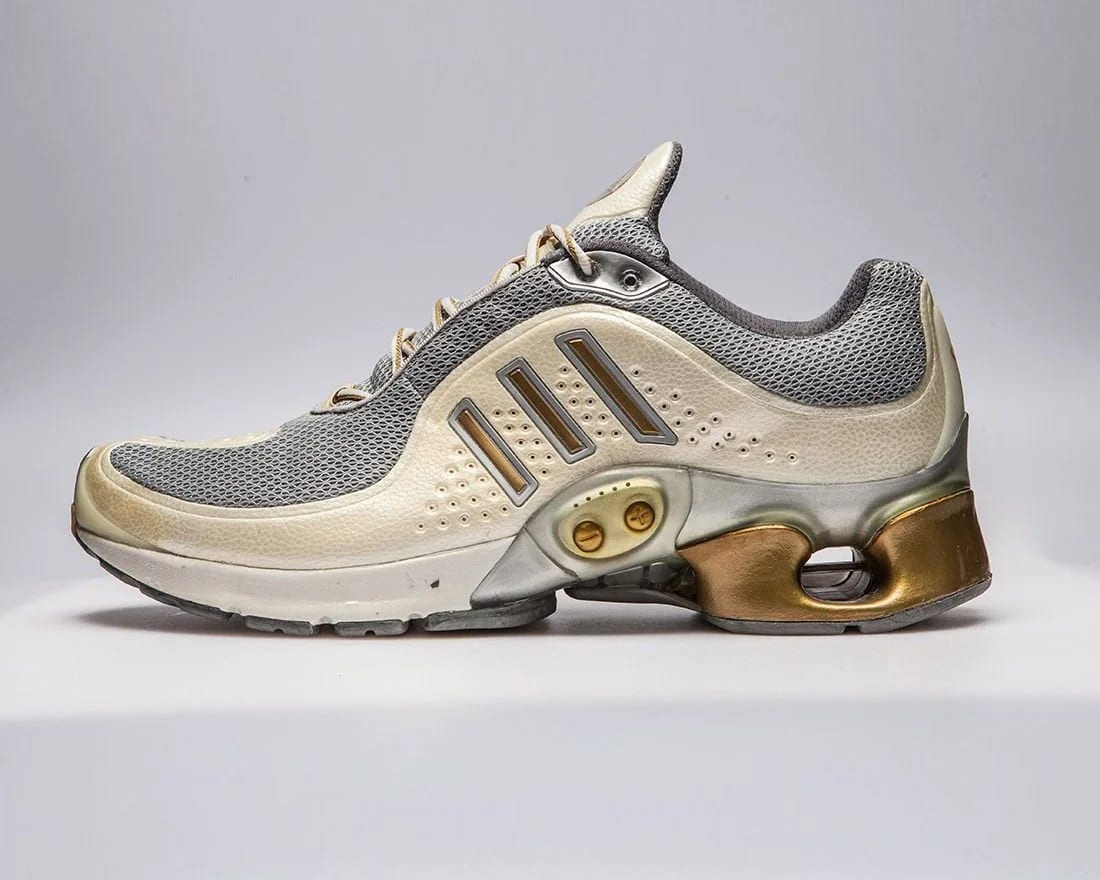
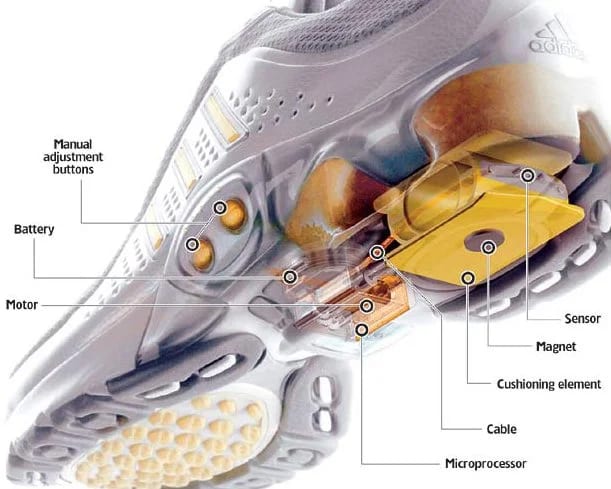
In 2005, the world welcomed the adidas a_1, a line of performance footwear for running and basketball developed by engineers Christian DiBendetto and Mark Oleson, utilizing a microprocessor that controlled a series of wires and gears that altered the compression of the heel pad.
It suffered the same fate as its predecessor, thanks to a general lack of interest outside of its novelty, and a steep retail price of U.S. $250, or over U.S $400 in 2026.
As if this wasn’t indicative enough, the Three Stripes would once again try to make wearable tech practical and feasible with miCoach just a few years later, which, as previously stated, didn’t go too well like all their other attempts.
Back to the Future
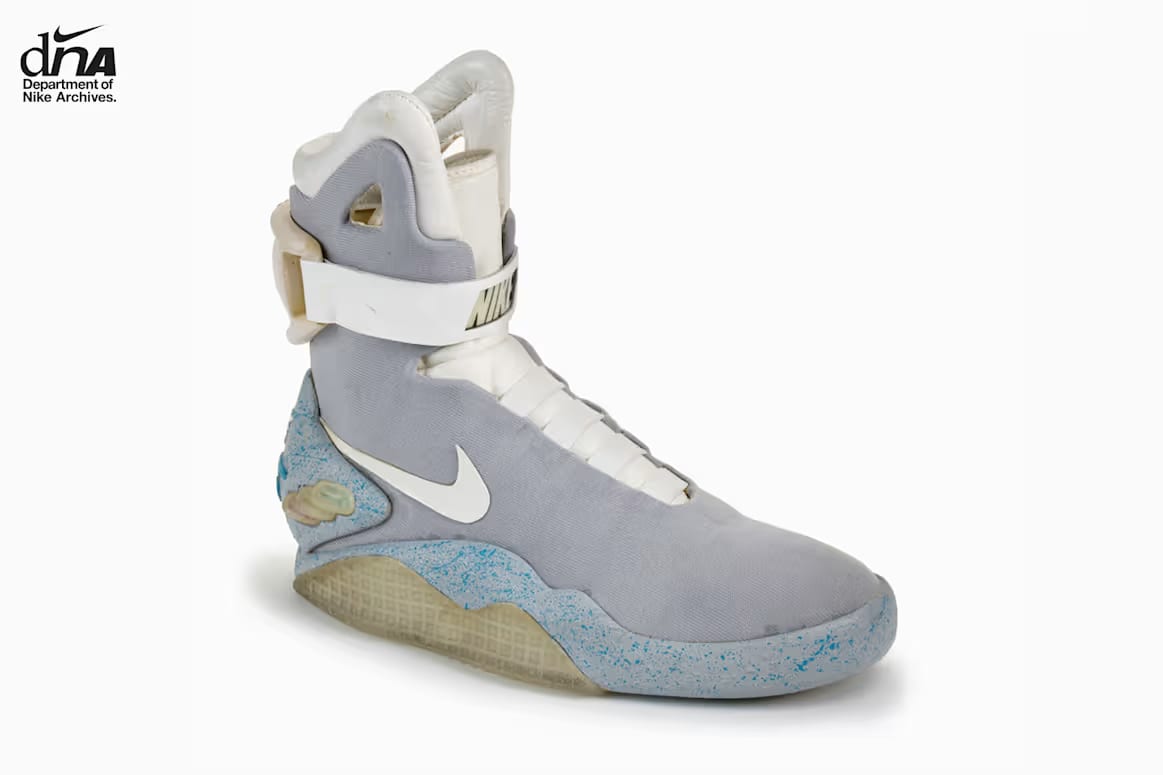
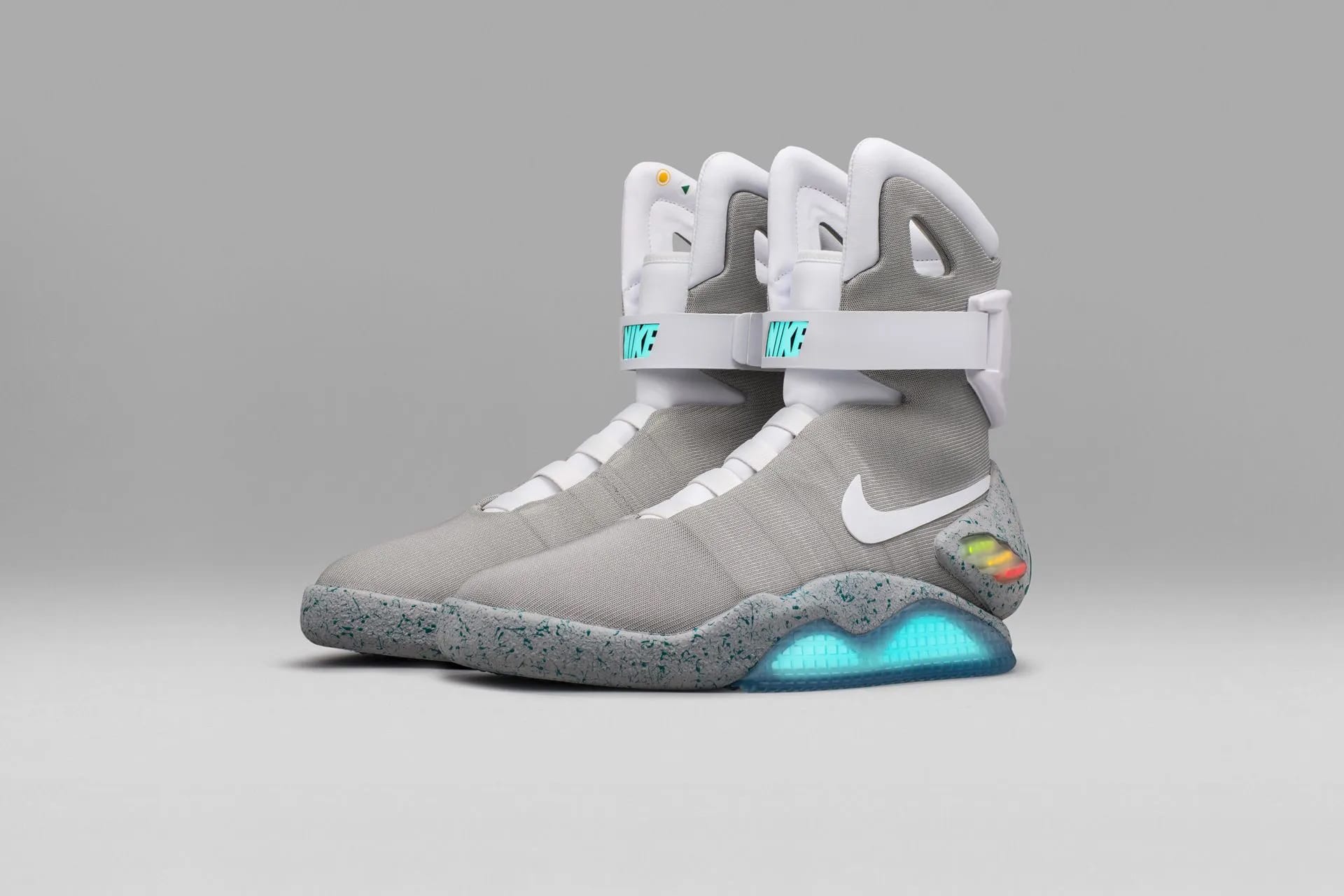
It’s only fitting to end on the one futuristic most people actually know and acknowledge: the Tinker Hatfield-designed Nike Mag. While the original movie prop shoe was nothing more than some prop people literally pulling some strings behind the scenes to create the illusion of a self-lacing shoe, 2016 saw the completion of Tiffany Beers’ years-long project, the Nike EARL, or Electro Adaptive Reactive Lacing. In essence, Nike was trying to do to lacing what Adidas tried to do with cushioning—EARL allowed for automatic loosening or tightening of shoelaces as dictated by the wearer’s level of activity.
EARL technology would debut on the 2016 iteration of the Nike Mag, finally fulfilling the future foretold in Back to the Future (1989). More accessible mass market models featuring EARL technology would be released to much fanfare until the sheer ridiculousness of paying more than twice the average price of most sneakers just to not tie your own laces outweighed whatever benefits the tech may have provided.
For all their industry knowledge and resources, these corporations seem to fail to understand that people just do not mind tying their own shoelaces, or that cushioning gimmicks are unnecessary because people intuitively know what shoe feels right for their feet.
But the sportswear companies were indeed right to imagine a time when people would care a lot about religiously recording their fitness statistics. And while their shoes ultimately weren’t the ones to fulfill that duty, sneakers like the Micropacer and the RS-Computer undoubtedly ran, albeit poorly, so that today’s tech could run too, but better.
ALSO READ:
Tick or Tech: Traditional Watches vs Smartwatches
I Wore Rokid AI Glasses for a Month—and What in the Black Mirror Is This?
JV Emmanuel is a writer, photographer, and human rights activist. See some of his photos on IG @gospelchordsonly.
View More Articles About: