
How Nina Lee Aquino Represents the Voiceless in Asian-Canadian Theater

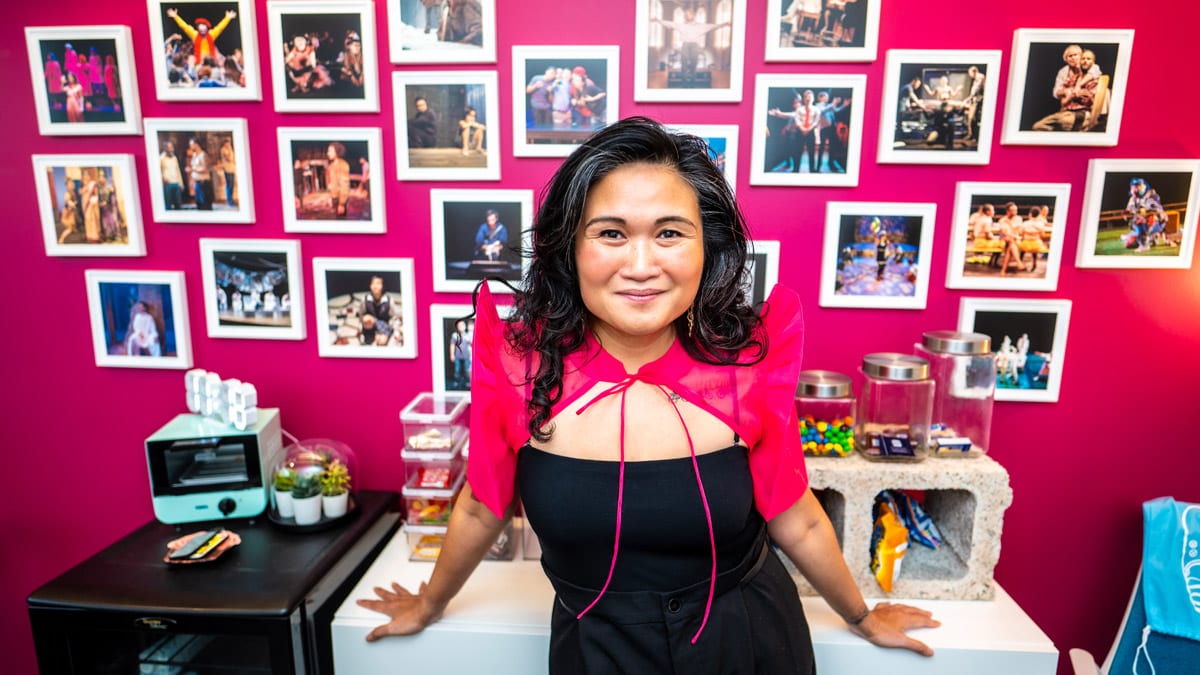
"I'm not really interested in the things that tie us together. I'm more interested in examining what makes me different from you," Filipino-Canadian Director Nina Lee Aquino told Esquire Philippines in an interview. She's currently in her second season as Artistic Director of Canada's National Arts Centre (NAC) English Theatre, and their 2024 - 2025 lineup is a reflection of her advocacy for representation in Canadian theater.
This September, for example, NAC is presenting a twin-bill production of live radio dramas that imagine the future of two neighborhoods in Canada and their evolving relationship with water amid the climate crisis. cicadas by David Yee and The Woman of One Thousand Years by Berni Stapleton are under the second volume of Irresistible Neighbourhoods, which is a collaboration between NAC English Theatre and NAC Orchestra.
Also in September is their staging of First Métis Man of Odesa, which tells the real-life love story of award-winning Métis playwright Matthew MacKenzie and acclaimed Ukrainian actress Mariya Khomutova. The month of October features Frances Ya-Chu Cowhig's Snow in Midsummer, which follows the ghost story of a young widow wrongfully executed for murder. It will be directed by Aquino.
Another play with a female character is Andrea Scott's Controlled Damage, which examines the life of Canadian civil rights figure Viola Desmond, who was once jailed after entering the whites-only section of the Roseland Theatre in New Glasgow, Nova Scotia. It is slated for February 2025.
Pushing things further is Anusree Roy's Trident Moon in April 2025. It tells the story of six women hiding inside the back of a truck at the very beginning of India's emancipation from British rule.
"Overall, what makes me really excited about 24-25 is that we scaled up. I am just really excited about the audacity of the storytelling of each of these productions. I'm just so thanking my lucky stars because [in] programming and curating, part of it is luck. Yes, I hunt down things that I want to put together for a season, but if the stars don't align, if schedules, availabilities, affordability...sometimes you have to make the sacrifice. That's why this season feels extra special to me, is that I think I want everything I wanted, I got. But I wanted it because all of these shows are just...big. And I'm not talking just about [having] a big cast or a big [production], but the storytelling just takes up the space, the space that it deserves. I think each of our productions has this confident way of telling the story that takes up big space," Aquino explained about the ongoing season.
ALSO READ
Theater Etiquette 101: Dos and Dont's When Watching a Live Show
Repertory Philippines Partners With UK Drama School for Free Theater Classes
How Nina Lee Aquino Takes Up Her Own Space
Aquino's default of "[leaning] hard into difference, more so than similarities" can be credited to her being a "diplobrat," as she calls herself. As the daughter of retired diplomat Amelita Aquino, she has called many places home. "Home is wherever I am. It's a state of mind."
She was born in the Philippines, but her family immediately moved to Houston, Texas, when her mother got the assignment to work at the consulate. After the six-year term, they moved back to the Philippines, where she completed her primary and secondary education at Maryknoll College (now Miriam College).
Even early on, Aquino had always been a performer. She participated in plays in Houston and joined the drama club in elementary and high school. So, when it was time to apply for college, she knew she wanted to pursue theater arts.
"My mom said, 'If you want to really do this, we are 100 percent going to support you.' Because, again, they supported ambition. It didn't matter what profession, but they really cultivated in me a sense of ambition. And my mom was like, 'Okay, if you're going to do this, then we want you to apply to the best universities that offer theater.' Like the University of the Philippines (UP), because back then in the Philippines, UP was probably the only one that offered theater arts," she narrated.
Aquino, however, failed all of the college entrance exams: UP, Ateneo de Manila University, and University of Santo Tomas. She revealed that she felt a bit guilty because her mother let her take pre-classes for the admission tests.
"So, thank God there was a talent test," she exclaimed.
UP offers Associate in Arts (formerly Certificate) programs, where admission doesn't require passing the UPCAT. This system is specially made for disciplines in theater arts, fine arts, and creative writing, where students are admitted after passing a specific exam (i.e., objective and essay questions related to the field), going through an interview and auditions, and submitting a portfolio. After two years in the Associate in Arts program, students can continue two more years to earn a Bachelor of Arts degree.
Aquino's older brother graduated from the state university by taking the same route: a talent test at the UP Fine Arts.
"I got into UP with a scholarship and everything because of the talent test. I was so confident, and I knew I was prepared for that. It was like a monologue and a song. And so I was set to go to UP for Theater Arts," Aquino said.
She also did some theater work with local production companies like PETA, Trumpets, and Repertory Philippines.
But her mom, whose "dream was to live in different parts of the world," got another assignment. This time, in Canada. But that didn't really change the path of Aquino's ambition to be in theater. It was really just a matter of where she was going to pursue it.
She had to retake high school, where she signed up for a lot of drama courses. Eventually, she got into Tarragon Theatre, her first taste of Canadian theater. She completed a Bachelor of Arts in drama at the University of Guelph.
"I feel like my parents gifted me with a really expanded view of the world. [...] So even now, as an adult and an artist, it is incredibly important for me to be an observer of life and a documenter of the goings-on of what we're going through as a society. But also to be able to learn different points of view from other cultures, from other people."
A Vow to Represent the Voiceless
Aquino looked back at a specific moment in her artistic journey that led her to vow to "never, ever be voiceless again."
At the time, she was taking her Master of Arts degree in Theater at the Drama Centre, University of Toronto, where she did her research on Asian Canadian theater. "Because, again, I was curious."
As all research work goes, she went to the library and started digging up reading materials, books, and journals.
"When I went to the library and to the computer catalog and typed 'Asian Canadian Theatre,' it was a blank screen and a blinking cursor. I remember that day so clearly because I was just like, 'Never mind me being able to do this paper, this homework.' I felt invisible. I felt voiceless," she said.
Being given that empty search result, Aquino questioned how she could thrive in Canadian theater as a Filipino, let alone as an Asian.
"I can't even look back to the past and celebrate our milestones. There are no milestones to celebrate."
Undeterred, she had this "renewed determination" amid the trope of being a woman, a Filipino, and an Asian-Canadian of having to work 10 times harder to prove that her roots are just as good as the dominant culture.
"It was for me a long-term dream for the next student, the next Master of Arts student doing their research on Asian-Canadian [culture]; this is not ever going to happen again. I am not going to allow this to ever happen again."
Aquino went on to become a Founding Artistic Director of fu-GEN Asian-Canadian Theatre Company. "Founded in 2002, fu-GEN Theatre is devoted to providing a home for the Asian Canadian theatre artist, nurturing their voices and producing works of the highest artistic caliber that explore the Asian Canadian experience," its About page said. She retained the position of Artistic Director until 2009.
"We did the first-ever Asian Canadian Theatre Conference [in 2010], and that was to mark and to celebrate finally two Asian Canadian drama anthologies, of which I was like the editor for that, ever in the country. It was one of the sweetest things for me. I tested it out; I went back to the library and typed 'Asian-Canadian Theatre', and not only were there plays finally in there, but the two anthologies that held amazing Asian Canadian works were now finally in the catalog. It was no longer a blinking cursor staring back at me," she said.
From 2009 to 2012, she was Artistic Director of Cahoots Theatre Projects, a Toronto-based, intercultural company with a focus on new writing and professional development. She then served 10 seasons as Artistic Director of Toronto’s Factory Theatre, where she was the first person of color to lead the organization and the first woman of color to serve as AD of a venue theatre company in Canada. She brought diverse voices to the stage and launched the playwriting careers of numerous BIPOC creators during her tenure that ended in 2021.
In August 2022, Aquino was appointed Artistic Director of NAC English Theatre, where she also staged and directed Canada's first all-Filipino musical production titled Prison Dancer. The musical, which was inspired by the once-viral video of Cebu's dancing inmates, was created by Filipino Canadians Romeo Candido and Carmen De Jesus.
Being a trailblazer and doing all these "firsts" seem to be intrinsic to Aquino.
"I recently found out that my mom, who kind of dedicated her life as a diplomat, was actually one of the first women to be admitted into the program. At that time, foreign service was very brand new in the Philippines. Hearing that story, it was no wonder that she was just so big on ambition. She knows what it's like to have those same challenges and barriers and to get what she wanted through hard work," she narrated.
Theater as a Rehearsal for the Revolution
Aquino also comes from a family of politicians, including the late Ninoy Aquino, who was a staunch critic of the Marcos dictatorship.
"I realized that my uncles and my aunties who ran for office, whenever they lost, they put in their chips again and went for it again until they did win. That kind of mentality. Wow, you must really want to help change the world, shape the world, and feel like you can contribute something useful to them. Now I'm learning to really appreciate that I'm like them, but just in theater," she explained.
Whether it's directing a production or curating a theatrical season, Aquino follows the dictum: "Theater is a rehearsal for the revolution." It was a quote from Brazilian theater director and theorist Augusto Boal, who's also often quoted by one of the Filipino-Canadian director's mentors.
"I don't do theater because it's cute. I really do feel like this is my way of contributing to trying to make the world a better place. I wake up in the morning knowing that's the biggest goal. And I go to sleep at night, resting for another day to fight."
And Aquino does it by allowing NAC's audience to see stories that are both theirs and not theirs.
