
Theater Review: Kaliwaan Is (Still) Not Your Typical Kabit Drama

For a society that's keen on keeping the so-called sanctity of marriage while vehemently opposing same-sex unions and divorce, we have a surprisingly long list of kabit-seryes and films about extramarital affairs. The 2010s alone saw Philippine cinema and television dramas produce hits like No Other Woman (2011), The Mistress (2012), The Love Affair (2015), The Unmarried Wife (2016), The Legal Wife (2014), and Two Wives (2014). The formula is familiar: heated encounters, public confessions, and tearful hysterics.
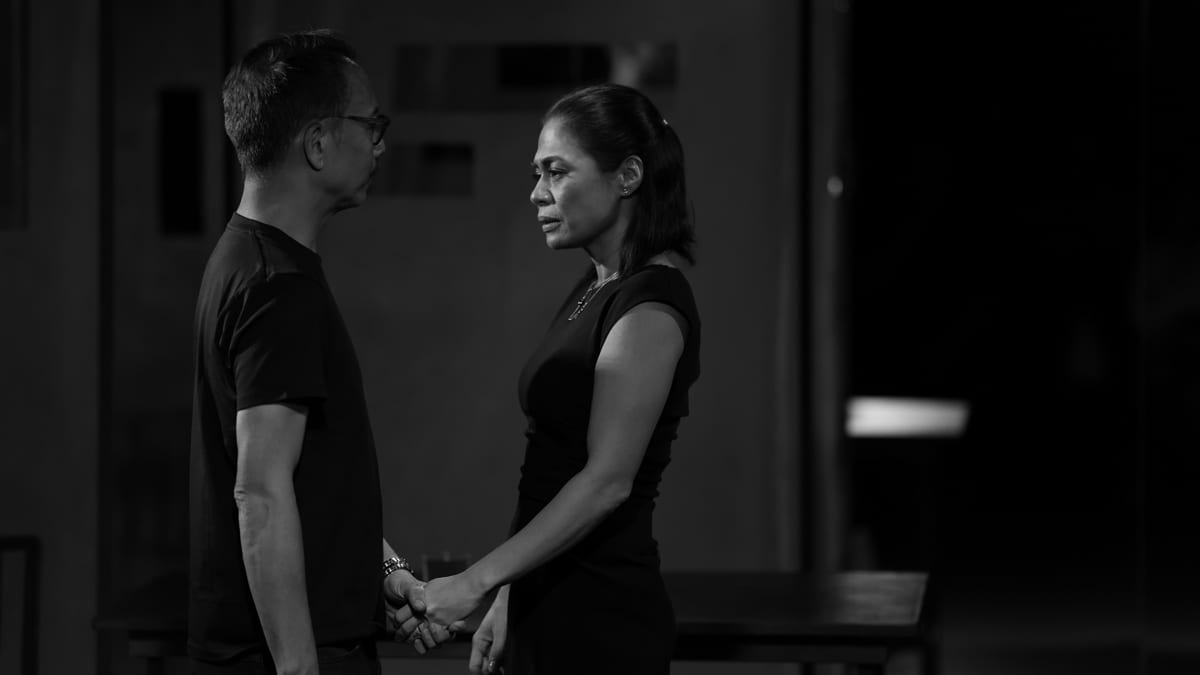
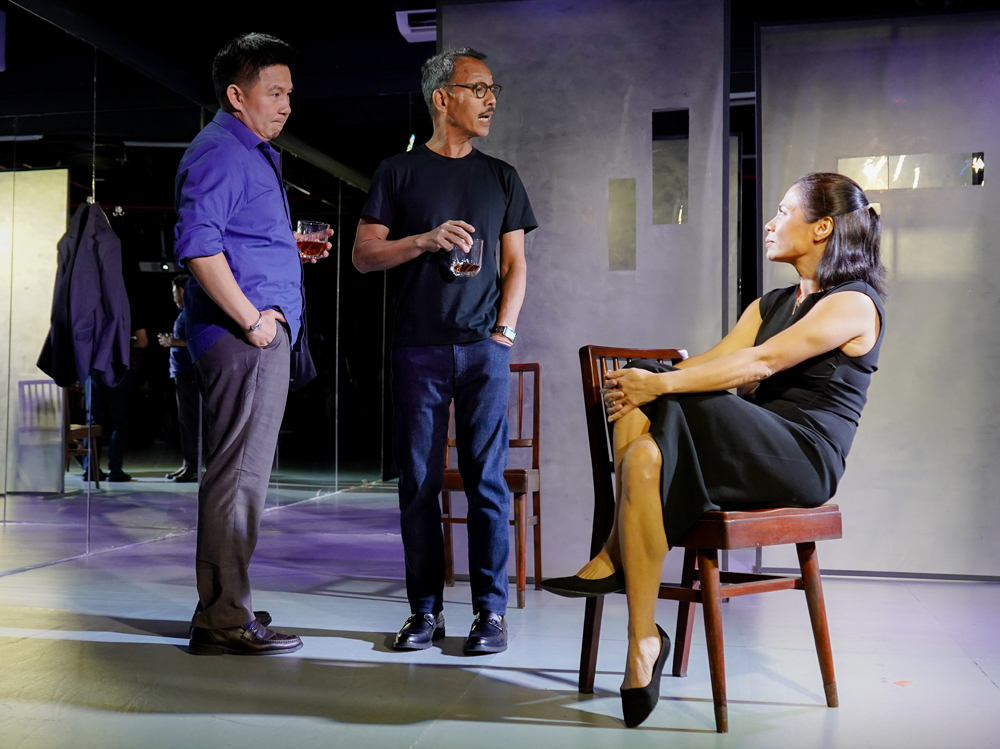
And then there's Guelan Varela-Luarca's Kaliwaan, which runs until September 7 at The Mirror Studios in Makati. It is a Filipino translation of Harold Pinter's Betrayal (1978), which was staged by Repertory Philippines in March 2024. The play follows the course of a seven-year-long affair between Emma (played by Missy Maramara), a gallery owner, and Jerry (Nor Domingo), a literary agent. Emma is married to Robert (Ron Capinding), a publisher and Jerry's best friend.
Ron Capinding (as Robert), Nor Domingo (as Jerry), and Missy Maramara (as Emma) in Scene Four of 'Kaliwaan' by Guelan Varela-Luarca
This two-sentence synopsis could easily describe your typical kabit drama, but Pinter's Betrayal—and consequently, Luarca's translation, Kaliwaan—is anything but.
ALSO READ:
More Shows, New Audiences: How Philippine Theater Is Experiencing a Renaissance
Les Misérables: World Tour Spectacular Is Coming to Manila in 2026
Kaliwaan as an Exercise in Translation
Betrayal lays out the interwoven strings of love and deception while deliberately avoiding melodrama. It is, after all, a play by an English playwright, and what else are the British known for if not their self-restraint, calmness, and the stiff upper lip? In this narrative, emotions are buried in hurried thoughts, packed away in subtext, and hidden in moments of silence. I can only imagine the challenge of translating such a work into a language that is inherently emotive and whose words already carry a weight and depth of feeling. Filipino words that are not only onomatopoeic but also deeply affective are often at risk of getting lost in sampalan-at-sabunutan.
Jerry and Emma catch up over drinks in Scene One
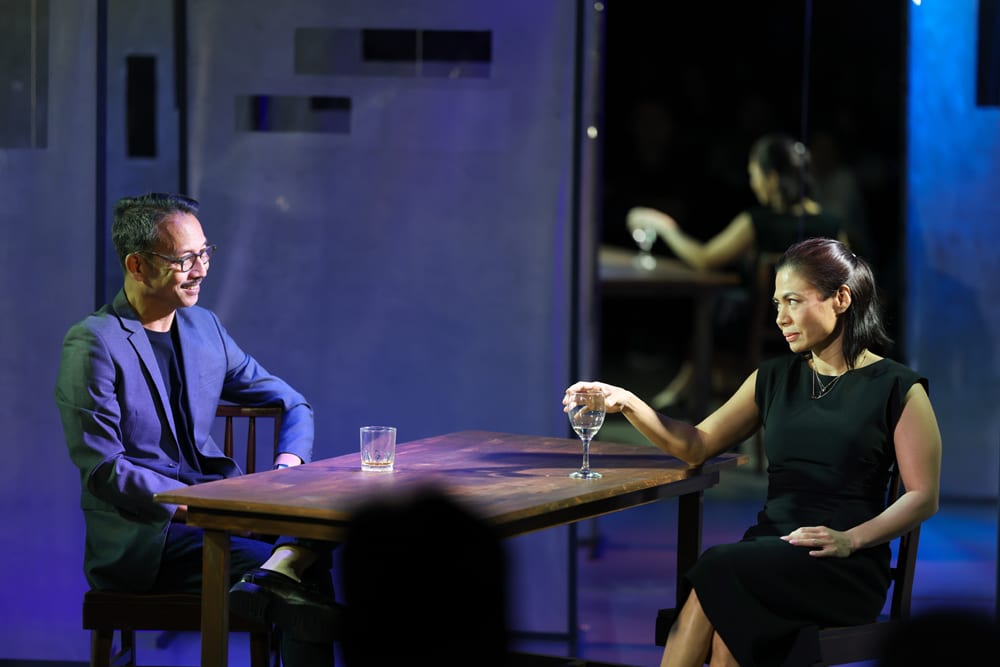
This difficulty was evident in the first scene, set in 1977 London, where Emma and Jerry meet for the first time in two years. As is common in Pinter's signature dialogue, the exchange is almost painfully mundane and awkward—fitting for exes who haven't seen each other in a while. In this initial scene, Luarca's translation, perhaps still trying to find its footing with actors Missy Maramara and Nor Domingo, felt like a word-for-word rendering of the original, creating an unnecessary stiffness on top of the text’s already required awkwardness.
This was easily resolved, however, as soon as Ron Capinding's Robert appeared in the second scene. It's possible that Capinding's natural diction perfectly aligns with Luarca's translation, or that Robert's character himself provided the grounded anchor the play needed. But from this point on, the translation finally landed.
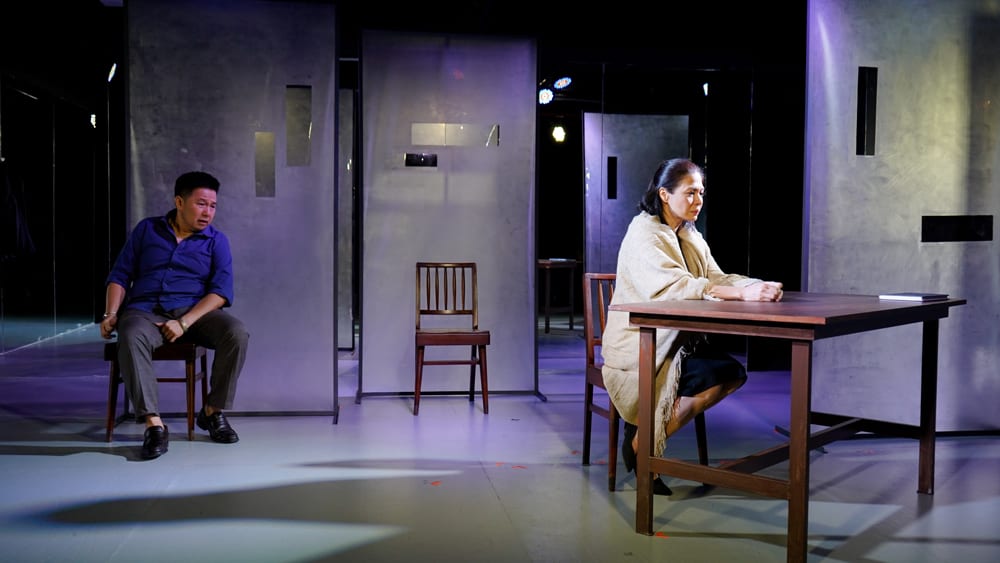
'Kaliwaan' Scene 6
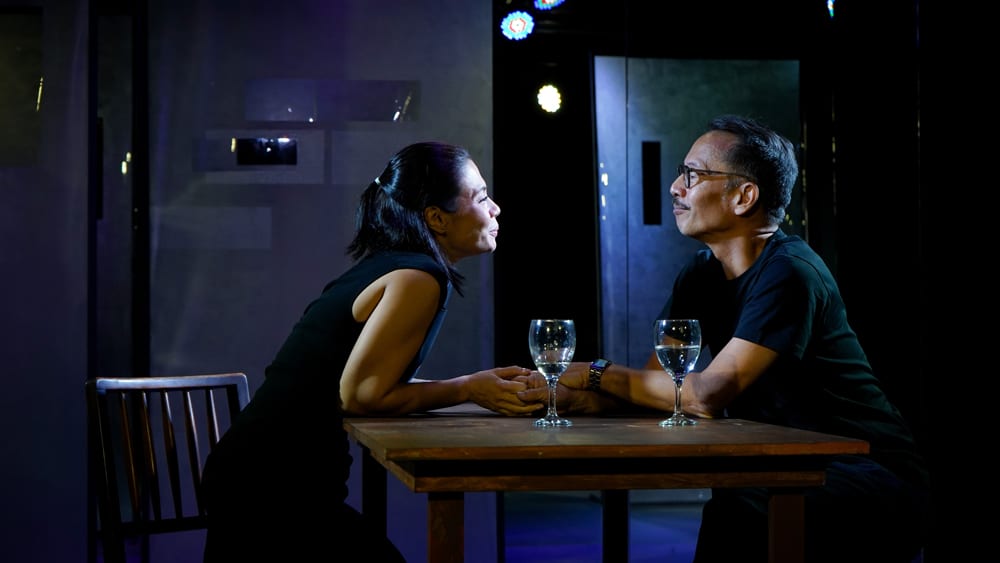
Suddenly, Jerry and Emma speaking in Filipino in their London apartment made perfect sense, and I was in for a rollercoaster of emotions for the next hour or so. Through her subtle, non-verbal cues, Maramara poignantly internalizes the iconic Pinter silence, skillfully holding back emotions that are clearly simmering just below the surface.
Structure as a Dramatic Device
Aside from the restraint in storytelling, Pinter's Betrayal is particularly different because of its reverse chronology. With a total of nine scenes, the years between 1968 and 1977 occur in reverse order, with the exception of the scenes within the years 1977 and 1973, which move forward. This means the audience already knows the consequences of the betrayal and its implications on all relationships—between husband-and-wife Robert and Emma, between lovers Jerry and Emma, and between best friends Robert and Jerry—even before finding out how everything started in the first place.
'Kaliwaan' Scene 9
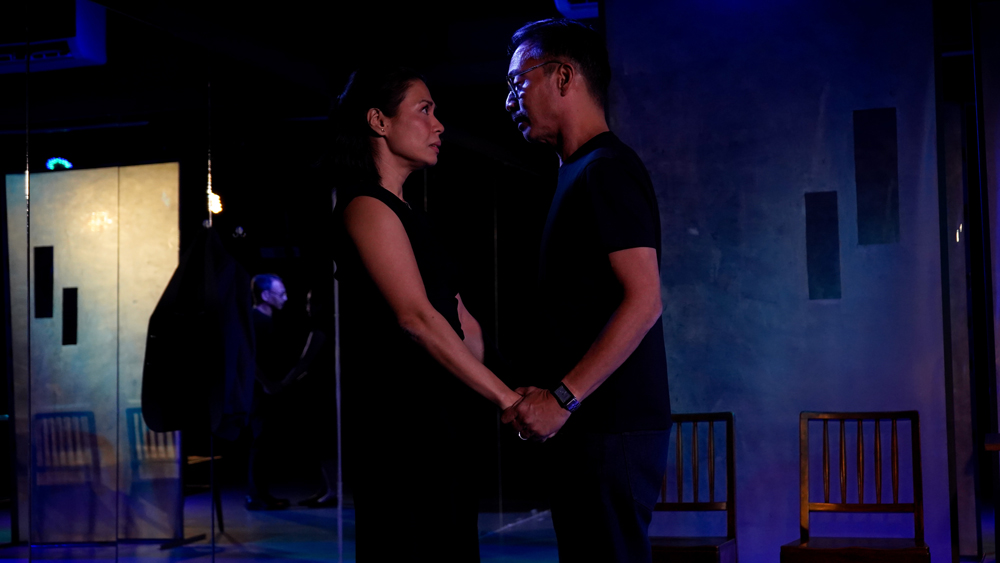
This structure allows the audience to experience the play in a way a linear story cannot, creating a profound dramatic irony. We watch Jerry and Robert in Scene Four, for example, toast their drinks and plan to play squash, even though we know from Scenes One and Two that these best friends have been deceiving each other for years. This reverse structure also reveals a deeper, more intricate web of deceptions. We learn of Robert's betrayal of Jerry, who never knew his best friend was aware of the affair for years; and of Emma's betrayal of Jerry for confessing the infidelity to Robert. Each scene moving backward peels away another layer of deceit, showing that the emotional cost of the affair was far greater and more intricate than it first appeared. Again, this is not your usual kabit-serye.
Robert and Emma in Scene Five
Highlighting the Subtext
As with any difficult exercise, the translation of Betrayal from English to Filipino served to highlight Pinter's intention of using subtext. Our language, after all, has a culture of "parinig." That little comment from Robert to Emma, who's reading a book on betrayal. The stubborn insistence of Robert on Jerry to play squash. And finally, that retort in the last scene (which is actually the one that started it all) of how Jerry is Robert's best man.
All these seemingly little things, with the right mix of Filipino parinig, become underhandedly tragic.
In Scene Seven, Robert gets drunk over lunch with Jerry. This is after the scene where he finds out about his wife and his best friend's affair.
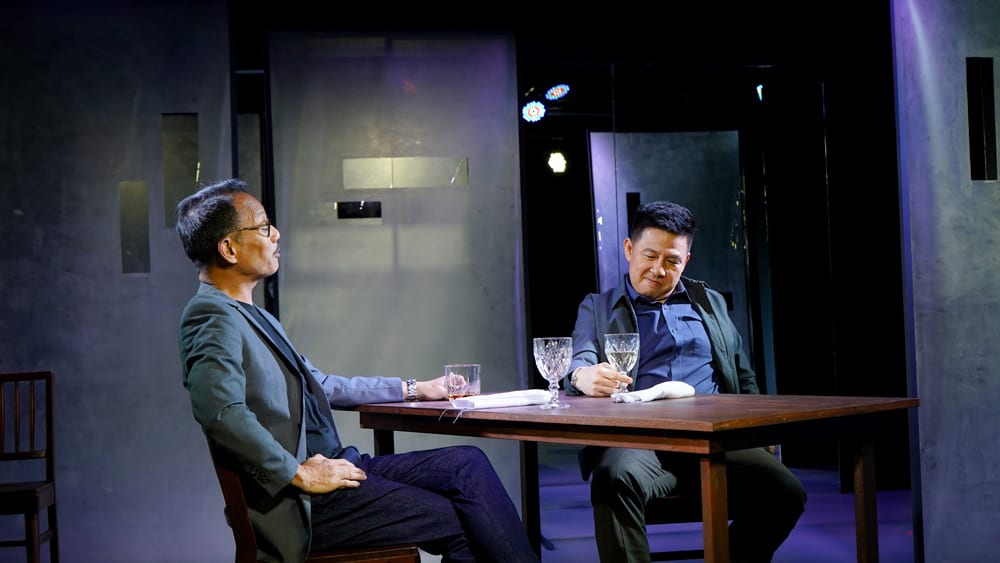
Toxic masculinity is also highlighted in this translation, which I don't remember being as vivid in the original play. Perhaps the Filipino culture's machismo, a baggage carried by the target-language text, gave emphasis to Jerry's and Robert's (and even Casey's) hegemonic masculine behaviors of competing for Emma's attention and asserting dominance through deception.
Luarca's translation and Loy Arcenas' direction hold up a mirror to a society obsessed with the public spectacle of infidelity. (It isn't lost on me that this is staged in the intimate Mirror Studios.) What else can be said about betrayal? Maybe a lot. But apparently, not everything needs to be said, and maybe that's the most heartbreaking betrayal of all.
Kaliwaan's two-weekend run is extended for a third weekend, and now runs until September 7 at The Mirror Studio Theatre, 3/F SJG Building, 8463 Kalayaan Avenue, Makati City. Ticket prices range from P800 to P1,250, available through MusicArtes' Google Form.
