
Theater Review: We Aren't Kids Anymore Reads Like a Poetry Collection

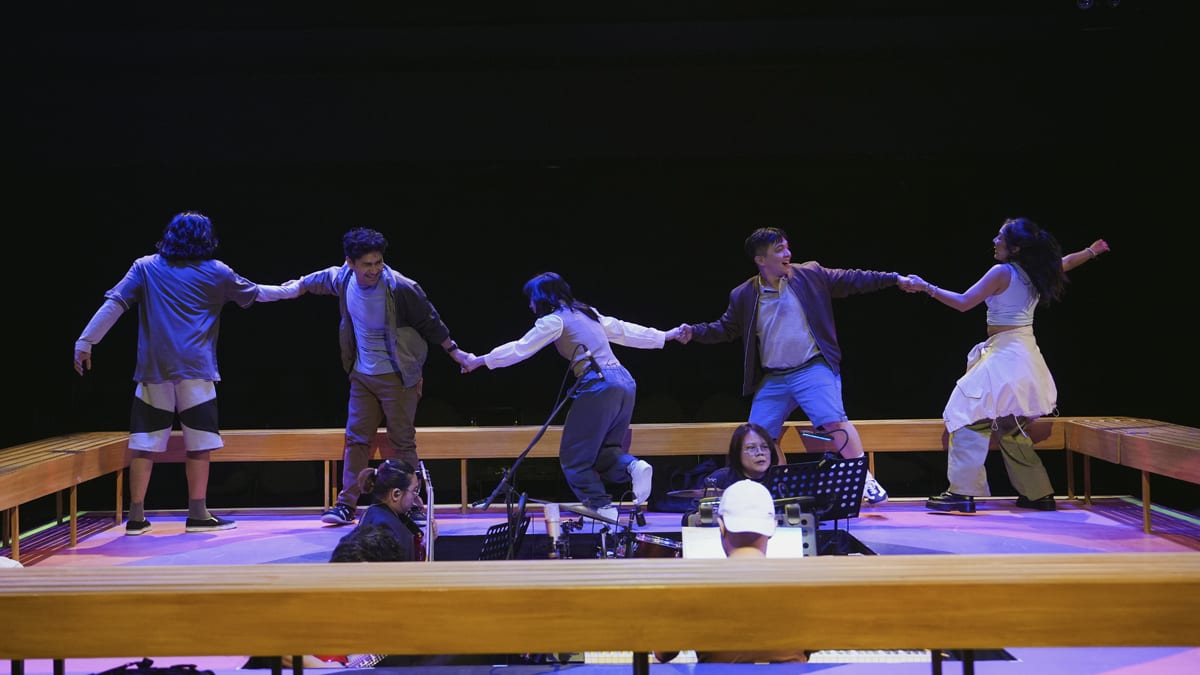
'Form follows function' is an 1896 precept in the world of architecture, which recommends that design follow the purpose of the structure. In literature, we know this to be 'form follows content,' where the choice of genre, style, language, and structure enhances the insight that the text hopes to convey. This couldn't be more true for We Aren't Kids Anymore, a song cycle by Drew Gasparini, featuring a poem by Keith White, with orchestrations and vocal arrangements by Justin Goldner and Gasparini. Staged by Barefoot Theatre Collaborative, the makers of Mula sa Buwan and Bar Boys: A New Musical, it opened last May 2 at the Power Mac Center Spotlight Blackbox Theater.
We Aren't Kids Anymore as a Song Cycle
We Aren't Kids Anymore (WAKA) is not your usual book musical with music, lyrics, and a book (or script) that all follow a narrative. And this lack of a clear structure can be a bit unfamiliar for a casual theatergoer who's used to a three-act musical with an exposition, rising action, and resolution. After all, we just came from the hero's journey trope of the Rivermaya jukebox musical Liwanag sa Dilim, which followed the quest of Elesi in an attempt at a Noli Me Tangere retelling; and straight play Kisapmata, which had a crystal clear climax with the based-on-a-true-story massacre—both opened in March.
'We Aren't Kids Anymore' cast: (L to R): Myke Salomon, Luigi Quesada, Maronne Cruz, Gab Pangilinan, and Gio Gahol
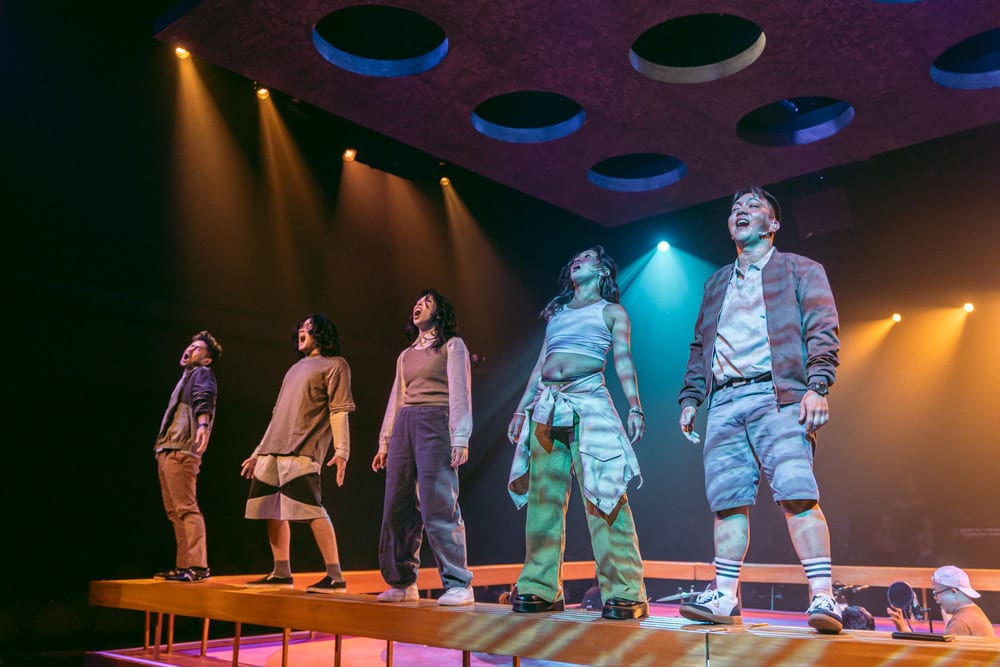
To appreciate WAKA is to appreciate its form. It's branded as a song cycle right out of the gate, where song cycle is defined as a collection of related songs written by one person and connected by the same characters, idea, or theme. It debuted in 2019 as a student showcase at Christopher Newport University's Ferguson Center for the Arts in Virginia, U.S. In 2020, a studio cast recording became available on Spotify, and it wasn't until April 28 (just a couple of days before Barefoot Theatre Collaborative) when it marked its world premiere (and West End debut) at the Savoy Theatre.
But even without prior knowledge about what a song cycle is (and is not) or what WAKA is about, its form becomes obvious after maybe three songs in, where the first track is not directly related to the second track, at least if we're talking about chronology. It can be likened to listening to an album, but that in itself does not justify the power in Barefoot Theatre Collaborative's staging. I streamed the studio cast recording right after the preview, and believe me when I say that it doesn't hold a candle to our local production, both in terms of the cast's vocal prowess and the spectacle of the stage.
And so I say that watching We Aren't Kids Anymore is like reading a poetry collection, where all senses are engaged and where insights can bring out a Stendhal syndrome (at the risk of exaggerating) if you're open to it. It is one where a song stands on its own, but is made richer by the songs surrounding it; one where a track makes sense alone, but a cycle encapsulates the experience. The sequence, at first, seems not to have any logic, but when taken as a whole, there is a reason why each track needs to breathe and then echo its thoughts.
Plus, that music rendition, led by musical directors Myke Salomon and Farley Asuncion, may just bring you to tears—even with the notoriously bad acoustics of PMCS. Sound engineering can really do wonders.
The Many Drews in We Aren't Kids Anymore
Likewise, the content is immediately made known in the opening song: "Hello, my name is Drew," with the first line sung by Myke Salomon, followed by the rest of the cast's own "Hello, my name is Drew" lines. Drew is the composer himself, basically making WAKA an autobiographical collection of songs about growing up, love and heartbreak, family, making it in New York, and life as an artist.
These aspects in Drew's life are played by five different Drews, and in Barefoot Theatre Collaborative's staging, Salomon is joined by Gab Pangilinan, Maronne Cruz, Gio Gahol, and Luigi Quesada, with covers Katrine Sunga and Angelo Lantaco. It should be noted that these five Drews do not necessarily play a specific age of the lead character, but rather, more of a temperament or a mindset.
Salomon, for example, who sings about spending time with his older brother ("Danny & Andrew"), being an older brother himself ("Little Sister"), and being raised by a music-loving mother ("Mom Could Play Guitar"), reflects Drew's family-oriented views. The non-chronological format from one song to the next is emphasized as well in "Danny & Andrew" and the songs before and after it, as Gasparini jumped from one timeline to another.
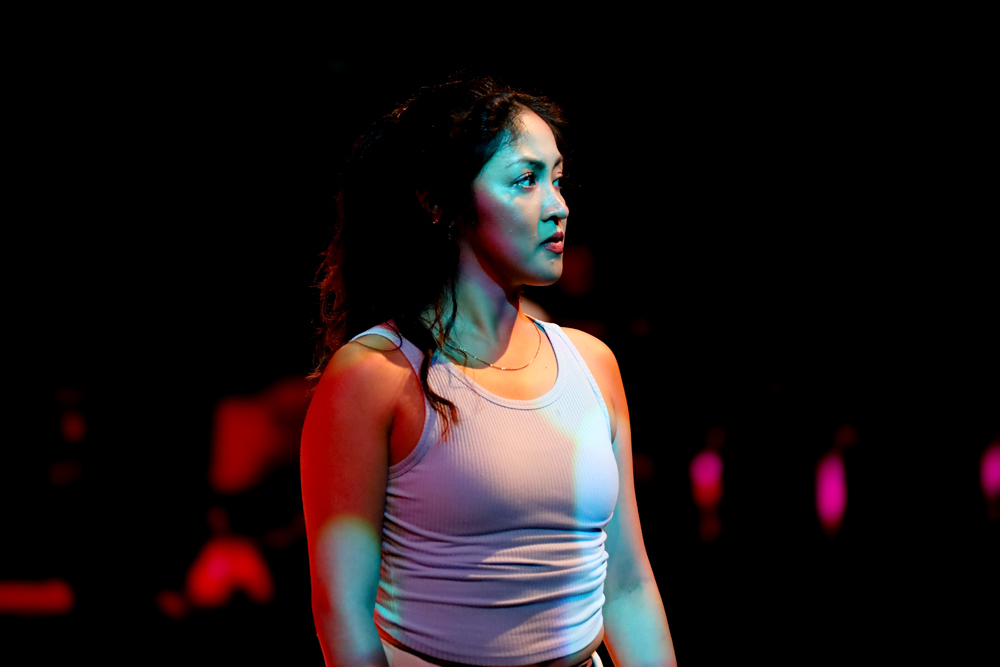
Pangilinan in "On the Edge," which is the second song," gives us a glimpse of Drew as a free-spirited artist, who is also often plagued by self-doubt (as in "Faking Cool"). "I'm faking it for you, how could I be your idea of cool?" is a line that too many artists would find relatable. As expected, Pangilinan owned her tracks, not only with her vocal strength, but also with her authenticity and commanding presence. I'm always thankful to be a theater-goer in this generation of Gab Pangilinan.
Cruz' solo comes up as the fourth song, "Turn the Page," which talks about being caught in between, closing and opening a chapter. Her Drew also sings the titular song, "We Aren't Kids Anymore" (track 17), which mirrors this sense of being at that crossroads in life: childhood and adulthood.
Gahol's pessimistic temperament is revealed in the 10th song, "I'm Not Falling for That," an upbeat track about wrongly depending on someone; and also in "Snow," his solo at number 16, where he sings about finding himself at "rock bottom at six o'clock today." Earlier in the cycle, he had "Something Good," which is still optimistic, if only for a bit, so you can just imagine where that landed him later in the 90-minute show.
Quesada plays the Drew who falls in love and gets his heart broken, as in "I Wish I Never Met You" (fifth song). But this heartbreak isn't always related to romantic relationships. A few times in the cycle, they would blurt out the phrase "I wrote a note," which would always seem to be interrupted by another song—as if there's a thought in the artist's deep recesses, a thought that is feared to be let out.
Eventually, everything is tied up by Quesada's monologue, which is a spoken word piece by Keith White, that's both quiet and powerful. As with the whole show, it is best listened to live. The delivery prepares the audience for when Quesada's Drew breaks out into a ballad of hope, "I’ll Stick Around."
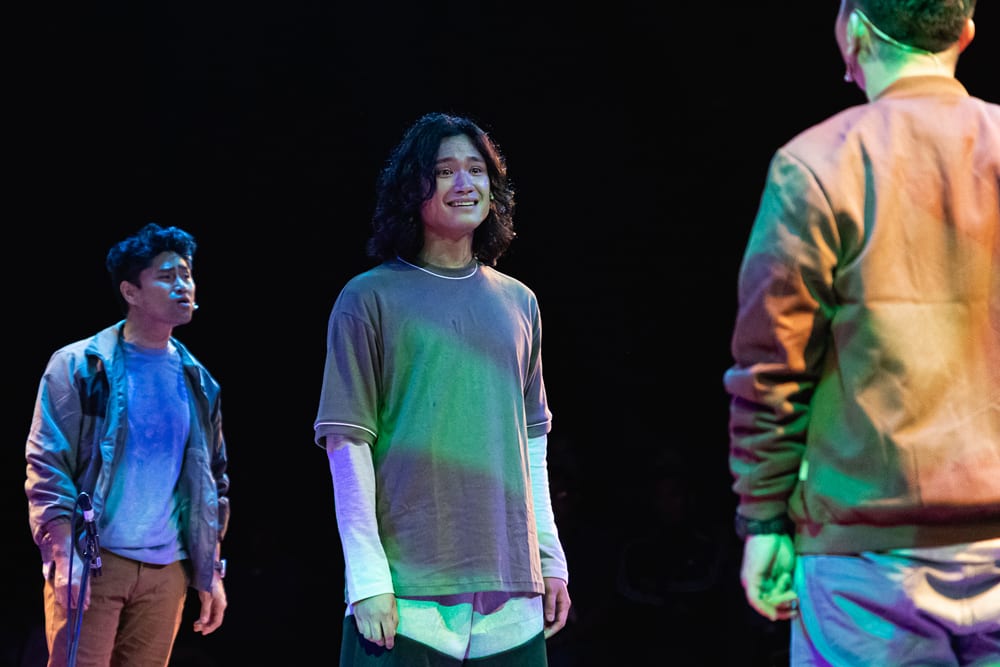
Aside from these solos, the group songs emphasize the many facets of Drew's personality, which isn't only applicable to artists, but to all humans as well. Aren't we all filled with nuances and ironies that are shaped by many things as we grow up and stop being kids, sort of?
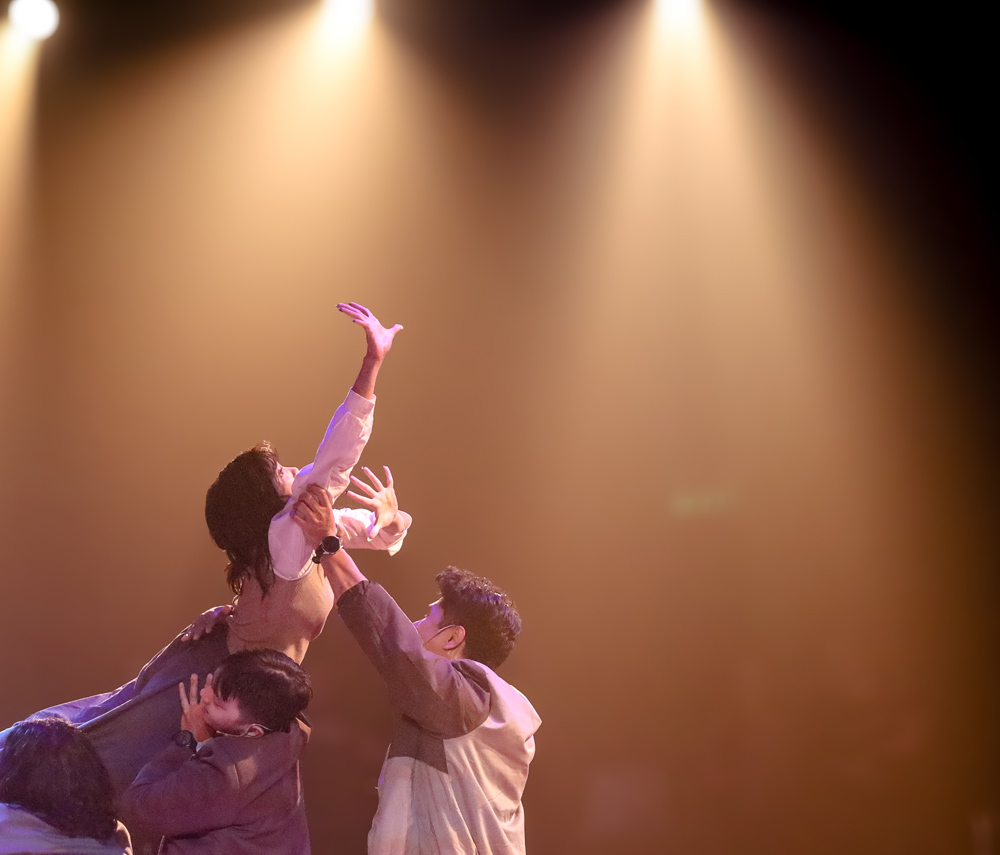
This multi-faceted Drew is emphasized by the set: an elevated square stage where the five artists are seemingly separated from the rest of the space through the wooden bench. I think of it as a box where all the Drewness is mixed in and contained as one. Shake the box and you get the chaos that often goes on in one's mind, visually represented by Jomelle Era's movement design.
Gasparini's 19-track song cycle ends with "When I Go," a bop song about legacy-making, which is never easy. And much like WAKA's seemingly unmanageable format and disconcerting narrative structure (or lack thereof), life is never manageable nor structured. Enter that space, ride that emotional rollercoaster, and you might just have to go for one deep breath after the 90-minute show. And, much like the last song, WAKA will leave you with something when you go.
We Aren’t Kids Anymore runs until May 25 at the Power Mac Center Spotlight Blackbox Theater, Circuit Makati. Tickets are at P3,200 (Gold) and P2,700 (Silver). Available through their ticket channels.
