
This Artist Paints Stillness Amid Urban Chaos

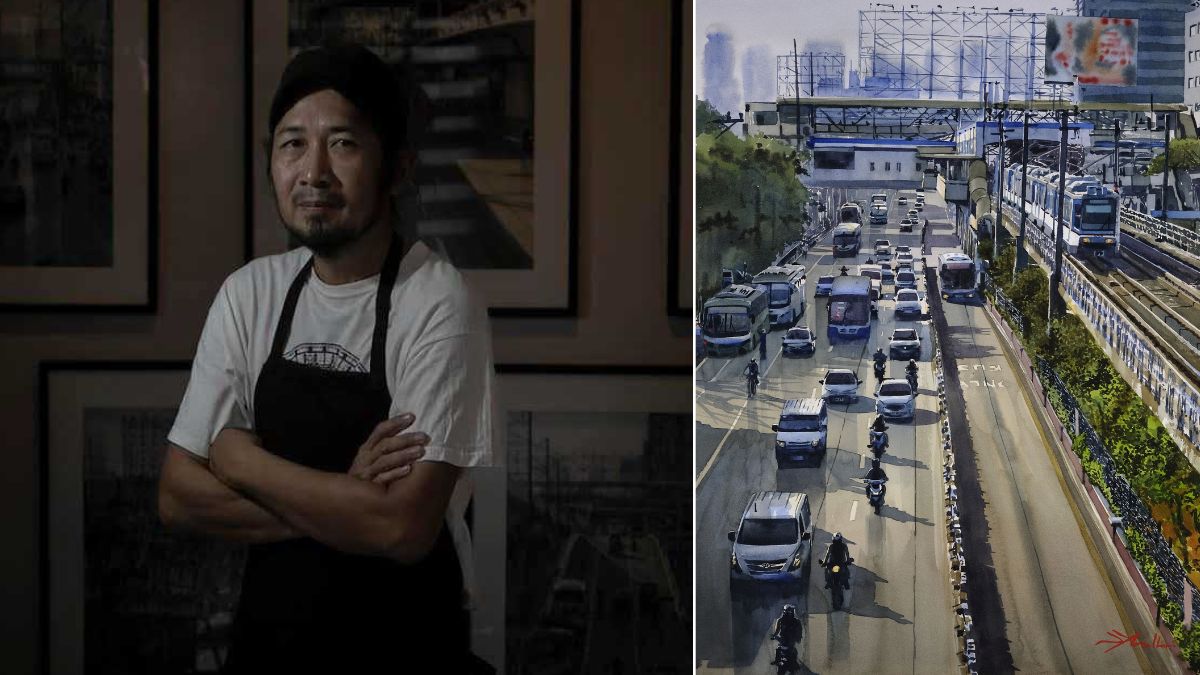
How do we remember certain places? The thing is, all places tend to change their appearances. More often than not, destinations, even specific routes to get there, can be confusing and confounding, and time can simply erode, if not elude, our sense of familiarity and direction. Even the people we meet at certain locations change. Somehow, they are always in a push and pull between sameness and change, leaving almost everyone disoriented and lost.
But thanks to artists like Erwin Mallari, who manage to make time stand still and capture moments of spatial consciousness, we are able to resonate with the current moods of the locations he decides to paint.
"Diverge"
Artistic Voyage of Erwin Mallari
Although raised in the city, his penchant for the outdoors and adventure has been a developed habit and borne out of persistent passion. Usually armed with his watercolor and coffee equipment, kitted out in his biking gear, he would usually go out and wander around nearby cities, provinces, and wherever his artistic instincts would take him.
“The outdoors just generates in me many ideas and I am just drawn with spontaneity that makes forces not to do anything contrived. I am pleased in this dialogue with nature and the community,” he said.
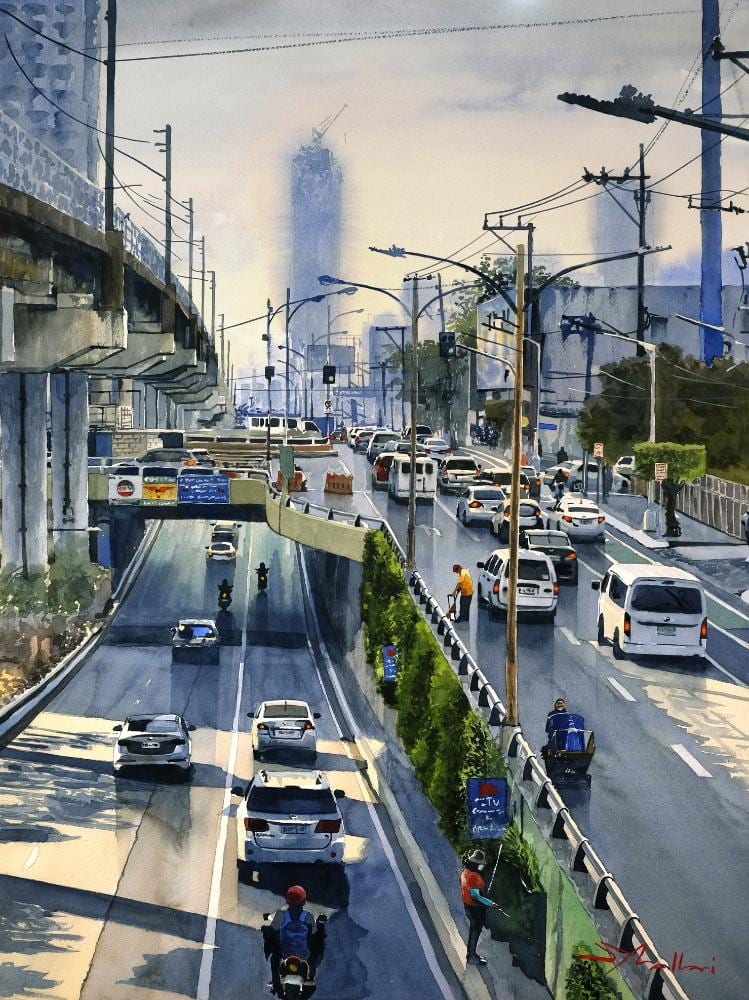
"Unang Pasada"
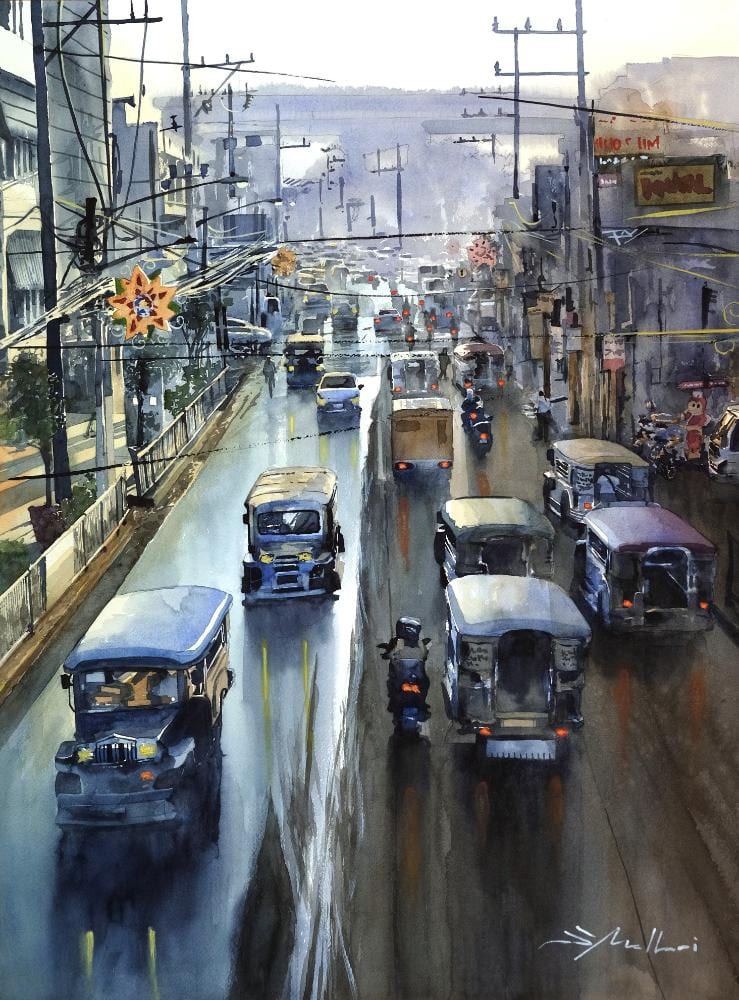
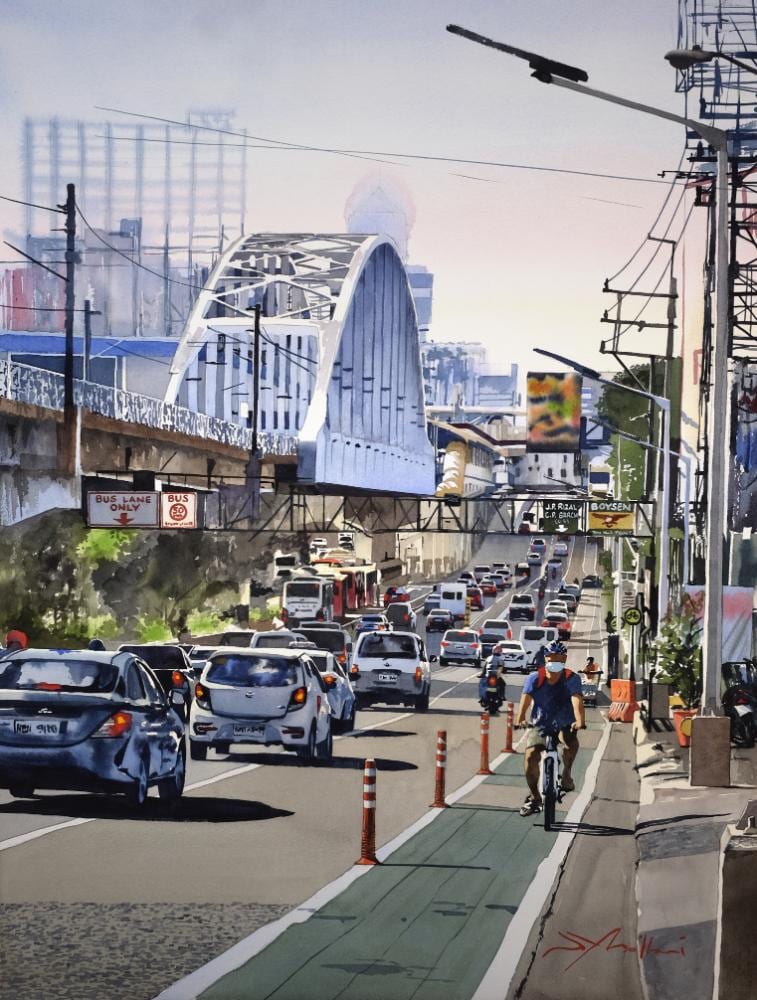
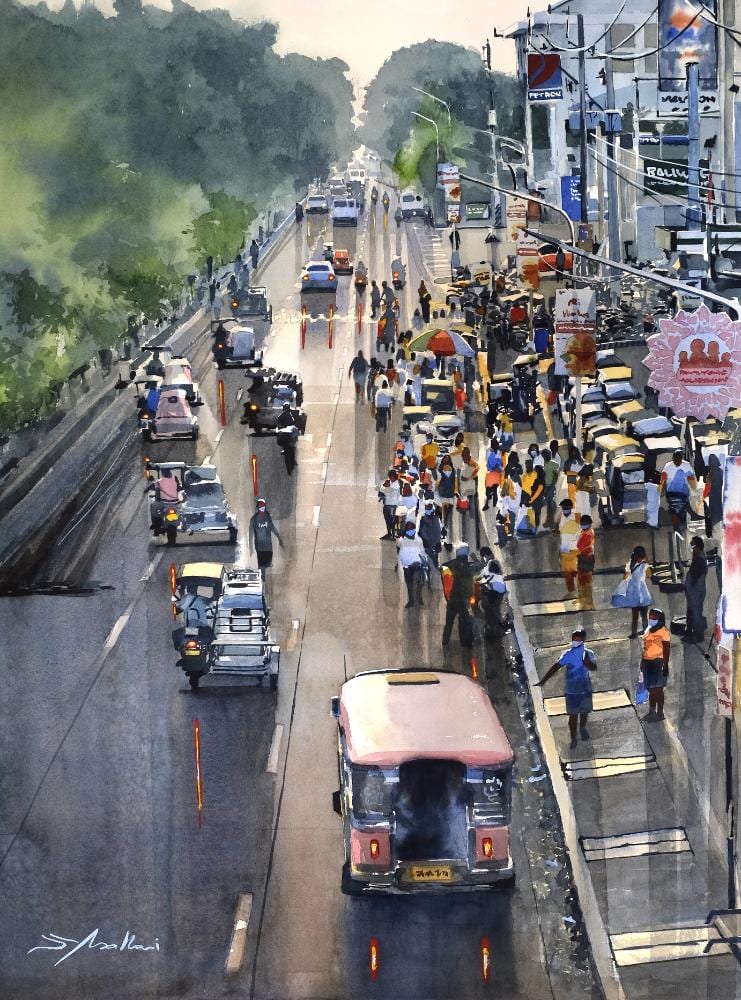
Mallari’s en plein air and genre watercolor (aquarelle in French) paintings offer glimpses of the city’s streets, architecture, and the innate charms of both natural and built environments. They also reflect the prevailing cultures of the people who occupy and traverse these spaces, capturing all the interesting scenes of everyday life. He faithfully captures and echoes the essence of places with an unflinching gaze, transforming the ordinary into something poignant and interesting.
As to why he has chosen to paint in watercolor, he says, “It suits my personality as a traveler because it is portable and even with its difficulty as a medium, my consistent practice made me realize that it is the easiest medium to use if you know how to control it."
"Marikit Home"
Finding Peace and Calm
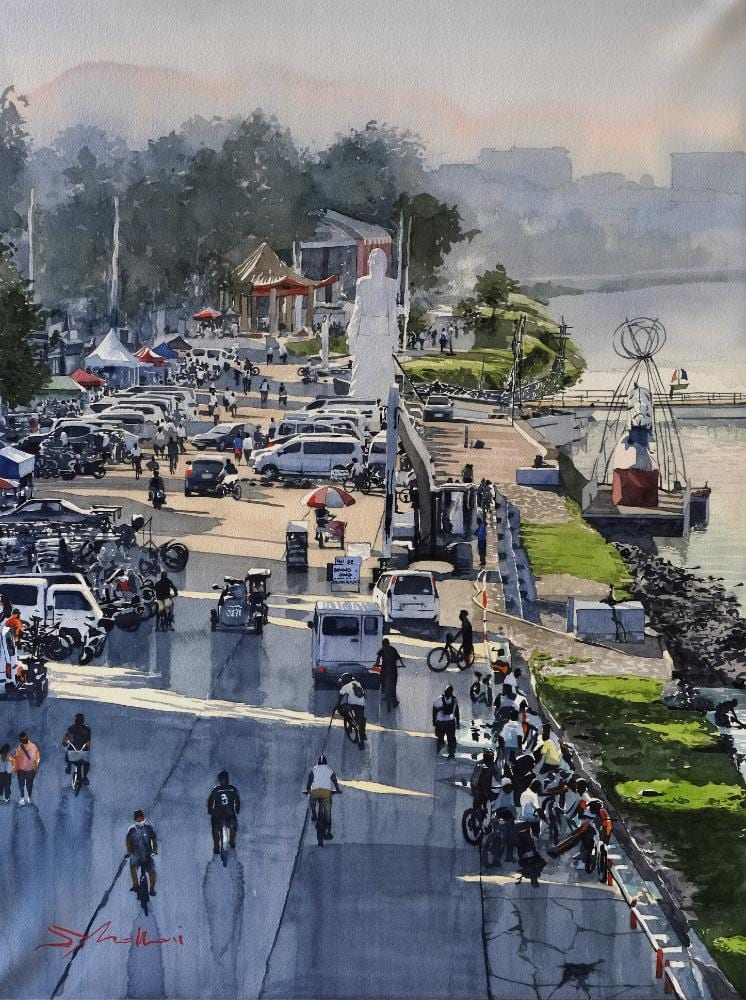
Beyond the spawning concrete buildings, he adds contemporary cues—legible markers that are immediately accessible at this time. These include visible shops, signage, wires, and modes of mobility, as well as other pedestrian features, helping him demonstrate the lush and willful incongruities and intangible contradictions of these spaces and the times he painted them. In his more rural scenes, he is typically drawn to capturing the serene atmosphere that can only be felt outside the cacophonous noise of cities. Otherwise, he paints the ordinary activities of the locals.
Mallari’s work can be deemed fragments and responses to the urban zeitgeist of city centers and love letters to the sublime quality of natural sites. His work can be viewed with such historical notes and documentary fidelity as psychogeographical tools, almost on the cusp between art and journalism. What he provides us with are mental maps akin to those created by geographers, allowing us to engage with spatial knowledge and features of captured at specific times. This aims to record these places for the future, as they are never static and are bound to change.
"Share the Road"
Though landscapes and similar forms of art continue to be sidelined and deemed passé in relation to current forms and directions of contemporary art practices, they remain steadily relevant in generating cultural memories. This is especially true with the burgeoning interest in heritage preservation and tourism in the country, with groups promoting these interests and activities through walk tours, sketch and photo walks, and other similar events.
Amidst the chaotic charm of wild lights, sounds, and restless energy of evolving urban landscapes, marked by continual construction and demolition, Mallari offers silent meditations on his canvas.
Some of his notable works tap into the peculiar ethos of cities culturally available at this time. Just imagine Binondo, Quiapo, Edsa Guadalupe, or Cubao. If he is not in the metropolis, he is probably driving around mostly in Central Luzon, Aurora, and Quezon provinces. He trails the unbeaten paths to find his muse in nature. If he’s not cycling, he regularly treks to the countryside to reinvigorate and rekindle his creativity.
ALSO READ
Movers of Filipino Contemporary Art: 25 Artists We Love
Movers of Filipino Contemporary Art: 30 Gallerists, Collectors, and Curators to Know
His sensibilities, inquiring nature, and leniency towards the rhythms, paces, and charms of the outdoors have become integral to his work and practice. Thus, travel and encounters and the revelations they provide, whether narratives, stories, or anecdotes that shape the spaces he visits, constitute the core of what he tries to often depict.
For Mallari, it’s a way to absorb and soak in the place and the moment. Borrowing the words of the writer Pico Iyer, "You are not travelling to move around but you travel to be moved.' The same goes for Mallari."
But given his choice of subjects, he does not allow his presence to be an interruption anywhere he pursues to paint, and he makes sure he works from between the distances of intimacy and detachment at the same time.
"Urbanites"
Mallari is from Malabon City and obtained his degree in Fine Arts, major in Advertising, from the University of the East-Caloocan in 2002. He has so far done 11 solo exhibitions; the first one was in 2012, titled “Embracing Black and White.” His other significant shows include Manila Now & Then, a two-man show with Alwinder Sarmiento at the Art Circle Gallery in Shangrila Mandaluyong in 2014, and Life on Water at the Galerie Joaquin in 2016."
Also, in 2014, he won the grand prize in the Kulay Sa Tubig Watercolor Competition, the premier art prize for artists working in this medium, regularly organized by Gallery Genesis. He is also one of the founders of The Outdoor Archivists, a group that paints en plein air and aims to archive and record scenes through paintings. For all his creative artistic contributions, he was named a Gintong Parangal Awardee by the City of Malabon.
