

To Be Elsewhere Is to Imagine Possibilities for Visual Artist Lyra Garcellano


ILLUSTRATION: War Espejo
To navigate the art world is to grapple with opposing realities and acknowledge both the bleak and hopeful times, the struggles and small successes, and the harsh and kind gestures that reaffirm our attitude towards our perceived existence and place in that world.
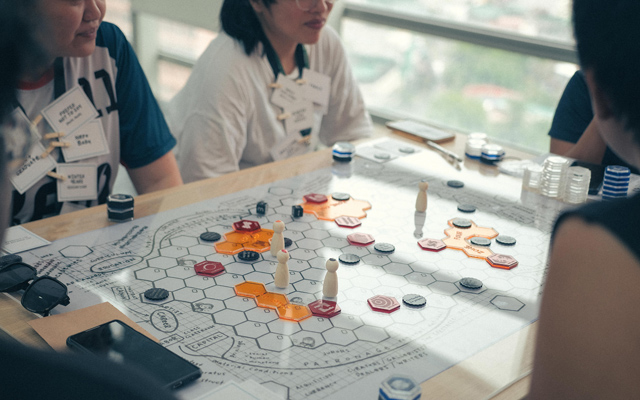
In her newest book, Elsewhere: Writings on Art (2024, Grana Books), Lyra Garcellano gathers essays that she wrote during defining moments in her personal and professional life as a visual artist and researcher. She makes sense of the negotiations and contradictions that artists like her dealt with and are dealing with in order to sustain an artistic practice. Her articulations of various concerns—past and present conditions of the art and culture landscape and its ever-shifting economies—are evident in her early body of works, such as her postcards and videos, and have been expanded in the format of a tabletop game (STAKEHOLDING: Chapter One) that is now presented for playtesting at the Benilde Open, a grant-giving program by the De La Salle-College of St. Benilde. The symbolic and performative aspects in Garcellano’s visual works encourage the viewers to contemplate experiences that inform the myriad of ways individuals and art personnel circulate within a system that operates the art world. In the book, although seemingly coming from a place of fear, at the core of it, her writings combined with her comic strips are actually her own form of resistance by having the courage to be vulnerable.
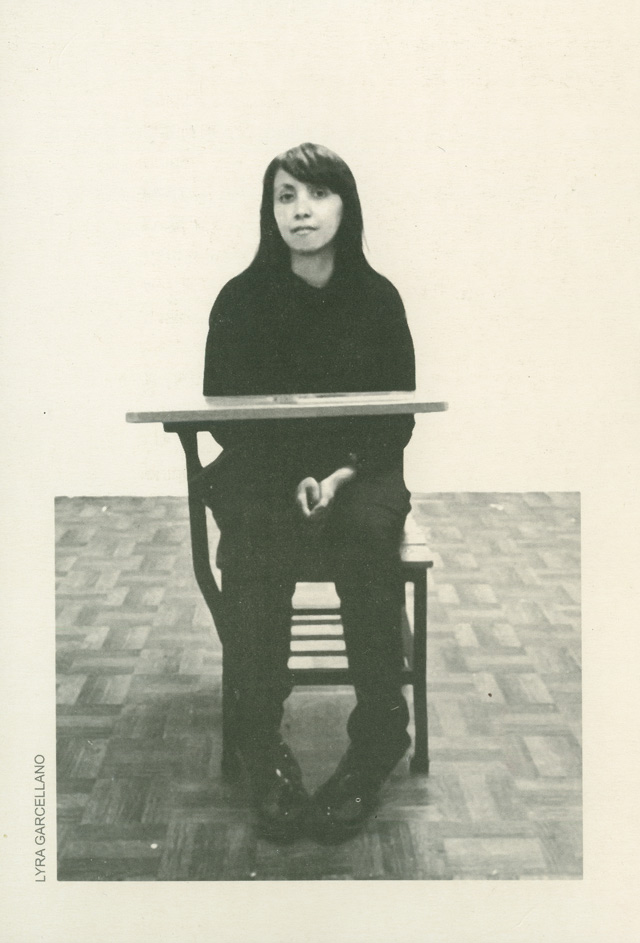
'Double Consciousness' (2014)
ALSO READ
The Merch-ification of Book Publishing
What's the Future of Books?
"When we decided to put up a small press, we said—and this became our sort of tagline or slogan, 'We’d publish works that are not only exciting and challenging but also expand the possibilities for creation.' So I guess this gives the idea about the kind of manuscripts that we are after, regardless of genre or form," says writer and publisher Mesándel 'Ayer' Arguelles, one of the triumvirate founders of the small press Grana Books, together with his wife Jane and daughter Rilkë. He continues, "Lyra’s book is exciting, challenging, and offers so many possibilities in terms of thinking and engaging with art and artmaking."
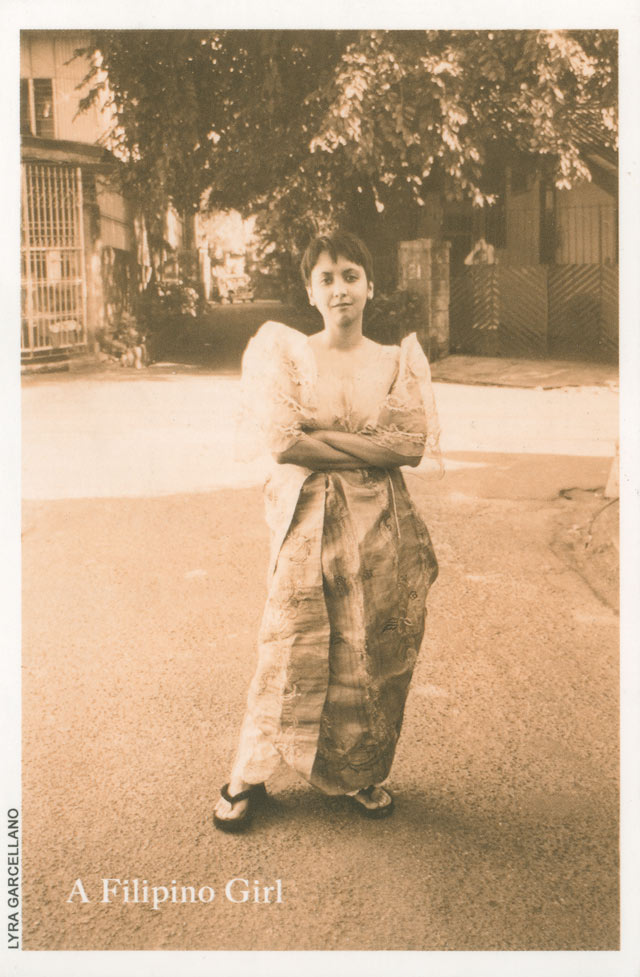
A Filipino Girl (2001)
In an e-mail exchange with Esquire Philippines, Garcellano shared her thoughts on particular essays, as well as the processes involved in the selection of writings and in conceptualizing the book.
Esquire Interview with Lyra Garcellano About Elswhere: Writings on Art
Esquire Philippines: I am curious about the title of your book and your use of "elsewhere." Does this hint at your continued contemplation of your space/place within the complex systems of the different art worlds? Your 2023 essay "Zombie Scrolling," for example, dives into uncertainties and questions that are either impossible to answer, or we already have answers to.
Lyra Garcellano: I recognize in the way I talk with people that the word "elsewhere" has been an integral part of my vocabulary. I seem to use it a lot in regular conversations. That’s probably why the term came up in the essay "Zombie Scrolling," and in the other essays, too. I also like the word zombie—this concept of being dead but not quite—because the compulsion to move as being a critical part of a zombie’s "existence or survival" is creepily and amusingly bigger than life itself.
Interestingly, I’ve noticed that I’m drawn to the phrase "brick and mortar" as well.
I recall using the term "elsewhere" for the first time as the title of my mini-paper in 2010. I was invited to discuss my work, and I riffed the Elsewhere title from a book that I saw on a bookshelf in my house. I like how the word can be a noun or even an adverb.
For me, the word is akin to the phrase "utopian imagination," which was the theme/subject of a conference that was named after my father, Edel E. Garcellano, at PUP in November 2023. Now, I don’t know if I am interpreting the phrase utopian imagination correctly, but I find it as vague as the word "somewhere" or "anywhere."

Esquire Philippines: You are not new to independent publishing. I believe that you also maintain an independent practice outside the gallery system—as a creator, comics illustrator, and writer. How significant is it for you to have your first book of essays published by an independent local publisher, Grana Books? Is this a deliberate decision from your end?
Garcellano: Yeah! I’ve done my small share of independent publishing. It helps that the printing press I often work with is only a block away from where I live. I spend hours in the press whenever I have something to be printed.
Seeing a book that I authored gives me this comforting joy, but I also feel a sense of lingering worry. I’m always in a state of opposing feelings with anything I produce. There are a lot of emotions that go with the production—be it in the idea, the process, the end product, and the work’s afterlife.
I suppose it feels different when it is not "self-published." There’s a slightly altered level to the process, and to the decision-making. The path isn’t unfamiliar, but with Grana Books, it was great because it was a healthy collaboration.
I didn’t feel the dejected isolation of working on something.
I am glad it happened (to have a published book), but I didn’t dream it would happen. What I mean is even if I grew up having an understanding of the publishing world because of my parents and environment, I just didn’t have that space in my head that allotted a big desire to have my own book that is released/produced by another institute or party. I didn’t nurture the fantasy of it much. For a long time, I was satisfied being part of anthologies or having my individual essays published online. Although, those opportunities were hard to come by. So, of course, when Ayer Arguelles offered me the chance to publish my own collection, I was surprised at the thought and beyond excited. It even took me months to accept the idea of the possibility of it.
Come 2024, and a few days before copies of the book were released from the printing press, Ayer and I reminisced about the time when the idea of having a book came about. He sent me a screenshot of our conversation in 2021. At that time, we were talking about how he and Jane were also thinking of coming up with their own publishing (ad)venture, and I joked with him that I hope he has space to publish my comics. Of course, three years later, Elsewhere turned out differently because it wasn't purely comics.
When copies of the book first arrived in the house, I told Ayer and Jane that I wouldn’t go through the pages until after a few days. Sure, I was quietly happy that the book was finally out—but I wasn’t sure if I was ready to read it.
'MIKI BLUE' comics, excerpt from the book
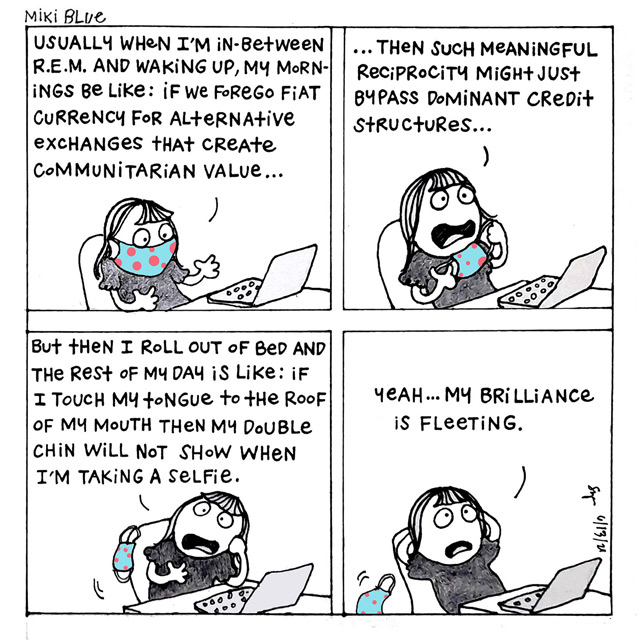
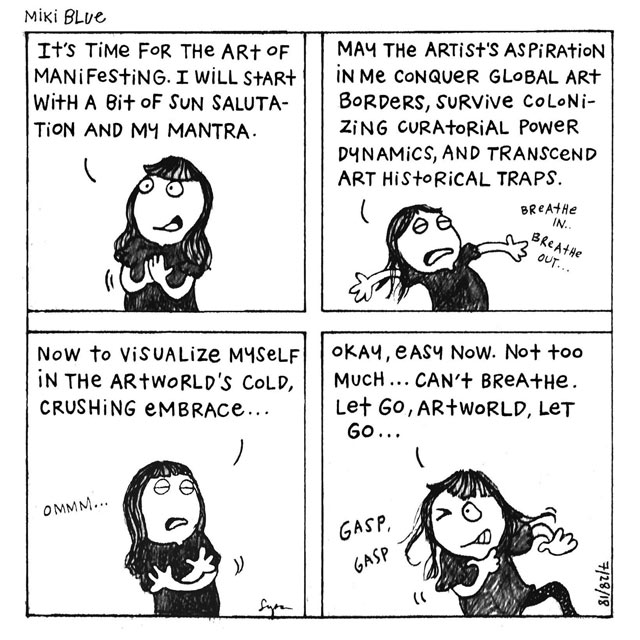
Esquire Philippines: I think I have mentioned before that you were able to cleverly feature some of your artworks and incorporate them as both design and content of your book—your MIKI BLUE comic strips (some with colors), your neon light installation SOUTHEAST ASIAN Artist To be or not to be as cover of the book, and an install shot of your postcard Double Consciousness. The aforementioned works, to a degree, are symbolic of the concerns that you articulated in your book. I wonder why the neon light works as the cover of the book.
Garcellano: Oh, thank you for noticing that. I really feel that the neon that appears on the back cover expands the meaning/definition of the word "elsewhere." That phrase was one of the more significant frameworks I was jumping off from—of being Southeast Asian and how, in that labeling, my life/our lives are already defined. It’s because of such categorizations that we’re constantly made to adjust to the entire world. It’s a type of forced positioning, which, in many ways, I had tackled in the book.
I also liked how the image of the diffused light on the front cover had some people wondering what that blob of light is. When the readers flip the book to look at the back cover and read Lara Acuin’s blurb, I (also) hope they’ll have a thorough understanding of what the neon is all about.
Although the work "Double Consciousness" isn’t so obvious, given it only appears as a video still on the author’s page, I tried to play on "the-me-on-the-telly" as my bio pic. It feels very meta—which is double, double consciousness. Maybe only a very few of those who are familiar with the work will find that cute.
Esquire Philippines: The book features 18 of your essays and a foreword by curator, writer, and professor Eileen Legaspi-Ramirez. She talked about trying and thriving amidst exhaustion. You ended with an epilogue where you also talked about the "meanwhiles"—the world's uncertainties and your own physical exhaustion ([your] "hands are shakier... [your] eyes are blurrier... and [your] speed is lower.") How is it important for you to acknowledge this seeming exhaustion, both physical and mental, while not losing hope for something better despite the seeming helplessness in real life situations?
Garcellano: Eileen is so skilled in making her readers feel exactly as she writes. I was up and down in my emotions reading her piece. I honestly still think about the dog she vividly described.
I always felt that I’ve been slowly eroding since I was born. I’m just gloomily wired that way. It’s my (unfortunate) operating system. Ironically, in a few write-ups here and there, I’m often described as being funny and not serious. That is why I get phone calls from friends when something like that comes out, and a few would say: "Well, someone actually called you cheery. That’s scary."
Then again, it’s probably because there are people who have only seen my comics.
My family has often described me as serious, and the doom and gloom feels run in my veins. So yeah, I exist to be exhausted.
However, on a serious note, aging and "peaking" (physically and even socially) aren’t easy things to accept. Maybe I’ve internalized capitalism and have functioned far too long with this twisted belief of life being commodified and that to become obsolete in this society is the terrible, inescapable way of the world.
As a painter, I feel my hands already hurt a lot. My fingers are dead-ish, and I feel [that the way] I painted 10 years ago is different now because my brushstrokes are unintentionally different.
So, yes, aside from the physical exhaustion, my weariness also comes from the constant emotional and even mental weight of knowing that the world is sick and I’m helpless to do anything about it. I'm not an overly hopeful person considering the kind of local and overseas current events we are living with.
Yet, even if I exercise and seem to flow from cynicism, I'm still honestly buoyed by others who persistently fight the good fight (because that is something I cannot do as I get easily depressed). Sometime back, I saw a timely quote attributed to Eduardo Galeano on my Facebook feed—"To be defeated and not to surrender is victory."
I just had to google and find out more.
But guess what? A few people have said my writings seem to circle on hope. I wonder where that reading comes from. Still, I suppose that’s a good thing.
'MIKI BLUE' comics, excerpt from the book
Esquire Philippines: Your earliest essay is from 2002, followed by an essay from 2014. There seems to be a big gap here. Out of curiosity, how did you select what essays to include in your book? Could you recall what took place and why there were no entries from 2003 to 2013?
Garcellano: Yeah, it did jump from 2002 to 2014. Was that weird for you? Originally, I had planned to begin the timeline with an essay from 2018. But I suddenly thought of including the 2014 essay on artist-in-residency programs (AIRs) because, strangely, it still made sense. A lot of people don't have an idea what AIRs are, and I often get asked to describe them. I thought it would be something I could include in the book just so certain readers not familiar with the scene can get a definition. It’s a 10-year-old essay—that should be a sign for me to be rewriting that piece already.
While working on the book, I also looked at my very first published 2002 journal. The journal wasn’t widely circulated because it was meant to be just an end product of an artist-in-residency program in Jogjakarta, Indonesia. After I reread it (to find out who I was 20 years ago), I just felt I needed to share that snippet about Dwight. That was 22 years ago, and yet, here we are living in a world where it feels we haven’t progressed at all.
What did I do from 2003 to 2013? I was working, doing art, and living life as a Filipino artist—which means a life full of everybody else’s similar experiences. I wasn’t, and am not primarily a writer, but I did deal with a lot of text-based works during those years. I also got into relationship heartbreaks (the icky kinds), and I went to grad school in 2011.
I wrote something in 2010 where I voiced concerns about how, in art practice, practitioners are made to feel extinct or outmoded because many opportunities become limited to people over 35 years old. Of course, a few programs have now been rewritten and re-imagined, with some institutions taking out the age clause. However, not all have done that.
Unfortunately, I couldn’t find that essay anymore. It was published online, but the site has closed down, and since I’m not particularly good at collecting or documenting (or archiving) my works, I no longer have a copy of it.
STAKEHOLDING: Chapter One, a tabletop game on display at the College of St. Benilde for Benilde Open until June 30
Esquire Philippines: My first encounter with your writings was when I got to read your essay "Prestige Machines and Performance Anxieties," an essay found in Ctrl+P Journal of Contemporary Art. I would forward this essay to fellow writers as recommended reading. The essay actually sums up your thesis for your master's. I felt uncomfortable when I first read, perhaps because, in one way or another, I found myself in different scenarios you cited in your essay. It made me conscious that I have been "performing" whether I like it or not. How important is it for you to come from certain uneasiness/discomfort to confront our realities as artists and cultural workers
Garcellano: Thank you so much for helping circulate that essay! This is a difficult question. But let me try to formulate something that will sound sensible.
Looking at my essays (and even my toons, as well as paintings, installations, etc.), I acknowledge that I moved from a place of uneasiness/discomfort. I tend to write so I can study and understand things. Even my toons come from a level of discomfort because the uneasy topics I jump off from when tackled with humor come across better nuanced (for me, at least).
Also, as a visual artist whose primary platform is undeniably the white cube, I tend to navigate in designated routes associated with such spaces. I suppose I didn’t know any better. But traversing (and performing in) those spaces are always fettered with hard lessons, and I observed that we/I actually develop unhealthy coping mechanisms when immersed too long in such environments.
Having said that, I’ve been encouraged by the idea of carving spaces because it's better than being stuck in a hole crying. As I learned along the way (and at times, not early enough), I realized that to expand into other liminal spaces/territories where my research can potentially find temporary placement of sorts is what I must continually and logically explore—it helps with the sanity. Or simply help develop a better awareness of other important things in life.
Then I occasionally hear "sayings" like this: “It is essential to figure out where to go in life independently.” Or something like that. This again adds another layer to the discussion because what does it actually mean to be independent? Does being "independent" refer to having access to resources? And so another round in our life as practitioners gets dissected again.
At times, my answer to the question "If you win the lottery, what would you do" is as simple and small as saying: "I want to have literal physical space." I want a room with a desk because I don’t have a desk. I don’t have a table because it won’t fit my already cramped room—thus, my bed is my desk.
I always had to improvise or make do with what was only available. I practically wrote my entire grad school thesis using the ironing board—"caballo," as we call it—as my table.
But going back to the idea of "independence," I like to relish in the fantasy of having access to all the resources I can think of.
Esquire Philippines: Eight essays are from 2023. I am aware that you wrote these during your residencies and in between a lot of other things, such as a group show at Mono8 and a solo show at Underground Gallery.) These most recent essays show tropes (even referencing a K-Drama), navigations, negotiations, interactions, and exchanges that are actually not far from realities, or perhaps actual realities at present that we could also possibly experience. At some point when reading these essays, there’s this realization that such experiences attribute actual events, realities, and ponderings from a practicing artist like you. What do you want readers to realize, most especially those who are not familiar with the "tropes" of the art world and are confronted by the realities you presented?
In your epilogue, you mentioned your parents. I am wondering if, to some degree, you were influenced by your parents—journalist, essayist, and author Rosario Garcellano and poet, critic, novelist, and teacher Edel Garcellano—in becoming a writer. If yes, in what way did they influence you?
Garcellano: Yeah, it all seemed that a bulk of my essays were written in 2023. I actually started writing most of them in 2020 during the lockdowns. The essay regarding the auction was first written a little after the performance in 2019. But in the three years I began working on it, I just kept on butchering it and rewriting every chance I got. By the time I felt I could accept the elements I wrote in most of the essays, it was already 2023. Until now, I still feel the need to add stuff to some of the pieces.
I suppose the objective—my bare minimum goal—is for the readers to become aware (if they aren’t already) of what’s been happening in the world/field. Well, it's not as though I have experienced all the permutations in an "artist’s" life. Obviously, people have different experiences.
However, with what I wrote, some are reminded of their own personal and individual moments, situations, or versions. I know that as stakeholders, we all come from different positions in the art world, and I understand that I only touched on a small percentage of the scene based on what I know. Surely, there's a world that's bigger, wider, more uncomfortable, poignant, and even more (or even less) meaningful than what I have experienced.
Going back to the subject of spaces and the limited access to them—and this is not always to refer to physical ones, in the book, I spoke about professional and personal aspirations as being dependent on one’s economic portfolio, and in another essay on how our passports influence the space and time allotted to us by the world at large. Such examples of "normalized" inequalities, which are also evident in our daily realities, are something I feel must be talked about. That’s why I talk about them.
I don’t offer messianic solutions because I don’t have any. But I can suggest ideas. I would also like readers to look at their realities based on the things I've experienced and observed as an art practitioner. I’m definite that the readers will reflect on their experiences too after having read about mine.
As for my parents having an influence on me, there’s no escaping that. I've often said—sometimes in jest—that I carry such heavy baggage, given that my parents are known for their writings and ideas. My father is a theorist (can’t use the past tense on him even if he passed in 2020), and I’m only recently learning from his writings. My mother is known as a brilliant essayist. Her prose is something I wish I could do.
I also tend to feel that if I had met my father at a time when I was ready to understand what he was trying to say (most of his students can still quote him, whereas I can’t), my perception of life would probably be different. Of course, I had lived the bulk of my life with him when he was still around, but he and I had a regular father-daughter relationship. Discussing theories wasn't something we did. We were too stuck in the busyness of daily living and domestic chores.
And given all that, if people enjoyed my writing in Elsewhere, I would happily say thank you very much.
This conversation has been edited for clarity and length.
Elsewhere: Writings on Art (2024, Grana Books) by Lyra Garcellano is available on Lazada for P650.
