

The Mystery of the Green-faced Parrotfinches


In his 2015 article “Green-Faced Parrotfinch Explosion in Letran Bataan,” Fr. Oscar Novem Enjaynes, fondly called Father Auckhs, wrote in eBON, the official newsletter of the Wild Birds Club of the Philippines (WBCP):
"But there is this one recurring question that everyone is asking about these birds – what happens in between flowering bamboo seasons? To many, including myself, the Green-faced Parrotfinch remains a mystery. The only clue to this bird is the flowering bamboo. That is perhaps the reason why, in local terms, this bird is called Mayang Kawayan. But aside from flowering bamboo, it is as if this bird does not exist. According to the Kennedy Guide, there is no breeding information. So, I asked myself this simple question – where do they roost?"
Father Auckhs was a Dominican priest and the former vice president for financial affairs at the Colegio de San Juan de Letran Bataan in Abucay. He was a dedicated member of both the WBCP and the Wild Bird Photographers of the Philippines (WBPP).
ALSO READ
Unique Adventures and Rare Sightings at the 1st Vietnam Bird Race
Why Are Thousands of Birds Flocking to Bataan?
In 2015, more than a thousand Green-faced Parrotfinches were sighted in Letran Bataan. This irruptive event—a sudden appearance in large numbers—added to the ongoing mystery of the parrotfinches.
Father Auckhs passed away in December 2020 at the age of 51 after collapsing while climbing the country's highest mountain, Mt. Apo. Today, he is remembered once again with the reappearance of the parrotfinches in Baras, Rizal. Many bird enthusiasts recall seeing this rare bird for the first time during the birding sorties he hosted back in 2015.
Green-faced Parrotfinch feasting on bamboo flowers in Abucay, Bulacan, 2015.
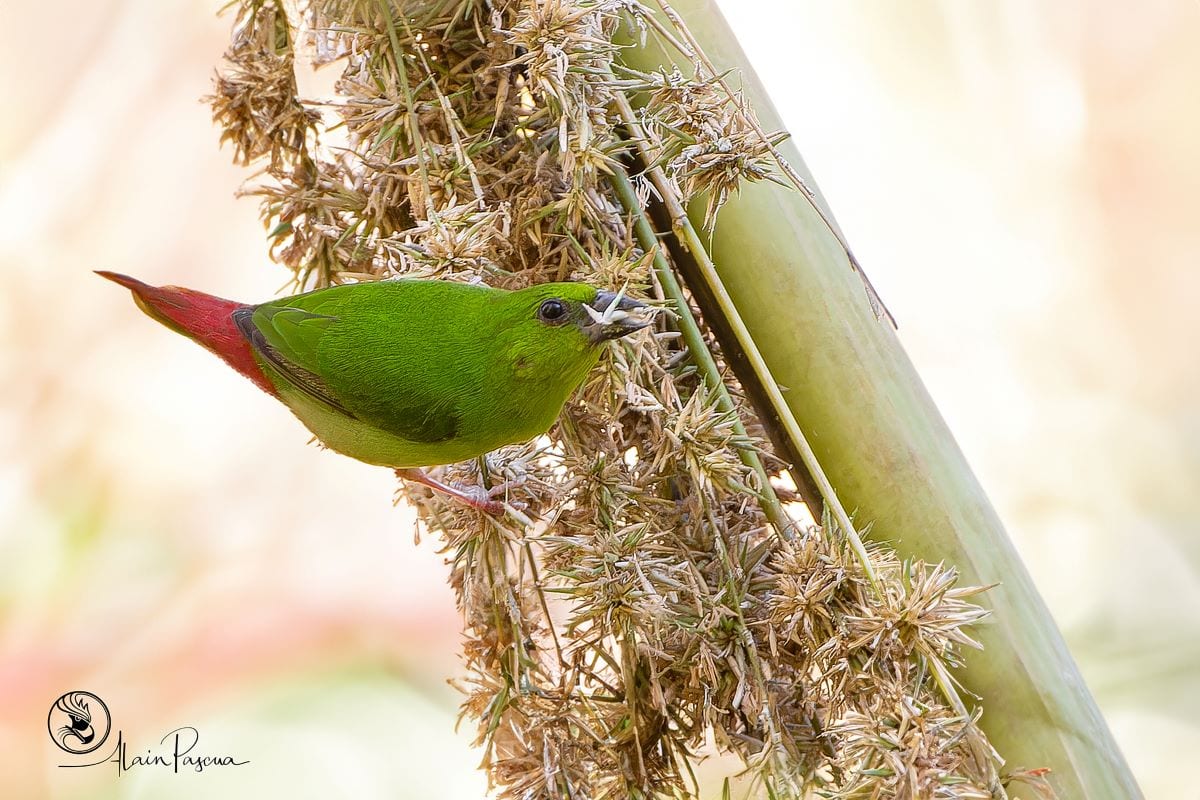
In search of the Green-faced Parrotfinch
The Green-faced Parrotfinch, or Erythrura viridifacies, is a bird endemic to the Philippines. It is classified as endangered because its population is believed to be declining rapidly, largely due to massive habitat loss and trapping for the pet trade. These birds, along with the Java Sparrow, various Munias, and the Eurasian Tree Sparrow, are dyed in different colors and were favorites at Sunday sales in churchyards. The International Union for the Conservation of Nature (IUCN) and BirdLife International estimate its population at around 6,000 to 15,000 adult individuals.
Another notable moment in Philippine birding occurred in January 2013 when the Green-faced Parrotfinch was spotted by Dr. Joey Soriano, a member of WBCP, in Samal, Bataan. At that time, the bamboo plants were in bloom, and when the flowering ceased, the birds disappeared, only to be sighted again two years later. Father Auckhs reported their presence in nearby Letran Bataan in 2015, when the bamboo plants started to bloom on the campus.
The bird was observed feeding on the flowers of a bamboo variety that blooms every 10 years. However, the flowering of these bamboo plants also signals their death, which in itself is a mystery. While it is believed that the birds feed on bamboo flowers, how the species survives is unclear given that the bamboos flower only every ten years and then die. Do the birds migrate from one flowering bamboo grove to the next? Are there enough bamboos flowering in succession to sustain their population?
In 2017, Dr. Soriano noted that the bamboo groves where the birds were spotted in 2013 had disappeared. Since then, there have been no sightings in that area.
Green-faced Parrotfinch in Baras, Rizal, photographed in 2024.

Surprising diet
There have been reports of several sightings of the Green-faced Parrotfinch in other places. But they did not spark the same curiosity about their mysterious appearance, nor did they attract birders or create a buzz within the birding community—until a recent sighting.
On May 11, 2024, Raphael Jordan managed to photograph the Green-faced Parrotfinch in Baras, Rizal. His colleagues from WBCP—Forest Jarvis, Bom Gomez, Timmy Romero, Bambi Martinez, and Michael Dagnelie—spotted the birds and reported their findings on social media. Soon the birding world was abuzz, and groups of birdwatchers and photographers began flocking to the site.
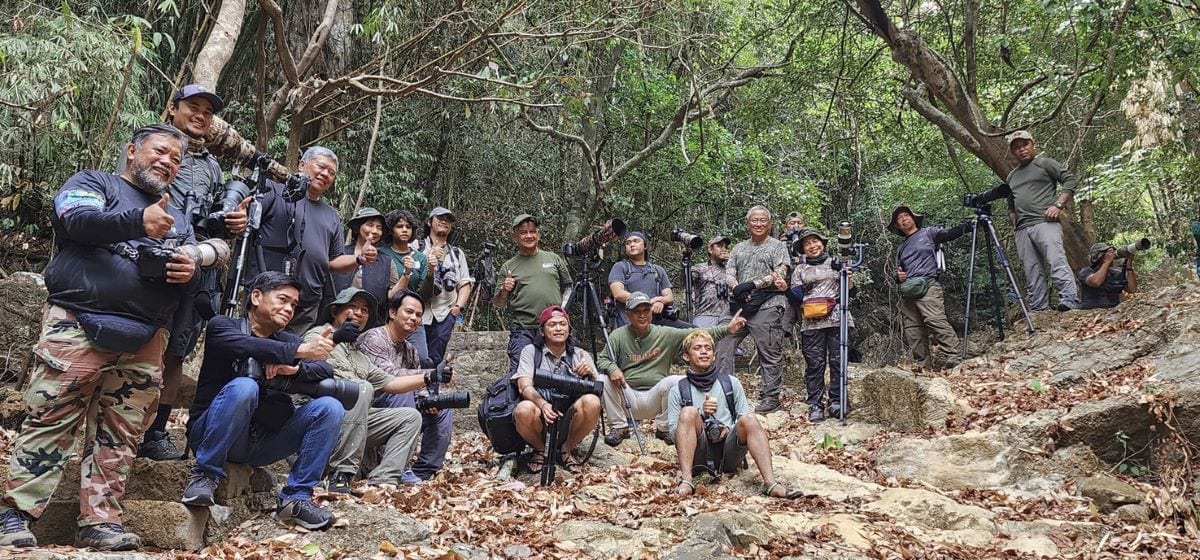
Although no more than 50 birds were spotted this time, the sighting attracted many interested birdwatchers and bird photographers who visited the area day after day. At one point, the number of enthusiasts reached about 25, raising concerns about the safety of visitors and the area, which is undergoing some kind of land preparation. As a result, restrictions have now been imposed in the area.
Amidst the excitement of once again seeing this rare bird, another mystery began to unfold. Although there are bamboos in the area, none were in bloom at this time. Instead, the birds were settling in some water patches in a dried-up river with large boulders, picking up snails. It turns out that snails, not bamboo flowers, were what interested the parrotfinches in Baras.
Birders in Baras, Rizal
When I asked members of WBPP if the birds were eating the soft inside of the snail shells, Albert Abaricio replied, "There was no indication in my photos that they ate the soft flesh of the snail." When I inquired further if the Green-faced Parrotfinches use the snail shells to scoop water, he replied, "No. Some of them take snails from dry parts of the shore."
Gid Ferrer said he saw in his video that the bird is gulping something. Edwin Martinez has a video of the bird sipping the liquid from the snail shell. Prof. Ferdie Llanes mentioned that the bird appears to suck only the liquid from the shell, as someone checked a shell after the birds had taken off and found that the inside meat or mollusk's body was still intact.
WBPP external vice president Steve Albano believes that the Green-faced Parrotfinch drinks the juice of the snail. He said that the bird instinctively drops the shell into the small stream to collect water. After a few seconds, it picks up the shell and sucks the juice from it. Remarkably, there is no breaking of the shell.
Lu-Ann Fuentes-Bajarias, a WBCP member, wrote in her post, “One of this Green-faced Parrotfinch pair appears to have already chosen its preferred snail shell but relinquishes it to an insistent partner, who then proceeds to use it as a water scooper. Questions that came to mind (as a non-biologist): Does drinking water from naturally decomposing shells provide birds with minerals or even 'grit' for digestion? Does this activity of picking snail shells together also figure into courtship? Perhaps because the calcium carbonate aids in eggshell formation?” Watch the videos of Bajarias here.
These observations brought back memories of the pigeons that have been mysteriously, but regularly, flocking to the coast at certain times of the year. This phenomenon was observed and recorded by Richard Ruiz and Petus Calupe, WBCP members in Ilocos Norte, from 2011 to 2014. It is a mysterious annual ritual that takes place every year on the rocky coast of Pasuquin, Ilocos Norte, when a flock of endemic Philippine birds called "Barog" or Spotted Imperial Pigeons (Ducula carola) leave their forest habitat to congregate on the coast. Many believe that perhaps they perform this ritual to ingest calcium and other nutrients needed to strengthen their eggshells.
We have yet to solve the mystery of the Green-faced Parrotfinch's bamboo flower-eating habit from ten years ago and the irruption associated with it. Now, we face another mystery involving freshwater snails. For now, we can only let the mystery of the Green-faced Parrotfinch unfold and hope that someday, someone will unravel it for all to understand. That is part of the beauty of birding. In one way or another, the mystery of birds unfolds before our very eyes.
Alain Pascua is the co-founder and president of Wild Bird Photographers of the Philippines, a member of the Wild Bird Club of the Philippines, and author of "Haring Ibon: The Great Philippine Eagle" and co-author of "Endangered Bird Species of the Philippines." He served as Undersecretary of the Department of Education of the Philippines from 2016 to 2022.
