
Unique Adventures and Rare Sightings at the 1st Vietnam Bird Race

We have just returned from the recently concluded 1st Vietnam Bird Race, organized by Vietnamese ornithologist Nguyen Hoai Bao. He also heads the Vietnam Wildlife Photography Club, Wildtour Co. Ltd, and the Wild Bird Hotel, entities behind this exciting event.
Twenty teams participated in the race, including two teams from Malaysia, one from the Philippines, one from Cambodia, and two individual photographers from Peru and Norway who joined Vietnamese teams. In total, 77 bird photographers and birdwatchers comprised the teams. Representing the Wild Bird Photographers of the Philippines (WBPP), we competed as Team Pilipinas.
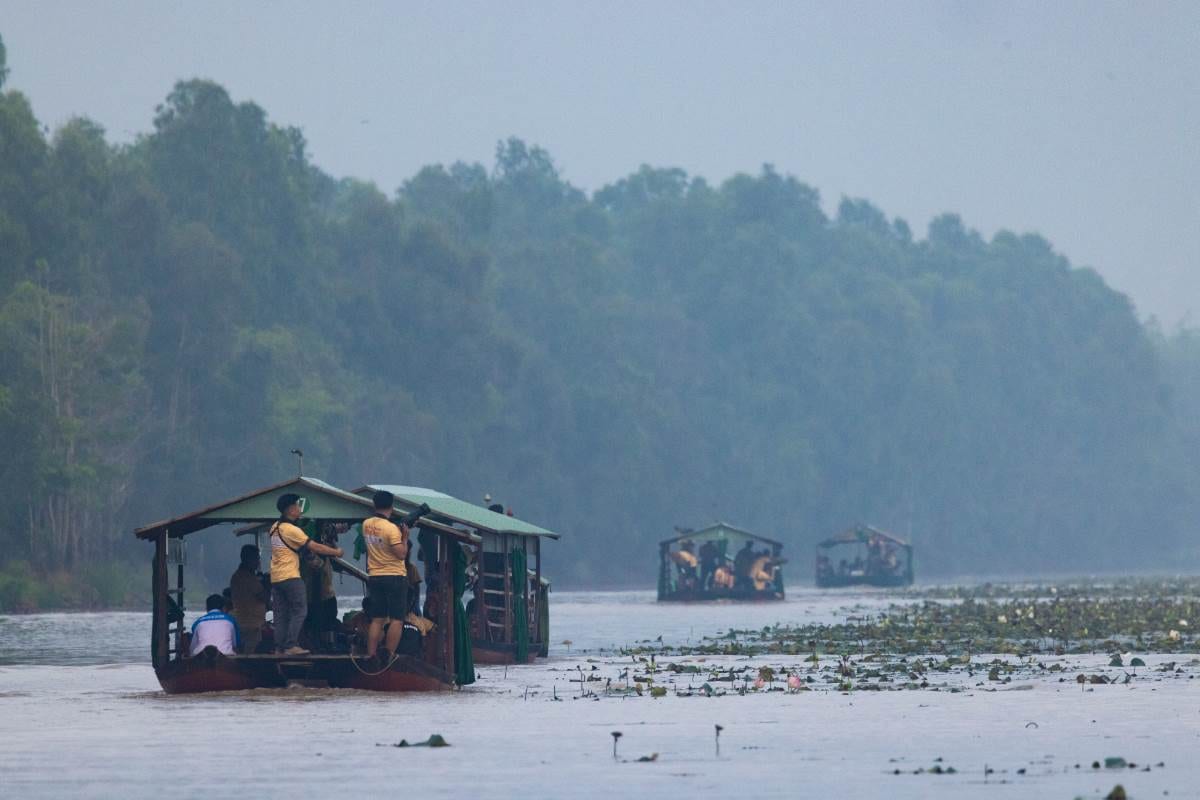
The Vietnam Bird Race is quite unique as all participants have to search for birds in the wetlands by boat.
After arriving at the Tan Son Nhat International Airport in Ho Chi Minh City at 12:25 a.m. on May 10 and clearing Immigration and Customs, we drove straight to Tram Chim National Park in Dong Thap province, about 147 kilometers away. We reached the Wild Bird Hotel around 5:00 a.m. Although the organizers had provided a bus for foreign delegates at 1:00 p.m., we chose to drive earlier to maximize birding time, despite the extra cost.
We thought we would be the first participants to arrive at the venue, but to our surprise, some Vietnamese birdwatchers were already having breakfast at the hotel's restaurant, waiting for their boat rides. They were a few minutes ahead of us while we unpacked, set up our camera gear, and quickly grabbed breakfast.
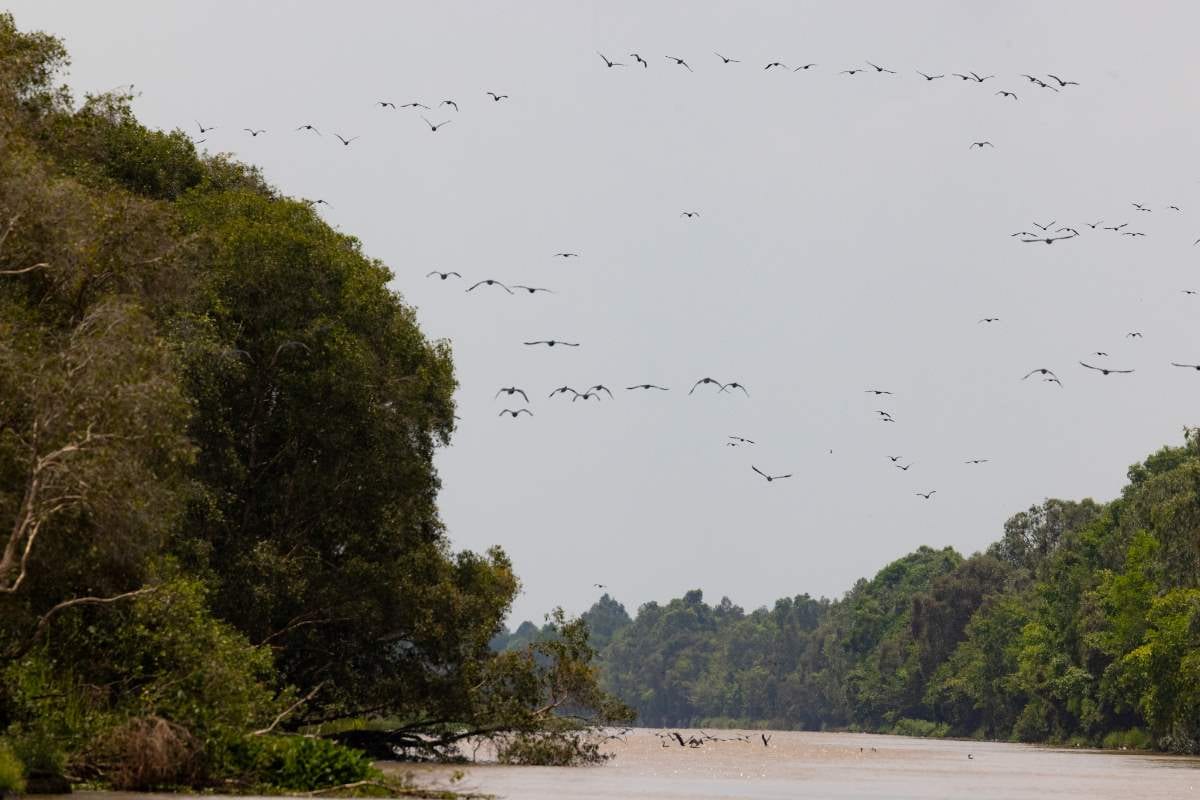
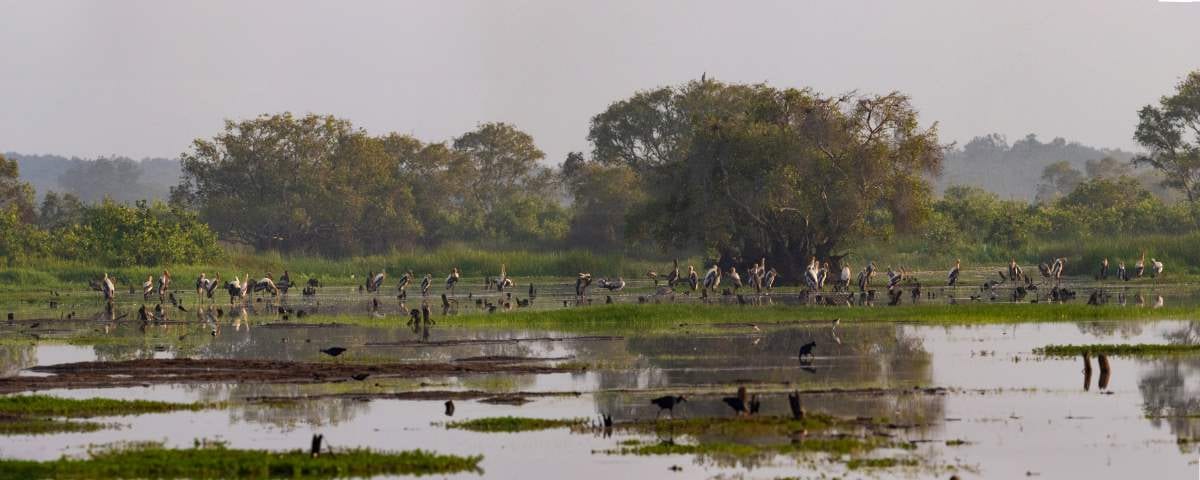
Our team spent the entire morning on the boat, focusing on capturing quality shots of birds, which would not be possible during the race. The race prioritizes quantity over quality in bird photos. The morning boat ride gave us a clear overview of Tram Chim National Park, a wetland in the Plain of Reeds in Vietnam's Mekong Delta. The park was established to restore a degraded wetland and protect several rare birds, particularly the Sarus Crane, a species on the IUCN Red List.
ALSO READ
What's the 'Ibong Adarna' Doing in Antique?
This Philippine Bird Is Unfortunately Called Taeng Baboy
I was quite disappointed that we couldn't see or photograph the Sarus Cranes, which, we later learned, have become a rare sight because the water level in the park is quite high. Sarus Cranes prefer shallow wetlands where they can easily reach food sources with their long legs and beaks.
Birds spotted during the race
My photos of the Sarus Cranes, which were once on display at the National Museum of the Philippines, along with a taxidermy bird, were taken in Cambodia.
The boat trip that morning showed us how hot it can get at 10 a.m. to noon. So, our first task for the race was to prepare an ice bucket with water bottles and get wet face towels from the hotel to keep us cool. This provided the comfort we needed during the extreme heat.
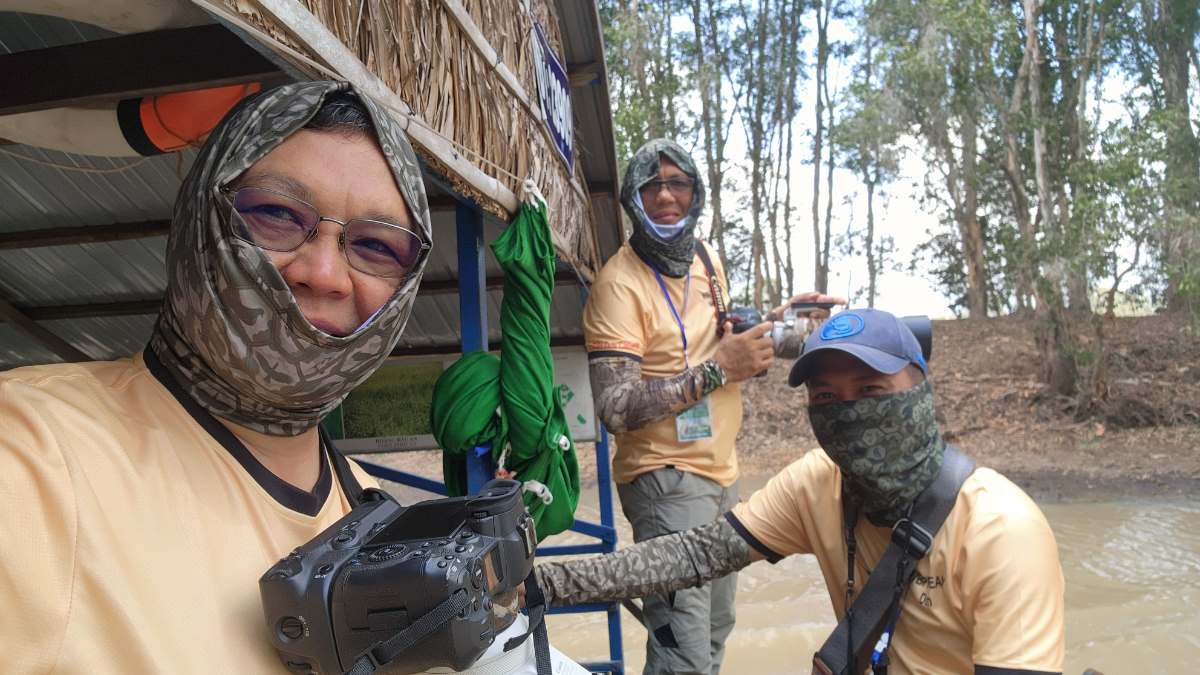
During the race, we discovered another cooling method: soaking multifunction neck tubes in ice-cold water and wearing them over our heads, leaving only our faces exposed. These neck gaiters, which can also be used as face masks, headbands, or beanies, were more effective than cold towels. It felt like our heads were filled with cool air.
Team Pilipinas cooling under the extreme morning heat
Eagle eyes and high-tech lenses
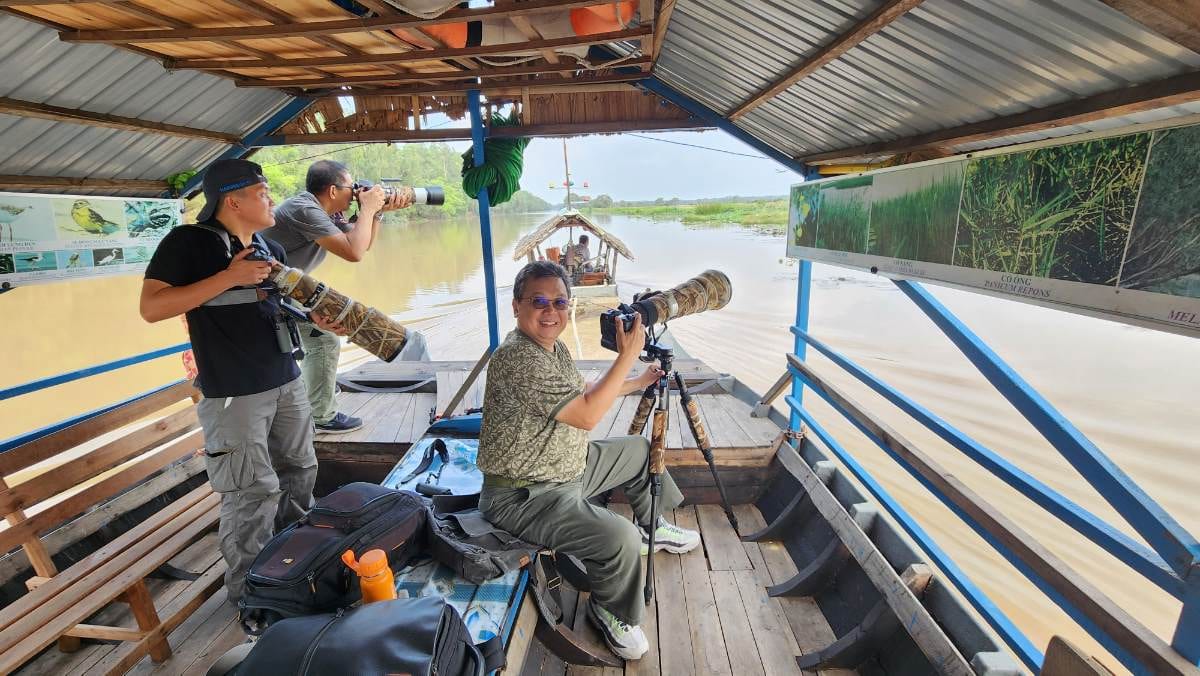
Loel Lamela (WBPP trustee) and Djop Tabaranza (WBPP treasurer) were at the rear bow, tasked with photographing birds over 50 meters away. Loel used a 600mm lens with two 2x teleconverters to extend his range to 2,400mm. I asked how he managed this, as I could only combine a 2x and a 1.4x teleconverter from different brands when photographing the Philippine Eagle in 2014. He explained that he used two versions of Canon's 2x teleconverter, versions II and III.
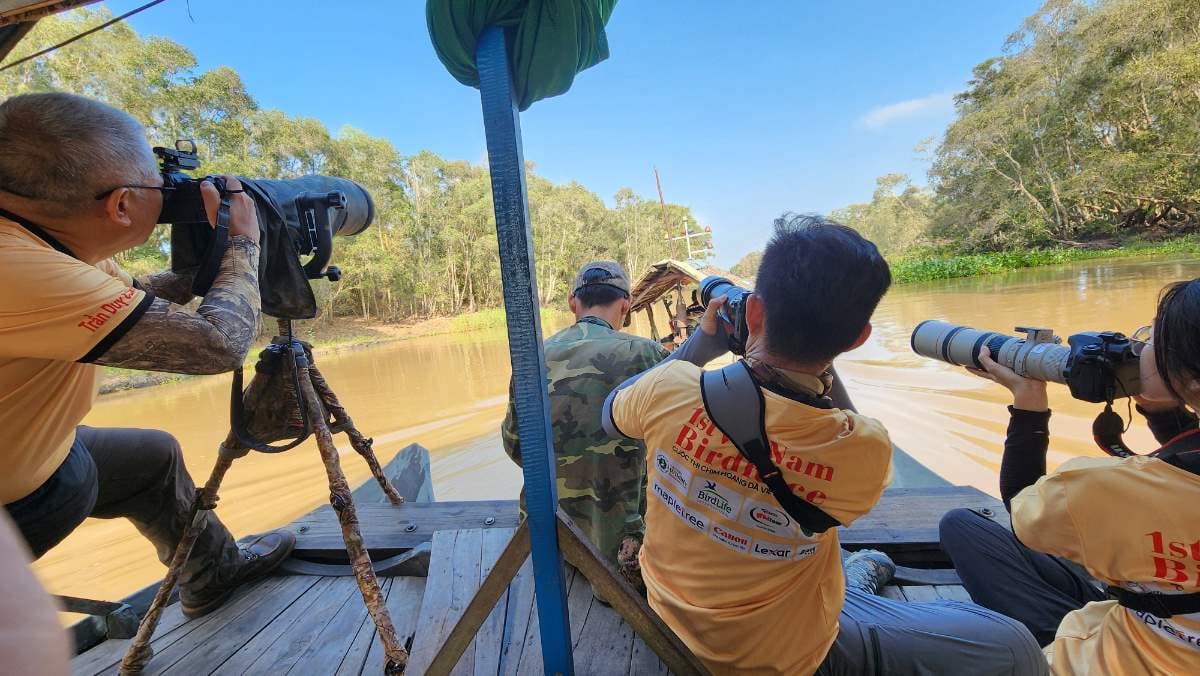
Prof. Bert Madrigal (WBPP secretary) and I were positioned at the front bow, specifically tasked with photographing birds less than 50 meters away. I used my 100-500mm lens, while Prof. Bert used a 400mm f/5.6 lens. We handheld our lenses to stay flexible and ready for action.
Alain Pascua seated in the boat
Djop and I used Optisan binoculars to scout bird areas. Haring Ibon-Birds in Focus distributes Optisan optics in the Philippines. The clarity of these binoculars helped us identify birds from a distance. Our targets were sandpipers and plovers, which we thought would tilt the balance in our favor. Unfortunately, we could not find these migratory birds that usually congregate in wetlands. Perhaps they had already left as the migration season had come to an end, which made me wonder why the bird race was held at the tail end of the migration season and not at its peak.
After the morning boat trip, Loel, Djop, and Prof. Bert birded in various areas near the Wild Bird Hotel. I stayed back at the restaurant to finalize a presentation I would be giving to the participants in the evening—an introduction to Philippine birds, the three major events happening in the Philippines this year, and the various birding tour packages offered by Bird Finder Philippines, to which we also belong.
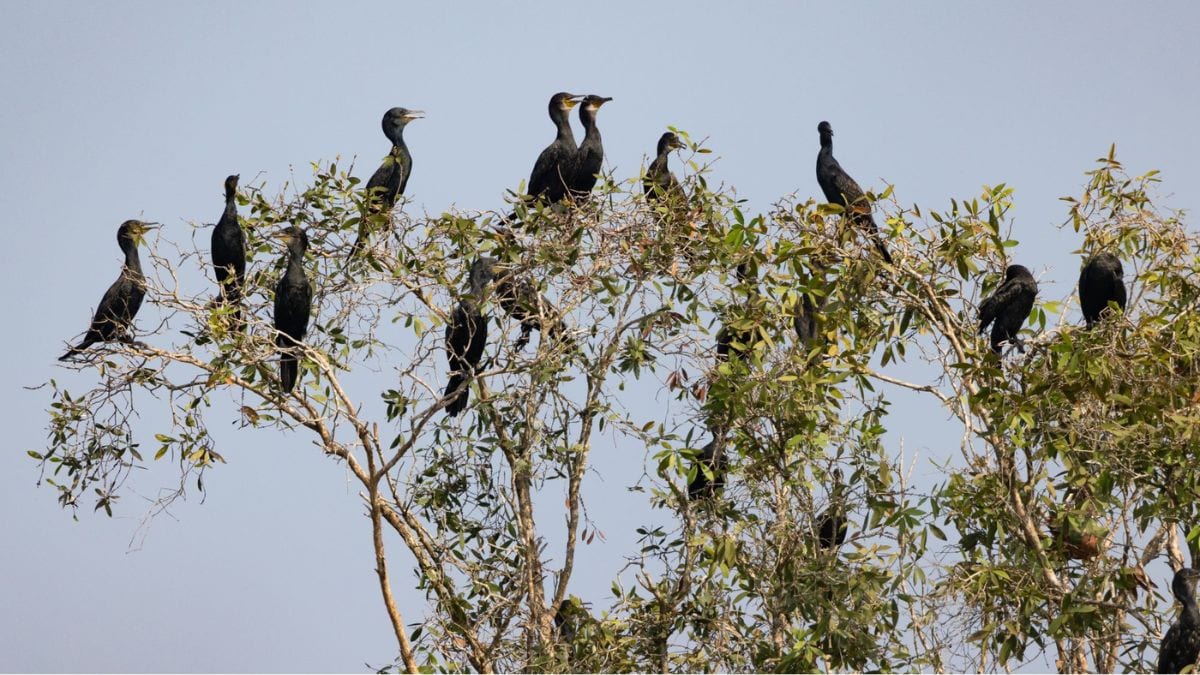
WBPP Team Pilipinas photographed around 68 species, securing fourth place. The 68 species we photographed are: Asian Green Bee-eater, Asian Koel, Asian Openbill, Black Bittern, Black-crowned Night-heron, Black-headed Ibis, Black-winged Kite, Black-winged Stilt, Blue-throated Bee-eater, Bronze-winged Jacana, Brown-throated Sunbird, Cattle Egret, Chestnut Munia, Chestnut-tailed Starling, Chinese Pond Heron, Cinnamon Bittern, Collared Kingfisher, Common Iora, Common Moorhen, Common Myna, Common Tailorbird, Coppersmith Barbet, Cotton Pygmy Goose, Eurasian Tree Sparrow, Freckle-breasted Woodpecker, Germains Swift, Glossy Ibis, Golden-bellied Gerygone, Great Cormorant, Great Egret, Greater Coucal, Grey-headed Swamphen, Grey Heron, House Sparrow, Indian Cormorant, Indian Spot-billed Duck, Intermediate Egret, Lesser Whistling Duck, Little Cormorant, Little Egret, Little Grebe, Malaysian Pied Fantail, Oriental Darter,l Oriental Magpie-Robin, Oriental Pratincole, Oriental Reed Warbler, Ornate Sunbird, Paddyfield Pipit, Painted Stork, Pied Kingfisher, Pink-necked Green Pigeon, Plain Prinia, Plaintive Cuckoo, Purple Heron, Racket-tail Treepie, Red Collared Dove, Scaly-breasted Munia, Scarlet-backed Flowerpecker, Spotted Dove, Streak-eared Bulbul, Striated Grassbird, Striated Swallow, White-breasted Waterhen, White-rumped Munia, Yellow Bittern, Yellow-bellied Prinia, Yellow-vented Bulbul, and Zebra Dove.
One of the highlights of the competition was the appearance of two migratory bird species: the Comb Duck and the Northern Shoveler.
We missed three key species: the Large Scimitar Babbler, a Skylark species, and the Black-capped Kingfisher. We didn’t spot the Collared Scops Owl or the Large-tailed Nightjar, having opted to relax over beers instead of night owling. We also missed sightings of the Spotted-billed Pelican, Comb Duck, Spoon-billed Duck, Northern Shoveler, and other species seen by the winning teams.
Nevertheless, our team was only one point behind the Vietnamese team (Spot-billed Pelican), which scored 69 points and took third place. Second place went to the Vietnamese team (Bengal Florican) with 70 bird species, while the winner was the Vietnamese team (Brown Bobby) with 71 bird species. It was a close race, with all four teams separated by a very small margin. WBPP Team Pilipinas was the only foreign team to place in this tight competition.
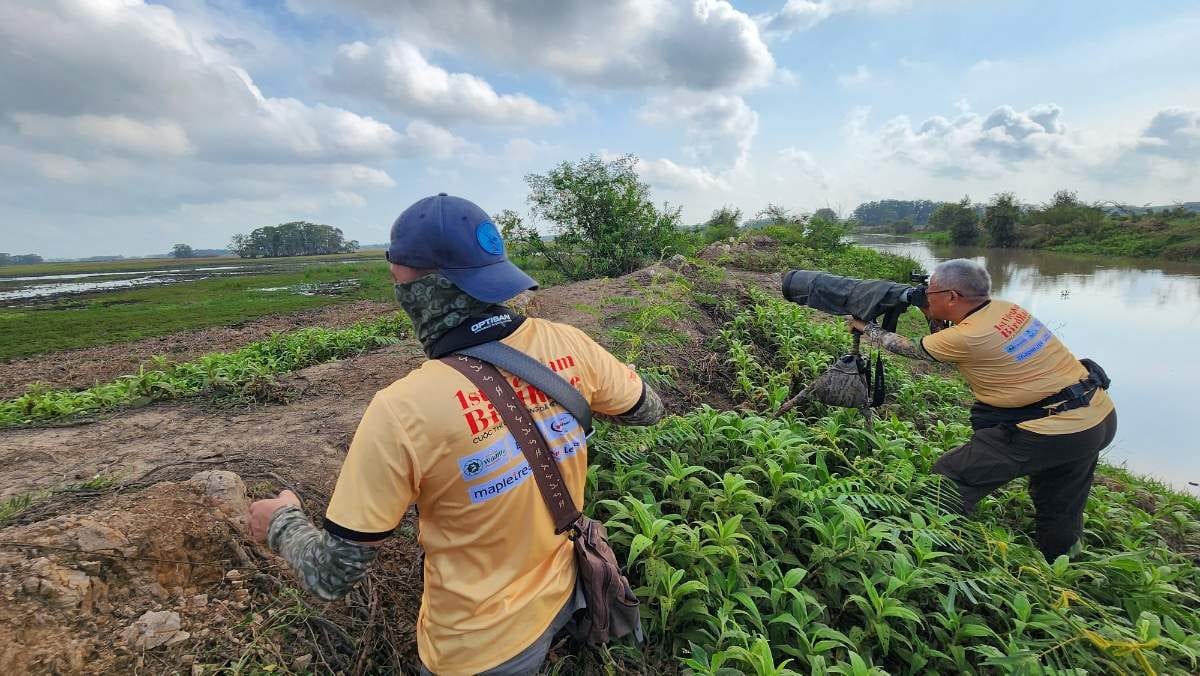
Things bird photographers do to nail a shot.
Birding together
The Vietnam Bird Race is unique as all participants must search for birds in the wetlands by boat, at least in the morning.
The highlight of this competition was the appearance of two migratory bird species: the Comb Duck and the Northern Shoveler. These extremely rare sightings are a positive sign that Tram Chim is recovering well.
Three things also made this year's Vietnam Bird Race extra special.
Firstly, a painting workshop led by Dao Van Hoang engaged children and young students, who created watercolor paintings using Vietnamese bird photos as references. Their best works were judged and the top 8 were auctioned, raising a total of 50 million dong (USD 2,000; PhP 114,000) for the Tam Nong Education Department scholarships, thanks to contributions from a Canon representative and photographer Doan Nh? Hoan. This initiative uniquely combined wildlife awareness, conservation, and education support.
Secondly, the organizers hosted an evening workshop for delegates to present to all participants and local organizers. Highlights included Malaysia's Utan Lodge, the Spoon-billed Sandpiper by Mr. Bao and Mr. Yong Ding Li from Birdlife Asia, and my introduction of Philippine birds and major birding events in 2024. These events are the Subic Bay 1st International Photomarathon (August 30 to September 1), the 7th Puerto Princesa Underground River International Birding Festival (November 17 to 19), and the 13th Asian Bird Fair in Las Piñas (November 20 to 23).
Thirdly, a fun contest was held where teams submitted photos of rare bird species they believed only they had photographed. Claims were playfully disputed by others, and the winning local team shared their prize of five cases of Saigon beer with everyone.
Team Pilipinas secured the fourth spot in the race.
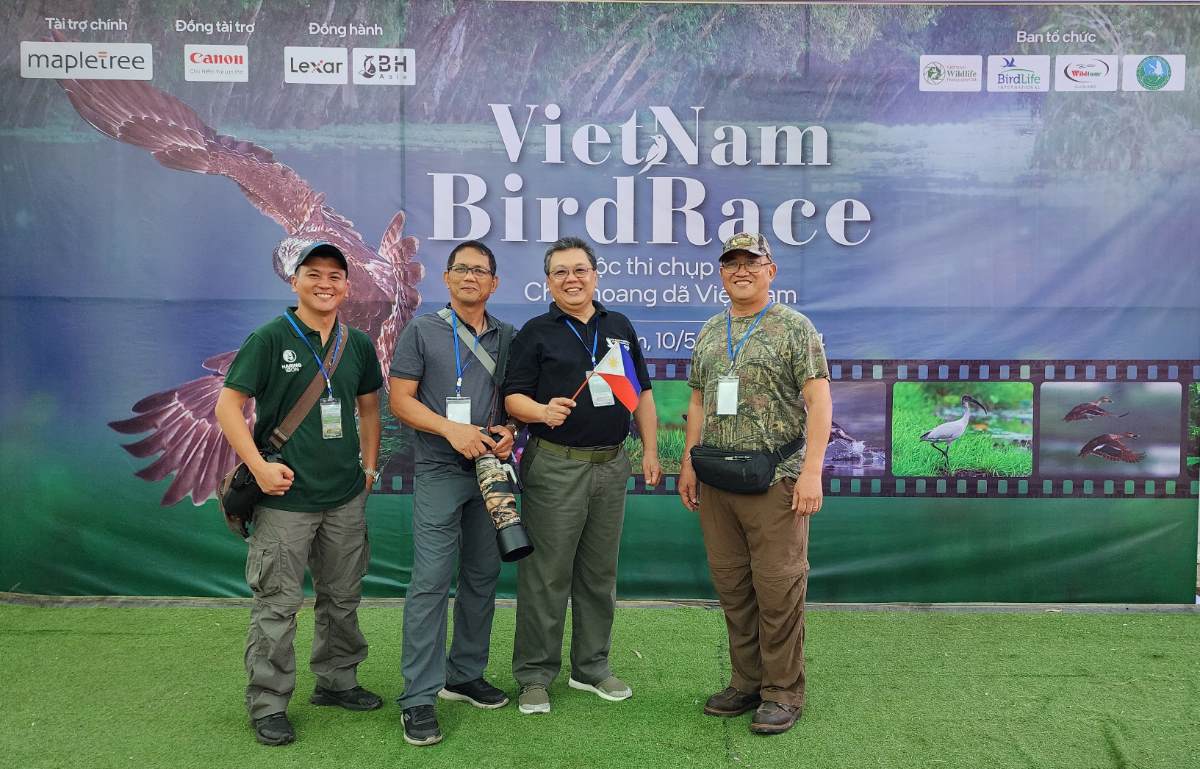
The evening workshops and the rarest bird photo contest strengthened friendship, solidarity, and camaraderie among local and foreign birders who participated in the race. This is what I always look for in international birding events—the opportunity and time to interact and establish friendships with fellow birders.
I recall what Noah Strycker wrote in his book “Birding Without Borders: An Obsession, a Quest, and the Biggest Year in the World”:
“This is what birding is all about: people with a shared passion, sometimes from entirely different continents and maybe not even speaking the same language, meeting as strangers, joining in a common goal, and becoming the best of friends.”
Alain Pascua is the co-founder and president of Wild Bird Photographers of the Philippines, a member of the Wild Bird Club of the Philippines, and author of "Haring Ibon: The Great Philippine Eagle" and co-author of "Endangered Bird Species of the Philippines." He served as Undersecretary of the Department of Education of the Philippines from 2016 to 2022.
