
Today I Learned: How Magic the Gathering Became So Popular

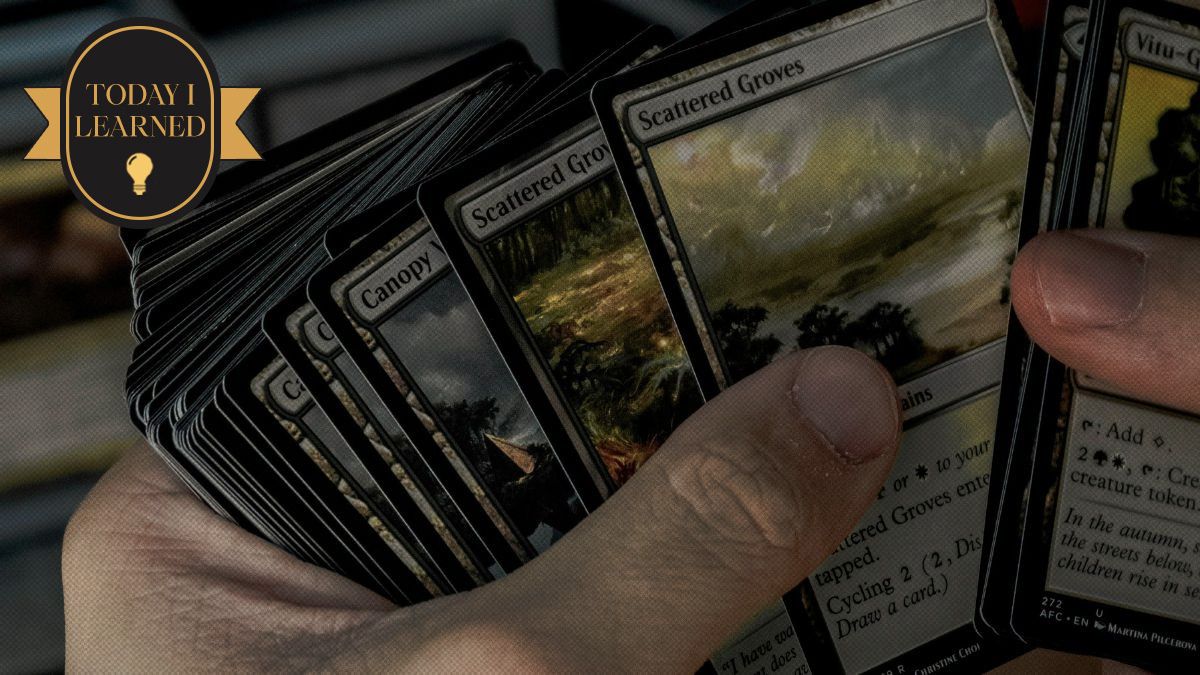
Imagine this: you’re in OTO, a bar that stands today as a shining vestige of Poblacion’s heyday, where most Makati partygoers pull up to sip cocktails and shake ass on the dancefloor. But that’s not what you’re seeing, standing here one sweltering afternoon in May. The venue is throwing a casual, open invite event with free entrance, where people can just play Magic the Gathering for a few hours with other like-minded nerds. The bar’s usual clientele is replaced with folks talking about power levels, fast mana, and a Counterspell with SpongeBob Squarepants on the card art.
Granted, the age of the marginalized nerd is over: baddies have always loved Lord of the Rings, and roleplayers are selling out Madison Square Garden tix to play Dungeons & Dragons in front of a live audience. Magic, too, has long been been very popular, boasting a 20 million-strong player base worldwide as far back as 2015. Still, it’s interesting to watch a formerly niche hobby escape Neutral Grounds containment, attracting new demographics who previously didn’t give the game so much of a glance.
How did Magic the Gathering reach this level of popularity?
Magic the Gathering (or “MTG” for short) is a trading card game created by game designer and mathematician Richard Garfield, owned by game publisher Wizards of the Coast (WOTC for short, the same company behind Dungeons & Dragons), and released in 1993. High fantasy-inspired and brimming with beautiful art, MTG is a game where players use decks of their own design to sling spells and fantastical creatures at each other to take their opponent’s life total to zero. That’s the gist. There are many trading games in today’s hobby ecosystem, but for decades, Magic the Gathering has stood at the top of the mountain alongside other giants, namely Yu-Gi-Oh! and Pokemon.
For a while, Magic was characterized by a healthy and active tournament scene, and made much of its profits through a booster pack-based business model, which sold cards in randomized packages. Some strong cards would be rarer than others, incentivizing players to buy and trade to keep up with an ever-evolving meta. Upon building decks with their cards, players could participate in multiple constructed formats, with Standard, Modern and Pauper being the most prevalent. As the game’s head designer Mark Rosewater wrote: “Magic invented a brand-new genre of game. The idea that there are many different pieces and you, the player, choose which pieces to use, was revolutionary. It allows each player to customize the game to their desire.”
That sky’s-the-limit potential would reach even greater heights, though, when a new format blew in: Commander, also known as Elder Dragon Highlander (or EDH for short).
Formerly known as just Highlander (after the 1986 film of the same name), the format used to be totally unofficial and fan-made. Players looking for a little variety with their MTG experience were presented with an interesting deckbuilding challenge: make a 100-card deck where every single card (save for the Basic Lands) had to be different, and have that deck be helmed by a Legendary Creature. Some of the first Legendary Creatures in the game appeared in the Legends set, which introduced the now-iconic Elder Dragons: Arcades Sabboth, Chromium Rhuell, Nicol Bolas, Palladia-Mors, and Vaevictis Asmadi—giving rise to the format’s other name, Elder Dragon Highlander.
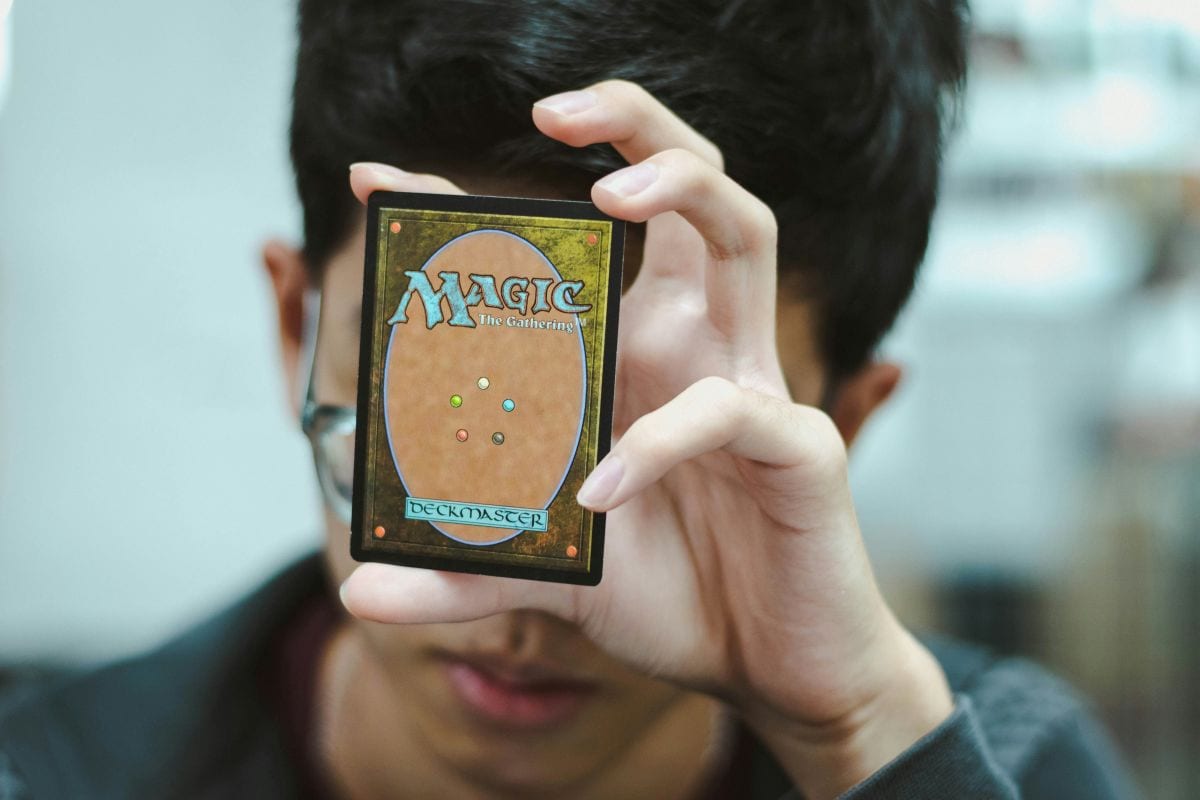
Today, Commander players are spoiled for choice, with over 3,000 Legendary Creatures to choose from. And while most formats are played traditionally as two-player duels, EDH is structured like a battle royale-style match–four players face off, last person standing wins. This multiplayer feature allowed WOTC to market EDH as the game’s premier social format. A game of Commander fulfills the same social function of, say, a board game night or a round of drinks, where one could easily invite a house-party-amount of people that could split into multiple playgroups.
In fact, Commander used to just be a way Magic judges would pass the time between tournament matches. The late great Sheldon Menery, a level 5 Magic judge, brought the format with him during Pro Tour stints, playing with friends. As Charlie Hall of Polygon writes: “With Menery’s help, EDH became an exciting new option for casual play, one that leveraged players’ deep knowledge of how different Magic cards could work together on the table. It caught on like wildfire with the other judges on the Pro Tour, who were looking for something to do after hours.” Word of mouth popularized Commander, and even the game conglomerate Hasbro (of which WOTC is a subsidiary) took notice, formally intervening in the format, and releasing the first pre-constructed Commander decks in 2011.
Meanwhile, as Commander was taking off, a separate cottage industry of YouTube-based Commander gameplay programs, which showcased internet personalities playing Magic and shooting the shit, was thriving. The most popular of these shows is Game Knights, which regularly features special guests to promote whatever new set is coming out, from musician Post Malone, to drag queens Bosco and Irene the Alien. You’ve probably seen your favorite streamers, from MoistCr1TiKaL to Dr. Lupo, get in on the action. This has served to make the game feel friendly and more approachable, with more LGBTQ+ coming into the planeswalking fold.
But all is not well in Magic’s multiverse. Some players argue that Commander’s success comes at the expense of other formats, and even the game as a whole, citing how the format’s influence has motivated the breakneck-pace release of multiple core sets a year, with a batch of Commander product to go with each set–way too much for the average player to keep up with.
2019 saw the release of 15 card sets, while 2022 busted out a tidal wave of 39. Formats like Standard and Pauper are falling by the wayside–60-card starter decks manufactured specifically for those formats are pretty much an extinct species of product. This shift in the business model is disorienting for competitive players, or long-time players who are just straight-up icked out that a format once lovingly cultivated by a small community, is now monetized at the mercy of a conglomerate that seems to be money-first, people-second. It is hard to trust a multinational toy company that, in 2023, laid off over a thousand workers in one fell swoop.
ALSO READ
Labubu And Blind Boxes: Pop Mart and the Rise Of A Billion-Dollar Business
Up Next for Local Online Collectibles Marketplace Toki: Pokémon, One Piece Trading Cards
***
These players’ criticisms are not unfounded, especially given the rising popularity of Universes Beyond (UB), a “sub-brand” of Magic, in which the game ties into other universes and IPs. Hasbro CEO Chris Cocks kicked off the product line series at a 2021 investor event by announcing its first crossovers: beloved miniature wargame Warhammer 40,000, and the genre-defining epic Lord of the Rings.
Such Fortnite-esque crossovers were previously limited to the Secret Lair product line, which makes its bank primarily with the sub-demographic of big-spender collectors looking for unconventional art or extremely rare reprints. Today, most UB crossovers are given the same weight, relevance, marketing, and tournament legality as core sets that take place in Magic’s main multiverse. The Warhammer and LOTR products were met with universal praise, though one could argue that these products’ success are owed to how aesthetically congruent they are with Magic’s aesthetics, high fantasy motifs, and dalliances with sci-fi. That might also explain how the recently released Final Fantasy set broke sales records, securing $200 million dollars in revenue in a single day.
As of writing this article, WOTC is drumming up hype for the upcoming Avatar: The Last Airbender set, which is shaping up to attract a whole new batch of players. Clearly, the logic of Universes Beyond is to reach new people in distinct but adjacent fandoms, and bring them through the cardboard crack funnel.
Other crossovers however haven’t been so well received. Leaks for the upcoming Spider-Man set were met with product fatigue malaise. Matt Bassil of Wargamer called the Assassin’s Creed crossover “a set made for no one.” And who can forget the Secret Lair x Walking Dead drop, which was met with major backlash for its competitive legality? Imagine playing an official tournament with your deck full of dragons, when suddenly, Daryl Dixon and Rick Grimes pop in and mess with your immersion. And don’t get me started on the SpongeBob drop.
Rosewater would come to defend the success of UB in a personal tumblr post, writing, “This idea that Universes Beyond is forsaking existing players for other groups is simply wrong. The reason Universes Beyond is so successful is because many longtime, invested, enfranchised Magic players enjoy it.” And with record-breaking sales to back it up, it is hard to argue against the logic of a company meeting great demand with an absolute glut of supply, cash cow accusations notwithstanding. That is unless you’re the Bank of America, which in 2022 issued a statement that "Within its Wizards segment, Hasbro continues to destroy customer goodwill by trying to over-monetize its brands,” and faces a potential decline in its stock value. It is a point of great friction between the company’s hit-and-miss business decisions, and public perception of the company as some treasure-hoarding lich, that makes players worry about the game’s enjoyability and long-term health.
***
Magic, as I see it, will continue to adhere to its business model of centering the health of the Commander format with each set release, while flirting with other IPs to keep the UB train chugging. It is hard to say how this will affect the health of the market or the sanity of the game’s player base, as newbies who come into the game through Commander quickly learn that some products can price as high as $50, while some individual cards boast price tags that clock in at five digits.
Still, the future of the game looks bright–long-time players can look forward to returning to the beloved plane of Lorwyn in 2026. One can imagine new players becoming acquainted with the plane, and connecting to a special part of Magic’s long and storied worldbuilding history. There must be some way for the game to balance its priorities of pleasing both contingents of its player base without risking product fatigue, while nourishing its other formats, pricing its products fairly, and honoring its myriad worlds that don’t have Sonic the Hedgehog in it. The only thing we can say for sure about the foreseeable future, is that Magic players will continue to rely on their most powerful card: their credit card.
