
Thunderbolts* Is the Best MCU Film Since Winter Soldier

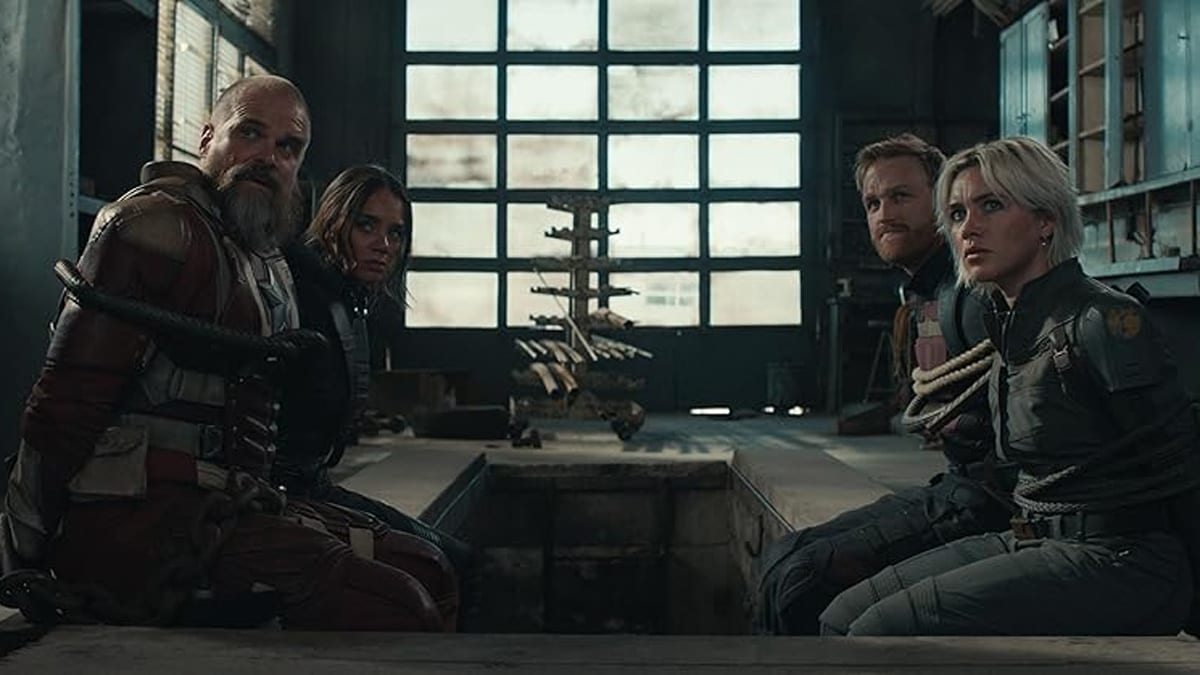
The MCU hasn’t been the same since Endgame. An unparalleled cinematic experience borne from over a decade of elaborate and carefully planned, interconnected theatrical releases that set the bar so high that Marvel hasn’t quite found a way to top it. This isn’t to say that MCU stories post-Endgame haven’t been good, because a lot of it is, particularly some of the Disney+ shows like Agatha All Along or Daredevil: Born Again. But the question Kevin Feige and the rest of Disney must’ve been asking themselves after the cinematic feat of a lifetime is: What now?
We’re all in the same boat. For Marvel audiences, in both the cinematic universe and sometimes even in real life, there’s a palpable lack of purpose, a nagging emptiness in post-Endgame stories that, although entertaining, doesn’t quite fill the void left by the aftermath of Endgame. With the Avengers all but non-existent, it feels as though the MCU is just puttering about with neither an anchor nor a sail. Nobody embodies that ennui and aimlessness more than Yelena Bolova (Florence Pugh), the Black Widow’s little sister and former Black Widow herself. When the film opens with Yelena atop the Merdeka 118, the world’s second-tallest building, voicing over a monologue that begins with, "Something is wrong with me," we can all relate.
ALSO READ:
Every Marvel Studios Film and Disney+ Series Announced Through 2027
Every Marvel Cinematic Universe Movie, Ranked From Worst to Best
Yelena looks like shit, which is to say, better looking than most of us on good days, but Pugh insisted that she look sleepless and unkempt for the opening sequence, wearing sweatpants and a matching top in lieu of her many-pocketed combat armor to drive home the point that she just doesn’t care anymore. Who hasn’t had those days when we just try to brute force ourselves out of bed and clock in to work? Sure, most of us probably aren’t highly trained assassins, but the emptiness, the search for meaning, and the melancholy are all too familiar.
Wyatt Russell, David Harbour, Sebastian Stan, Hannah John-Kamen, and Florence Pugh in Thunderbolts* (2025)
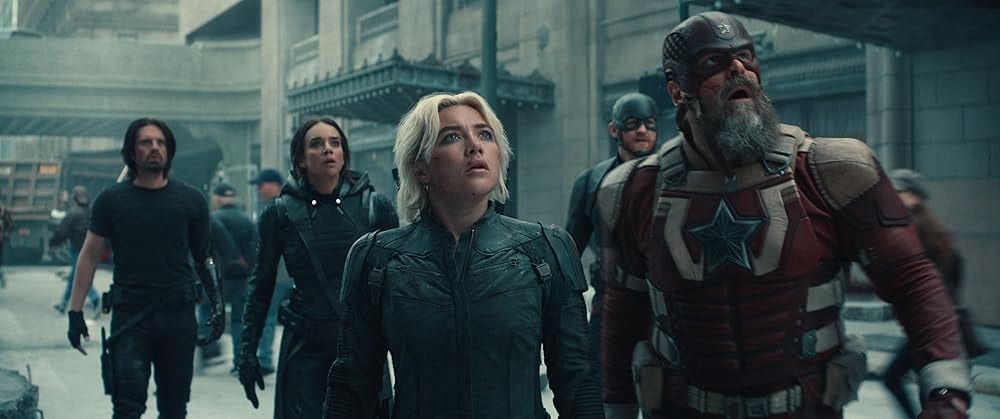
Thunderbolts* doesn’t try to pretend that nothing has changed. While other MCU stories acknowledge the events of Endgame and carry on, Thunderbolts* embraces the core of the problem head-on. The Avengers are gone, and they’re not coming back anytime soon. The Avengers were the heart of the MCU, and every movie in the first three phases of Feige’s master plan was intended to crescendo into an Avengers movie. Every story, every post-credits scene, pointed to the Avengers. In Phases 4 and 5, the MCU went in every imaginable direction, with some mid- or post-credits scenes either no longer relevant, such as a multitude of Kangs in Quantumania, or left completely in the air, with no indication of whether it’ll amount to anything. These include high-profile cameos such as Charlize Theron as Clea in Multiverse of Madness or Harry Styles as Starfox in The Eternals. No other MCU film has had the courage and sobriety of The Thunderbolts*, which tries to answer the question of ‘what now?’ as honestly as it can.
And the honest truth is that this is the best we get. We get the B-team. The rejects. We get The Thunderbolts*, a team without even a proper name that Disney insists it always be written with an asterisk. Yelena is one of those rejects, part of an ad hoc assemblage consisting of the supporting characters or villains in films that other people headline with the exception of Bucky Barnes (Sebastian Stan), the Winter Soldier, who managed to get co-billing in a Disney+ miniseries. There’s an adorable anecdote that comes with the team name, and it basically encapsulates what The Thunderbolts* are all about, a testament to scrappiness, perseverance, and hope.
Bucky might already be the most popular hero on the roster, but make no mistake: this is the Florence Pugh show, and she’s the brightest star in the MCU. This is actually an ironic realization given that Yelena starts out weighed down by an all-consuming emptiness, a lack of purpose made heavier by numerous sins of the past. No Marvel superhero has radiated as much sadness; not the Scarlet Witch pining for her children, not beer-belly Thor who ate and drank his way through depression, and neither of the Peters whose girlfriends forgot about them. Yelena is heartbreakingly sad, and she’s so much more relatable because of it.
In contrast, her father, Alexei Andreovitch Shostakov (David Harbour), the Red Guardian, is an irrepressible beacon of joy. If Thunderbolts* was a late-night talk show, Harbour would be the Guillermo to Pugh’s Jimmy Kimmel. Pugh is the star, but boy, does Harbour steal every scene he’s in. Red Guardian is an old man who dreams of his glory days, whiling away the time in his trash heap of an apartment watching antiquated videotapes of his time as the Soviet Union’s answer to Captain America. The Red Guardian may be old, but he’s the little child in all of us, a superhero who fanboys over other superheroes, a father who can’t see anything but the good and bright and beautiful about his only remaining daughter. Pugh carries The Thunderbolts* squarely on her shoulders, but Harbour is the cheerleader who makes sure she doesn’t falter. Yelena and Alexei have an earnest, genuine relationship that delivers the film’s most powerful emotional beats. Thunderbolts* works because they’re real, Red Guardian is a father just trying to show up for his very lost, very distraught daughter.
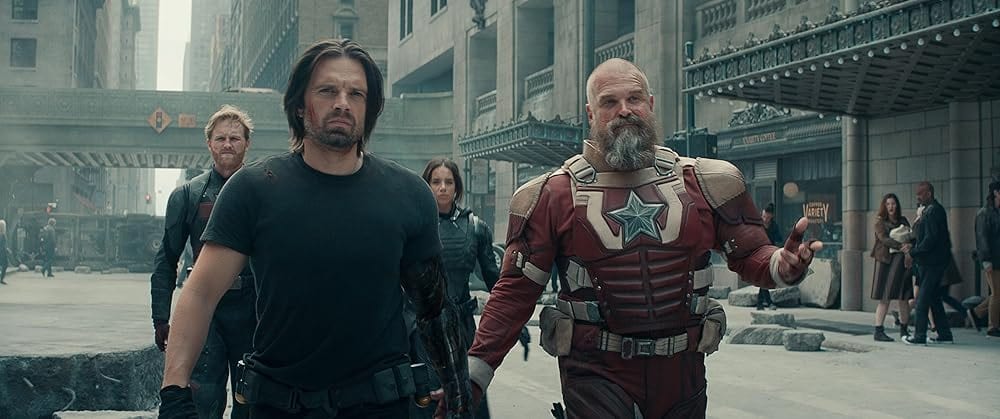
Thunderbolts* is also the MCU’s most intense exploration of mental health. The Thunderbolts* are a team made up of career criminals, mercenaries, and fallen heroes. John Walker (Wyatt Russell) or U.S. Agent is a failed hero, a highly decorated soldier given the Super Soldier Serum and carrying Captain America’s shield and name until his arrogant, violent nature showed the entire world he was unfit for the role. Ghost (Hannah John-Kamen) was the antagonist of Ant-Man and The Wasp, a spectral agent of chaos, while Taskmaster (Olga Kurylenko) is a former Red Room operative and a villain in Black Widow. These are people who’ve done some very bad things, and despite appearances, are weighed down by them. Even the mysterious Bob (Lewis Pullman) is a former meth addict who struggles with the trauma of his past.
It’s a little hard to identify with billionaire-playboy-philanthropist, Nordic gods, or poster-perfect super soldiers. But it’s really easy to recognize and empathize with depression and other mental health problems in people just like us. Sure, with a little more super powers than us, but it’s not hard to feel sorry for or at least understand a man left by his wife and child because he just can’t help being a total asshole; or the crippling depression and self-destructiveness that comes with being untethered and aimless. Thunderbolts* is the realest the MCU has ever been outside of Ms. Marvel, arguably the MCU’s most down-to-earth and grounded show. But Kamala Khan’s optimism and exuberance are endemic to her youth, whereas Thunderbolts* is a mirror for adults who’ve been ground down by adulting.
Director Jake Schreier, whose only previous feature films were the indie Robot & Frank and the 2015 romantic drama Paper Towns based on a John Green novel, pulls off an astounding feat with Thunderbolts*, infusing the film with a grittiness and dynamism rivaling the Russo Brothers. For all the greatness and singular cinematic experiences delivered by the Avengers films, those were the result of all the films that came before it, and one could argue that a viewer coming in cold with no prior knowledge of the MCU would have little emotional investment and a significantly tempered response. This is why Thunderbolts* is the best film the MCU has produced since The Winter Soldier, because it arguably starts with a clean slate but pulls you in all the way, anyway.
Even if audiences knew nothing about the MCU, even if they never watched any of the movies before it, Thunderbolts* delivers a solid story with characters you genuinely care for. Florence Pugh is stellar, delivering a performance more powerful than a superhero role has any right to be. But the best thing is that she carries her team in lockstep, and nobody is left behind. Julia Louis-Dreyfus is equally impressive as the cold and conniving Valentina Allegra de Fontaine, arguably one of the best villains in the MCU, no Infinity Stones necessary.
One of the most powerful scenes in the film is when the team comes together to save an innocent bystander, working together to pull off a feat that Iron-Man or the Hulk could manage single-handedly. This is the entire point of Thunderbolts*. None of them is strong enough on their own, but they manage to work wonders together as a team. This is humanity in a nutshell, a redefinition of what’s super, a subversive rebuke of the godlike beings addicted to their own power. Thunderbolts* reveals to us that real heroes can show weakness, that real heroes have bad days just like the rest of us, and sometimes those bad times can be just too much to bear. More than any other MCU film before it, Thunderbolts* shows us that none of us are meant to tackle hardships alone. So, to answer the question the MCU faces, the ‘what now?’ The answer is, we don’t know. But as Thunderbolts* shows us, we’ll find out together.
