

Yes, a Filipino Invented Video Conferencing

Some of you may have heard of the myths claiming that Filipinos invented certain things: the yo-yo, the M16 or Armalite rifle, and the fluorescent lamp. You might also have been disappointed to see these myths disproved.
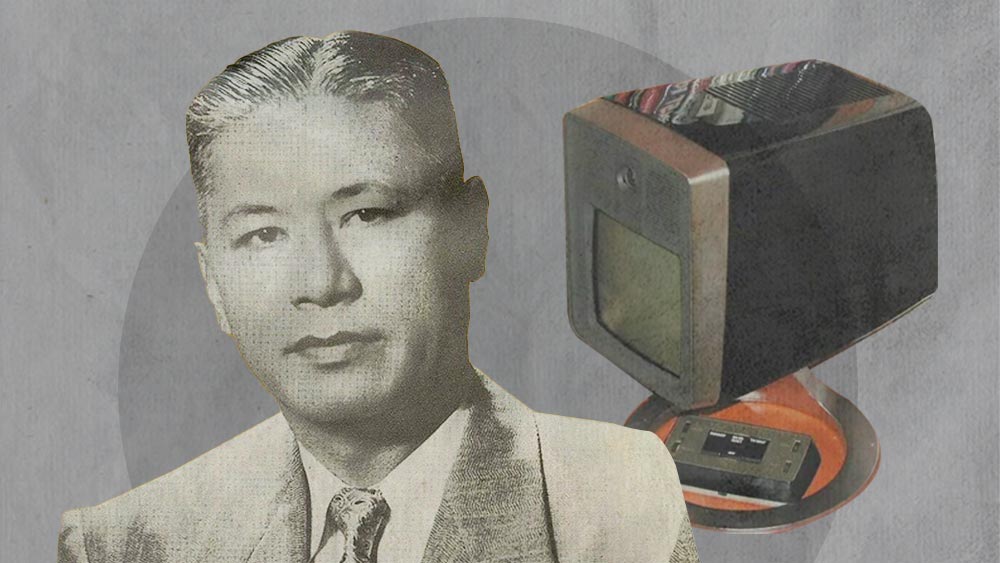
However, if you’ve seen posts saying that video conferencing technology was invented by a Filipino in the 1950s, that claim is most certainly true. The inventor is engineer and physicist Gregorio Ynciong Zara.
School Prodigy
Zara was born on March 8, 1902 in Lipa, Batangas. He was a consistent achiever in school, having graduated as valedictorian from Lipa Elementary School in 1918 and again as valedictorian from Batangas High School in 1922. After initially enrolling in the University of the Philippines in Manila, he wound up in the United States specifically at the Massachusetts Institute of Technology (MIT) from which he graduated in 1926 with a Mechanical Engineering degree.
But that wasn't all. He also graduated with a Master Degree in Science in Aeronautical Engineering from the University of Michigan in 1927 with summa cum laude status. He then went to France and obtained a Ph.D. in Physics from Sorbonne University in Paris, where he also graduated summa cum laude and even earned a "Tres Honorable," considered the highest honor given to graduate students.
Getting Down to Work
Upon returning to the Philippines, Zara first worked for the then-DPWC (Department of Public Works and Communications), later becoming the chief of its aeronautical division. Next, he became assistant director and chief aeronautical engineer in the Bureau of Aeronautics of the Department of National Defense. He also served as director of the aeronautical board until 1952.
As an expert in aeronautics, he was appointed as the technical editor of Aviation Monthly magazine. Furthermore, he served as vice chairman and acting chairman of the National Science Development Board, the predecessor to today's Department of Science and Technology.
Zara also worked as an educator at the Valeriano Aviation School, American Far Eastern School of Aviation, and Far Eastern University. In 1946, after World War II, he joined Far Eastern Air Transport Incorporated (FEATI) where he also taught and published many books and papers on the subject of aeronautics.
The Videophone and Other Inventions
Zara patented his video conferencing device in 1955 under the name 'photo phone signal separator network.' In the publicity photo of the invention available online, Zara is shown talking to a woman using his device, which looks like a TV set of the time with a camera mounted on top and a telephone handset for audio. This seems little different from the modern computer monitor that uses a webcam mounted on top, although the transmission technology then was likely to be wired analog. Note also that the TV monitor is marked with the logo of FEATI, for which he was working at that time.
The basic principle today is the same as then: a camera picks up the visual to be sent to the other person’s monitor, and a microphone picks up sound at the same time to be sent to the other’s speaker, and vice versa. Today’s smartphones have micro-sized versions of this technology for portability, such as our earbuds with microphones in place of a telephone handset. The signals today travel on both wired and wireless digital media which differ greatly from 1950s analog technology.
Other notable creations of Zara include an earth induction compass still used by pilots today. He also devised water heaters, stoves, and battery designs that utilize solar power. Another significant invention is an alcohol-fueled airplane engine, which he successfully tested during a flight at Nichols Field, now known as Ninoy Aquino International Airport.
In 1930, he discovered the physical law of electrical kinetic resistance, in which a resistance to the passage of an electric current is generated when contacts are in motion. This phenomenon was named the Zara Effect in his honor. Additionally, he developed a microscope with a collapsible stage, Philippine-made wooden aircraft propellers, and a walking robot named Marex X-10. Throughout his career, he filed approximately 30 patents.
Awards and Recognitions
Throughout his lifetime, Zara received numerous awards, culminating in his recognition as a National Scientist of the Philippines by President Ferdinand Marcos in 1978, marking a significant highlight of his career.
His notable accolades include receiving a Diploma of Merit and Gold Medal in 1954 for inventing an airplane engine powered by alcohol, and in 1959, he was awarded the Presidential Diploma of Merit for his contributions to government service and for his work at the Far Eastern Aeronautics and Technological Institute (FEATI).
That same year, he received The Distinguished Service Medal in recognition of his pioneering research in solar energy, aeronautics, and television. In 1961, Zara was honored with Three First Prize and Certificate of Merit awards by the National Economic Protectionism Association (NEPA) for his invention of the TV-Telephone, the Solar-Powered Oven, and Philippine-made Airplane Propellers. Furthermore, in 1966, he was awarded the Presidential Gold Medal and Diploma of Honor for Science and Research for his scientific contributions, alongside the Cultural Heritage Award for Science Education and Aero Engineering, acknowledging his inventive work in aeronautics.
In his personal life, Zara married Engracia Arcinas Laconico in 1934, the 1933 Miss Philippines. Together, they had four children: Antonio, Pacita, Josefina, and Lourdes.
Zara's illustrious life came to an end on October 15, 1978, coincidentally the same year he received his National Scientist distinction. He was laid to rest in the Libingan ng mga Bayani, leaving behind a legacy of innovation and scientific achievement.
