

Who Is Former Davao Archbishop, CBCP President Fernando Capalla?

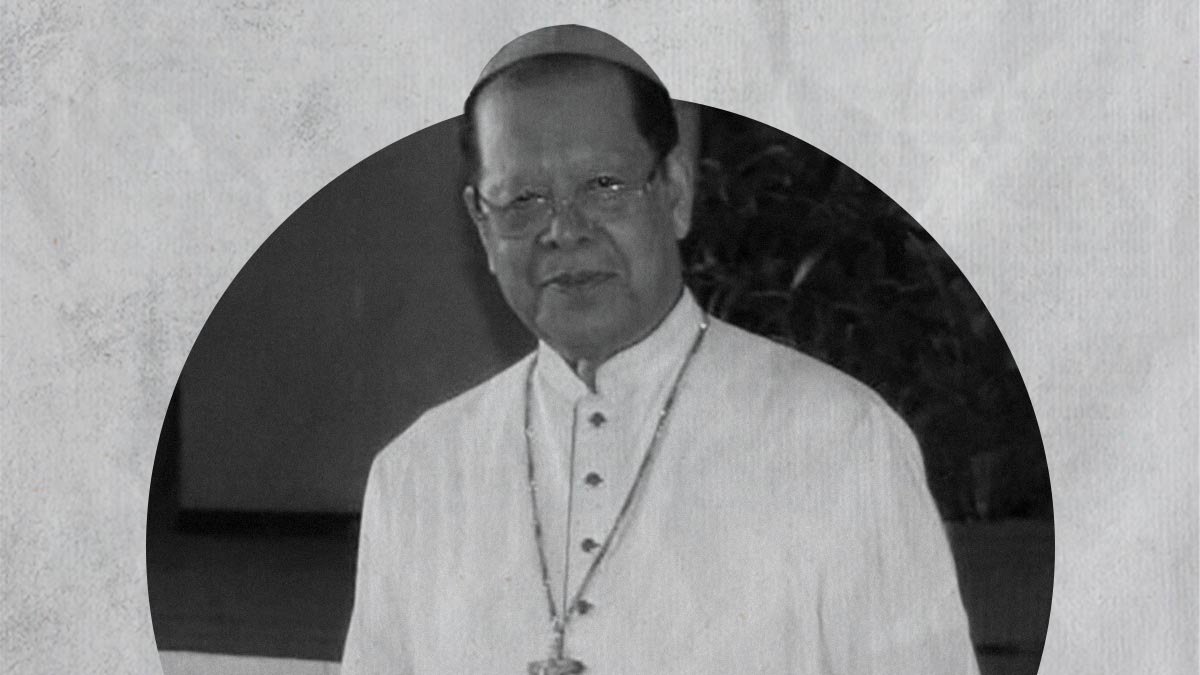
The local Catholic community mourns the passing of Archbishop Emeritus Fernando Capalla, who dedicated more than half of his life in service of God and humanity. Capalla, who turned 89 last November 1, served the Archdiocese of Davao for more than 15 years and held the leadership of the Catholic Bishops Conference of the Philippines (CBCP) from 2003 to 2005. The archbishop passed away at 1:38 a.m. in the city of Davao, according to CBCP News.
Archbishop Capalla was a well-known critic of former President Rodrigo Duterte’s war on drugs, which according to Human Rights Watch has led to the death of over 12,000 Filipinos, mostly urban poor.
“Everybody that I know is worried about it. From my point of view, I think it's the question of violence, getting it into a spiral and it seems intensifying,” Capalla said in a 2016 interview. “Wrong is wrong even if everybody is doing it and right is right even if nobody is doing it. Our sense of morality, our moral values, our sense of right and wrong is not anymore strict. Our conscience (has) become callous, the end does not justify the means.”
The archbishop urged Duterte to listen to public opinion. “I would like to ask him to listen to the people, to the poor people who are also suffering, he is the one who loves them and will do everything for them, they have something to say about what's happening, not just to the experts,” he said.
ALSO READ:
'True Face of Evil': Filipino Priest's Homily Goes Viral
Handsome Filipino Priest: Only Jesus Deserves a Fans Club
A priest answers the question we all ask: What does it mean to have faith?
Activist Priest
Capalla was born on November 1, 1934 in Leon, Iloilo. It’s hard to imagine but the future archbishop was once a mischievous kid. “My parents could not stand me in the house. They sent me out of the house. I was the black sheep,” he told the Davao Catholic Herald.
He subsequently lived with his priest-uncle in Jaro, Iloilo, who sent him to the seminary for reform. Despite being a brilliant student, the boy from Iloilo initially struggled with Good Manners and Right Conduct (GMRC), finding the rigid restrictions challenging to adhere to. “In the seminary, I violated many rules, restrictions, policies… You know, I was supposed to kneel down in the corridor every day during study hours. And do the rosary while they’re eating. I was punished but I don’t mind being punished,” he shared in the same interview.
Capalla was ordained as a priest for the Jaro Archdiocese in 1961. In his early years as a clergyman, he actively participated in activist movements. “We stoned the old buildings during the time of Marcos. Many of my friends were killed and some were arrested during the Martial Law and they were hunting for me but they didn’t find me. I was in the room of Cardinal Sin in Jaro,” he reminisced.
During that period, he led an experimental group of formators with the aim of training seminarians in conflict areas, enabling them to serve the poor. Unfortunately, they were labeled as communists, resulting in the killing of some members.
Mindanao Peace Advocate
Capalla took on various roles within the Catholic Church. In April 1975, at the age of 40, he was appointed auxiliary bishop of Davao and was consecrated in June of the same year. He later became the prelate of the Prelature of Iligan in 1977 and served as its first bishop when Pope John Paul II made it a diocese in 1982.
During his tenure, Capalla also took on the responsibilities of apostolic administrator of Marawi from 1987 to 1991. In 1994, he assumed the role of coadjutor archbishop of Davao and eventually became the Davao archbishop in November 1996, a position he held until his retirement in February 2012.
Within the CBCP, Capalla led various departments, including the Episcopal Commission on Interreligious Dialogue and Episcopal Commission on Ecumenical Affairs. He is known as the founding father of the Bishops-Ulama Conference, an interreligious organization dedicated to fostering understanding between Muslims and Christians.
In an essay published on CPCP News, Fr. Sebastiano D’Ambra, PIME, founder of the Silsilah Dialogue Movement described him as “a good friend who contributed a lot for the promotion of interreligious dialogue in Mindanao and on the national and international level.”
In recognition of his efforts in promoting interfaith dialogue, Capalla was honored with various accolades, including the San Lorenzo Ruiz Award for Peace and Unity in 1991, the Public Service Award for Peace from Ateneo de Manila University in 1998, and the Aurora Aragon Quezon Peace Award for Peace Advocacy and Peace Building in 2000.
Defender of Life
Archbishop Capalla was as a staunch advocate for the sanctity of life. He opposed practices that he perceived as detrimental to life, such as capital punishment and extrajudicial killings.
In a pastoral letter published on Minda News in November 2001, he wrote: “It is therefore erroneous and wrong for any government to have recourse to the principle of self-defense when it inflicts capital punishment on prisoners. Or, when it seems to tolerate criminal groups like the Davao Death Squad to kill. It is an admission of failure in the fulfillment of its obligation to prevent crime and its recurrence.”
He said crimes such as individual murder and drug pushing, despite being social sins and problems, do not directly assault society. Hence, society cannot justify the use of capital punishment, let alone salvaging by death squads, as a form of self-defense. “The so-called death squads are violating both civil and moral laws and therefore are criminals themselves. We call on our government and its law enforcement agencies to stop them from making Davao City a ‘wild, wild, West’ where the only law is the law of the gun.”
Ready to Meet His Maker
Even in his retirement, Archbishop Capalla remained actively involved in the service of the church. He presided over three masses every weekend, took on a teaching role at the Regional Major Seminary and the Ignatian Institute of Religious Education Foundation, Inc. (IIREF), penned weekly columns, and chaired four foundations. Notably, he led the initiative called Freedom, dedicated to providing skills training to farmers, Lumads, and Muslims.
During the requiem mass for Archbishop Capalla, Davao Archbishop Romulo Valles shared in his homily that, upon returning home from San Pedro Hospital during the holidays, Capalla expressed his wish not to be taken back to the hospital, stating “I am ready to go.”
