

This Wall-Worthy Map Showcases the Philippines' Biodiversity

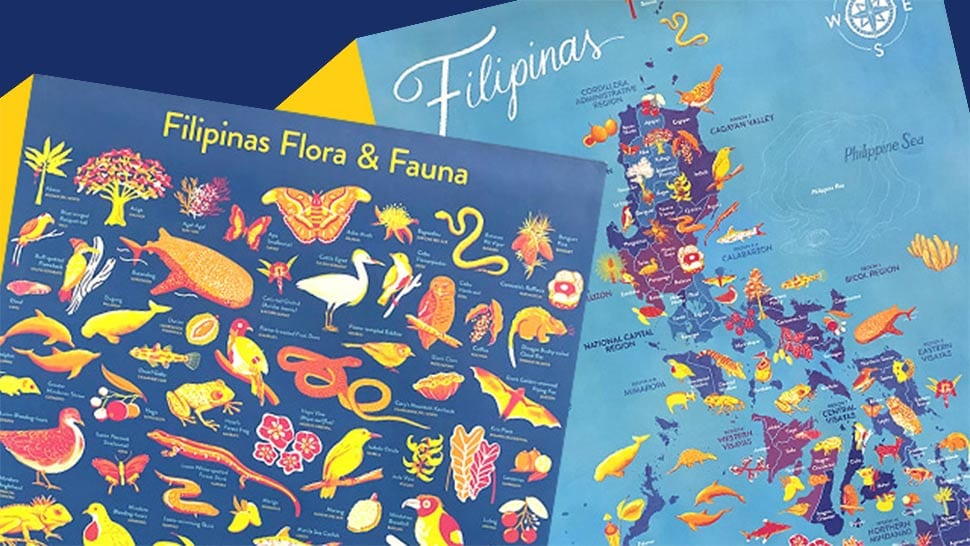
These days, it's hard to believe that the Philippines is one of the luckiest countries in the world. But we are, if only for our rich flora and fauna. With more than 50,000 species—half of which are only found in the Philippines, we're considered "a mega-diversity country rivaled only by a few countries in the world," according to the Department of Environment and Natural Resources. To illustrate just how #blessed we are, Studio Dialogo has released a back-to-back Philippine map that features the country's endemic plants and animals. It is available online at P250.

The Filipinas Flora and Fauna Map features the most prominent species per province in the country. There's the Batanes Pit Viper in the northernmost island; the aciga tree in Kalinga; the Luzon Peacock Swallowtail—which is neither a peacock nor a swallow, but a butterfly—in Abra; Consuelo's Rafflesia in Nueva Ecija; Giant Golden-crowned Flying Fox—which is a bat, not a fox—in Quezon; the Samar Squirrel—yes, we do have our own squirrels; the Mindoro Bleeding-heart, which is a type of ground dove with a distinct red or orange patch on its chest; and the Venus' Flower Basket—which is neither a flower nor a basket, but a sponge found only in the deep of waters of the West Philippine Sea.
It also shows the more popular plants and animals that we might have seen in our Sibika or Hekasi textbooks: the tamaraw in Mindoro, tarsier in Bohol, Philippine eagle in Davao, and butanding in Sorsogon.

But knowing about these things doesn’t end in identifying them. The Filipinas Flora and Fauna Map was also created in an effort to raise awareness about environmental preservation. This is why the map’s illustrations are printed on 18.75-by-25.5 inches of “rock paper,” advertised to be tree-free, water resistant, tear resistant, non-toxic, and photodegradable. It’s one small step towards solving our huge garbage problem.
We may be considered a megadiversity country, but we are also now labeled as a biodiversity hotspot—which means that we’re experiencing an alarming rate of destruction in our natural sources, resulting in the dwindling population of our plants and animals. If we don’t change now, the illustrations on this map may be all we’re left with in the future.
Studio Dialogo’s Filipinas Flora and Fauna Map (P250) can be ordered through a Google Form. For more information, follow Studio Dialogo on Facebook or Instagram.
This story originally appeared on Spot.ph.
* Minor edits have been made by the Esquiremag.ph editors.
