

Breaking the Ice: How PH Won Its First Asian Winter Games Gold


In a brilliant display of physical skill, strategic thinking, and perseverance, the Philippine Curling Team made history at the 2025 Asian Winter Games by winning the country's first-ever gold medal in curling. At the helm of this groundbreaking achievement was Alan Frei, who was tasked with leading the team. His assistance and precision on the ice propelled the Philippine team to success against stronger and more seasoned opponents. This victory not only solidifies the Philippines' place in the world of winter sports but also highlights the strength and tenacity of our athletes breaking barriers in a sport unfamiliar to many Filipinos.
Simply put, curling is a winter sport played on ice. There are two teams, each composed of four players, who take turns sliding a heavy, polished granite stone toward a target called the "house," located at the opposite end of the ice rink. The curling players use highly specialized brooms to sweep the ice in front of the stone, which reduces friction, influencing its speed and direction. The goal is to have stones closer to the center of the house than the opposing team's stones. Each game consists of multiple rounds called "ends," and points are awarded based on the position of the stones at the conclusion of each end. It is a game of strategy, precision, and ultimately, teamwork. It is both a physical and mental sport.
Esquire Philippines sat down with Frei at Buffalo’s Wings N’ Things in SM North Edsa to chat about this monumental win, the challenging journey leading up to it, and what it means for the future of curling in the Philippines.
First of all, congratulations on the team’s win. Gold medals for any Philippine sports team are hard to come by, especially in international competitions, let alone at the Asian Winter Games. What inspired you to take on this role of team lead for the Philippine National Curling Team?
Yes, it's the first gold medal for the Philippines in the history of the Winter Asian Games. Over the course of nine editions, this achievement has never been accomplished before. I'm very happy about it.
The position was given to me. Curling positions are specific, divided into the front end (lead and second) and the back end (third and skip). The most important role on the ice is the skip, who is like the captain and makes the decisions.
In my case, I handle a lot of team communication off the ice. That's my job. It was clear to me that I would be the lead, which is the first position, and that would be my responsibility.
Philippine Curling Team's Alan Frei
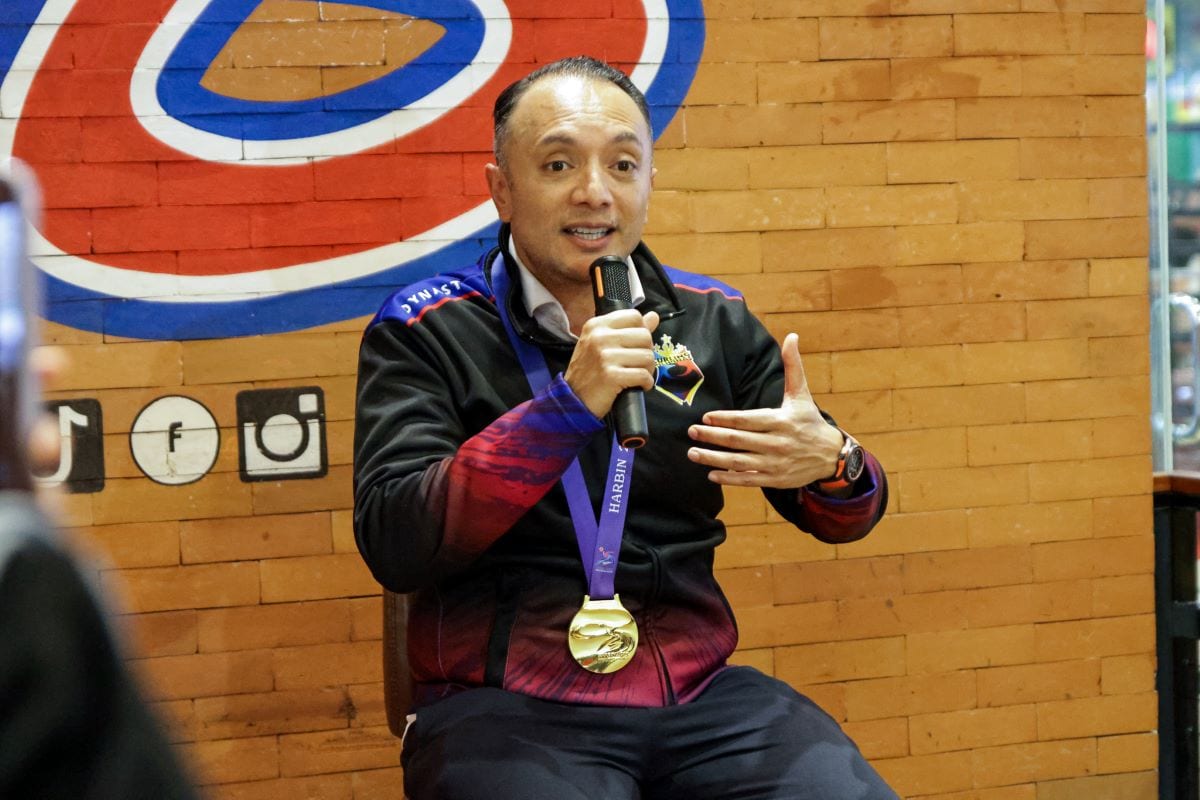
What challenges have you encountered in developing curling in the Philippines, a nation with a tropical climate and no natural ice?
We faced so many challenges at the start. The first obstacle was the absence of a recognized Filipino curling association. Together with our president, we established the Filipino Curling Federation. Next, we approached the Philippine Olympic Committee (POC). Initially, they were skeptical: “What are you doing? What are you planning?” They eventually showed their support, leading to our accreditation.
Then came the World Curling Federation, where we expressed our desire to compete on the world stage. Out of our four team members, two were yet to secure their Filipino passports. Although they had Filipino mothers, they still needed the official documentation.
Once the passports were sorted, we faced more hurdles before we could start playing. It was only then that we could dive into the competition. Initially, everything was self-funded. We didn’t receive financial assistance from anyone; every trip and every fee was paid out of our own pockets. Those early days were tough, but winning the gold medal has eased some burdens, and we hope for more support to meet our team's financial needs.
We have learned about available governmental benefits and received some financial help from the POC, for which we are grateful. Any additional support is welcome. Who knows, maybe I’ll even get free Jollibee for life... that would be nice.
How has the team grown since it was formed? Any particular milestones the team has its eyes set on?
In the initial stages, the Philippine Curling Team was incomplete. A curling team requires four members, but initially, there were only three. These three members were constantly searching for a fourth teammate. The stories from this period are quite amusing. They had a WhatsApp group and whenever they spotted someone who appeared to be Asian at a tournament, they would ask, "Are you Filipino?" The responses were usually, "No, I'm Indonesian" or "No, I'm Thai." Despite their efforts, they never found a Filipino. Eventually, they had to include me in the team, even though I wasn't very skilled at the time. However, I've improved significantly.
Now, we are very happy as a team because we have achieved several goals. We also get along well off the ice and make a great team. Looking ahead, our main goal is to participate in the 2026 Olympics. To achieve this, we have two crucial tournaments where we need to secure third and second places. The pre-qualifying event requires us to be third, and then in the qualifying event, we need to finish second. One tournament is scheduled in October and the other in December. This is what we need to do to reach our ultimate goal of participating in the Olympics. Our aspiration is to be the first Filipino team to qualify for the Winter Olympics.
Frei on what he thinks made them win: "...the difference is, maybe compared to professional teams, we want it a little bit more than the others because it's just our big dream. And we are so focused on, you know, let's try it. Let's make history here."

What steps do you think are needed to be taken to increase awareness and participation in curling among Filipinos?
I think it's very simple, but we have to work hard for it. With every success, we will create more awareness. With every success, media are coming and covering the story, and we are very thankful for that. So, more people will hear of it. Our job on the ice is to create success.
Our job is to show Filipinos around the world, "Hey, you can reach the gold medal in the Asian Games." So, with that, I believe that there will be somewhere a Filipino or a Filipina thinking, “You know what? Let me try curling.” And they will start. They're young, maybe six to seven years old, and they will start with curling. And then, maybe in a couple of years, they will be champions. That will make me very happy.
How long did you guys train?
The project started one year and ten months ago. I had never curled in my life before. So, I've been curling for less than two years now. As a team, we curl maybe once a week. So, all the other teams are professional curling teams, and we are not a professional curling team. All the guys have a job on the side, so they're working full-time. And they do a lot of sacrifices for our dream to go to the Olympics.
But the difference is, maybe compared to professional teams, we want it a little bit more than the others because it's just our big dream. And we are so focused on, you know, let's try it. Let's make history here.
Given the lack of local curling facilities, what are the team's plans to develop and grow the sport in the Philippines?
Yes. There's no ice here. We have a plan for how we will generate more homegrown curlers in the Philippines. Step one is, as I mentioned before, we create awareness through success. That's step one. That's our job.
The second thing is our president, Benjo, the president of Curling Pilipinas, is planning events with other Asian countries like South Korea or Japan, where we have learn-to-play camps, where Filipinos can go to Korea, or they can go to Japan to learn curling. There are different programs also from the World Curling Federation that help with these programs. This is step two.
And the third step would be having a curling arena. Maybe, you know, share it with the ice hockey team. That would be absolutely fantastic, having a curling arena one day in the Philippines. That would be the best.
"We are now number one in Asia. We expect an update at the end of the season, and hopefully, we'll break into the top 20, which would be fantastic," says Frei.

We already have a commercial ice skating rink here in Metro Manila. What specifically do we need to tweak to make it suitable for curling?
The base is the same, but you need to sprinkle the ice with water droplets. These droplets form what are called pebbles, and it's these pebbles that allow the stone to curl. If you use a curling stone on regular ice, it won't curl. It's only through these pebbles, created by the sprinkling of water droplets, that curling is possible.
So, what is needed?
First, we need someone who understands how the process works and can pebble the ice. Second, we require specialized curling stones; we need to purchase and transport them here. Lastly, the ice rink is likely too small and needs to be a bit longer. Once these three factors are in place, we can begin.
ALSO READ
How Philippine Esports Went from Neighborhood Cybercafs to the SEA Games
Meet The Stereotype-Breaking Numbers Nerd On the PH Hockey Team
What's your next tournament after this? Are you set on another tournament before the Olympics?
Yes. The curling season ends by the end of March. So, we will go back and we will train, and then it stops. And then the next tournament will be in August. The season starts again in the mid of June, training starts, and the first tournament will be in the mid of August, which will be in Europe.
There will be a big tournament with all the top teams of the world. The world champion will come, world number one will come. All the top teams from Europe will play there. Then we will play there as well, and we will see how far we get with the Europeans.
Does the curling sport have rankings similar to those in other sports? Do you move up the ranks by the team’s recent gold?
Yes, it does, but not yet. Rankings are typically updated at the end of the year, following the season. Currently, the Philippines is ranked 53rd in the world. All the countries we've played against are ahead of us. The Chinese are in the top 10, Japan is in the top 5, and Korea is in the top 6.
Everyone ranks higher than us, except for Thailand, as they have just formed their federation.
In reality, we are now number one in Asia. We expect an update at the end of the season, and hopefully, we'll break into the top 20, which would be fantastic.
Frei: "Our vision is to be the first stepping stone. We are the first part of the bridge we want to build."

Does the Philippine Curling team already have a team nickname like Gilas or Azkals?
We don't have one yet, so if anyone has ideas, please let us know. Perhaps we can turn this into a social media initiative. Someone even asked if we have a mascot, and we don't have one yet either. It would be fantastic if Filipinos could suggest a nickname for the team. That would be really nice.
Beyond the medal itself, what has been the most rewarding aspect of the team's success for you?
I'm grateful for all the messages I've received. To give some perspective, a friend of mine in Florida visits a coffee shop daily, where the barista is Filipino. On the morning we won, she mentioned to him, “You see, the Philippines won gold in the Asian Games. I'm not sure which sport it was, as I've never heard of it, but they won.” We received an avalanche of messages from Filipinos and friends. My Facebook, Instagram, and WhatsApp have been flooded, and I haven't caught up yet. That's my task for the coming days—to catch up.
What’s your vision for the future of curling in the Philippines?
Our vision is to be the first stepping stone. We are the first part of the bridge we want to build. It's not my responsibility to ensure that we have facilities like a curling arena—that's beyond my pay grade, right? These are things people in higher positions need to decide. My job is to create success, show Filipinos what we can achieve, and hopefully create this movement.
There will come a time when I leave the sport, and I hope the younger generation will take over. Maybe down the road, there will be a curling arena here in the Philippines. I would love to return and see it, feeling proud of what we've started.
