
Diving, Pudpod, and Basyaw: Into the Heart of Eastern Samar

From Magellan’s first landing on Homonhon island in 1521 to facing one of the most destructive typhoons in recent history with Yolanda in 2013, Eastern Samar has been on the frontlines of Philippine history.
The area is situated facing the Pacific Ocean, after all, which means it has become quite the entry point for cultural exchanges, as well as quietly becoming one of our nation’s great movers and observers. And that remains true today. Eastern Samar is thriving, in more ways than you’d think. A little immersion goes a long way.
The Revival of Marine Life
Nearly a decade after Typhoon Haiyan (probably better known in the Philippines as Super Typhoon Yolanda) struck, Eastern Samar has become as robust a destination as it was before the disaster. The experience, unfortunately, took many lives and the resources of the Warays in the region. Out of the aftermath, lessons were ingrained in the Warays’ hearts, one of which is the importance of conserving nature to fight the battle against climate change.
For the people of Eastern Samar, their marine life is everything. Warays depend highly on their waters for sustenance, employment, and the like that it has become their major economic driver. Fishing and farming, for instance, are their main sources of living. And the local government of Sulat is right behind them, keen on protecting and conserving these resources.
"Tourism and environmental protection go hand in hand. We want to preserve the marine life of our province for our people while at the same time promoting the beauty of our ‘untouched’ nature for tourists," said Javier Zacate, mayor of Sulat, Eastern Samar.
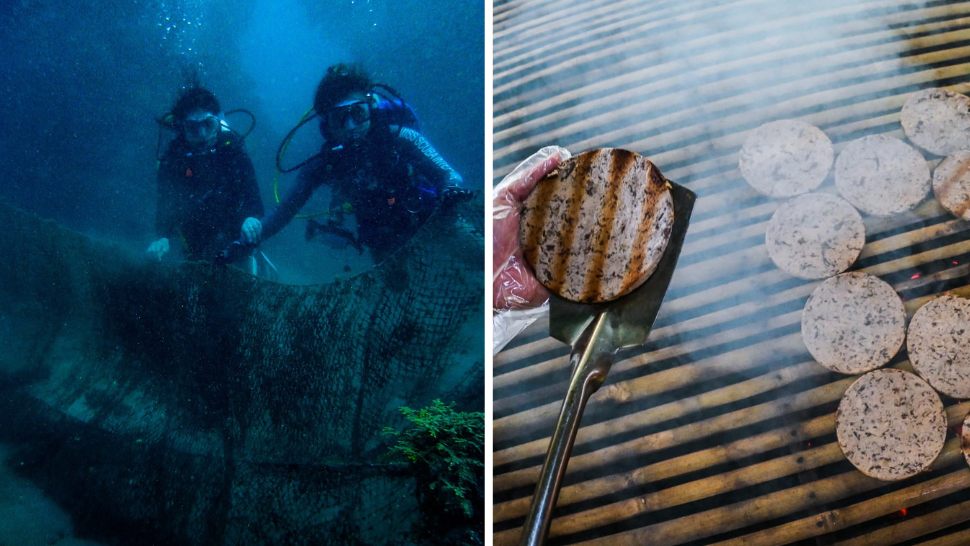
The local government of Sulat decided to come together with its neighboring municipalities, taking on the initiative of launching its first-ever clean-up dive. Local divers came to provide necessary assistance to local diving sites like those around Sulat and Borongan. Among the other sites visited were the fish sanctuaries of Ando and Divinubo islands, which also happen to be two of the most popular tourist spots in the province.
Getting our feet wet for the clean-up dive.


"When Typhoon Yolanda hit us, we lost a lot of lives. Our basic shelter was destroyed. [We had] no electricity, no water. That was our wakeup call,” said Sofia Isabelle Zacate, a Sulat, Eastern Samar council member who’s also a surfer and diver. “The impact of climate change has really affected Eastern Samar, and with this kind of initiative to protect our natural resources, municipalities were unified for a common goal—resource sustainability."
Zacate added: "The local government of Sulat is already doing its part to preserve the marine life of our municipality. We are now in talks with the authorities to declare marine and fish sanctuaries in some areas that need full monitoring and conservation.”
Some photos from the clean-up dive


ALSO READ:
This Tiny House With Ocean Views Is Worth the Trip to Eastern Samar
Sardines Are Vanishing in Samar and the Bicol Peninsula
Pudpod, Only in Eastern Samar
Visit any region, any province, and chances are, you're going to find their localized traditional crafts and knowledge systems. Eastern Samar is no different. The province, which is part of the third biggest island in the Philippines, offers so much more. Their local delicacy is called “Pudpod,” which is a smoked fish patty native to the Waray people.
Catalab-an is the place where Pudpod was born. It is a small island in Sulat where the majority of locals make Pudpod for a living. Locals around here say that the name of this delicacy comes from its intricate process. Pudpod directly translates to “worn out.” Makes sense, if we observe the process. I was told by one of them: "Sa sobrang hirap gawin ng Pudpod, nakaka-pudpod ito ng mga daliri."
Into the process.


This fish patty, usually made of yellowfin tuna and swordfish, another element of the practice deeply rooted in Sulat's rich cultural heritage, has become a significant source of livelihood for the local community.
Suffice it to say, the creation of Pudpod is a tedious, labor-intensive process that requires the utmost skill. The fresh tuna comes straight from Samar’s waters, and is intricately deboned and grounded using only peoples’ bare hands. After that, salt, pepper, calamansi, and other spices are added for flavor. Once everything is mixed, it is shaped like a patty, and then smoked in a makeshift oven for 45 minutes.
The shelf life of this local delicacy can last up to a month, they say. The final product is best enjoyed when it is cooked with coconut milk and malunggay leaves.
Finishing Pudpod.


The Mystery of Basyaw
On the first day of our week-long Sulat immersion, we passed a landmark rock just beside a sharp turn en route to our accommodations around Paninihian. At first glance, with its size and unique placement, you can tell that it's no ordinary rock. Our guides were glad we noticed it, too. They began telling the story of this mysterious rock called “Basyaw.”
The old story says that this rock is miraculous, answering requests and prayers (mostly material requests) of local dwellers. It is shrouded in myth and superstition.
“[According to elder’s stories], the people come here to ask for wedding gowns, plates, or drinking glasses of that rock,” one guide explained. “And come the next morning, when you go back to that rock, your request is ready for you to use.” There is, however, a catch.
The guide further claimed: “After you use the gown, the plate, or the drinking glass, [the only thing asked of you is for] you have to return it to the rock and give it a piece of that item as proof that you really used the gift. Or else, magtatampo ang bato.”
You can tell a lot about the local culture in a community by just living through them and their stories, from the food they consume to the motivations behind their practices and the realities they believe in. Such is the case with Eastern Samar, where, compared to neighboring provinces popular with tourists, has its own inherent character and value. They have it all: beaches to surf and dive in, caves to explore, and rivers to plunge into. It’s considered the “hidden gem” of east-central Visayas for a reason. Now, it’s just waiting for people like you to find it.
