
Today I Learned: The Boundary Dispute Between Caloocan and Malabon

Territorial or boundary disputes are not exactly uncommon. In many areas of the world, two or more sovereign nations will lay claim to the same parcel of land or body of water, thus setting off what can often be civilized discourse but can sometimes devolve into contentious and even violent clashes. In fact, many news headlines these days involve countries that are in some type of disagreement over competing claims to valuable territory.
But we’re not going to go over those now. Today, we’re going to discuss an issue much closer to home. Yes, territorial disputes aren’t limited to some far-away lands that we just read about in the headlines; we have them right here in our own country. Perhaps the most famous and high-profile in recent memory is the one involving Makati and Taguig over the entirety of Bonifacio Global City and other areas in between the two cities.
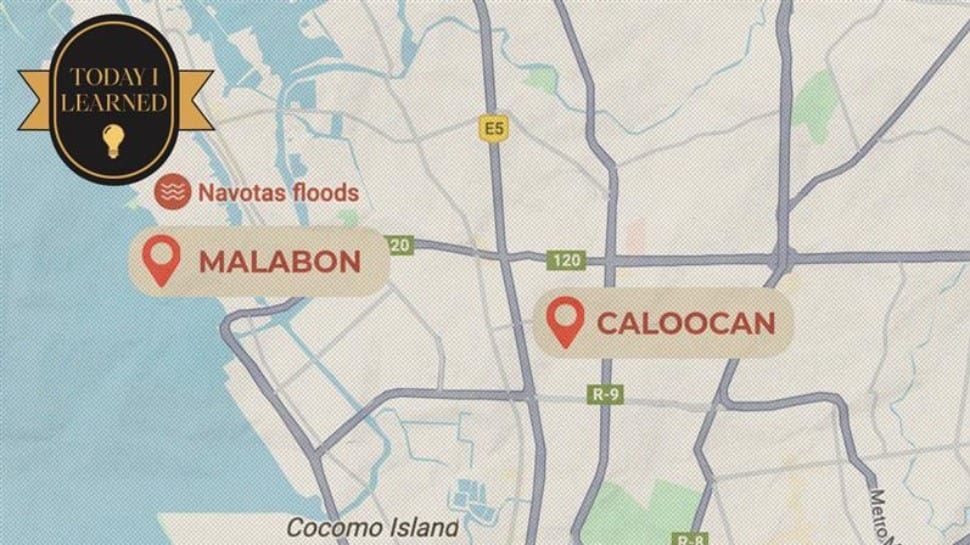
Recently, however, one other case involving cities in Metro Manila was brought into the spotlight after a Supreme Court decision. Caloocan and Malabon have been involved in a contentious clash over a swath of land since at least the early 2000s. It’s not something that’s been highly publicized—at least not like the issue involving Makati vs Taguig—but it’s no less interesting.
Before we get into the nitty-gritty, here’s a quick history lesson about the two cities.
ALSO READ
Makati Vs. Taguig: A Short History of the Fight for BGC
Taguig's Newest Additions: What's Going to Happen to the Second District of Makati?
Caloocan and Malabon: A short history
Caloocan traces its roots as a fishing and farming community founded by the Augustinians in the late 18th century. It was a part of the old province of Rizal before it became a municipality in 1815. Throughout the 19th and 20th centuries, it evolved from a quiet town into a bustling suburb and eventually a highly urbanized city. In fact, it is one of the original four cities of Metro Manila (including the City of Manila, Quezon City, and Pasay City). As of the last census in 2020, Caloocan had a population of over 1.6 million and is the fourth most populated city in the Philippines.
Malabon, meanwhile, was originally called Tambobong and was a part of the province of Tondo (before the latter became Manila). Also founded by the Augustinians, it became a part of Metro Manila in 1975 and was declared a highly urbanized city (HUC) in 2001. It was around that time that the dispute with its neighbor Caloocan started.
The roots of the dispute
After Malabon was converted from a municipality into n HUC in March 2001 by virtue of RA 9019, a plebiscite was conducted in the city that ratified the conversion. Section 2 of RA 9019 defined the boundaries of the new city: on the northeast by the City of Valenzuela; on the southwest by the Municipality of Navotas; on the northwest by the Municipality of Obando, Bulacan; and on the southeast by the City of Caloocan.
According to Henry Cammayo, a former member of the City Council of Caloocan, and former barangay chairpersons and kagawads of Barangay 160 and 161, Section 2 of RA 9019 “substantially altered the boundaries of Caloocan without the conduct of a plebiscite as required by Article X, Section 10 of the Constitution.” Thus, the respondents filed a Petition for declaratory relief, with prayer for issuance of a writ of preliminary injunction, against the City of Malabon including its officials.
Caloocan argued that changes embedded in RA No.?9019 (Malabon’s city charter) effectively annexed territory from Caloocan without the plebiscite required under the Constitution’s Article X, Section 10. In their view, that’s unconstitutional interference without proper voter consent.
To prove their claim, the respondents presented as evidence the fact that the subject barangays (Brgy 160 and 161) were already included in RA 3278 or Caloocan’s Charter, and that around 9,000 residents of said barangays voted in all the elections for the various positions in Caloocan from 1961 to May 2001. In addition, the respondents claimed that the Commission on Elections (COMELEC) conducted the barangay elections in Barangays 160 and 161 as local government units (LGUs) of Caloocan in July 2002.
In its answer, Malabon maintained that the contested portions of the subject barangays have always been part of its territorial jurisdiction; therefore, RA 9019 did not cause any alteration of the territorial jurisdiction of Caloocan. In other words, Malabon argued that because the subject barangays have always been a part of Malabon, there was no need to conduct a plebiscite there as the referendum conducted on April 21, 2001 to convert it to an HUC complied with the requirement of the law.
In essence, what Caloocan argued was that Malabon did not have the right to claim land via charter amendments and that they needed a plebiscite for that, and that the subject barangays were and have always been part of Caloocan. However, Malabon’s defense was that the contested lands have always been its territory based on modern geodetic surveys. That means, no land was taken, the city charter didn’t shift actual territory, so no plebiscite was needed.
What the courts said
On January 28, 2019, the Regional Trial Court of Caloocan handed down a decision: it found RA 9019 unconstitutional and, accordingly, made permanent the writ of preliminary injunction that was previously issued. Malabon filed a motion for reconsideration, but this was denied. Malabon then brought the case to the Court of Appeals.
Four years later, on February 28, 2023, the CA granted Malabon’s appeal and reversed and set aside the RTC ruling, and accordingly, dismissed the case without prejudice. According to the decision, it said “the case essentially entails a boundary dispute which should have been jointly referred first to the parties' respective Sanggunians for settlement pursuant to Section 118 of the LGC.”
Essentially, the CA said that the RTC should not have been so quick to assume jurisdiction of the case as both Malabon and Caloocan should have attempted to settle the dispute before their respective city councils first.
“It is only upon failure of this intermediary step will resort to the RTC follow,” the CA said.
Of course, the decision didn’t sit well with Caloocan, and the respondents filed its own motion for reconsideration, which the CA subsequently denied. The case was then elevated to the Supreme Court.
The SC agreed with the CA. In its decision, the High Court found Caloocan’s petition without merit, calling it premature.
“The core issue in this case involves a boundary dispute between two highly urbanized cities which should have been jointly referred for settlement pursuant to Sections 118 and 119 of the LGC,” the SC said. “Under the LGC, boundary disputes between and among LGUs must, as much as possible, be settled amicably through joint referral to the appropriate Sanggunians of the LGUs concerned.”
In its decision, the SC invoked the rules for settling boundary disputes as laid out in Section 118 of the LGC or Local Government Code: “Boundary disputes involving a component city or municipality on the one hand and a highly urbanized city on the other, or two (2) or more highly urbanized cities, shall be jointly referred for settlement to the respective sanggunians of the parties.”
“It is only when the foregoing procedure fails that a resort to the RTC will follow pursuant to Section 119 of the LGC,” the SC said.
The SC’s decision, which was penned by Associate Justice Antonio Kho Jr., was promulgated in November 2024 but was only made public in February 2025.
Where are we now?
For now, the disputed territory sits in limbo. Because Caloocan’s petition was dismissed—not on merits, but for procedural missteps—the case is back at square one. Now, both the city councils of Caloocan and Malabon need to conduct talks to resolve the issue. Only if it fails will the issue be brought to the courts.
While people might think this is just a negligible case of who owns what, it actually carries much weight. Besides setting legal precedent, the issue affects residents in the disputed areas in thigs like who pays their taxes, where they vote, and which city provides their basic services. It’s also a case study on how grassroots democracy works, because the LGC advises parties to talk amongst themselves first before going national.
Besides, in a densely populated metropolis like Metro Manila, land is prime real estate. A few hectares can mean millions in revenue and civic pride. It’s not just about lines on maps.
