
Is 'Mentalism' Legit? This Professional Mentalist Says Yes


Given the popularity of talent and variety shows in the Philippines, it's no surprise that many Filipinos have come across the term mentalist or mentalism. It's a sub-genre of magic in which the performer—called a mentalist—creates the illusion of extraordinary mental abilities, such as mind reading, prediction, and influence.
Despite how real it may seem, mentalism is not supernatural or psychic. It uses a combination of psychology, body language reading, verbal and nonverbal clues, oral linguistic programming, and suggestion techniques to achieve seemingly impossible outcomes.
Unlike other mentalists though who solely perform the art as a form of entertainment, 36-year-old business consultant Mateus Almeida applies the practice to help companies and employees in their business strategies. He calls himself a "business mentalist." Almeida, who has worked in the finance and technology sector for many years, claims that mentalism can help people in their professional and even personal lives.
Mentalism gives people the sense that one could reach into their minds, pluck out private thoughts, predict their decisions, or influence their behavior in ways they couldn’t explain.

Meet Mateus Almeida
Almeida, who was born to a Portuguese father and Filipino mother, found his passion for magic when he was just eight. “I guess, it started out because my dad would show me magic tricks when I was a kid, and he would never explain how they were done,” he tells Esquire Philippines. “So it was up to me to try to figure it out because I was always a curious kid by nature. I would try to dissect how the trick is done. I would sometimes figure it out, but not the solution that my dad used. It would be my own way. So there was this creative element of breaking illusions down.”
By the age of 12, Almeida was already performing magic tricks. He began with close-up magic—cards, coins, pens—classic sleight-of-hand routines done just inches away from his audience. But it wasn’t long before he started experimenting with the illusion of mind reading.
What fascinated him wasn’t just the trick itself, but the reactions it provoked. Mentalism gave people the sense that he could reach into their minds, pluck out private thoughts, predict their decisions, or influence their behavior in ways they couldn’t explain. The responses were more visceral than card tricks alone.
“A card trick is impressive,” he says, “but telling someone the name of a relative? That’s a different level of amazement.” Over time, he found himself drawn to this branch of magic that went beyond simple amusement but left lasting impressions.
“I’d say magic is more of a feast for the eyes, while mentalism is a feast for the mind,” he explains. “It fools your thoughts and makes you believe that impossible things could actually happen in the real world. Magic, on the other hand, relies more on physical illusions—your eyes see things that are seemingly impossible.”
That same fascination with how people think and perceive the world would later influence not just his performances, but also his professional journey.
Almeida began his career as a banker at Credit Suisse in Singapore after completing his undergraduate studies in the United States. He went on to earn his Master of Business Administration from INSEAD, a leading business school in France. With over a decade of experience in the tech and finance sectors, he has held senior executive roles at companies such as Lazada, SEEK Asia (the parent company of JobStreet), and Honestbee. His work has spanned the U.S., Singapore, and the Philippines, focused on strategy and quantitative problem-solving.
He began practicing mentalism professionally at around 23 years old. “I would perform in bars on weekends for extra cash and to meet people,” he shares.
While working full-time in the corporate world and practicing mentalism on the side, Almeida began to see how its techniques could enhance his everyday life. “I realized it could help me build rapport, influence people’s decisions, or steer conversations in the direction I wanted. I could even train myself to present a certain image during important meetings. There were so many opportunities to apply these tools at work, which is where I spent most of my time—not in a bar, you know?”
Almeida began practicing mentalism professionally at around 23 years old. “I would perform in bars on weekends for extra cash and to meet people,” he shares.

'It’s Not Supernatural or Devilry’
Because of its connection to magic, mentalism often draws reactions that stretch between awe and skepticism. It’s also easy to see why people might associate it with the supernatural or "evil" forces, especially given how mentalists can seemingly bend reality with their ability to influence perception and create illusions.
“People think it's spooky, or it's like devilry. It's really not. It's just lot of human psychology, a lot of techniques and framing, trying to control what the audience is receiving at any given time,” Almeida reveals.
“It's kind of like seeing a movie. You know implicitly that there's a camera behind, that there's a director, but you don't really think about it when you're watching the movie. So mentalism is just about controlling the narrative,” he further explains.
Almeida swears that mentalism can benefit one’s professional life because, “at the end of the day, we work with humans, and mentalism is fundamentally about dealing with people.” But there are particular careers where he believes it will be especially potent, such as sales, branding, and marketing.
ALSO READ
Mystics and Miracles: 10 Stories of Filipinos With Supernatural Gifts
Albularyo: Why 'Magic' Healing Still Prevails in the Philippines
“When we think about magic and mentalism, those in the craft are constantly seeking the most cutting-edge ways to influence people’s thoughts and plant ideas in their minds. That’s what we dedicate our time to, right? Myself included. I’m always thinking about it. What does a marketer or brand builder do? They’re focused on making their brand stick in a person’s mind. Many of the techniques developed over more than a century in mentalism and magic can be applied directly to the business world of marketing and branding. It's about making brands stand out and make them memorable.”
Beyond marketing, Almeida sees mentalism as a powerful tool for leadership as well. “Leaders need to inspire others and earn their trust and buy-in. They’re selling a vision, a dream. That’s why the ability to be compelling and persuasive is essential. In that sense, I think leaders have a lot to learn from mentalism,” he says.
The business mentalist emphasizes two important skills one should have to succeed in applying the practice in their professional and personal life. First, a mentalist needs to master the art of rapport building. “Mind reading is not like stealing something from a safe, like a thought from your mind. It has to be shared willingly,” he stresses.
Equally important is the ability to be self-critical, as mentalism involves a lot of trial and error. “You need to really assess your work and your style, and pick out flaws… There’s a high learning curve, and you kind of have to brute-force your way through it to eventually succeed.” Together, these skills—emotional intelligence and disciplined self-reflection—form the foundation of effective mentalism.
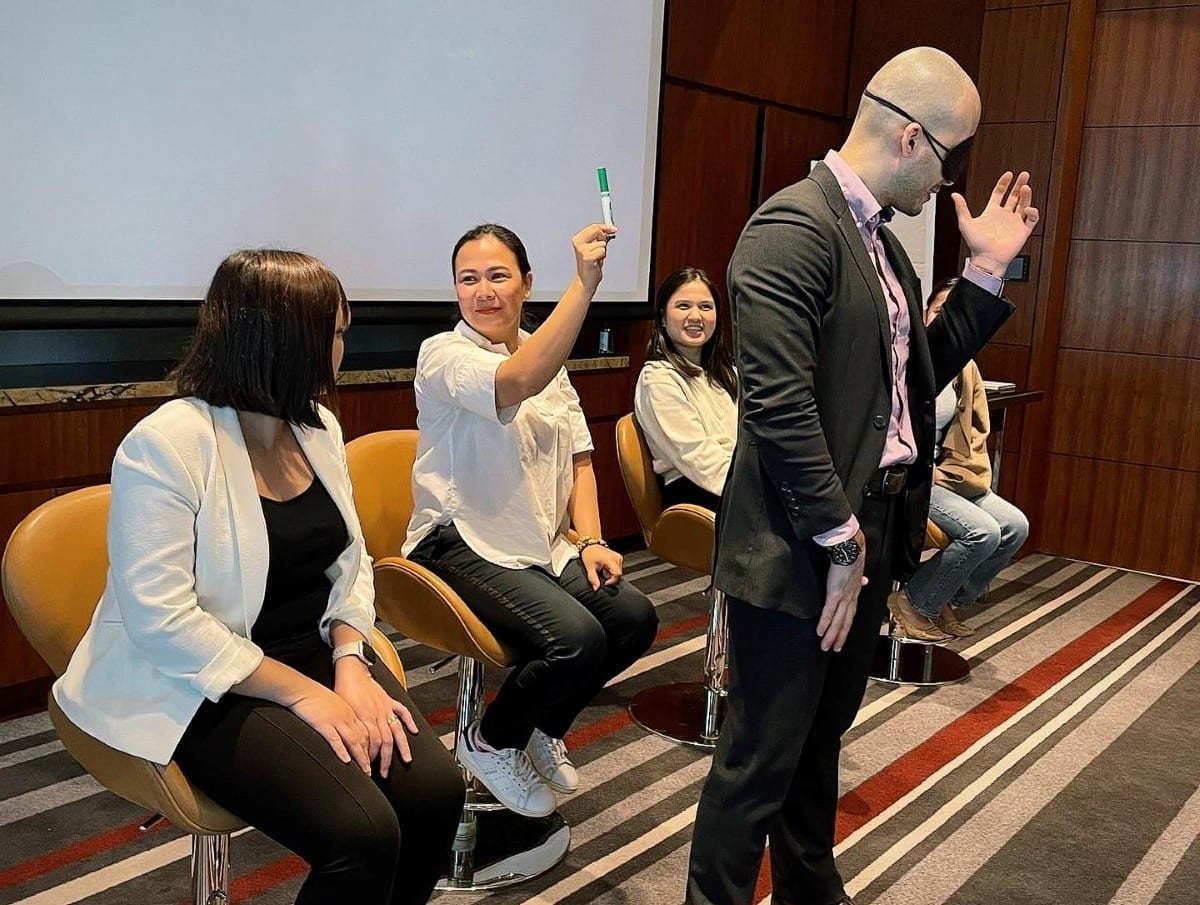
Unlike other mentalists though who solely perform the art as a form of entertainment, Almeida applies the practice to help companies and employees in their business strategies.
Applying Mentalism in Everyday Life
One of the most practical applications of mentalism lies in improving personal interactions. Even small tweaks in how we present ourselves can have a powerful, compounding effect on how we're perceived by others, says the business mentalist.
"You can tweak how you’re coming across even before you start talking, and that can amplify your relationships—even if just a little bit. Sometimes, even small improvements can have an exponential effect. How you dress, how you smell—these things matter. Our sense of smell is actually very strong as humans; we just don’t consciously think about it most of the time."
Mentalism can also be applied to enhance personal credibility. “There are techniques you can use to build credibility for yourself and gain a bit more respect in certain situations—say, if you want to seem like you know more than you do, or if you want your existing knowledge to come across a little more strongly,” he says.
Almeida says one of the most valuable lessons he’s taken from mentalism is the habit of putting himself in someone else’s shoes. “Every time I do something, I try to think, ‘How would a person receive this if they were talking to me?’ I think I’m pretty good at understanding the motivations of the other party, and that eases a lot of things. It makes everyday conversations smoother, helps in negotiations, and encourages me to give people the benefit of the doubt. I typically assume the best-case scenario with others because I’m consciously trying to put myself in their shoes,” he elucidates.
For Almeida, mentalism is both a form of creative expression and a way to rekindle something many adults have lost: a sense of wonder.

The Ethics of Influence
Mentalism provides valuable tools for influencing others, but it also raises a fundamental question about ethics: when does influence become manipulation?
“There’s a fine line between influencing someone and manipulating them—especially when manipulation means exploiting a person’s insecurities to get what you want. My rule of thumb is simple: it comes down to their well-being. If what I’m doing harms that, then I know I’ve crossed an ethical line.”
He shares what transpired in a recent session. "Earlier, I asked one of the participants, ‘Would you like pizza or Japanese for dinner? She said, "Japanese." This is influencing. It's a basic technique, but it's an influencing technique where I frame the choices with only two options, so that I always end up with the two options I like. So I will never say, ‘Do you want Mexican?’ if I don't want Mexican. It’s all about framing. If omitting an option—say, option C—would negatively impact the client had they known about it, then leaving it out becomes ethically questionable.”
A good counter-example would be in medical treatments. “Imagine I’m a doctor and I frame a question like, ‘Would you prefer chemotherapy or surgery?’ Let’s say my goal is to encourage the patient to choose an expensive procedure. However, there’s also option C: holistic care. If withholding option C negatively affects the patient’s well-being, then it’s clearly unethical,” Almeida explains.
Almeida encounters skeptics and the occasional misunderstanding about his craft. Despite this, he remains committed to mentalism. What keeps him going, he says, isn’t just public approval—it’s something much more personal. For him, mentalism is both a form of creative expression and a way to rekindle something many adults have lost: a sense of wonder.
“I love giving people that sense of wonder,” he says. “When was the last time we really felt that kind of childlike awe? Probably when we were kids, watching something like Jurassic Park. As adults, we get numb to that. So what I’m doing injects that feeling back into people.”
To know more about mentalism and Mateus Almeida's services, visit mentalist.ph.
