
Today I Learned: The Modern-Day Guadalupe Bridge Is Almost 60 Years Old

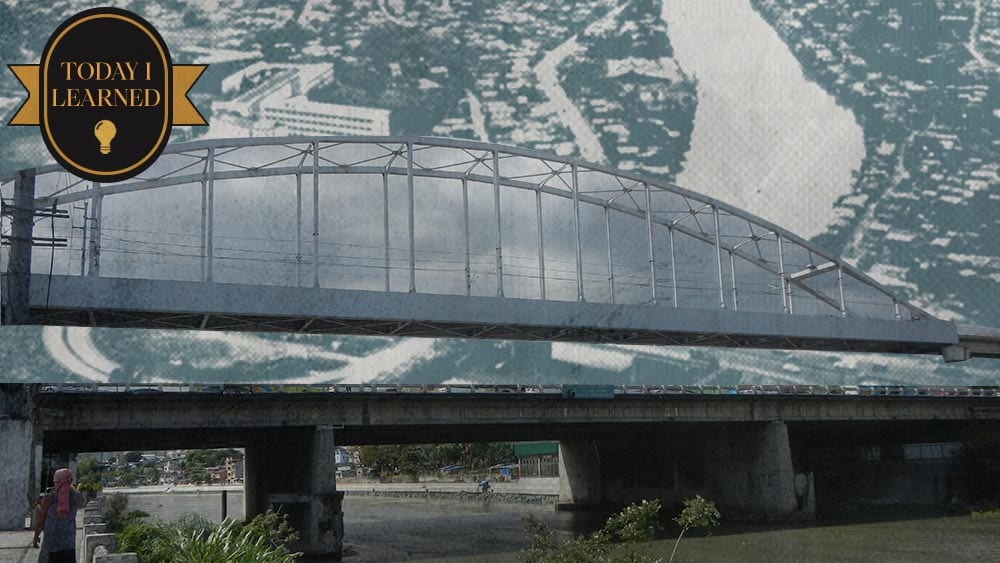
ILLUSTRATION: Igi Talao
The Guadalupe Bridge over the Pasig River is one of the busiest transport infrastructures in Metro Manila. Not only does it connect Makati and Mandaluyong, but it also allows motorists from the northern part of the Metro to get to the south side and vice-versa. Up to 141,000 vehicles pass through the Guadalupe Bridge daily on average, according to the Metropolitan Manila Development Authority (MMDA).
So when MMDA Acting Chairman Atty. Don Artes announced last August 29 that the EDSA-Guadalupe Bridge is set for a 17-month closure starting in October 2025, best believe that it was big news.
ALSO READ
30 Photos of Makati During Its Early Days
This Is the Story of That Big Hole in EDSA-Ortigas
Closure and Rehabilitation of Guadalupe Bridge
The MMDA clarified that the closure only includes the outer lanes of the bridge. It will not be closed to traffic until a temporary bridge has been fully constructed, which is expected to be completed after 10 months, starting January 2025. Traffic rerouting and traffic management plans are also set to alleviate congestion during the construction of the temporary bridge. As for the Pasig River Ferry Service and passage of barges through the major waterway, it's business as usual.
Traffic management plan along EDSA during the closure of the outer bridges
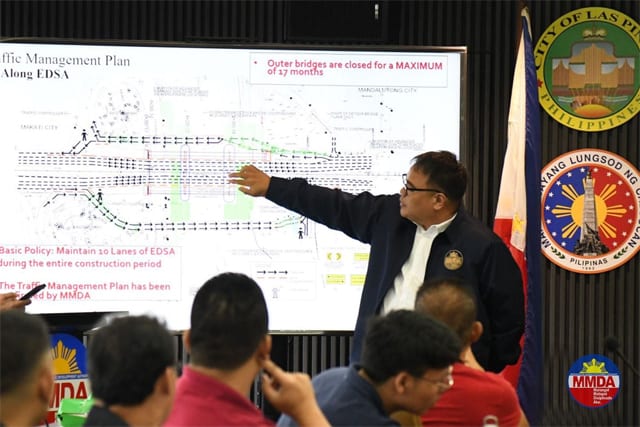
The construction and rehabilitation were deemed necessary after studies revealed in 2016 that the infrastructure is likely to collapse in the event that a strong earthquake hits Metro Manila, commonly known as the "Big One." The outer lanes are already deteriorated and filled with noticeable cracks. Liquefaction is also a possibility on the current foundations where the Bridge stands.
History and Design of Guadalupe Bridge
These things don't come as a surprise for a bridge that's already almost 60 years old.
Guadalupe Bridge's origins trace back to the early 20th century when it was first constructed to facilitate transportation and commerce between the two burgeoning areas. Highway 54, now EDSA, was partially opened in the 1940s; then, plans to link the north and south banks of the Pasig River were carried out in the 1950s through a narrow bridge. Originally a simple structure, the modern-day Guadalupe Bridge underwent replacement in the 1960s, with construction running from 1962-1963 to 1966.
Road bridge widening followed in 1974. In 1979, Umali-Pajara Construction Company was contracted to build the two outer bridges. The inner bridge, which is a rail bridge for the Manila Metro Rail Transit System Line 3 by EEI Corporation, was inaugurated in 1999.
Guadalupe Bridge's outer bridge design uses girders to support its deck (the surface of a bridge where vehicles and/or pedestrians pass). It's made from prestressed and reinforced concrete and features a total of 10 lanes (five per outer bridge). The length is at 114.44 meters, the width is 18.7 meters each, and the load limit is 20 metric tons.
The inner bridge, on the other hand, is a separate but unconnected tied-arch rail bridge. It hovers above the road bridge and has a length of 135 meters and a width of 9.1 meters.
Repairs were done on the bridge in 2019 when the outer bridges were replaced by three-span steel deck box girders. Back then, the inner bridges were retrofitted. The sidewalk for pedestrians was expanded to 1.5 meters.
Earlier in the year, the southbound lanes of the EDSA-Kamuning Flyover were partially closed for retrofitting and rehabilitation. The closure lasted for three months, from May 1 to August 15.
