

What Is Ophir and Why Does a Laguna Congressman Think the Philippines Could Be It?

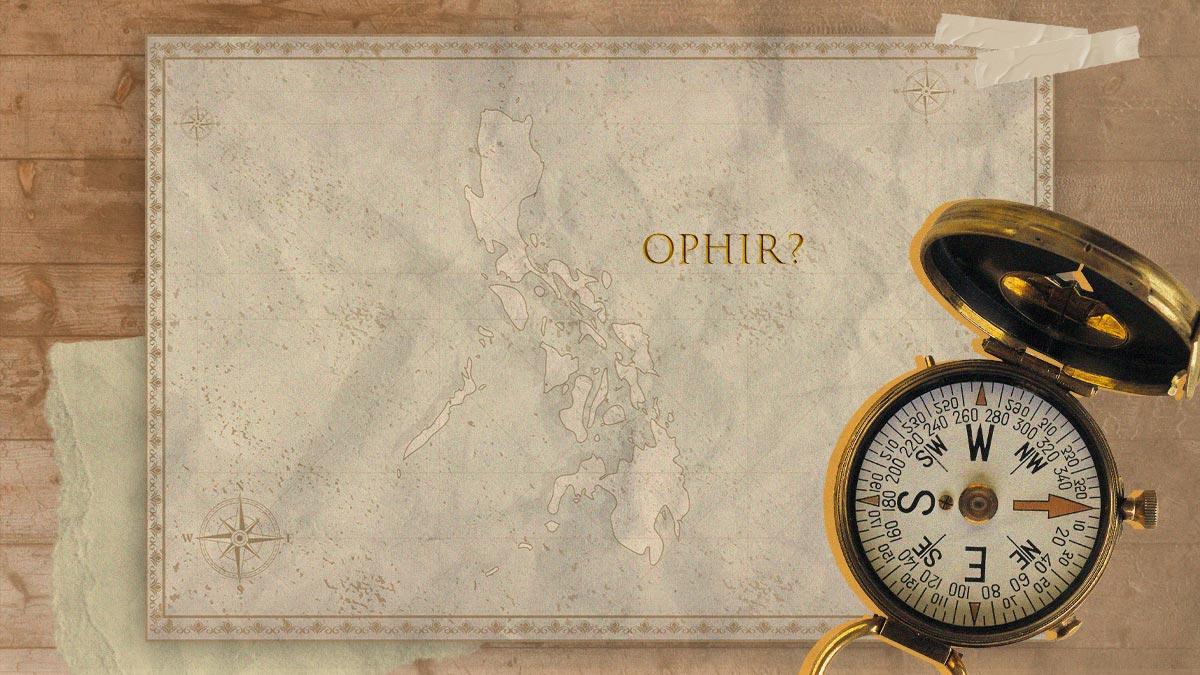
On Monday (July 30), Rep. Dan Fernandez of the lone district of Santa Rosa, Laguna delivered a privilege speech that was noteworthy mostly because he gave credence to theories that the Philippines is, in fact, the biblical city of Ophir.
Ophir what?!
In a report on Rappler, Fernandez, who is a former actor and licensed optometrist, spent over 20 minutes citing historical evidence establishing the Philippines as the ancient city known for its great wealth. The congressman invoked a 16th century document in the Archivo General de Indias that contained directions to get to Ophir, as well as the fact that the Baybayin writing system bears a resemblance to Hebrew, in which the Bible was written.
It's all a bit of a stretch, until you realize that Fernandez is not the first to make the Philippines-is-Ophir claim; conspiracy theories abound on YouTube, Facebook, and elsewhere.
But what—or where—exactly is Ophir?
ALSO READ
The British Once Controlled Islands in Mindanao When the Philippines Gained Independence
Debunking the Mystery of the Phantom Island of San Juan
What is Ophir?
In the Bible, Ophir is first mentioned in the book of Genesis not as a place but as a person, specifically one of the sons of Joktan, who is descended from Noah. Eventually, Ophir is described as a place famous for its gold. According to the Encyclopedia Britannica, Ophir was initially placed somewhere in Arabia, but by the time of King Solomon, it was apparently in a faraway land overseas.
1 Kings 10:22 says: “The king had a fleet of trading ships at sea along with the ships of Hiram. Once every three years it returned, carrying gold, silver and ivory, and apes and baboons.”
Ophir is also mentioned in other books in the Old Testament:
“Then you will lay up gold as dust, and the gold of Ophir as the stones of the brooks.” (Job 22:24)
“Kings' daughters were among thy honourable women: upon thy right hand did stand the queen in gold of Ophir.” (Psalm 45:9)
“I will make a mortal more rare than fine gold, A man more than the golden wedge of Ophir.” (Isaiah 13:12)
Clearly this Ophir was a place known for great riches, wherever it was.
Where is Ophir?
By the time of the Egyptian pharaohs, there is evidence of the royals sending naval expeditions to places in East Africa for things like monkeys, ivory, frankincense, and slaves, which led many to believe that Ophir could have been in that area.
However, others contend that the city was actually in India. “The Hebrew words for the products of Ophir may be derived from Indian languages; furthermore, sandalwood and peacocks are commonly found in India, whereas, at least in modern times, they do not exist in East Africa,” the Encyclopedia Britannica says.
Another theory claimed that Tell Qasile (modern-day Tel-Aviv) was Ophir based on a pottery shard that bore inscriptions that referenced the place. Even the United States had made an announcement back in the 1970s that a place in Saudi Arabia called the Mahd adh Dhahab (Cradle of Gold) is the biblical Ophir.
Other places that have been proposed as the real Ophir include Sri Lanka; Kerala, India; Zimbabwe; Mozambique; Indonesia, and, of course, the Philippines.
Is Ophir the Philippines?
In his speech, Rep. Fernandez floated the idea of changing the name of the country to Ophir. “When we learn to know ourselves, we will be known in the entire world as Ophir and we will know that we are the sons of the living father, but if not, we will continue to be ignorant just what the Spaniards wanted,” Rappler quoted the congressman as saying.
Just as Fernandez cited, perhaps the strongest evidence believers hold about Ophir being the Philippines is a book called Colección General de Documentos Relativos a las Islas Filipinas (General Collection of Philippine Islands related Documents), that gives specific directions to reach the ancient land.
In the section “Document No. 98,” which is dated 1519-1522, the book says that Ophir can be found “by travelling from the Cape of Good Hope in Africa, to India, to Burma, to Sumatra, to Moluccas, to Borneo, to Sulu, then finally Ophir facing the Pacific Ocean.”
The book also said Ophir is “in front of China towards the sea, of many islands where the Moluccans, Chinese, and Lequios (a group of ancient Hebrews who supposedly settled around Ophir) met to trade...”
Historians and academics believe that this “group of islands” could not be Japan because the Moluccans never reached Japan, nor Taiwan, since it is not composed of “many islands.” That leaves only the Philippines that fits the description.
There are also Spanish records that mention the presence of the Lequios in the Islands to gather gold and silver.
“Some historians believe that the seat of Ophir in the Philippines is the Pacific Ocean side of the Island of Samar which was led once upon a time by a Samaritan Hadi Iberein (according to historian Henry Scott),” says this page. “Datu Iberein is a staunch ally of the Kingdom of Tondo.
“The Pacific side of Samar is also recognized by some historians as the ancestral homeland of the Polynesians/Austronesians,” it added. “Ophir is more formally called by some historians as the Lakanate of Lawan. According to Hebrew scholars like Dr. Narag, the original inhabitants of Lawan, the Lequios Waray Tribe, named the place after Awan or Aklia, the daughter of Adam. It also means in Hebrew as white beach which pointed to the golden white beach named Onay, in Lawan.
“In 726–722 BC, the new king of Assyria, Shalmaneser V, invaded the land and besieged the city of Samaria. After an assault of three years, the city fell and much of its population was taken into captivity and deported.They settled them in Halah, in Gozan on the Habor River and in the towns of the Medes and in far away pacific island, using the Ophir route, whom he named as Samar. Their growing tribe is known as lequios tribe, or waray hadlok, in local dialect of the Philippines. The ancient Philippine (Ophir) aborigines or natives are the descendants of the mixture of the Rhinoceros Man, Dawn Man and Callao Man who intermarried with the Lequios and they are called Ophirians since there is no Philippines on those ancient times.”
So, is the Philippines really this ancient land once called Ophir? What do you think?
[ArticleReco:{"articles":["12658"]}] [ArticleReco:{"articles":["27461"]}]