
Today I Learned: The Philippines Is Home to Two Domesticated Buffalo Species

ILLUSTRATION: Igi Talao
The Philippines is one of the 18 mega-biodiverse countries in the world, according to the Convention on Biological Diversity. Its list of plant and animal species—whether endemic or introduced—is too long that it is home to about two-thirds of the planet's biodiversity. This diversity is true for buffalo species found in the Philippines, specifically the domesticated ones that are primarily used for milk and meat production, as well as tilling farmlands.
ALSO READ
How This Bulacan Farm Shifted from Raising Goats to Making French-Inspired Heritage Cheese
Sustainable Farming and Winemaking at the Beringer Vineyards
Two Domesticated Buffaloes in the Philippines
Researchers from the University of the Philippines – Diliman College of Science and the Department of Agriculture – Philippine Carabao Center have confirmed that there are two distinct species of domesticated buffaloes in the Philippines: the swamp buffalo (Bubalus bubalis carabanensis) and the riverine buffalo (Bubalus bubalis bubalis). This revelation clarifies the long-standing debate about the classification of these animals, which were previously considered subspecies of Bubalus bubalis.
The research team, including Dr. Ian Kendrich C. Fontanilla from the UP Insitute of Biology and Dr. Lilian P. Villamor from the Philippine Carabao Center, conducted a comprehensive investigation to determine the taxonomic status of these buffaloes. By analyzing the DNA sequences of genes from both swamp and riverine buffaloes, they discovered that the genetic differences and distinct chromosome numbers between the two confirm that they are separate species.
A Philippine native carabao (Bubalus kerabau Fitzinger, 1860) dam and her calf grazing in Pitogo Island, Bohol.
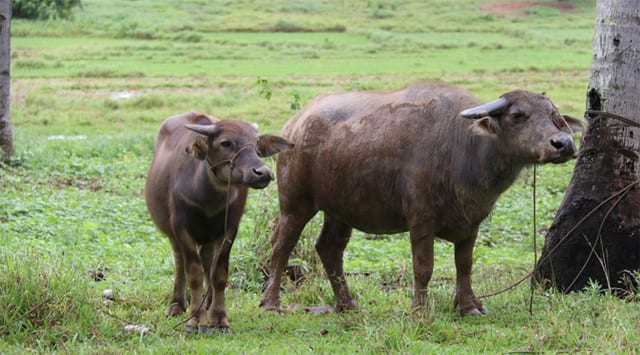
Swamp buffaloes (Bubalus bubalis carabanensis), or what we know as the Philippine carabao, are primarily used for agricultural tasks such as tilling land and transporting tools. They also provide meat, milk, hide, and manure, which serves as organic fertilizer. These buffaloes can be identified by their lighter skin and coat color, white or light gray markings on their lower jaw and brisket, and crescent-shaped horns. They are smaller in size, typically weighing between 325 and 450 kilograms. It is found primarily in China and Southeast Asian rural areas.
A riverine buffalo (Bubalus bubalis Linnaeus, 1758).
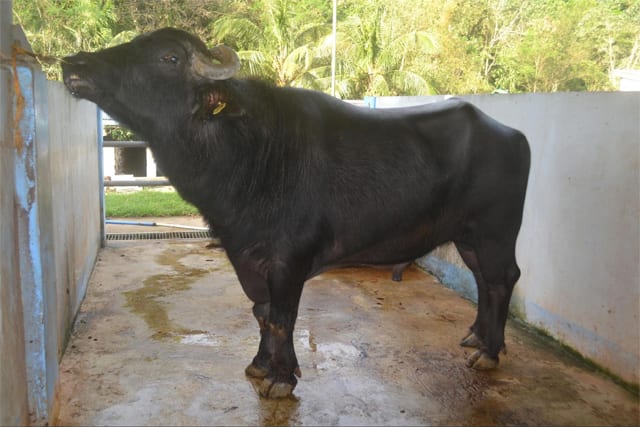
On the other hand, riverine buffaloes (Bubalus bubalis bubalis) are mainly raised for milk production and are larger, weighing between 450 and 1,000 kilograms. These buffaloes have curly horns and are distinguished by their darker skin and coat color. The hybridization of swamp and riverine buffaloes has been explored to enhance milk and meat production, but the results have been mixed, with some offspring not achieving the desired traits. It is found mostly in India, Pakistan, Italy, and the Middle East.
Given these differences, the team proposed that the Philippine native carabao (Bubalus bubalis carabanensis) be reclassified as Bubalus kerabau Fitzinger, 1860. This highlights that the swamp buffalo is a distinct species from the riverine buffalo and that the two are not subspecies of the Bubalus bubalis.
The Importance of Taxonomy
Villamor highlighted the significance of these findings, stating that the observed physical differences between the two species align with the genetic data. The confirmation of these two distinct species not only advances scientific understanding but also has practical implications for breeding programs and agricultural practices in the Philippines. It ultimately paves the way for more targeted and effective breeding strategies. Buffaloes, after all, are very important in an agricultural country like ours.
The research team also included Nelvie Fatima Jane A. Soliven, John Gregor A. Roño, Francis L. Fontanilla, Emerson R. Servo, Therese Patricka C. Cailipan, Alexander M. Paraguas, and Aivhie Jhoy E. Cuanang. Their study titled "Molecular Data and Karyotype Revealed Two Distinct Species of Domesticated Water Buffaloes in the Philippines" was published in the Philippine Journal of Science in October 2023.
Source:
Cailipan, T. P., Paraguas, A., Cuanang, A. J., Soliven, N. F., Roño, J. G., Fontanilla, F., Servo, E., Cao, E., Fontanilla, I. K., & Villamor, L. (2023). Molecular data and karyotype revealed two distinct species of domesticated water buffaloes in the Philippines. Philippine Journal of Science, 152(5). https://doi.org/10.56899/152.05.27
