While visiting Samal Island in early September, I asked my driver Rommel (not his real name) what he thought about the bridge that’s set to be built to connect the island with the Davao City mainland. He did not hesitate to voice his support for the project.
“Pabor po ako diyan,” he said. “Naalala ko yung lolo ng misis ko, a few years ago, kinailangang dalhin sa ospital. Namatay na lang siya sa sasakyan kahihintay sa ferry na tatawid sa dagat para dalhin siya sa Davao City.
“Kailangan talaga namin dito yang tulay na yan,” he added.
Over the course of three days staying at a resort in the island, I asked several locals—many of whom worked in the tourism sector as waitstaff, sales and marketing representatives, speedboat pilots, security guards, and resort executives—what they thought about the bridge project. While no one gave an answer quite as dramatic as that of Rommel’s, everyone agreed that the bridge is a good idea and that its completion can’t come soon enough.
Paradise Island Beach Resort has been welcoming visitors for decades
Well, not exactly everyone. Several individuals and groups have come together not to oppose the Samal Island-Davao Connector project per se, but the fact that its construction will destroy a marine sanctuary directly in the bridge’s alignment. Paradise Reef, which is located within the Paradise Island Beach Resort (PIBR) on Samal Island, is a 7,500-square-meter marine sanctuary that its protectors claim is one of the few remaining natural reefs in Davao Gulf, a key marine biodiversity area, and a vital component of food and fish supply in the Davao region.
Leading the fight against the current iteration of the project is Ecoteneo, the environmental advocacy group of Ateneo De Davao University, as well as the Rodriguez family, led by Juli Rodriguez, who manages the family-owned PIBR.
I paid a visit to the Rodriguezes’ resort one Sunday morning. Although Rodriguez was there to meet me and show me around the property, he was unable to directly comment on the issue owing to the filing of a request for a temporary restraining order against the project. The TRO request was denied by the Court of Appeals earlier this year and the plaintiffs took it to the Supreme Court. Rodriguez did hand me digital copies of documents containing his family’s position on the matter.
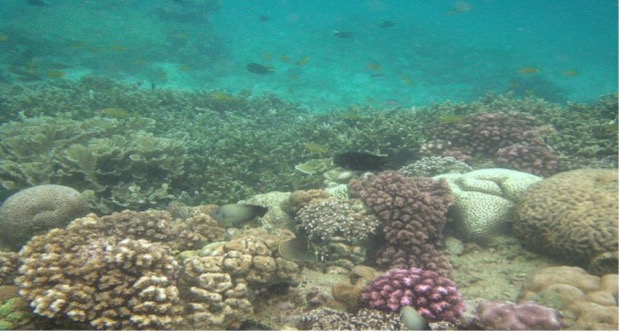
Corals in Paradise Reef photographed by marine biologist Dr. John Lacson
Rodriguez, and Mylai Santos of Ecoteneo, maintain that they are not opposed to the bridge project and are actually quite supportive of it, only that the process that led to its current form impinges on the rights of nature and could potentially destroy a protected marine sanctuary.
“The issue is the process,” Santos said. “How they’re doing it, and why they’re doing it.”
History of the Davao-Samal Island bridge project
Efforts to link Samal Island, or what’s officially known as the Island Garden City of Samal (IGCS), to Davao City, the economic center of Mindanao, have been going on for decades. One of the earliest records of government attempts to get the project going is a news item from the Mindanao Times dated January 18, 1979.
“Bridge to Link City and Samal,” the headline reads.
The article says the bridge proposal came from former Assemblyman Rodolfo del Rosario, who said that he requested the technical staff of the Davao Del Norte Provincial Government and the district office of the then-Ministry of Public Highways to conduct a study on the feasibility of such a project.
“Should the study show that the project will be viable, the proposed bridge may be given to a private firm under a turnkey basis,” the article said.
That wasn’t the first time that such a project had been proposed. Several years earlier, talk of a bridge surfaced when an aluminum plant was being planned to be built on Samal Island by an eight-nation consortium of “giant corporations.”
An illustration of where the bridge will be located on Samal Island

Save for sporadic news items, not much was heard of the project in the following decades, until in 1998, when, by virtue of Republic Act 8471, the municipalities of Babak, Samal, and Kaputian merged to become the IGCS. By then, Samal Island had become a rising tourist destination, with several beach resorts opening to take advantage of the area’s beautiful sandy beaches touching the clear waters of the Davao Gulf. Divers had also discovered the rich marine resources of the island and its surrounding seas.
Even in 2011, when a local paper conducted an informal survey among residents of Davao City and Samal Island about the bridge, an overwhelming majority (138 out of 150) said they were in favor of the project. Throughout the 2010s, economic activity in the island had risen to such levels that local officials said that the barges “could no longer handle” the rising volume of vehicles crossing from Davao City to Samal Island and vice versa. In 2014, the bridge project was said to be undergoing feasibility study.
But it would be at least five years before any significant step toward the realization of this project would be taken. In 2016, the year when former Davao City Mayor Rodrigo Duterte became President of the Philippines, the legislative agenda of the local government of the IGCS contained an item that would “request the Office of the President to include in his Flagship Project the Construction of Bridge (sic) connecting Samal – Davao City.”
It seems the local government officials were successful with their request. Duterte had indeed included the SIDC as a priority project in his flagship Build Build Build infrastructure initiative. But even then, the project hit a few snags and it wasn’t until January 2021 when it was announced that the Philippines signed a $350 million (about P19.32 billion) Framework and Loan Agreement with China, which would cover about 90 percent of the project’s total cost of P23.039 billion, according to the Department of Public Works and Highways (DPWH).
Despite optimistic projections, further delays caused by funding issues as well lengthy environmental and geologic studies pushed the project back until groundbreaking finally happened on October 27, 2022, with President Ferdinand “Bongbong” Marcos Jr. himself in attendance.
According to the DPWH, the SIDC will have four lanes and will measure 3.9 kilometers, connecting the R. Castillo and Daang Maharlika Junction on the Davao side with the Samal Circumferential Road in Barangay Limao on the Samal Island side over the Pakiputan Strait. It is expected to see up to 25,000 vehicles crossing both ways daily and will cut travel time by boat between the two sides from 30 minutes to only five minutes.
Over four decades of waiting will finally bear fruit.
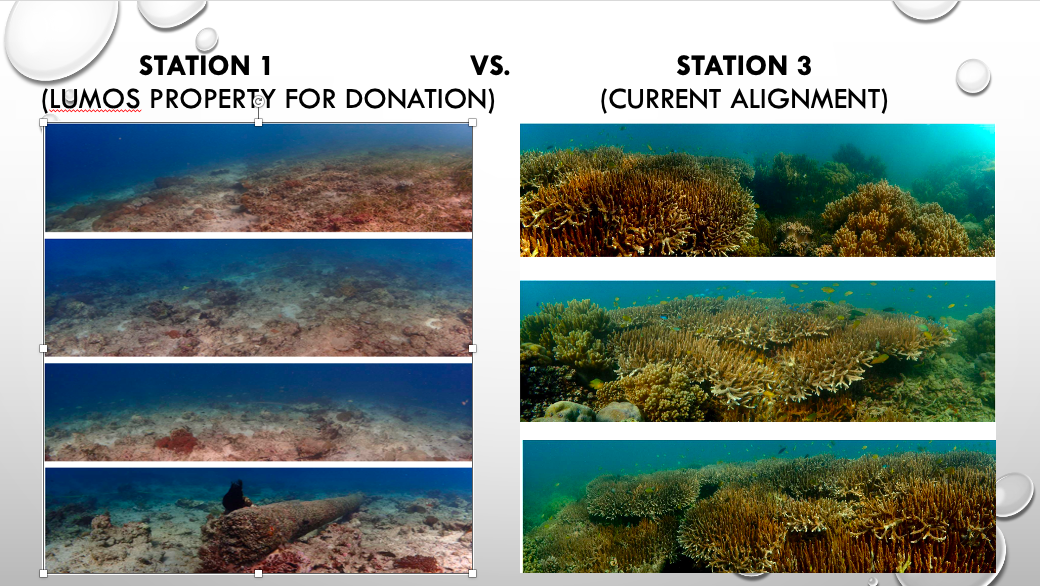
Comparing the underwater life in the donated property versus Paradise Reef
Right of way issues
On the Samal Island side, the final design will have the bridge cutting through the PIBR and the adjacent Costa Marina Beach Resort (CMBR), both of which are owned by the Rodriguez family. Both resorts also claim that rich marine life located just offshore will be severely impacted by the project.
Although the DPWH said it had conducted an environmental impact study and received an environmental clearance certificate from the Department of Environment and Natural Resources (DENR), the Rodriguez family claims that that study is “largely incomplete, grossly misleading, deceptive, and highly inaccurate.”
The family commissioned its own biophysical assessment of three proposed landing stations for the SIDC, which was led by noted marine biologist Dr. Filipina Sotto. The three study sites included:
- Station 1 – the El Paril Beach Resort (formerly Lumos Beach Property), which is also owned by the Rodriguez family and was actually offered for donation to the DPWH as an alternative landing site of the SIDC Bridge on the Samal Island side.
- Station 2 – the Old Shipyard/ Bridgeport, which was recommended as the best option of the landing site by the Japan International Cooperation Agency (JICA) in its own study for the project conducted in 2016.
- Station 3 – the PIBR property, Lucas Beach Property, and Costa Marina Beach Resort, which is the current landing site chosen by the DPWH based on a study by as final landing based on the study by advisory group Ove Arup & Partners Hong Kong Ltd.
Aerial view of Samal Island showing the three proposed landing areas for the bridge project

According to the Rodriguez’s own report, the chosen landing site for the SIDC “has the best and highest benthic communities comprised of coral reefs, seagrass meadows, reef fish population and its associated fauna and flora among the three stations in front of Samal Island.” It also recommended that the bridge’s landing site be moved or realigned to either station 1 or station 2.
A paper written by marine biologist Dr. John Michael Lacson also highlighted the rich biodiversity of Paradise Reef.
Vibrant marine life in Paradise Reef according to marine biologist Dr. John Lacson
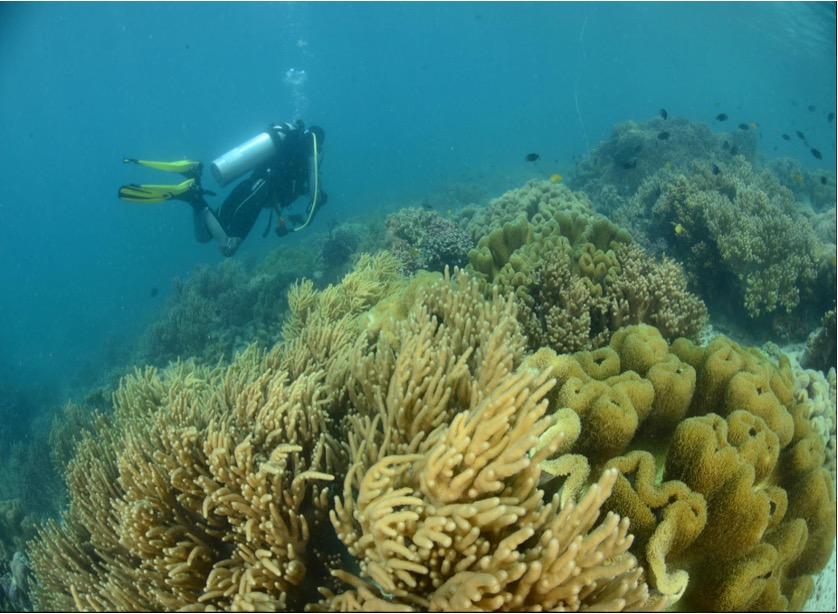
“The key indicator species documented in this study demonstrate conclusively that the Paradise Coral Reef ecosystem is highly biodiverse, mature in colonial structures of corals, and complex in terms of intricacy of habitat provision and available niches,” Dr. Lacson says in his paper, a digital copy of which was furnished to Esquire Philippines by Rodriguez. “The evidence provided herein indicates that the Paradise Reef ecosystem is vital to the survival of coral reef communities fringing Samal Island. Without protection of the species’ gene pools, corals and coral reef fish populations will become threatened and, eventually, endangered.
“For the sake of preservation and conservation, local communities should act to protect this valuable resource at all costs, and should take steps to prevent illegal fishing of all kinds, imprudent anchoring, and disallow careless recreational habits including collection of specimens and reckless recreational behavior (i.e., standing on corals, striking corals with kayak oars, accidental impact of jet skis on the reef, and other such human inflicted damage),” Dr. Lacson added.
The Rodriguezes also contend that the DPWH’s decision to locate the Samal Island side of the bridge project on station 3 carries with it several other material lapses, including the failure to conduct “genuine and honest public consultations from directly impacted communities and LGUs,” the failure “to consider the revised Philippine Fisheries Code, which expressly prohibits any activity that damages coral reefs,” and the “blatant disregard of much cheaper, shorter, and less environmentally (destructive) landing site.”
In previous interviews, Juli Rodriguez questioned the DPWH (as project proponent)’s decision to say no to the donated land (station 1) as landing site in favor of station 3. He said it didn’t make sense for the government to snub the “free land,” for which it would have saved millions to acquire, in favor of another site, which it did have to pay for.
In addition, the Rodriguez family’s position paper claim that the bridge’s current alignment lies “precariously on a sinkhole,” putting “the safety and integrity of the bridge in jeopardy during construction and operation.” This is actually corroborated by the government’s own environmental impact study (EIS), although that report says engineering solutions could help address the problem.
Impact on business
Although the Rodriguez family is putting the welfare of the environment front and center in its argument against the SIDC in its current form, it also acknowledges the impact the bridge will have on its beach resort business. In the position paper about the issue handed to members of the media, the family said the bridge will cut through about 1/3 of the rooms of PIBR and about 30 meters from Costa Marina.
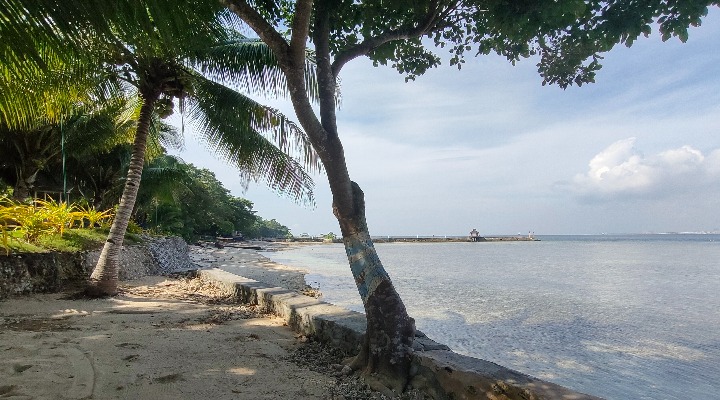
Part of the Paradise Island Beach Resort's beach area. In the distance is the bridge port that the Chinese contractors have built in anticipation of full-scale construction work for the bridge